Slave to the Game
Online Gaming Community
ALL WORLD WARS
THE FRENCH YELLOW BOOK.
DIPLOMATIC DOCUMENTS (1938-1939)
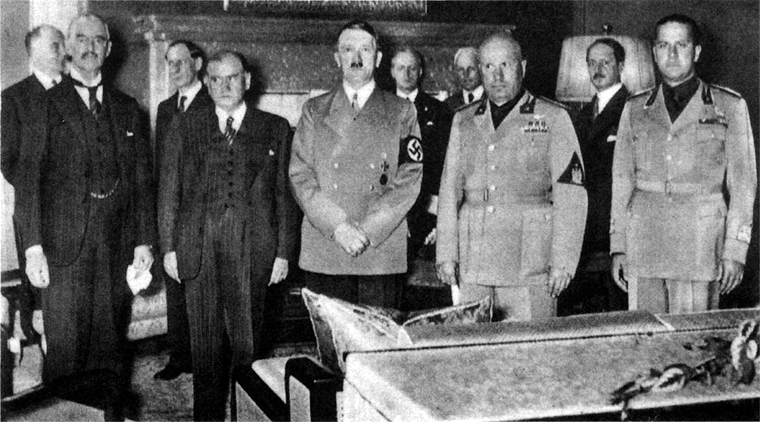
Papers relative to the events and negotiations which preceded the opening of hostilities between Germany on the one hand, and Poland, Great Britain and France on the other.
FOREWORD
THE present Yellow Book is a collection of the most important among the documents which bring out clearly the course of French diplomatic action from September 29, 1938, the date of the Munich Agreement, to September 3, 1939, the date when France and Great Britain, in execution of their pledges of assistance, declared themselves to be in a state of war with Germany.
This publication is limited to the general theme of Franco-German relations, as it clearly was not possible to find space for all the other problems on which our diplomacy was active during the same period (Spanish affairs, Franco-Italian relations, events in the Far East, negotiations with Moscow and pacts of assistance).
Two principal phases can be distinguished in the period under review:
From October 1 to march 15 French diplomatic action followed the policy of détente and collaboration of which the framework had been set up by the Anglo-German declaration of September 30 and the Franco-German declaration of December 6. French diplomacy made a sincere and whole-hearted effort to put Franco-German relations on a normal footing in every sphere, to establish wider possibilities and enlarge peaceful cooperation between the two countries.
As early as the month of February the resistance opposed by the German Government to any practical organization of the international guarantee stipulated on September 29 in favour of Czechoslovakia was such as to raise doubts regarding the sincerity of the intentions of the Reich. On March 15 the entry of German troops into Prague completed the violation of the Munich Agreement and irrevocably destroyed the element of mutual confidence without which the declaration of December 6 became a dead letter.
In the course of the following weeks the direction of the next German drive became evident through numerous incidents, until at last the speech delivered by Herr Hitler to the Reichstag on April 28 plainly disclosed Poland as the next victim of German imperialism.
French diplomacy spared no effort, during the next four months,to avert the danger which menaced Europe: efforts were made to reach an agreement with the U.S.S.R.; secret but categorical warnings were given to Germany that France would be faithful to her pledges of assistance; Poland was encouraged to persevere in her attitude of moderation and patience in face of German provocation. Nothing was neglected which could directly or indirectly induce the German Government to renounce the use of methods of force and violence; nothing was concealed from Germany which could make her realize the risks to which her policy exposed her and, with her, the whole of Europe. To This persevering will for peace the message of the French Foreign Minister to Herr von Ribbentrop on July 1, as well as the appeal of The French Prime Minister to Herr Hitler on August 26, bear witness in an unimpeachable manner.
At the very moment when the Italian initiative of August 31 and the acceptance by Poland of the Franco-British proposals for direct negotiation offered a last chance of peace the German aggression of September 1 deliberately plunged Europe into war.
PART ONE
The Munich Agreement and its Application
(September 29-October 4, 1938)
No. 12
Agreement concluded at Munich, September 29, 1938, between Germany, Great Britain, France and Italy
GERMANY, the United Kingdom, France and Italy, taking into consideration the agreement, which has been already reached in principle for the cession to Germany of the Sudeten German territory, have agreed on the following terms and conditions governing the said cession and the measures consequent thereon, and by this agreement they each hold themselves responsible for the steps necessary to secure its fulfillment:
(1) The evacuation will begin on 1st October.
(2) The United Kingdom, France and Italy agree that the evacuation of the territory shall be completed by the 10th October, without any existing installations having been destroyed, and that the Czechoslovak Government will be held responsible for carrying out the evacuation without damage to the said installations.
(3) The conditions governing the evacuation will be laid down in detail by an international commission composed of representatives of Germany, the United Kingdom, France, Italy and Czechoslovakia.
(4) The occupation by stages of the predominantly German territory by German troops will begin on 1st October. The four territories marked on the attached map will be occupied by German troops in the following order:
The territory marked No. I on the 1st and 2nd of October; the territory marked No. II on the 2nd and 3rd of October; the territory marked No. III on the 3rd, 4th and 5th of October; the territory marked No. IV on the 6th and 7th of October. The remaining territory of preponderantly German character will be ascertained by the aforesaid international commission forthwith and be occupied by German troops by the 10th of October.
(5) The international commission referred to in paragraph 3 will determine the territories in which a plebiscite is to be held. These territories will be occupied by international bodies until the plebiscite has been completed. The same commission will fix the conditions in which the plebiscite is to be held, taking as a basis the conditions of the Saar plebiscite. The commission will also fix a date, not later than the end of November, on which the plebiscite will be held.
(6) The final determination of the frontiers will be carried out by the international commission. The commission will also be entitled to recommend to the four Powers, Germany, the United Kingdom, France and Italy, in certain exceptional cases, minor modifications in the strictly ethnographical determination of the zones which are to be transferred without plebiscite
(7) There will be a right of option into and out of the transferred territories, the option to be exercised within six months from the date of this agreement. A German-Czechoslovak commission shall determine the details of the option, consider ways of facilitating the transfer of population and settle questions of principle arising out of the said transfer.
(8) The Czechoslovak Government will within a period of four weeks from the date of this agreement release from their military and police forces any Sudeten Germans who may wish to be released, and the Czechoslovak Government will within the same period release Sudeten German prisoners who are serving terms of imprisonment for political offences.
Munich, September 29, 1938. ADOLF HITLER,
NEVILLE CHAMBERLAIN,
EDOUARD DALADIER,
BENITO MUSSOLINI.
No. 1
Annex to the Agreement
HIS MAJESTY's GOVERNMENT in the United Kingdom and the French Government have entered into the above agreement on the basis that they stand by the offer, contained in paragraph 6 of the Anglo-French proposals of the 19th September, relating to an international guarantee of the new boundaries of the Czechoslovak State against unprovoked aggression.
When the question of the Polish and Hungarian minorities in Czechoslovakia has been settled, Germany and Italy for their part will give a guarantee to Czechoslovakia.
Munich, September 29, 1938. ADOLF HITLER,
NEVILLE CHAMBERLAIN,
EDOUARD DALADIER,
Benito MUSSOLINI.
No. 2
Declaration
THE HEADS of the Governments of the four Powers declare that the problems of the Polish and Hungarian minorities in Czechoslovakia, if not settled within three months by agreement between the respective Governments, shall form the subject of another meeting of the Heads of the Governments of the four Powers here present.
Munich, September 29, 1938. ADOLF HITLER,
NEVILLE CHAMBERLAIN,
EDOUARD DALADIER,
Benito MUSSOLINI.
No. 3
Supplementary Declaration
ALL questions which may arise out of the transfer of the territory shall be considered as coming within the terms of reference to the international commission.
Munich, September 29, 1938. ADOLF HITLER,
NEVILLE CHAMBERLAIN,
EDOUARD DALADIER,
Benito MUSSOLINI.
No. 4
Composition of the International Commission
THE four Heads of Governments here present agree that the international commission provided for in the agreement signed by them to-day shall consist of the Secretary of State in the German Foreign Office, the British, French and Italian Ambassadors accredited in Berlin, and a representative to be nominated by the Government of Czechoslovakia.
Munich, September 29, 1938. ADOLF HITLER,
NEVILLE CHAMBERLAIN,
EDOUARD DALADIER,
Benito MUSSOLINI.
No. 13
M. EDOUARD DALADIER, President of the Council, Minister of National
Defence and War,
to M. GEORGES BONNET, Minister for Foreign Affairs.
Munich, September 30, 1938, 330 a.m.
PLEASE transmit most urgently to Prague:
The text of the agreement which has been concluded to-night by the four Powers in Munich has been communicated by the British Prime Minister and M. Daladier to M. Mastny. The latter will leave this morning at 6 a.m. by aeroplane for Prague.
M. Ashton Gwatkin, who accompanies M. Mastny, will give you, simultaneously with the French text of this document, the attached map.
You should as a matter of extreme urgency get in touch with M. Benes in order to make sure of his agreement. I request you to express to him my deep emotion at the end of these negotiations-and to assure him that it was not by my choice that no representative of Czechoslovakia was present. I have no doubt, however painful the sacrifices imposed by the present situation, that M. Benes will agree with me that it is of the highest importance, whilst safeguarding for the future the essential conditions enabling his country to retain its faith in its destiny, to save the Czechoslovak nation from the more redoubtable trial of war.
No. 14
M. GEORGES BONNET, Minister for Foreign Affairs,
to M. V. DE LACROIX, French Minister in Prague.
Paris, October 2, 1938.
PLEASE make an immediate communication to M. Krofta to express the sentiments of profound sympathy with which, from hour to hour, I have followed his noble and courageous personal handling of the situation during so painful a national trial. Please assure him of the admiration felt by myself and by all my countrymen for the strength of character and the incomparable self-control shown by all Czechoslovak leaders, whose clear-sightedness has done so much to protect their country from the horrors of war. Will you assure him of my most loyal personal friendship and of my desire to help him to the best of my ability in the constructive task which now lies before him. The dignity and the self-abnegation shown by the entire Czechoslovak nation afford proof of its reserves of strength and vitality, the best safeguard of her historical patrimony and of her proud and free destiny.
GEORGES BONNET.
No. 15
M. GEORGES BONNET, Minister for Foreign Affairs,
to all diplomatic posts.
Paris, October 3, 1938.
THE answer given on September 27 by Herr Hitler to the personal message from Mr. Neville Chamberlain conveyed to him in Berlin the day before by Sir Horace Wilson was not such as to bring about a relaxation of the general tension. Herr Hitler refused to make any concessions, and maintained his decision to send his troops into the territory inhabited by the Sudeten Germans on the 1st of October. Field-Marshal Goering still further emphasized this attitude by declaring to Sir Nevile Henderson on September 27 that, if the Czechoslovak Government had not accepted the terms of the Godesberg memorandum on the next day, September 28, by 2 p.m., measures of mobilization would immediately be taken and followed by action.
In spite of this German intransigence, the French and British Governments persevered in their efforts to find a basis for a peaceful solution of the Czechoslovak question.
In the evening of September 27, Sir Nevile Henderson presented to the German Government a new plan consisting mainly of the occupation, on October 1, of the territories of Eger and Asch.
This plan not having been accepted, the French Ambassador immediately approached Herr Hitler himself, during the morning of September 28, with another proposal which, while conforming with the procedure contemplated in the British plan, considerably enlarged the zone of territory to be occupied by the Germans from the 1st of October.
As a result of this conversation, which lasted a whole hour and during the course of which the Chancellor had behaved in a calm and almost friendly manner, our Ambassador had the impression that it might not be impossible to reach an agreement. Without rejecting the French proposal, Herr Hitler reserved his reply with a view to a written communication.
It was in these circumstances that, as a result of a suggestion made by Mr. Neville Chamberlain in agreement with the French Government after President Roosevelt's appeal, and supported in Berlin by Signor Mussolini, Herr Hitler, in the afternoon of the 28th September, invited the Heads of the French, British and Italian Governments to meet on the 29th September at Munich.
After laborious negotiations, which began at midday on September 29, an agreement was signed during the night of the 29th-30th of September.
There is no need to summarize here the text of that agreement, which was published on the 30th of September; nevertheless, it seems useful to compare the principal points of the agreement with the demands formulated by Herr Hitler at Godesberg on the 23rd September.
(1) At Godesberg, the whole of the zone inhabited by the Sudeten Germans was to have been ceded to Germany on the 1st October. At Munich it was agreed that this occupation would take place by stages, being spread over a period of ten days.
(2) At Godesberg, the new frontier was to be determined by a unilateral decision of Germany alone. At Munich, an international commission was to determine it finally.
(3) At Munich, Germany gave up the idea of the plebiscite which had been insisted upon at Godesberg in the zone inhabited by a strong majority of Sudeten Germans, no doubt with the intention of creating a precedent which Germany might invoke in other cases.
(4) At Godesberg, Herr Hitler had demanded the organization of plebiscites in certain regions with a strong Czech majority, but with German minorities. At Munich, he abandoned this claim, leaving it to the international commission to decide upon the advisability, and to determine the territorial limits, of any plebiscites.
(5) At Munich, Germany conceded to the population the right of option "to be included in the transferred territories or to be excluded from them."
(6) Whilst, in the Godesberg plan, the German Government would accept only one plenipotentiary representing the Czechoslovak Government and Army as agent de liaison with the German General Staff, it has now agreed to the presence within the international commission of a Czechoslovak representative on an equal footing with the German representative.
(7) The German plan at Godesberg did not mention any project of international guarantee. At Munich, Britain and France have undertaken unconditionally and without delay to participate in an international guarantee of the new Czechoslovak frontiers against any unprovoked aggression; Germany and Italy have undertaken to give their guarantee as soon as the question of the Polish and Hungarian minorities shall be settled.
(8) Taken as a whole, the Godesberg plan resembled in many respects a veritable armistice convention concluded after victorious military operations on the part of Germany; the Munich agreement as the character of a settlement, concluded under the guarantee of the four Powers, the execution of which is essentially under the control and even, in many cases, subject to the decision of an international commission.
The Czechoslovak Government, with the highest self-abnegation, and in a spirit to which we must pay tribute, has accepted the agreement of the 29th September. All the measures provided for in this agreement are now in course of execution.
GEORGES BONNET.
No. 16
FRANÇOIS-PONCET, French Ambassador in Berlin,
to M. GEORGES BONNET, Minister for Foreign Affairs.
Berlin, October 4, 1938.
THE agreement reached on September 29 at Munich has been received with no less relief in Germany than in France and Great Britain.
The Chancellor's speech delivered on September 26 and the news of the military measures taken by France and Great Britain had brought the prevailing anxiety to a high pitch. The Chancellor had burnt his boats. It was felt to be unthinkable that he could retreat. Contrary to general expectations, the Western Powers appeared resolved to fight. During the days of the 27th and 28th September, one could sense the hourly approach of the catastrophe. This state of mind was clearly visible in the expressions of the Berliners who had been urged, during the evening of the 28th September, to listen to a speech by Dr. Goebbels, the general opinion was that he was to announce general mobilization.
It was in this atmosphere that on Wednesday, towards 10 p.m., the news began to spread that the Four-Power Conference was to open the next day at Munich. It immediately aroused a feeling of immense satisfaction. Nobody doubted for a moment that the imminent danger of war had been averted. The miracle that all had ceased to hope for had occurred.
With the exception of a few fanatics, very few Germans thought that the Sudetens were worth the risk of a European war. The great masses of the people knew nothing of the Sudeten: they were in no way conscious that the Sudeten had ever belonged to the Reich; they were hardly more interested in their fate than in that of the Germans in Rumania. They would have been quite pleased with a punitive expedition against Czechoslovakia, but they certainly would have abandoned the Sudeten rather than see the entire world in arms against Germany.
At the moment when the German-Czech conflict threatened to turn into a European conflagration, the atmosphere in Germany was very different from the feverish and aggressive atmosphere of August 1914. It is certainly without any feeling of enthusiasm that the German people would have followed their Führer into a general war
Though these are the general reactions brought about in the country by the events of the last few days, it does not appear that unanimity reigns in the leading circles of the Reich as to the lesson to be learnt from them. In that respect one can discern two separate schools of thought.
The more reasonable circles have been very much struck by the resistance that the Führer's will has encountered for the first time In the face of the attitude adopted by Great Britain and France, and; at the last moment, even by Italy, Adolf Hitler was not able to maintain in its entirety the position he had assumed at Godesberg, and which was formulated in his memorandum of September 23. He was preparing to dictate terms to Czechoslovakia as to a vanquished country. He had, with a unilateral gesture, determined on a map the zone which German troops were to occupy from the 1st of October The time allowed for evacuation was so short that the Czechs could not have retired in an orderly fashion. The Führer had to compromise on all these points. Even though he has obtained satisfaction on the main issues, he was obliged to accept an international procedure as regards the mode of execution, in spite of his repeatedly expressed dislike of such methods. He was not able to go as far as he wished. He recognized that he had reached the limit beyond which foreign opposition threatened to become armed intervention.
In German high political circles, and even among the most convinced and influential Nazis, there is no lack of counsels of moderation to the effect that the Germans should be satisfied, for the time being at least, with the results obtained, that they should allow themselves a respite, relax the economic and financial tension, and seek to reach some arrangement with the Western Powers. These are the circles which, during the crisis of the 28th September, influenced Field-Marshal Goering and whose counsels prevailed over Herr von Ribbentrop's.
Yet there are many who proclaim that one must continue to go ahead and to take the utmost advantage of the military superiority which the Reich believes itself to possess at present. Their influence is felt within the International Commission itself, where they assume the attitude of victors who have the right to formulate imperative demands. It has been necessary more than once to remind them that the agreement of September 29 was not a German "Diktat," but an international arrangement. The annexation of the Sudeten, following the Anschluss of Austria after an interval of seven months, has not satisfied their appetites. At the very moment when the German army is occupying the mountains which have hitherto been the historic frontiers of Bohemia, they are scanning the horizon in search of new demands to formulate, new battles to fight out, new prizes to conquer.
Clearly anxious to spare the feelings of France and Great Britain, to allay mistrust and awaken hopes, the German Press has not ceased during these days to affirm that the Munich Agreement might become the keystone for building a new Europe released from prejudices and mutual hatreds, ruled by respect for the vital rights of all peoples and orientated towards a harmonious cooperation between the nations. The newspapers of the Reich are prodigal in expressions meant to please France. They have repeatedly stated that no subject of contention now exists between France and Germany. They have been at pains to pay tribute to the role played by M. Daladier at the Munich conference; they have praised him as an ax-serviceman whose chief concern is to spare his country and Europe the horrors of a new war. Quoting a remark of Field-Marshal Goering's, they have written: "With a man like M. Daladier, politics become a practical proposition."
Commenting on the declaration issued by the Führer and the British Premier after the Munich conference-a declaration which has been represented here as a non-aggression pact-they have let it be understood that, in their opinion, there is no reason why France and Germany should not come to a similar arrangement. Evidently the primary condition would be that France, adopting a realistic policy, should draw certain conclusions from the events which had so profoundly shaken the whole of Europe.
In that respect, the Munich conference should serve us as a warning. In order that the agreement which assigns to Czechoslovakia new frontiers and a new place in Europe should become the starting-point of a reorganization of the Continent on an equitable basis, it is indispensable that the Western Democracies should draw a lesson from the dramatic events of last week. It is necessary that while continuing to affirm their will to peace and neglecting no means of reaching an understanding with the totalitarian States, they should nevertheless eliminate all causes of internal weakness, that they should fill up as quickly as possible any gaps in their armaments, and that they should give to the outside world tangible proof of industry, cohesion and strength. This is the price we must be prepared to pay if Europe is not to undergo again, after a respite of uncertain duration, crises similar to the last one just settled at the Munich conference after threatening for several days to degenerate into general pandemonium.
FRANÇOIS-PONCET.
PART TWO
The Franco-German Declaration of December 6th, 1938
(October 19-December 22, 1938)
No. 17
M. FRANÇOIS-PONCET, French Ambassador in Berlin,
to M. GEORGES BONNET, Minister for Foreign Affairs.
Berlin, October 19, 1938.
THE Chancellor of the Reich gave me a farewell audience yesterday afternoon, not at Berchtesgaden, but in the eagle's eyrie which he has had built on a rocky spur 6,000 feet high with a view extending over the vast arena of mountains which surround Salzburg. The conversation, at which the Reich Minister of Foreign Affairs was present, soon assumed an interesting and important character.
Referring to the Munich Agreement, Herr Hitler expressed his regret that subsequent events had allowed a dangerous state of tension to continue between the Great Powers, and had not fulfilled his hopes. With regard to France, he took a rather indulgent attitude but on the other hand he insisted bitterly on the fact that he could, so he said, discern in the British attitude the expression of a fundamental antagonism.
Endeavouring to moderate and correct his views, I tried more especially to explain to him the reasons for the currents of opinion in France and in England as a result of the speech at Saarbrucken, and after the conclusion of an agreement which had saved peace, but at the price of heavy sacrifices.
The Chancellor declared in a general way that he was prepared to seek ways and means of improving existing conditions and to develop the potentialities of appeasement and conciliation which the Munich Agreement seemed to contain.
(1) Herr Hitler would consent to sign an agreement by which France and Germany would reciprocally recognize their existing frontiers and express their determination not to attempt to change them.
(2) For his part he believed that this text should be accompanied by an undertaking to hold mutual consultations on all questions likely to have repercussions on the relations between the two countries.
(3) Alluding to the problem of the limitation of armaments, Herr Hitler seemed extremely irritated and greatly impressed by the military measures announced in Great Britain and in the United States. He is of the opinion that, owing to the practical difficulties which would arise if a programme of disarmament were to be set up without further preliminaries, it would be wiser and more opportune to begin with a programme for the humanization of war (bombardment of open cities, etc.).
(4) Speaking of economic questions such as, for instance, the possibility of stabilizing the currencies, Herr Hitler recognizes both their importance and the difficulties they present. But he declared that, having little knowledge of these matters, he would gladly, if need be, have recourse to the services of experts.
At the end of this conversation, and in conclusion, the Chancellor asked the Reich Minister for Foreign Affairs to cause the different suggestions that had been examined in the course of the interview to be studied, and more or less detailed plans on their execution to be prepared. The texts thus drawn up would then be communicated to us for careful consideration and eventual correction and criticism.
In view of the conversations I have had with Your Excellency, I took it upon myself to give the assurance that the French Government would consider with the greatest sympathy all proposals or suggestions favourably received by the Chancellor or initiated by him. We agreed that the preliminary study of these questions should remain confidential until further notice, it being understood that we would for our part ascertain the views of the British Government while Germany reserves the right to inform the Italian Government.
FRANÇOIS-PONCET.
No. 18
M. FRANÇOIS-PONCET, French Ambassador in Berlin,
to M. GEORGES BONNET, Minister for Foreign Affairs.
Berlin, October 20, 1938.
WHEN on the evening of October 17, the German Chancellor asked me to see him as quickly as possible, he placed one of his private planes at my disposal. I therefore left by air for Berchtesgaden on the next day accompanied by Captain Stehlin. I arrived there towards three in the afternoon. From there a car took me not to the Obersalzberg villa where the Führer lives, but to an extraordinary place where he likes to spend his days when the weather is fine.
From a distance, the place looks like a kind of observatory or small hermitage perched up at a height of 6,000 feet on the highest point of a ridge of rock. The approach is by a winding road about nine miles long, boldly cut out of the rock; the boldness of its construction does as much credit to the ability of the engineer Todt as to the unremitting toll of the workmen who in three years completed this gigantic task. The road comes to an end in front of a long underground passage leading into the mountain, and closed by a heavy double door of bronze. At the far end of the underground passage a wide lift, paneled with sheets of copper, awaits the visitor. Through a vertical shaft of 330 feet cut right through the rock, it rises up to the level of the Chancellor's dwelling-place. Here is reached the astonishing climax. The visitor finds himself in a strong and massive building containing a gallery with Roman pillars, an immense circular hall with windows all round and a vast open fireplace where enormous logs are burning, a table surrounded by about thirty chairs, and opening out at the sides, several sitting-rooms, pleasantly furnished with comfortable arm-chairs. On every side, through the bay-windows, one can look as from a plane high in the air, on to an immense panorama of mountains. At the far end of a vast amphitheatre one can make out Salzburg and the surrounding villages, dominated, as far as the eye can reach, by a horizon of mountain ranges and peaks, by meadows and forests clinging to the slopes. In the immediate vicinity of the house, which gives the impression of being suspended in space, an almost overhanging wall of bare rock rises up abruptly. The whole, bathed in the twilight of an autumn evening, is grandiose, wild, almost hallucinating. The visitor wonders whether he is awake or dreaming. He would like to know where he is-whether this is the Castle of Monsalvat where lived the Knights of the Graal or a new Mount Athos sheltering the meditations of a cenobite, or the palace of Antinea rising up in the heart of the Atlas Mountains. Is it the materialization of one of those fantastic drawings with which Victor Hugo adorned the margins of his manuscript of Les Burgraves, the fantasy of a millionaire, or merely the refuge where brigands take their leisure and hoard their treasures? Is it the conception of a normal mind, or that of a man tormented by megalomania, by a haunting desire for domination and solitude, or merely that of a being in the grip of fear?
One detail cannot pass unnoticed, and is no less valuable than the rest for someone who tries to assess the psychology of Adolf Hitler: the approaches, the openings of the underground passage and the access to the house are manned by soldiers and protected by nests of machineguns....
The Chancellor received me amiably and courteously. He looks pale and tired. It is not one of his excitable days, he is rather in a period of relaxation. Immediately, he draws me towards the bay-windows of the great hall, shows me the landscape and enjoys the surprise and admiration that I make no effort to conceal. We exchange some compliments and a few polite phrases. At his order, the tea is served in one of the adjoining sitting-rooms. When the servants have left and the doors are closed, the conversation begins between the three of us; Herr von Ribbentrop intervenes only at rare intervals, and always to stress and emphasize the Führer's remarks.
Adolf Hitler is disappointed with the sequels of the Munich Agreement. He had believed that the meeting of the Four, which banished the spectre of war, would have marked the beginning of an era of conciliation and improved relations between nations. He cannot see that anything of the kind has occurred. The crisis is not over; it threatens, if the situation does not improve, to become worse within a short time. Great Britain is sonorous with threats and calls to arms. For the Chancellor this is an opportunity to utter, against that country, against her selfishness and her childish belief in the superiority of her rights over those of others, one of those tirades which he has already delivered several times in public.
The Chancellor's irritation calms down fairly quickly. I point out to him that after the joy at the preservation of peace, a reaction was inevitable; the realization of the sacrifices exacted from Czecho-slovakia, the harsh treatment meted out to that country could not fail to stir the hearts and even to disturb the conscience of many people; and especially, the Saarbrucken speech had spread the impression that all these sacrifices had been made in vain, that their only effect had been to increase the appetite of the Third Reich. This speech had considerably strengthened the position of the adversaries of the Munich Agreement.
The Führer protests; he had not started the present trouble; the English had done so; he had not uttered a single word against France; and as to Czechoslovakia, it was not true that he had ill-treated her; all that he had done was to insist upon the rights of the German people, which had been trodden underfoot!
I interrupt his self-justification; we must not linger over the past, the future is more important; after the joy at the preservation of peace and the subsequent bitterness aroused by the sacrifices it exacted, a third stage is now reached. The statesmen must now with more self-control consider whether the Munich Agreement is only to be a fruitless episode or whether now that experience has proved that the democracies and the totalitarian states can cooperate in promoting general appeasement, they will attempt to develop this first successful experiment into a larger enterprise and gradually lead back Europe towards more normal and enduring conditions.
Herr Hitler does not raise any objection. He declares that, as far as he is concerned he is quite prepared to do this, and that he had asked me to visit him as much in order to be able to discuss this matter with me as to allow me to take my leave of him.
In my telegram of yesterday, I indicated in a sufficiently explicit manner the course the conversation then took. On the three points that were raised in turn, and which, taken as a whole, form a complete programme starting from Franco-German relations and widening to questions of importance to all the Powers, the Chancellor is full of arguments, objections and suggestions, like a man who has already considered the matter and is not being caught unaware.
As regards the suggestion of a written recognition by France and Germany of their common frontier and an agreement to hold consultations in all cases which might affect the relations of the two countries, Herr Hitler declares that he is ready to accept it immediately; actually, this appears to be the point which makes the greatest appeal to him. He stresses the difficulties which might arise from a formula of non-aggression if it were accompanied by reservations relating to the Covenant of the League of Nations, or to the existence of pacts with a third party. He hopes that these difficulties may be removed, and he does not ask once that France should renounce her pact with Soviet Russia.
As to the problem of a limitation of armaments, he is undecided; he is not opposed to the principle of such a limitation, but he does not see by what means it can be put into practice; he outlines, without dwelling on it, the theory according to which Germany, situated in the centre of Europe and exposed to simultaneous attacks on several fronts, has no true equality of armaments unless she is superior in that respect to any of the States that could attack her; he also fears that if he were to speak of the limitation of armaments, the opposition in Great Britain would say that he was retreating before a display of British energy; his thoughts remain uncertain. On the other hand, he is ready to approach without hesitation the problem of the humanization of war and to go fairly far in this matter. He sees here a good introduction, a happy preface from which might arise a more favourable atmosphere for the ultimate examination of the disarmament question.
As to the monetary and economic problems, he obviously leaves to others the task of dealing with them. That is no business of his. He understands nevertheless that it is important not to leave these matters in abeyance, but to invite experts to take up again the work already begun and to examine the possibilities offered by present conditions.
Concluding the conversation, he gives Herr von Ribbentrop the order, as I have already said, to set his department to work and to make them study the suggestions arising out of our interview with a view to formulating concrete proposals. Paris will then study the drafts and state its own views. I promise that we shall receive his suggestions with earnest sympathy and study them carefully, being moved by the same peaceful intentions that appear to animate the Führer. In the meantime, Germany will approach Italy. France, on her side, can investigate British views. We are not committed, on either side, to anything precise but both sides are agreed to proceed in all good faith to an investigation.
Therefore the utmost discretion should be maintained towards the public until further notice; public opinion must not be informed until the assurance of a positive result has been obtained.
On two other subjects I attempt to persuade the Führer to reveal his views: the claims of Hungary and the war in Spain.
He admits frankly that he considers the pretensions of the Hungarians excessive, although he adds that the cessions and concessions of the Slovaks are insufficient. For him, the only criterion is the ethnographical one, the race; it was the only one on which he based his claims towards the Czechs in tracing the new frontiers; the Hungarians and the Poles had better keep to these principles as well; obviously he has no sympathy with the efforts they are making to obtain a common frontier. The Chancellor boasts that he has brought about the failure of the appeal which Hungary had intended to make to the four Munich Powers. He believes that in so doing, he has avoided a definite danger.
"Such a conference," he says, "would have placed us before two conflicting theses. I should have been obliged, regardless of my personal opinion, to side with the Hungarians and Poles, because of the political ties that unite them to us; Mussolini would have acted in the same manner. You, however, and the English, for similar reasons, would have defended the Czechs. Thus, three weeks after Munich, we should again have had a conflict, which this time could not have been settled. I rendered a service to Europe in avoiding it. I preferred to exercise pressure on the Hungarians and the Czechs and persuade them to take up the interrupted negotiations, with less intransigence on both sides. Mussolini helped me. I hope that a compromise will take place. But the whole business is dangerous. This occasion shows how wrong France and England were to promise Czechoslovakia to guarantee her frontiers, even before the latter were clearly defined. This may still lead to most unpleasant complications."
With regard to Spain, the Chancellor repeats that he never had any intention of establishing himself there permanently. He had secured some economic advantages, but he would have obtained them in any case. It is far from his thoughts, so he assures me, to use Spain as a perpetual menace against France. Spain herself needs to maintain good relations with France. General Franco's attitude during the September crisis proved this plainly. Let all the foreign volunteers be withdrawn and let the two Spanish factions remain face to face with each other; in these conditions Franco will win in the end, and France will be none the worse for it.
For nearly two hours Herr Hitler has been readily listening to my questions; he has answered them without any embarrassment, with simplicity and-at least apparently-with candour. But the time has come to release him. Antinea's Castle is now submerged in the shadow that spreads over the valley and the mountains. I take my leave. The Führer expresses the wish that I might later return to Germany and come to visit him in a private capacity. He shakes both my hands several times. After going down in the lift and through the underground passage, I find the car waiting for me; passing through Berchtesgaden it takes me back to the airport, from where our plane starts immediately on its night flight to Berlin.
During the whole of our conversation, except for a few outbursts of violence when referring to England, the Führer was calm, moderate, conciliatory. One would have been justified in thinking that one was in the presence of a man with a well-balanced mind, rich in experience and wisdom, and wishing above all things to establish the reign of peace among nations. There were moments when Herr Hitler spoke of Europe, of his feelings as a European, which are, he asserts, more genuine than those expressed so loudly by many people.
He spoke of our "white civilization" as of a very precious possession common to us all, which must be defended. He appeared sincerely shocked at the persistent antagonism which has remained after the Munich Agreement, and which the British attitude revealed to his mind with great clearness. Obviously, the possibility of a coming crisis and the eventual outbreak of a general war are ever present in his mind. Perhaps at heart he himself is skeptical as to his chances of preventing this tragedy? In any case, he seems willing to attempt to do so or he wishes to feel he has made the attempt so as to calm if not his own conscience, at least the conscience of his people. And it is through France that he thinks this attempt must be made.
I have no illusions whatever about Adolf Hitler's character. I know that he is changeable, dissembling, full of contradictions, uncertain. The same man with the debonair aspect, with a real fondness for the beauties of nature, who discussed reasonable ideas on European politics round the tea-table, is also capable of the worst frenzies, of the wildest exaltations and the most delirious ambitions. There are days when, standing before a globe of the world, he will overthrow nations, continents, geography and history, like a demiurge stricken with madness. At other moments, he dreams of being the hero of an everlasting peace, in which he would devote himself to the erection of the most magnificent monuments. The advances that he is prepared to make to France are dictated by a sentiment which he shares, at least intermittently, with the majority of his countrymen, namely the weariness of an age-long contest, and the desire to see it end at last; this feeling is now strengthened by the memories of the Munich interviews, by the sympathy that the person of President Daladier aroused in him, and also by the idea that our country's evolution tends to make it easier for her to understand the Third Reich. But at the same time we may be certain that the Führer remains true to his wish to disintegrate the Franco-British bloc, and to stabilize peace in the west, so as to have a free hand in the east. What plans may be revolving already in his mind? Is it Poland, Russia, the Baltic States which, in his thoughts, will be called upon to pay the cost? Does he himself even know?
Be that as it may, Hitler is one of those men with whom one must never relax one's utmost vigilance, and whom one can only trust with reservations. Personally, I do not draw the conclusion that we should not listen to his suggestions. In these circumstances, as in many other previous ones, I hold that the main thing is that we should know exactly where we stand and with whom we are dealing. But it does not follow that an attitude of abstention and negation is the right one. Dr. Goebbels said recently, and not without reason, that one cannot win in a lottery if one does not take at least the risk of buying a ticket. It is our bounder duty not to neglect a single one of the ways that lead to peace. If it so happens that Herr Hitler, either as a feint or as a deliberate plan, engages himself far enough on that path, it is possible that he will end by not being able to turn back again, even if he wished.
Besides, who could predict the astounding changes of front of which this dictator, impressionable, mutable and abnormal, may be capable, and what will his personal destiny and that of Germany be tomorrow ?
After the Munich conference, it was normal and necessary that one should think of expanding the results of an agreement on which public opinion had pinned such high hopes.
As matters stand to-day, Germany is expressing a wish to take the initiative; Germany is trying to work out a formula and a plan.
If we were to turn a deaf ear, we would, to our detriment, be providing her with the alibi which she wishes for perhaps in order to cover her future enterprises.
Besides, the contracts she appears ready to enter into have only a limited scope.
If these promises are kept, they will contribute in a large measure to the lessening of tension in Europe.
If they are broken, the guilty party will assume a moral responsibility which will weigh heavily on his future position.
France should, therefore, undertake to consider the proposals without fear. Perhaps it is not unreasonable to think that the events France has now lived through may have finally convinced her people of the pressing need for national order and cohesion, for a certain moral reform and for rapid and thorough overhauling and improvement of our military organization.
No. 19
M. GEORGES BONNET, Minister for Foreign Affairs,
to M. FRANÇOIS-PONCET, French Ambassador in Berlin.
Paris, October 21, 1938.
THE suggestions which you have conveyed to me in your telegram of October 19 arising out of your conversation with Herr Hitler have been the subject of attentive scrutiny and have in principle been favourably received by the French Government. I should like you to inform the Chancellor of this personally. The Government of the Republic are disposed for their part to devote their utmost care to the study of the plans announced as soon as they are submitted to them. For this purpose they will not fail to make the necessary contacts with the British Government while strictly maintaining the utmost discretion, as agreed.
Moreover, referring to the two specifically Franco-German questions of a mutual agreement to hold consultations and a reciprocal recognition of existing frontiers, you will add that the French Government declares itself prepared from now on to take part with the Government of the Reich in a preliminary exchange of views opening the negotiations, as soon as the precise details of which you have been told are submitted to them. Indeed, as you do, I look upon the initiative taken by Herr Hitler with all the interest it deserves, and I agree with you that we must endeavour to reach concrete results as quickly as possible.
GEORGES BONNET.
No. 20
FRANÇOIS-PONCET, French Ambassador in Berlin,
to M. GEORGES BONNET, Minister for Foreign Affairs.
Berlin, October 22,1938.
THIS morning, in the absence of Herr von Ribbentrop, I have conveyed the communication prescribed by your telegram of October 21 to Baron von Weizsäcker. He will pass it on without delay, to the Chancellor of the Reich.
FRANÇOIS-PONCET.
No. 21
FRANÇOIS-PONCET, French Ambassador in Berlin,
to M. GEORGES BONNET, Minister for Foreign Affairs.
Berlin, October 24, 1938.
IN the course of a conversation, during a farewell luncheon which he was giving for me, Field-Marshal Goering declared that he was very much in favour of the projected plans; he appeared very optimistic as to their realization, and it seems that he himself will see that they are carried out without delay. Herr von Ribbentrop, so Field-Marshal Goering assured me, was also, as well as the Chancellor, favourably disposed and would use all his efforts to further the projects.
I have also had a conversation on the subject with Herr Gauss, to whom the preparation of the drafts has been entrusted; he had been summoned to Berchtesgaden, after my visit to the Chancellor.
FRANÇOIS-PONCET.
No. 22
Note by the Minister
Paris, November 22, 1938.
THE Polish Ambassador was informed, on November 22, by M. Georges Bonnet, of the French Government's intention of signing, with the German Government, a declaration about the frontiers and an undertaking to hold consultations. This declaration, reserving in principle the relations of the contracting parties with third countries, and consequently those of France with Poland, does not in any way interfere with France's commitments towards the latter country.
M. Lukasiewicz showed himself very favourably disposed towards this project.
No. 23
M. COULONDRE, French Ambassador in Berlin,
to M. GEORGES BONNET, Minister for Foreign Affairs.
Berlin, November 23, 1938.
YESTERDAY, at Berchtesgaden, I presented my credentials to the Chancellor of the Reich.
The Führer received me affably in his simple and elegant dwelling of the Berghof.
After we had exchanged the usual speeches, he conversed with me for half an hour, and, contrary to his habit-for usually he does not mention politics in the course of these formal visits-he almost immediately attacked the problem of Franco-German relations.
"These relations," the Führer said, "I wish to see peaceable and pleasant, and I see no reason why they should not be so. There is no cause for conflict between Germany and France." He then looked at me insistently, but without trace of harshness, and added, "I hope, in any case, should difficulties arise, that you will do your utmost to smooth them out, in the same spirit as your predecessor and with the same sincerity."
The substance of my reply was that I was bringing with me a certainty and a hope. The certainty of the absolute sincerity dictated by my conscience and by my fervent patriotism. (Here Herr Hitler signified his approval by nodding his head with vivacity.)
I continued: "The hope is that of an effective and enduring rapprochement between the two nations. I have gained this hope both from your speeches, which I have recently read over again, and through which the word 'reconciliation' seemed to shine as a gleam of light as well as in the dispositions evident in France. During my last stay in my country, when I returned from Moscow, I gathered in the most varied circles precise indications that have convinced me of the fact that the vast majority of the French nation wishes for a rapprochement with Germany. France was profoundly stirred by the September crisis; like the German nation, she touched the fringe of war, and like the German people, our people have expressed their gratitude to the leader who preserved them from war. They look upon the Munich Agreement as a possibility for opening up a path for a policy of reconciliation and they wonder whether France and Germany might not in the end reach a mutual understanding, once and for all time, so as to avoid the possibility of a repetition of such a menace."
I concluded that it was the task of the Governments to answer this question, and I alluded to the last conversation of M. François-Poncet with the Führer.
Herr Hitler assured me that he shared these feelings, that he, on his side, was anxious without delay to translate into action the good intentions he had expressed to my predecessor, and he repeated that no territorial question remained in suspense between France and Germany.
I then stressed the importance, in order to start the two countries on the path of reconciliation and collaboration, of not delaying too long the first manifestation of the mutual goodwill of the two Governments, otherwise we ran this danger, that the effects of the psychological shock caused by the September crisis would fade out like a photograph which had not been fixed.
The Führer smiled and agreed, then he became more animated, his tone warmed up and he said: "I am an ex-Serviceman, I know what war is. I want to spare my people these trials; even an alteration of the frontier between our two countries would not be sufficient justification for the sacrifices it would entail. That is my opinion, and I know it is also that of President Daladier."
Herr Hitler then bade me good-bye after adding while shaking hands: "We are both ex-Servicemen; if ever difficulties should arise, we will find a way of solving them peacefully."
It is in that spirit, with which the mysticism of the National-Socialist regime is so largely permeated, that as soon as I got back to Berlin, I laid a wreath on the tomb of the Unknown Warrior of Germany.
At the luncheon which after I had been received by the Chancellor was offered to me by Herr Meissner, Minister of the Reich Chancellery, Herr Hitler's intimates evinced satisfaction at the progress of the conversations which had gone far beyond a mere expression of courtesy. A high official whom I have known for twenty years said to me: "From this you can infer the Führer's state of mind."
The Counselor and the Military Attaché of this Embassy had accompanied me to Berchtesgaden. During the whole journey we were the guests of the Government of the Reich, and the German authorities did their utmost to show us attentions and courtesy.
COULONDRE.
No. 24
M. COULONDRE, French Ambassador in Berlin,
to M. GEORGES BONNET, Minister for Foreign Affairs.
Berlin, November 24, 1938.
THE D.N.B. agency publishes the following communiqué for its foreign service:
We have had the following information from an authoritative source concerning Franco-German relations:
In the course of recent years, the Chancellor and Führer has repeatedly seized opportunities of declaring that no problems exist between France and Germany which could form a fundamental obstacle to friendly and neighbourly relations. After the meeting at Munich, both parties found they had the wish to give concrete expression to this attitude. During the last few weeks, the possibilities of a Franco-German agreement on the lines of the Anglo-German declaration of Munich have appeared in a very favourable light. This is the reason why the French and German Governments are both considering a declaration that would be prepared jointly concerning the friendly relations between the two States, and it is to be expected that Herr von Ribbentrop, Minister for Foreign Affairs of the Reich, will visit Paris very soon in order to settle the agreement with M. Bonnet
COULONDRE.
No. 25
M. GEORGES BONNET, Minister for Foreign Affairs,
to M. COULONDRE, French Ambassador in Berlin.
Paris, November 25, 1938.
ON November 22 I saw Count von Welczeck, who informed me that his Government accepts the draft which was communicated to you before your departure from Paris, the final text of which will be sent to you without delay.
The German Ambassador added that Herr von Ribbentrop is ready to come to Paris for the exchange of signatures, which could take place between November 28 and December 3. Perhaps we shall have to postpone the date by two or three days; I shall inform you as soon as it is fixed.
GEORGES BONNET.
No. 26
M. GEORGES BONNET, Minister for Foreign Affairs,
M. DE SAINT-QUENTIN. French Ambassador in Washington.
Paris, November 27, 1938.
IN my communication or October 3, [See Document 15] I called your attention to the possibilities of an international détente contained in the Munich Agreement; it would have been inconsistent not to attempt to translate such possibilities into actual facts in so far as this action was compatible with the execution of the policy of national defence undertaken in France as well as in England.
The communiqué which was published after an interview between Mr. Neville Chamberlain and Herr Hitler on October 1 on the day immediately following the signature of the Munich Agreement, showed that both parties were at one in their desire for appeasement.
The Chancellor of the Reich, when he received M. François-Poncet for a farewell audience on October 19, declared himself ready to seek means to improve Franco-German relations and to further the elements tending to a rapprochement which are contained in the agreement of September 29. At the same time, he made various suggestions to this effect; the French Government, after examining them carefully, informed Berlin as early as October 21 that they were prepared to exchange views on this subject with the authorities of the Reich without delay.
The two Governments soon arrived at an agreement on the text of a declaration to be signed by the respective Ministers for Foreign Affairs, which would stress the following main points:
(1) That pacific relations and a neighbourly attitude between the two countries constitute an essential condition for the preservation of peace; that efforts should be made on both sides to develop their relations in this direction;
(2) That no problem of a territorial nature remains in suspense between France and Germany, the existing frontier being solemnly recognized as permanent;
(3) That the two Governments are determined, while reserving their special relations with third Powers, to remain in contact on all questions of importance to both countries and to enter into consultation in case developments arising out of these questions should threaten to lead to international difficulties.
This document is to be signed in Paris, at a date which is to be fixed shortly, and will then be published immediately.
I do not consider it necessary to emphasize the importance of this declaration: it will not escape your notice that not only does it demonstrate the desire for appeasement and reconciliation common to both Governments, but also recognizes by means of a diplomatic instrument the German intention, already expressed unilaterally by the Chancellor in some of his speeches, of regarding the mere possibility of territorial disputes between the two countries as excluded, and of recognizing the existing frontier between France and Germany as permanent.
The procedure of mutual consultation foreseen in case of international difficulties can, moreover, provide a valuable means of avoiding, in future, certain sudden initiatives likely to endanger the preservation of peace.
Finally, the text that has been adopted leaves us our entire freedom of action regarding third parties to whom we are bound.
Mr. Neville Chamberlain and Lord Halifax, during the conversations which took place in Paris yesterday, have clearly expressed their satisfaction with a declaration, which, in their opinion, is, like the Anglo-German declaration, an immediate contribution to the task of international appeasement.
You should be guided by the above considerations during your conversations on the subject with the Secretary of State, asking him also to treat them as confidential until the document has been published.
GEORGES BONNET.
No. 27
Note by the Minister for Foreign Affairs
Paris, November 28, 1938.
I RECEIVED M. Souritz on Tuesday, November 22. I explained to him the main points of the plan for a Franco-German declaration, emphasizing that this declaration made a reservation about the special relations of the contracting Powers with third Powers, and consequently about the Franco-Russian pact.
M. Souritz took note of the information which I had conveyed to him. He has informed his Government. He made no special comment.
On the evening of the following day, M. Souritz telephoned to ask me for the text of the agreement. I answered that, as I had not yet communicated it to anyone, it would be impossible for me to give it to him in its entirety. Nevertheless, I informed him of the essential points of the document over the telephone.
M. Souritz come to see me again on Saturday the 26th. On that occasion I asked him whether he had any comment to make with regard to the agreement.
He replied that he had received no communication from his Government, and that, moreover, the agreement in its present form could not be modified.
I drew his attention to the fact that before putting the agreement before the Council of Ministers, I had informed him of its main contents. M. Souritz made no further comment.
No. 28
Franco-German Declaration
M. GEORGES BONNET, Minister for Foreign Affairs of the French Republic
and M. JOACHIM VON RIBBENTROP, Minister for Foreign Affairs of the
German Reich,
ACTING in the name and by order of their respective Governments, have agreed on the following points at their meeting in Paris on December 6, 1938:
(1) The French Government and the German Government fully share the conviction that pacific and neighbourly relations between France and Germany constitute one of the essential elements of the consolidation of the situation in Europe and of the preservation of general peace. Consequently both Governments will endeavour with all their might to assure the development of the relations between their countries in this direction.
(2) Both Governments agree that no question of a territorial nature remains in suspense between their countries and solemnly recognize as permanent the frontier between their countries as it is actually drawn.
(3) Both Governments are resolved, without prejudice to their special relations with third Powers, to remain in contact on all questions of importance to both their countries and to have recourse to mutual consultation in case any complications arising out of these questions should threaten to lead to international difficulties.
In witness whereof the Representatives of the two Government have signed the present Declaration, which comes into force immediately.
Executed in duplicate in the French and German languages at Paris, on December 6, 1938.
Signed: GEORGES BONNET,
JOACHIM VON RIBBENTROP.
No. 29
Communiqué published at the conclusion of the Franco-German conversations
Paris, December 6, 1938.
THE visit of the Minister for Foreign Affairs of the Reich to Paris on December 6, has provided the opportunity for a Franco-German exchange of views over a wide range of questions. In the course of the conversations that have taken place, the principal European problems have been examined, most especially those which have a direct bearing on the political and economic relations between France and Germany. It has been recognized on both sides that the development of the relations between the two countries on the basis of the unequivocal recognition of their frontiers would not only serve their mutual interests, but also constitute an essential contribution towards the maintenance of peace.
In this spirit the Ministers for Foreign Affairs of both countries have signed a declaration which, while reserving the special relations of both Governments with third Powers, expresses their determination to cooperate in a peaceful spirit on a basis of mutual respect, and thus marks an important step on the way to general appeasement.
Declaration of M. Georges Bonnet, Minister for Foreign Affairs
I WISH first of all to greet H. E. the Minister for Foreign Affairs of the German Reich, whom we are happy to welcome and whose presence here emphasizes the importance of the documents we have just signed.
The efforts of the present French Government, continuing those of all its predecessors, have been directed with unswerving sincerity towards the maintenance and the organization of peace.
The furtherance of good neighbourly relations between France and Germany, as well as the expression of their mutual desire to develop peaceable relations, constitute an essential element in this enterprise.
For this reason I feel gratified at the signing of this Franco-German declaration, which, by solemnly recognizing the existing frontiers, puts an end to a long historical contest and opens the way to a collaboration which is made easier by the conviction that no difference which might endanger the peaceful basis of their relations now exists between the two countries.
This conviction is further reinforced by the mutual appreciation of the value of the intellectual exchanges which have always existed between the two nations, and by the esteem rightly felt for each other by two peoples which, after fighting heroically during the Great War, now desire to work in an atmosphere of understanding and peace.
Furthermore, I have no doubt that this joint declaration will bring to the cause of general appeasement a contribution the value of which will be confirmed in the future; it marks a particularly important stage in the task of reconciliation and cooperation in which France ardently desires to see all nations participate.
Declaration of Herr von Ribbentrop, Minister for Foreign Affairs of the Reich
WITH to-day's declarations, France and Germany, taking into consideration the solid foundation constituted by the friendship uniting them to other States, have agreed to put an end to the age-long conflicts concerning their frontier, and, by mutually recognizing their territories, hope to facilitate the course of reciprocal understanding, and of consideration for the vital national interest of both countries.
As partners with equal rights, two great nations declare themselves prepared, after serious differences in the past, to establish good neighbourly relations in the future. With this declaration of good will, they express the conviction that no opposition of a vital nature exists between them, which could justify a serious conflict. The economic interests of the two countries complement each other. German art and the spiritual life of Germany owe valuable inspirations to France, just as Germany, on her side, has often enriched French art.
The mutual esteem which arose from the courage shown by the French and the German peoples during the World War can find its natural complement in peace, and still increase, thanks to the courageous effort of each nation in its daily work.
I am therefore convinced that the Franco-German declaration of today will help to remove historical prejudices and that the détente in our neighbourly relations which finds expression in this declaration will meet with unanimous approval not only from the leaders, but also from the peoples of our States.
The feelings of the German people towards a new orientation the relations between the two States were manifested by the warm welcome given at Munich to the French Prime Minister, M. Edouard Daladier. The marks of sympathy which I have received during the few hours of my stay in Paris prove how these feelings are also shared by the French population.
I hope and trust that the declaration of to-day will initiate a new era in the relations between our two peoples.
No. 30
M. GEORGES BONNET, Minister for Foreign Affairs,
to M. CORBIN, French Ambassador in London.
Paris, December 11, 1938.
I HAVE fully informed Sir Eric Phipps of the substance of my conversations with the Reich Minister for Foreign Affairs. Nevertheless I should be glad if you would call the particular attention of the Secretary of State to the fact that, in my conversation with Herr von Ribbentrop, I made a point of taking the initiative to state in the clearest manner the character and scope of Franco-British solidarity and its fundamental importance for the orientation of French policy.
During my conversations with the German Minister, I left him in no doubt of the impossibility of Germany being able at any time to speculate on any dissociation of France and Great Britain.
On the other hand, when examining with Herr von Ribbentrop the means of translating into fact an easing of Franco-German relations, I indicated very clearly that I could not conceive such an effort except in the framework of a general adjustment of European relations; any attempt at developing Franco-German relations appeared to me futile without a corresponding effort to improve the relations between the Reich and Great Britain. Pointing out the bitterness of the polemics against England in the German Press, I remarked that they could only harm our efforts.
GEORGES BONNET.
No. 31
M. CORBIN, French Ambassador in London,
to M. GEORGES BONNET, Minister for Foreign Affairs.
London, December 12, 1938.
IN answer to a question put by Mr. Arthur Henderson, the Prime Minister declared in the House of Commons this afternoon:
"His Majesty's Government welcome the conclusion of the Franco-German agreement with great satisfaction, and the French Government was so informed when it communicated, on November 24, the terms of the declaration to His Majesty's Government."
A member of the Labour Party then asked Mr. Chamberlain whether the Franco-German declaration, in its bearing on the frontiers of France and the Reich, would in any way affect the obligations of Great Britain under the Treaty of Locarno. Mr. Chamberlain answered in the negative.
CORBIN.
M. GEORGES BONNET, Minister for Foreign Affairs, to the French
Ambassadors in London, Berlin, Brussels, Rome and Barcelona, and to
the French Minister in Prague.
Paris, December 14, 1938.
HERR VON RIBBENTROP'S visit to Paris was undertaken for the express and sufficient object of signing the Franco-German declaration. Nevertheless, it has provided an opportunity for a wide exchange of views between the Foreign Ministers of the two countries. Although these conversations on the whole retained a very general character, they have made it possible to obtain definite information on the German attitude regarding some particularly important international questions.
The anti-French incidents that have recently occurred in Italy naturally gave rise to the question of Franco-Italian and German-Italian relations, and I expressed the wish to see every element incompatible with the pursuance of a policy of Franco-German appeasement disappear from the relations between Paris, Berlin and Rome. Referring to the solidarity between Germany and Italy, similar, he said, to that uniting France and Great Britain, Herr von Ribbentrop was at pains to assure me that nothing in the existence of these two groups appeared to him to prejudice any attempt to bring into harmony the relations between the four Powers, which might eventually extend to an arrangement for cooperation between the two Axes. By indicating that the struggle against Bolshevism is the basis of the common political views of the German and Italian Governments, but without saying so openly, Herr von Ribbentrop wished to convey to us the impression that no other aim could be attributed to it. The recent demonstration in the Italian Chamber of Deputies, which in his opinion involved no government responsibility, appears to have made no particular impression on the German Minister, who affects in the circumstances to consider the Mediterranean questions involved as outside the scope of German interests; in any case he persists in declaring himself convinced that the improvement of Franco-German relations is of a nature to exert a favourable influence on future Franco-Italian relations.
Concerning Spain, he gave us to understand that there again the action of Germany had from the beginning been inspired solely by the struggle against Bolshevism. The German Minister continues to desire the victory of General Franco, as, in his opinion, it would be a guarantee for the re-establishment in Spain of a national order which would favour a general resumption of commercial relations with that country, without prejudice to the interests of France. Moreover, he does not believe in the possibility of mediation. He did not then dispute the propriety of the position maintained by France as well as by Great Britain regarding the application of the decisions of the Non-Intervention Committee.
These considerations incidentally led the Foreign Minister of the Reich to raise the question of French policy toward the U.S.S.R., without however laying any particular stress upon it and only with a view to informing himself of the position. This policy appeared to him to be a survival of the encirclement policy of Versailles. I had to remind him that the Franco-Russian pact was not originally meant to remain only bilateral, that it had been and still was conceived as an element of collective agreement, in which Germany and other Powers had been invited to participate, and that it was the fault neither of France nor of the U.S.S.R., if it had actually developed into an apparently purely Franco-Soviet affair.
With regard to Great Britain, I stressed to Herr von Ribbentrop the part that the improvement of Anglo-German relations must play in any development in the policy of European appeasement, which was considered to be the essential object of any Franco-German action. The Minister was at pains to throw all the blame for the present state of affairs on the British Government. He said that the British Government and especially the British Press, which in the days following the Munich Agreement had appeared to show a certain degree of understanding, had now adopted an attitude that was most disappointing for Berlin; the emphasis placed in London on the urgency of rearmament, the repeated demonstrations in Parliament, under the influence of Mr. Duff Cooper, Mr. Winston Churchill, Mr. Eden and Mr. Morrison, and the articles in the newspapers, had been strongly resented in Germany, where he said it would have been impossible to restrain the action of the Press. I again stressed the fundamental and solid character of Franco-British solidarity, and gave him very clearly to understand that a genuine easing of Franco-German relations could not be conceived as enduring without a corresponding improvement between Great Britain and Germany.
With regard to Czechoslovakia, an exchange of observations was necessary in order to leave no doubt as to the implications of the international agreement of Munich, if executed both in the letter and the spirit. The Minister for Foreign Affairs is to re-examine, as soon as he returns to Berlin, the question of the setting up of the international guarantee, the principle of which was asserted by Germany in protocol No. 1.
Such are the principal political questions mentioned, in very general terms, in the course of the Franco-German conversations of December 6, which never assumed the formal character of a conference. Although they were not embodied in detailed heads of agreement or in any official record, they shed light on certain important points. These explanatory talks were essential at the moment when the Franco-German declaration was signed, which not only aims at promoting peaceful cooperation between the two countries but should also be conducive to a general appeasement in the relations of the principal European Powers.
GEORGES BONNET.
No. 33
M. COULONDRE, French Ambassador in Berlin,
to M. GEORGES BONNET, Minister for Foreign Affairs.
Berlin, December 15, 1938.
THE recent conversations between Your Excellency and the Foreign Minister of the Reich must have enabled you to ascertain the dispositions of the German Government as regards the chief political problems of the moment. It is, however, not unimportant perhaps that I should communicate to you, if only for purposes of comparison, the impressions I have received from my first contacts with German circles.
(1) The establishment of good relations with France meets, at the present moment, the general desire of the German people. All the leading personalities I have approached have, without exception, expressed their views on this subject in the most emphatic manner and without the slightest reserve; they have all assured me that Germany desired an understanding with France on the basis of the territorial status quo, and wished to make an end of the age-long quarrel between the two countries.
This sentiment, the sincerity of which cannot be questioned, also found expression in the satisfaction with which the signing of the Franco-German declaration of December 6 was received.
This feeling is explained by reasons which, no doubt, may vary according to the different circles in which it can be observed.
The German people, which taken as a whole is peacefully minded, sees in the better understanding of the two countries a guarantee of peace. Those who are disturbed by the excesses of National-Socialist "dynamism" and by the political and economic tension brought about by the regime, are hoping for some relaxation in the internal and external situation, which might help Germany to return gradually to more normal conditions of life. As to the Party, it is evident that they wanted an agreement with France essentially because of the security it offers in the West, if enterprises in other directions are contemplated.
(2) The will for expansion in the East, as a matter of fact, seems to me as undeniable on the part of the Third Reich, as its disposition to put aside-at least for the present-any idea of conquest in the West; the one is a corollary of the other. The first half of Herr Hitler's programme-the integration of the Deutschtum into the Reich-has been carried out more or less completely; now the hour of the "Lebensraum" has come. The insistence with which it has been explained to me that Germany has no claims in the direction of France would have been enough to enlighten me. But I received even more explicit information; all those with whom I held conversations, with the exception of Herr Hitler, spoke to me, in different ways, and always with intentional vagueness, of the necessity for German expansion in Eastern Europe, Herr von Ribbentrop spoke of "the creation of zones of influence in the East and South-East"; Field-Marshal Goering, of "an essentially economic penetration in the South-East."
I have not personally received very definite confidential information on this subject; but it appears that little by little one can see the outlines of a great German enterprise emerge from what is still nebulous. To secure mastery over Central Europe by reducing Czechoslovakia and Hungary to a state of vassalage and then to create a Greater Ukraine under German control-this is what essentially appears to be the leading idea now accepted by the Nazi leaders, and doubtless by Herr Hitler himself.
Unfortunately the vassalage of Czechoslovakia is almost complete by this time. "My country is now nothing more than a province," my Czech colleague said only yesterday. The German Secret Service is said to be already only working there with Poland in mind and certain German circles are reported to have gone so far as to declare that from now on the Czech army will be called on to play the same part as the Bavarian army under the Second Reich. The construction of the motor road between Breslau and Vienna and of the canal between the Oder and the Danube will be entrusted exclusively to Czech labour. From two equally trustworthy sources I have learnt that in the near future a German-Czech currency agreement will be concluded and will soon be followed by an economic and monetary union.
In Hungary, where resistance will evidently be more determined, they will first endeavour to establish a sort of economic vassalage, and to ensure for the German Army the right of transit, which has become indispensable for action in the east, since Hungarian territory cuts across the Slovak railway.
With regard to the Ukraine, it has been talked about by the whole staff of the National-Socialist Party for the past ten days. Dr. Rosenberg's Centre of Studies, Dr. Goebbels's Services and the "Ost-Europa" organization under the former Minister, Herr Curtius, as well as the Intelligence Service of the German Army, are working on the question. It looks as if the ways and means had not yet been decided upon, but the aim appears to be well defined: to create a Greater Ukraine which would become Germany's granary. In order to achieve this Rumania must be subdued, Poland won over, and Soviet Russia dispossessed; German dynamism is not to be stopped by any of these obstacles, and in military circles, they already talk of the advance to the Caucasus and to Baku.
It is unlikely that Herr Hitler will attempt to achieve his plans concerning the Ukraine by direct military action. It would be contrary to the principles he has professed at different times, and according to which the regime wants neither an ideological war nor the annexation of heterogeneous populations. It seems, moreover, that he has not yet decided on the means of action. Among those who approach him, a political operation is thought of which would repeat, on a larger scale, that of the Sudeten: propaganda in Poland, in Rumania and in Soviet Russia in favour of Ukrainian independence; support eventually given by diplomatic pressure and by the action of armed bands; Ruthenia would be the focus of the movement. Thus by a curious turn of Fate, Czechoslovakia, which had been established as a bulwark to stem the German drive, now serves the Reich as a battering-ram to demolish the gates to the East.
(3) Nobody in Germany has mentioned the Colonies to me. For the moment at least, only certain specialized circles are occupied with that question. When Herr von Ribbentrop alluded to the demonstrations in France following the German claims it was only to declare that the question might be discussed in five or six years' time. He expressed himself in precisely similar terms when speaking to one of my colleagues, which points to the existence of instructions on the subject. The Führer gave the Belgian Ambassador the definite impression that he was not interested in the question, and that he only raised it from time to time to prevent the "rights of ownership" of Germany from falling into abeyance. The Nazi leaders use the method of Descartes, taking up each question in turn; above all, their appetites, whetted both by their needs and by their ambitions, drive them towards the East, towards the "glorious adventure" and the great achievement of the regime, which they are eager to undertake.
(4) It would appear that the difficulties of the economic situation contribute largely to this haste. The shortage of foreign currency following on the enormous expenses for armament entails ever increasing restrictions, particularly of food stuffs. The population is badly nourished, and sometimes probably even underfed. Unemployment has disappeared, in fact there is actually a shortage of labour, as the manufacture of substitutes requires much more labour than the preparation of natural products, but the working men, who are forced to work ten hours a day, are showing signs of weariness, and I have heard of recent cases of ca' canny strikes that were fairly serious. Competent authorities which do not belong to the Party hold that the financial and economic capacity of the country is strained to the limit. But most of the leaders refuse to admit this. In order to sustain and reinforce this preparatory war economy, there is need of a granary, of mines, and of labour; the Ukraine is at the door of the Reich.
(5) The situation within the Party itself appears fairly tense. Well-informed people think that they can detect the usual premonitory signs of internal convulsions in the Third Reich, namely: unrest among the population, a general feeling of uneasiness and anxiety, outbursts of indignation and unexpectedly frank criticism of the regime on the part of high functionaries, officers and Party members, especially after the pogroms-in a word, the atmosphere of a thunderstorm. It is said that the tension between the Führer's principal lieutenants has increased: Herr Himmler, for instance, is supposed to have made vain efforts to bring about a reconciliation between Field-Marshal Goering and Herr von Ribbentrop.
I have not been in Berlin long enough to be able to reach personal conclusions on this last point. It certainly does not seem to me that the personal prestige of the Führer has suffered. He is above the clouds that pass over public opinion, as he is above the quarrels that divide his entourage. But it is quite possible that, among other advantages, he will see in a Ukrainian adventure an opportunity to divert the attention of his people from the internal difficulties now increasing in a dangerous manner.
COULONDRE.
No. 34
M. RISTELHUEBER, French Minister in Sofia,
to M. GEORGES BONNET, Minister for Foreign Affairs.
Sofa, December 16, 1938.
IN the course of a recent conversation that I had with the Prime Minister, the latter mentioned the great satisfaction he felt in consequence of the recent Franco-German declaration. He said that it had not come as a surprise to him. When Baron von Neurath passed through Sofia nearly two years ago, he stressed the very ardent desire of his Government to arrive at an understanding with France, as there were no questions at issue to divide the two countries. He had even confessed himself pained at the lack of enthusiasm with which Paris had responded to these advances.
As for Germany, while her desire for expansion eastwards was obvious, it was perhaps a mistake to imagine that her first objective would be South-Eastern Europe. It appeared to him that Poland was most menaced. The Polish-Soviet rapprochement constituted a defence against this danger. But the two Slav peoples hated each other so profoundly that their understanding could only be ephemeral and artificial. On the contrary, M. Kiosséivanov did not consider as impossible an understanding between the U.S.S.R. and the Reich, especially if the Comintern agreed to tone down its propaganda. Such had always been the dream of a section of the German General Staff. In that event a fourth partition of Poland would allow Germany to proceed with her forceful drive eastwards.
RISTELHUBER.
No. 35
M. COULONDRE, French Ambassador in Berlin.
to M. GEORGES BONNET, Minister for Foreign Affairs.
Berlin, December 22, 1938.
THE visit I paid yesterday morning to Herr von Weizsäcker on his return from leave afforded me the opportunity to discuss with the State Secretary various political matters of a general character.
Baron von Weizsäcker is an extremely courteous, but also, as it seemed to me, a very cautious man, proceeding with the utmost care whenever he ventures off the beaten track.
Stressing the importance of Anglo-German relations for the promotion of a European détente, as well as for the building up of Franco-German cooperation, I asked the State Secretary how he explained the tension now prevailing between England and Germany. Was it merely a matter of the Press, as Dr. Goebbels had told me ?
"Dr. Goebbels," he answered, "is thinking in professional terms when he gives this explanation. As a matter of fact, it is largely true. There is, in my opinion, no serious cause of misunderstanding between the two countries. It is a question of method rather than of fundamental differences."
With regard to the international guarantee envisaged in favour of Czechoslovakia, Baron von Weizsäcker was reticent. When I reminded him that in Paris Herr von Ribbentrop had expressed his intention of re-examining the question, and asked whether there were any new developments, he answered in the negative. "Could not this matter," he asked with a smile, "be forgotten? Since Germany's predominance in that area is a fact, would not the guarantee of the Reich be sufficient?" I did not fail to remark that obligations entered into cannot be forgotten, and placed the matter in its true light. But I received the impression that my interlocutor had already made up his mind.
"Besides," he concluded, "it would be for Czechoslovakia to claim that guarantee. In any case we are in no hurry to settle this question, and M. Chvalkovsky is not coming to Berlin until after the holidays."
Actually, the visit of the Czechoslovak Foreign Minister has already been postponed twice.
As my conversation with the State Secretary was no more than an exchange of personal views in the course of a courtesy visit I think that it would not be suitable to take official cognizance of it. Nevertheless, I thought it my duty to report his pronouncement on the last question to Your Excellency, as it seems to me to confirm the misgivings felt in Prague concerning the conditions that the Reich might intend to attach to the granting of its guarantee.
PART THREE
The End of Czechoslovakia
(January 5-March 19, 1939)
NO. 36
M. DE MONTBAS, French Chargé d'Affairs in Berlin,
to M. GEORGES BONNET, Minister for Foreign Affairs.
Berlin, January 5, 1939.
AFTER the undeniable successes of the Third Reich's foreign policy during the year 1938, it might have been imagined that the Führer, gratified at having attained his chief aims without striking a blow and shown the world the superiority of Hitlerian methods, would have addressed himself to the task of easing the internal tension, and would himself have given an example of satisfied calm.
But, according to information received from trustworthy sources, this is not the case. Herr Hitler is again said to be going through a period of crisis. He is said to be nervous, agitated, a prey to sudden and violent outbursts of rage. It is said that he shuns his collaborators and lives in sullen seclusion. In the presence of those happy few who are received by him, he gives vent to angry complaints; he declares that he receives nothing but disappointing reports; that the carrying out of the Four Year Plan encounters new difficulties every day; that in many regions of the Reich, the spirit of the public is not what it should be; that in Vienna, Bürckel is struggling in the midst of scandals caused by the corruption and extortions of the Austrian Nazis; that Sudetenland is costing great sums of money; and that he is assailed with requests for credits and subsidies from every side.
From abroad, the Greater German Reich has not received the flattering consecration or reaped the tribute of respect and consideration that its victories had led it to hope for. In spite of the Munich agreement, Anglo-German relations have never been so strained. With Washington Berlin sees itself engaged, willy-nilly, in vain and fruitless polemics, at the very moment when, the bloc of a German or German-controlled Mitteleuropa being as yet unorganized, the National-Socialist economic system finds itself sorely in need of safety-valves abroad. To the proposals for a German-American armistice which the Propaganda service has discreetly issued through certain press-agencies, the only answer so far has been President Roosevelt's message in which he raised the problem of a "reconsideration" of the American policy of neutrality.
In the East and South-East the situation tends to become more complicated: the collapse of Czechoslovakia has suddenly revived national prejudices, hatreds and appetites; German-Polish friendship, not so long ago a fine subject for official toasts and the usual leitmotif of the Führer's pacific speeches, has cooled down considerably. Deceived in their hopes, the Hungarians have become recalcitrant and restless. Far from taking refuge under the triumphant Swastika, the small nations are sheltering behind a neutrality which is not always a benevolent one.
The Franco-German declaration of December 6 is one of the few clear patches in a cloudy sky. But the tension between Rome and Paris is placing the Reich in a delicate position towards France. Confronted with the Franco-Italian differences, Nazi propaganda adopts for the time being a watchful attitude, notwithstanding platonic protests regarding the solidarity of the Axis.
It would be an obvious mistake to assume that the Chancellor attaches much importance to these setbacks. Since the events of last year, his faith in his own genius, in his instinct, or as one might say, in his star, is boundless. Those who surround him are the first to admit that he now thinks himself infallible and invincible. That explains why he can no longer bear either criticism or contradiction. To contradict him is in his eyes a crime of lèse-majesté; opposition to his plans, from whatever side it may come, is a definite sacrilege, to which the only reply is an immediate and striking display of his omnipotence.
The Chancellor chafes against all these disappointments with indignant impatience. Far from conducing him to moderation, these obstacles irritate him. He is aware of the enormous blunder which the anti-Jewish persecutions of last November have proved to be; yet, by a contradiction which is part of the dictator's psychological make-up, he is said to be preparing to enter upon a merciless struggle against the Church and Catholicism. Perhaps he thus wishes to wipe out the memory of past violence by fresh violence. It is in Austria, henceforth turned into an experimental station, that the signal for anti-clerical measures might perhaps be given, doubtless because the unity and the spirit of sacrifice among the clergy is not so strong there as in the rest of the Reich, where the memory of the Kulturkampf is still alive. Certain articles in the Schwarze Korps already point to the possibility of a far-reaching confiscation of Church property in the so-called Ostmark.
Outside the Reich, German domination is weighing down Czechoslovakia more and more heavily. The conclusion of a customs and monetary union to the profit of the Reich might prove at the same time a most advantageous operation and the first stage on the road to the Ukraine.
Thus, at the beginning of the year 1939, the atmosphere in the Third Reich can best be described as tense: tension in all fields- political, economic, confessional and psychological. As happens with an overheated engine, the machinery of the Third Reich is strained to breaking point, but the driver of Berchtesgaden does not appear to intend to moderate the pressure.
MONTBAS
No. 37
M. LÉON NOËL, French Ambassador in Warsaw,
to M. GEORGES BONNET, Minister for Foreign Affairs.
Warsaw, January 12, 1939.
WHEN he received me today, after a couple of days' rest, Colonel Beck began by telling me again that his journey to Bavaria had been made on the initiative of the German Chancellor, who had sent someone to see him in Monte Carlo for that purpose. He added that he had not considered it opportune, after recent events, to refuse the invitation thus tendered to him.
According to Colonel Beck, this is what the conversations between him and Herr Hitler and Herr von Ribbentrop really amounted to.
The necessity was again stressed of maintaining the good neighbourly relations created by the Polish-German declaration of 1934, and it was stated that these relations remained satisfactory in spite of certain difficulties.
The Minister for Foreign Affairs told me that he had found the Chancellor calm, talking a great deal as usual, but weighing his words,
and not at all in the feverish state in which he had seen him sometimes. "It does not appear," he said, "that at the present time Herr Hitler is contemplating a vast project for action in the near future, nor that his intention is to bring about great events at short notice; he did not give me the impression of a man who was preparing to start a crusade against anybody."
Colonel Beck gave me the following information:
(1) Herr Hitler expressed his satisfaction that war had been avoided in September 1938 and that the young people who had already so many difficulties to contend with had been spared this terrible ordeal.
(2) According to Colonel Beck, Herr Hitler referred twice to France; first he congratulated himself on Herr von Ribbentrop's journey to Paris, and gave an assurance of his "good intentions" towards us. Later, the conversation having strayed to architecture, he acknowledged the great debt which civilization owes to our country.
(3) Against Moscow, against "Russia," and not merely against Bolshevism, the Führer showed the same hostility as in days gone by.
(4) From certain remarks made by the Chancellor, Colonel Beck infers that the persecution of the Jews "will not slow down in Germany." As to the fate of the Polish Jews, the negotiations will be taken up again very soon, after a temporary interruption.
(5) Colonel Beck was able to ascertain, on the occasion of his visit to Berchtesgaden, that Herr von Ribbentrop appeared rather ill-informed of the intentions of the Chancellor, whom he had not seen for several weeks. This, in his opinion, confirms what he had told me at the time of Herr von Neurath's departure, concerning Herr Hitler's intention to direct himself the future foreign policy of the Reich, pondering over his decisions in the solitude of Berchtesgaden.
(6) The Foreign Minister of Poland hopes that Herr von Ribbentrop will come to Warsaw toward the end of January.
LÉON NOËL.
No. 38
M. LÉON NOËL, French Ambassador in Warsaw,
to M. GEORGES BONNET, Minister for Foreign Affairs.
Warsaw, January 27, 1939.
IN accordance with Your Excellency's instructions, I paid a short visit to the German Minister for Foreign Affairs just as he was leaving for Berlin by train. Herr von Ribbentrop expressed his deepest appreciation of this call.
As arranged, I informed the Minister that I had been instructed to show him this mark of courtesy in order to illustrate the spirit in which-a few weeks after his official visit to Paris and the signing of the declaration of December 6 to which we attach the importance stressed in Your Excellency's declarations yesterday-we regarded his visit to our Polish friends, and the good neighbourly relations which the German Government declares itself determined to maintain with them. Herr von Ribbentrop had just been shown an incomplete and partially inaccurate report of your speech, which made my démarche all the more opportune. The passage relating to France's policy towards Germany, and its reception by the Chamber had in fact been left out. The report stressed before everything else the parts of the speech bearing on the maintenance of the Franco-Soviet engagements.
Thanks to the telegram of the Agence Havas and to the conversation which I had last week with Your Excellency, I was able to put matters in their true light, and to repeat to the Minister the important portions of your speech concerning the declaration of December 6.
LÉON NOËL.
NO. 39
M. LÉON NOËL, French Ambassador in Warsaw,
to M. GEORGES BONNET, Minister for Foreign Affairs.
Warsaw, January 27, 1939.
IN the course of our conversation, Herr von Ribbentrop felt the need, in connection with Your Excellency's speech and with our pact with Soviet Russia to refer to what he calls "the policy of genes," and the events of last summer.
I interrupted these retrospective considerations by observing that, at present, the best course was not to discuss the past, but to look towards the future.
On the question of the Soviets, as he gave me to understand that he always dreaded their influence on our foreign policy, I replied that our Government's attitude as well as the situation at home and the state of public opinion in France, should be enough to prevent Germany's interpreting our relations with Soviet Russia in a way that would misrepresent their nature.
LÉON NOËL.
No. 40
M. GEORGES BONNET, Minister for Foreign Affairs,
to M. COULONDRE, French Ambassador in Berlin.
Paris, January 27, 1939.
THE debate which has just taken place in the Chamber of Deputies on our foreign policy gave several members an opportunity to emphasize the importance of the Franco-German declaration of December 6 for the development of the relations between both countries. During the sitting of January 26, Messrs. Oberkirch and Scapini laid special stress on their wish to see the consultations provided for in the agreement become more frequent.
You will receive under separate cover the text of the passage of my speech dealing with Franco-German relations, which the entire Chamber applauded.
I leave it to your discretion to make whatever use of this information you may consider desirable.
GEORGES BONNET.
NO. 41
M. LEON NOEL, French Ambassador in Warsaw,
to M. GEORGES BONNET, Minister for Foreign Affairs.
Warsaw, January 30, 1939.
THE officially inspired Press publishes the text of telegrams exchanged between Herr von Ribbentrop and Colonel Beck, after the Foreign Minister of the Reich had left. Herr von Ribbentrop thanks his Polish colleague for the "exceptionally cordial hospitality extended to his wife and to himself" and expresses the belief that the "friendly relations between the two States will have been in a large measure strengthened by the conversations of Warsaw."
"The spirit which Marshal Pilsudski and the Führer at that time introduced into German-Polish relations, give the guarantee," so he adds, "that the future will bring about a constant development of our peaceful relations, and at the same time draw still closer the ties of friendship now existing between our two countries and so many neighbouring States."
"I am convinced," Colonel Beck replied, "that the conversations of Warsaw, carried on in an atmosphere of sincerity and of mutual regard for the interests of the two nations, will contribute to strengthen the good neighbourly relations established by the agreement of 1934. These conversations will form a valuable addition to what the Chancellor and Marshal Pilsudski had achieved before, and will allow the relations between our two countries to develop in the most friendly spirit."
LÉON NOËL.
No. 42
M. LÉON NOËL, French Ambassador in Warsaw,
to M. GEORGES BONNET, Minister for Foreign Affairs.
Warsaw, January 30, 1939.
WHEN he spoke to me this morning about his conversations with Herr von Ribbentrop, Colonel Beck assured me that they had been such as he had predicted to me before the arrival of the Foreign Minister of the Reich. Nothing new has been either signed or concluded between the two Governments of Berlin and of Warsaw.
The Polish Foreign Minister then referred to the speech and telegrams which he had exchanged with Herr von Ribbentrop as well as to the text of the communiqué, and he told me that he had found himself in complete agreement with the German Minister on the necessity and the possibility of settling, in the "spirit of neighbourliness," which is the basis of the pact of 1934, present and future difficulties between both countries.
When I asked him if there had been any new developments on the subject of Danzig, Colonel Beck answered in the negative and renewed his promise to inform us, eventually, of what Poland and Germany, in the spirit of the pact, might agree upon concerning the Free City of Danzig.
The Minister for Foreign Affairs was good enough to inform me that his recent conversations had confirmed his impressions that the Franco-Polish alliance was accepted by the Reich as a fact, compatible both with the Polish-German agreement of 1934 and with the Franco-German declaration of December 6,1938.
LÉON NOËL.
No. 43
M. LEON NOEL, French Ambassador in Warsaw,
to M. GEORGES BONNET, Minister for Foreign Affairs.
Warsaw, February 4, 1939.
WITH reference to the question of transit through the Corridor, which has been examined during the Polish-German conversations, I have just received the following additional information:
Poland absolutely refuses to accept the establishment of "a corridor through the Corridor"; neither will she hear of the construction of a railway line which would be the property of Germany or of a motor-road with extra-territorial rights.
But as can be inferred from the inspired commentary issued on the communiqué, measures are being planned, which, according to the words of the Minister for Foreign Affairs, are meant to ease and "simplify" German transit through Pomerania.
Negotiations on this matter are to take place between the two Governments. They might possibly be carried on in connection with conversations on the Danzig question.
LÉON NOËL.
No. 44
M. GEORGES BONNET, Minister for Foreign Affairs,
to M. COULONDRE, French Ambassador in Berlin.
Paris, February 4, 1939.
LORD HALIFAX informed me in Geneva of Mr. Chamberlain's conversation with Signor Mussolini, and of the plan of the British Cabinet to sound the Government of the Reich on its intentions.
Please make a parallel démarche at the Wilhelmstrasse to that of your British colleague respecting the prospective guarantee of the new frontiers of the Czechoslovak State.
You might indicate that the French Government, which desires to give effect to the execution of all the clauses of the Munich Agreement, would be glad to be informed as soon as possible of the German Government's views on this matter.
GEORGES BONNET.
No. 45
M. V. DE LACROIX, French Minister in Prague,
to M. GEORGES BONNET, Minister for Foreign Affairs.
Prague, February 7, 1939.
THIS morning I had a conversation with the Minister for Foreign Affairs on his journey to Berlin. First of all, M. Chvalkovsky told me that, according to the desire expressed by the German authorities, it had been agreed not to publish anything on the conversations which had taken place. Taking advantage of this official silence, the Press published countless pieces of information, either inaccurate or entirely invented. M. Chvalkovsky denied especially that he had been ill-received in Berlin or that he had been disappointed with the result of his journey. He told me his visit was not meant to include any negotiation, that he went to discuss current affairs concerning both countries and in order to find out what was expected of Czechoslovakia.
The position of his country in regard to Germany supplied the atmosphere in which the Minister stated the facts and expressed his views. He stressed the fact that he was received by the Führer as an acquaintance and that the interview he had with him took the form of a conversation and not of the receipt of instructions.
The Foreign Minister summarized the indications he had given me and linked them up with the question of the guarantee of Czechoslovak frontiers. What appears to have impressed him most was the importance which Herr Hitler and Herr von Ribbentrop attach to the Jewish question-absolutely out of proportion to the importance given to the other questions dealt with. The Foreign Minister of the Reich, as well as the Chancellor, are said to have stated emphatically that it was not possible to given a German guarantee to a State which does not eliminate the Jews:
"Do not imitate the sentimental and leisurely manner in which we ourselves treated this problem," the two statesmen are reported to have said. "Our kindness was nothing but weakness, and we regret it. This vermin must be destroyed. The Jews are our sworn enemies, and at the end of this year there will not be a Jew left in Germany. Neither the French, nor the Americans, nor the English are responsible for the difficulties in our relations with Paris, London, or Washington. Those responsible are the Jews. We will give similar advice to Rumania, Hungary, etc.... Germany will seek to form a bloc of anti-Semitic States, as she would not be able to treat as friends the States in which the Jews, either through their economic activity or through their high positions, could exercise any kind of influence."
In connection with this part of M. Chvalkovsky's conversations, I learnt that the Director of the Commercial Department in the Ministry for Foreign Affairs, Herr Friedmann, and the former Consul-General in Paris, Herr Butter, at present attached to the Press Department at the Czernin Palace, have been relieved of their posts.
The second point which the Reich Chancellor is said to have emphasized during his talks with M. Chvalkovsky, inasmuch as it concerns the guarantee as well as the general relations between Germany and Czechoslovakia, is the question of the rights to be granted to the German minority within the Czechoslovak State: the right to teach according to the National-Socialist ideology in the German schools from which the Jewish teachers must be expelled; the right to organize themselves according to National-Socialist principles; the right for the German minority to wear National-Socialist badges. Then, M. Chvalkovsky mentioned that the Social-Democrats of the German minority had merged into the National-Socialist party, as had been the case in Germany. Only a few hundred people, who have compromised themselves too much to take the risk of returning to Germany, are remaining faithful to their original convictions.
Finally, the German statesmen are said to have asked for a reduction of the Czechoslovak army, in greater proportion than the reduction in territory and population already suffered. According to M. Chvalkovsky, who did not express himself quite definitely, no demand was made. The Reich seems to have mentioned that they would be prepared to give their guarantee to a neutral State, taking for granted that such a State would have no need for a strong army.
As the Foreign Minister reminded me, the Czechoslovak Government was waiting for the Munich Powers to state clearly the conditions upon which they were ready to give the international guarantee mentioned as early as September by France and Great Britain. According to M. Chvalkovsky, the conditions stipulated in the Munich Agreement had been fulfilled long ago.
In concluding, the Foreign Minister mentioned that Czechoslovakia remained faithful to the treaties signed, and to the alliances entered into by her Government.
LACROIX.
No. 46
M. COULONDRE, French Ambassador in Berlin,
to M. GEORGES BONNET, Minister for Foreign Affairs.
Berlin, February 7, 1939.
YESTERDAY afternoon I had an hour's conversation with Herr von Ribbentrop, by whom I had asked to be received. In its essentials the conversation was a long account by the Minister of the Reich's foreign policy, a policy which, as he stressed, was not his, but the Führer's, whose instructions he merely followed.
As I reminded him of the general approval given, in the Chamber of Deputies, to the declarations made by Your Excellency on Franco-German relations, Herr von Ribbentrop made substantially the following statement: "I will speak to you with complete frankness. It is outrageous to maintain, as is often done abroad, that we are pursuing war aims. I myself in 1933 and 1934, offered an agreement in turn to France and Great Britain. All my endeavours were of no avail. The Berlin-Rome Axis was forged. Today that Axis is a fact, and the London-Paris Axis is another. Moreover, the Western Powers have shown themselves unable to understand that our vital interests must be satisfied; the Press of those countries has played its part, together with irresponsible and mischievous elements, and the Czechoslovak crisis arose. Later, Germany did what was in her power to bridge the differences between the two Axes; hence the Anglo-German declaration, and then the Franco-German declaration to which, I insist, we attach the utmost importance. Is this a policy of war or a policy of peace? Nevertheless, in spite of the moderation of the German Press, a great number of British and American newspapers, under the pressure of Jewish and Bolshevising elements, do not stop attacking us; on account of this, we have decided to give our newspapers full liberty to answer back and you will soon see how they do it.
"In foreign policy, our aim is twofold:
(1) To fight Bolshevism by every means, and especially through the operation of the anti-Comintern pact.
(2) To regain our colonies.
"On the first point, believe me, the struggle we have started is merciless. Towards the Soviets, we will remain adamant. We never will come to an understanding with Bolshevist Russia. During the Spanish war some among us had advocated a policy of complete aloofness, hoping to weaken France through the creation of a revolutionary focus on her borders. This was not and is not the Führer's policy. This is the reason why our 'volunteers' went to the help of Franco.
"As to the Colonies, we cannot admit that the riches of the world should be divided between Powers, great and even small ones like Belgium or Holland, and that Germany should be completely deprived of them. One day or another, this colonial question will have to be settled. But, for the time being, the Governments of the countries concerned are too much under the pressure of the opposition parties to allow a free discussion.
"It is just for this reason that we are not prepared, generally speaking, to start negotiations. And why should we, as long as in the democracies the opposition parties are stirred up by the mischievous action of Bolshevism and Jewry? But we are confident that, in those countries, such influences will be gradually reduced and finally suppressed; then it will be possible to negotiate, and satisfactory solutions will probably be found. But, for the time being, should a conference be summoned, it would soon be seen that the only possible course would be to call it off."
I had no opportunity to take up each of the points mentioned by Herr von Ribbentrop during this monologue, which I thought it advisable not to interrupt. I found it expedient to do nothing more than point out to him that the last speech delivered by Your Excellency would provide him with definite information on the general position taken by the French Government.
Then Herr von Ribbentrop took up the sentence in your last speech relating to our agreements with Eastern European countries. One might gather the impression, he remarked, that France has not renounced the policy which brought about the last crisis, and in any case such an interpretation might be given to the declaration in certain countries; recently we had to make certain representations to M. Chvalkovsky. I answered him that France had no intention of giving up either her friendships or her interests in any part of the continent; as a great European Power she would make her presence felt in Europe. Nothing, however, in her attitude could give rise to suspicion on the part of the Reich; but I had to repeat that if Berlin wished France to show understanding of German vital interests, it was necessary to admit and practice reciprocity; this mutual understanding would be the best safeguarding for Franco-German relations and for peace itself.
COULONDRE.
No. 47
Note Verbale concerning the arrangement of the international guarantee to Czechoslovakia, transmitted by M. Coulondre, French Ambassador in Berlin, to the Reich Foreign Office on February 8, 1939
ACCORDING to annex No. 1 to the agreement signed in Munich on September 29, 1938, the German and Italian Governments declared themselves prepared to join in an international guarantee of the new frontiers of the Czechoslovak State against unprovoked aggression, as soon as the question of the Polish and Hungarian minorities in Czechoslovakia had been settled.
Referring to this declaration, as well as to the information recently given in Rome by Signor Mussolini to the British Prime Minister, as to the preliminary conditions under which the Italian Government as far as it was concerned, would consider the granting of this guarantee, the French Government, anxious to see all the clauses of the Munich Agreement effectively carried out, would appreciate information on the views of the Government of the Reich on the question of the guarantee provided for in the said agreement.
The French Embassy would be grateful to the Reich Foreign Office if it would kindly enable it with all speed to comply with the desire thus expressed by the French Government.
No. 48
M. V. DE LACROIX, French Minister in Prague,
to M. GEORGES BONNET, Minister for Foreign Affairs.
Prague, February 18, 1939.
THE conditions which the Reich lays down to the Czechoslovak Government for an effective guarantee of the Czechoslovak frontiers by Germany may be summed up in the following ten points:
(1) Complete neutrality of Czechoslovakia.
(2) The foreign policy of Czechoslovakia must be brought into line with that of the Reich; adhesion to the Anti-Comintern Pact is deemed advisable.
(3) Czechoslovakia must immediately leave the League of Nations
(4) Drastic reduction of military effectives.
(5) A part of the gold reserve of Czechoslovakia must be ceded to Germany. A part of the Czechoslovak industries having been ceded a part of the gold-reserve must accordingly pass into the hands of Germany.
(6) The Czechoslovak currency from Sudetenland must be exchanged for Czechoslovak raw materials.
(7) The Czechoslovak markets must be open to the German industries of Sudetenland. No new industry may be created in Czechoslovakia if it competes with an industry already existing in Sudetenland.
(8) Promulgation of anti-Semitic laws analogous to those of Nuremberg.
(9) Dismissal of all Czechoslovak Government employees who may have given Germany any ground for complaint.
(10) The German population of Czechoslovakia must have the right to carry Nazi badges and to fly the National-Socialist flag.
LACROIX.
No. 49
M. GEORGES BONNET, Minister for Foreign Affairs,
to M. COULONDRE, French Ambassador in Berlin.
Paris, February 22, 1939.
I SHOULD be glad if you would report as soon as possible the result of the démarche which I have instructed you to make at the Wilhelmstrasse, parallel to that of your British colleague.
GEORGES BONNET
No. 50
M. COULONDRE, French Ambassador in Berlin,
to M. GEORGES BONNET, Minister for Foreign Affairs.
Berlin, February 24, 1939.
I HAVE received no answer whatsoever to the démarche which I made in accordance with your instructions of February 4.
COULONDRE.
No. 51
M. COULONDRE, French Ambassador in Berlin,
to M. GEORGES BONNET, Minister for Foreign Affairs.
Berlin, March 2, 1939.
THE Minister for Foreign Affairs has just sent me his answer to my note of February 8, concerning the guarantee to be given to Czechoslovakia. The Department will find the translation of that document attached. The same answer, couched in identical terms, was given to the British Embassy.
As I am unable, owing to the late hour when the document reached me, to proceed to an exhaustive analysis of the document, I will confine myself to a rapid survey of the points which appear essential to me.
(1) In its comparatively veiled form, which does not however exclude certain brutal or perfidious thrusts, the German note, in substance, suggests that, in the opinion of the Government of the Reich, the conditions foreseen in annex 1 to the Munich Agreement for Germany to adhere to an international guarantee of the new frontiers of the Czechoslovak State have been in no way fulfilled up to the present time.
The annex to the Munich Agreement stipulates in fine that, after the question of the Polish and Hungarian minorities in Czechoslovakia has been settled, Germany and Italy, on their side, will also guarantee Czechoslovakia.
The German note endeavours to convey the impression that the difficulties between Poland and Hungary on the one hand, and Czechoslovakia on the other, are far from being settled. Without hesitating to contradict the official statements hitherto issued, it admits the failure of the Vienna Award. The position thus taken allows the Government of the Reich to refuse its guarantee, and consequently leaves the door open for it eventually to reconsider the entire question.
(2) The note from the German Foreign Office goes further still. It unequivocally declares that an intervention of the Western Powers in Central Europe, in the shape of a guarantee in favour of the Czechoslovak State, would do more harm than good. It would contribute to aggravate the differences of Czechoslovakia with her neighbours-other than the Reich-and perhaps even lead them to degenerate into a conflict. Doubtless the note seems in places to deal with a "premature" guarantee, but, for those who understand, it is the whole conception of a guarantee of the new Czechoslovakia by the Western Powers which it rejects. "The German Government," it points out, "cannot in any way see in an extension of this guarantee obligation to the Western Powers a factor that might allay internal quarrels in the said area, but rather an element liable to increase unreasonable tendencies, as has already been the case."
All that part of Europe henceforward is a preserve of the Reich "The German Government," the note adds, "is perfectly aware that, all things considered, the general evolution of that part of Europe falls primarily into the sphere of the Reich's most vital interests, and that not only from the historical point of view, but also from the geographical and, above all, the economic angle."
Translated into clear language, this phrase means that the Western Powers have no longer any right to interest themselves in Central European affairs.
This general theme is intermingled with perfidious allusions to the question of Palestine (for the London Government) to "more or less serious" military guarantees given by her Western friends to Czecho-slovakia (for Paris), and chiefly with thinly veiled threats against the elements which, in Czechoslovakia, might continue even today to oppose German domination.
At first sight this document is therefore anything but reassuring as to the immediate intentions of Hitler's policy towards Czechoslovakia.
COULONDRE.
Translation of a note from the Ministry of Foreign Affairs to the French Embassy in Berlin
Berlin, February 28, 1939.
IN its note verbale No. 78 of February 8, 1939, the French Embassy raised the question of a guarantee for the Czechoslovak State, a question dealt with in the annex to the Munich Agreement of September 29, 1938. Referring to the conversation which took place on this matter in Rome between the Head of the Italian Government and the British Prime Minister, the Embassy expressed the desire of its Government to know the attitude of the German Government in this matter. The Ministry of Foreign Affairs has the honour to reply to the Ambassador as follows:
In the course of the conversations which took place during the Munich conference, the German Government, in answer to the suggestions made to them, made it dear that they could not consider granting a guarantee to the Czechoslovak State, unless the other neighbours of that State showed themselves equally disposed to enter into a similar engagement. Even though the possibilities of a conflict between Czechoslovakia enjoying a guarantee and the German Reich are reduced to the minimum for the future, the same cannot be said of the differences which might arise between Czechoslovakia and her other neighbours. The participation of Great Britain and France in such an engagement to guarantee Czechoslovakia appears, in the opinion of the German Government, as an inadequate safeguard against such differences arising and multiplying and leading to conflicts. The Government of the Reich rather apprehends, on the basis of past experiences, that a declaration of a guarantee in favour of Czechoslovakia by the Western Powers might contribute to aggravate the differences of Czechoslovakia with the neighbouring States. It will not, for instance, have escaped the notice of the French Government that a divergence of view persists between Hungary and Poland on the one hand, and Czechoslovakia on the other, as to the fairness of the delimitation of their present frontiers. The Government of the Reich and the Italian Government undertook that delimitation in the hope of attaining, by an effort which they then thought to have been successful, such a compromise as would meet with the approval of all parties concerned. Since then events had shown that, in this region where national groups are so hopelessly intermingled, and where conditions of life cannot be compared with those prevailing in the West, it was really very difficult to arrive at a compromise which would be satisfactory to all. The French Government perhaps might better understand how uncertain the result of such attempts remains, even when prompted by the best intentions, if it will recall the alternative schemes of the British Government for the solution of the question of Palestine. It appears to be beyond doubt that the chief cause for the critical development of the Czechoslovak problem is to be found in the fact that, in the past, as a result of the more or less serious military guarantees which they had received from the Western Powers, the successive Czech governments thought that they could simply ignore the imprescriptible claims of the national minorities. Hence the state of internal tension which finally led to the solution arrived at in 1938.
It is not to be denied that even today the elements responsible for past developments are continuing their intrigues within Czechoslovakia, even though contrary to the wish of the present Government. An undeniable danger exists that prematurely given guarantees, far from bringing about a reasonable solution of the Czechoslovak internal problems, might rather contribute to consolidate existing opposition and thus provoke further conflicts. In the belief that it might pacify this region in which, by force of circumstances, it happens to be the most interested party, the Government of the Reich, in cooperation with the Italian Government, made the Vienna Award, which, as time has shown, met with only a qualified welcome from the interested parties. They do not therefore consider themselves in a position to provoke unnecessarily by another premature intervention criticism against measures which they have taken in countries with which they wish to live on terms of peace and friendship. Consequently, and as already indicated, they cannot consider an extension of this promise of guarantee to the Western Powers as likely to allay internal unrest in the area concerned, but rather as an element liable to encourage unreasonable tendencies, as has been the case before. The German Government are perfectly aware that, all things considered, the general evolution in that part of Europe falls primarily into the sphere of the Reich's most vital interests, and that not only from the historical point of view, but also from the geographical and, above all, from the economic, angle.
They are also of opinion that it is necessary first of all, before taking up a new position, to wait until developments within Czechoslovakia have been clarified, as well as for the improvement which cannot fail to be the result in the relations between that country and the neighbouring States.
No. 52
M. V. DE LACROIX, French Minister in Prague,
to M. GEORGES BONNET, Minister for Foreign Affairs.
Prague, March 10, 1939.
THE negotiations that were taken up again yesterday in Prague by the delegates of the Slovak Cabinet have culminated tonight in a new crisis which led the Government of Prague to dismiss President Tiso, as well as the Ministers Durcansky, Cabusinsky and Vanco. At the same time, the Czechoslovak Government entrusted the Government of the province to M. Sivak, who until now was Minister for Public Instruction.
According to the first information received, it seems that the following interpretation can be placed on the events leading to this decision which does not affect the autonomous arrangements stipulated in November last.
It is said that the Czechs rejected the Slovak proposal for the organization, not of a federal State, but a Confederation of States. In their opinion such a system did not afford them sufficient guarantees and involved serious risks for the future. In the Bratislava Cabinet, with which the Slovak negotiators were in constant communication by telephone, the uncompromising elements are said to have declared themselves for resistance.
In these circumstances the Government of Prague decided to recall the Ministers who were under the influence of the extremists, as well as the Prime Minister of Slovakia, who had proved incapable of keeping them in check. The Government also decided to take important police measures in Slovakia, so as to be ready for any contingency.
LACROIX.
No. 53
M. V. DE LACROIX, French Minister in Prague,
to M. GEORGES BONNET, Minister for Foreign Affairs.
Prague, March 10, 1939.
ACCORDING to information I have just received from Bratislava, the Central Government until now seems to remain in control of the situation in spite of intense agitation. The military authorities, under the orders of the general who is said to have been sent from Prague, have unlimited control. It is reported that some units of the Hlinka guard made a show of resistance, but that they were held in check It was all confined to a few shots and some scuffling.
The Cabinet of Prague, according to M. Chvalkovsky's communication this morning to my British colleague, is said to be confident of complete success on the home front. As to the attitude of Germany, the Minister for Foreign Affairs had not yet noticed the least reaction from that side.
According to rumours which seem to be gaining strength, concentrations of German troops are taking place near the southern frontiers of Moravia and Slovakia. It should be observed that such rumours, for the time being are interpreted as a probable indication of Germany's desire, by intimidatory action, to exploit the situation created by her agents and to exercise pressure so as to extend her domination over Czechoslovakia.
LACROIX.
No. 54
M. DE MONTBAS, French Chargé d'Affaires in Berlin,
to M. GEORGES BONNET, Minister for Foreign Affairs.
Berlin, March 11, 1939.
THE conflict which has arisen between the Czechs and the Slovaks has suddenly taken an alarming turn, not only following the proclamation of martial law in Bratislava and the disbanding of the Slovak formations for self-protection (this measure, since yesterday, is being commented on in the German Press in a threatening tone), but also by the fact that Mgr. Tiso is reported to have addressed (as confirmed this morning by the D.N.B.) an appeal for help to the Government of the Reich. In such circumstances we must expect the latter to intervene very soon by ordering the Government of Prague to reconsider the measures just taken and to respect Slovak autonomy. According to information received at the Embassy, this intervention may, as soon as next week, take the form of an "armed mediation."
Although up to the present moment the attitude of the German Press is less aggressive than when the "liberation" of Sudetenland was to the fore, it foreshadows that Germany will not remain passive and that she is adopting the cause of the nationalists revolting against the Government of Prague.
MONTBAS.
No. 55
M. COULONDRE, French Ambassador in Berlin,
to M. GEORGES BONNET, Minister for Foreign Affairs.
Berlin, March 13, 1939.
WHILE at the Wilhelmstrasse, as late as in the evening of March 12, they professed to be confident that M. Chvalkovsky would find a satisfactory solution for the crisis within Czechoslovakia, the Minister for Propaganda, according to information obtained this morning by my Belgian colleague, now declares that from the moment Germans are molested, the Reich will have to intervene in a more direct manner, but in what manner they decline to say.
The situation as I found it on my return to Berlin is, therefore, an extremely serious one, and seems to be developing rapidly.
Analyzed in its political and military factors, it appears in the following light:
On March 11 and 12 military preparations were noticed in certain German garrisons, and particularly in those near Berlin. These preparations, which consisted for instance in camouflaging the numbers on the cars and the men's regimental badges, are an indication of impending troop movements.
In the course of the same days, troop movements were definitely observed in the provinces, on one side through Saxony and Silesia in the direction of Gleiwitz, on the other in Franconia in the direction of Austria.
In spite of camouflage it was possible to identify light armoured units coming from Northern Germany, as well as certain anti-aircraft units. On the other hand, on March 12 no preparations could be noticed in Austria north of Vienna, or in Vienna itself. That region, however, is well provided with mechanized units, the second Armoured Division especially, which is now in line.
Everything suggests that Germany will very soon resort to force against Czechoslovakia. Although no actual measures of mobilization, even partial, have yet been noticed, movements of troop units belonging to the standing army are taking place with the object either of gripping the corridor or Moravia in a vice, or of surrounding the entire Bohemian Quadrilateral.
It appears from more recent information that, on the one hand Staff officers are to leave Berlin to-morrow morning, March 14, in order to take part in the operation, and also that the Black Militia would be entrusted with vanguard duties.
COULONDRE.
No. 56
M. COULONDRE, French Ambassador in Berlin,
to M. GEORGES BONNET, Minister for Foreign Affairs.
Berlin, March 13, 1939.
According to the declarations obtained by one of our correspondents this evening from a German who occupies an important post in one of the Ministries, the fate of Bohemia and Moravia is now settled. What Germany wants is the annexation of these provinces pure and simple. "It is not for the sake of Mgr. Tiso," said the person in question, "that our divisions are marching and that we are mobilizing several major aircraft units. You should understand that we intend to settle the question finally. Today an ultimatum will be sent to the Prague Government. The answer we receive is immaterial. It will be overtaken by events by the time it reaches us."
This latter indication should, in my opinion, be transmitted to Prague as a matter of the utmost urgency. It would be desirable for the Czech Government to take the necessary steps so as not to be overtaken by events as happened in September.
COULONDRE.
No. 57
M. COULONDRE, French Ambassador in Berlin,
to M. GEORGES BONNET, Minister for Foreign Affairs.
Berlin, March 13, 1939.
ONE may well wonder what political designs are to be realized by the display of force which I have reported. Though the secret appears to have been well kept, it seems, nevertheless, that the attitude of the German Press is sufficient to enlighten us.
As early as March 10 a D.N.B. dispatch made it known that Mgr. Tiso had actually addressed a note to the German Government. From that moment the newspapers of the Reich have been maintaining that the only regular Slovak Government for Germany was that of Mgr. Tiso. Yesterday, a new element appeared: the violent attitude adopted by the Czechs towards the German minority who made common cause with the Slovak extremists. But today the quarrels between Czechs and Slovaks are relegated to the background in the Press, which is clamorously denouncing the regime of terror which the Czechs are supposed to have unleashed, as in M. Beneš's time against the Slovak separatists as well as those of Bohemia and Moravia. The evolution in the German attitude towards the neighbouring country, which had become noticeable in the last few months, is now taking definite shape. It certainly looks as if the policy of reducing Czechoslovakia to a vassal state was giving way to that of separating of its component nationalities. It also appears that the Reich, while favouring the independence of Slovakia, is supporting the Polish and Hungarian claims on Ruthenia, which, if it secedes from Czechoslovakia, must inevitably fall into the hands of its neighbours. The future will show what sort of bartering with Budapest and Warsaw such a policy will involve. For the time being, in order that this policy should succeed, there must be a pretext for intervention. As in September last, the German Press denounces the persecutions alleged to have been suffered by German nationals, or by members of the German minority in Czechoslovakia. As in September, the newspapers announce that concentrations of Czech troops are taking place near the German frontiers. The German population, from what I hear, feels, as it did last autumn, a certain uneasiness caused by military preparations and by current rumours. They fear some rash adventure. But this factor appears to be even less decisive than it was in September. The leaders of the Reich, judging by news that reaches me from German sources, are not reckoning with any resistance whatsoever from the Czechs. The intended action, in their opinion, will not overstep the bounds of a police operation, and it appears, by the manner in which this operation is being prepared on the military side, that such are actually the German Government's anticipations.
In short, the situation appears to be serious enough for us to have to reckon with the possibility of a resort to force in one form or another against Czechoslovakia, Germany alleging that she is obliged to come to the rescue of her fellow-countrymen. My British colleague has the same feeling. This morning he asked for an interview with the State Secretary, with a view to obtaining indications as to the German Government's intentions. Until now he has not been able to see him. In view of the contemplated démarche of Sir Nevile Henderson, who, by the way, has been acting without instructions from his Government, I thought it preferable not to ask for an interview immediately so as not to create the impression of a concerted intervention which might recall those of last May.
If Your Excellency considers it suitable, I could, in view of the rapid development of events, try to see the State Secretary as soon as possible. I could point out to him that the French Government would very well understand that the Reich should help in bringing about some fair settlement between Prague and Bratislava; but I would stress that any violent solution, by destroying the foundations of the agreement of September 29, would seriously endanger the policy of mutual confidence and cooperation in the spirit of Munich, which was also manifested in the declaration of December 6. At the same time, I would remind the State Secretary that a mutual consultation in case of international difficulties was provided for by the stipulations in paragraph 3 of that declaration.
Both my British colleague and myself hold that it is essential that the necessary advice be given to Prague, so that no pretext for intervention and no argument that might be used for purposes of internal propaganda be supplied to the Reich.
COULONDRE.
No. 58
M. V. DE LACROIX, French Minister in Prague,
to M. GEORGES BONNET, Minister for Foreign Affairs.
Prague, March 14, 1939.
I HAVE just learnt that the Reich has presented an ultimatum or an imperative demand. My informant, who was not able to learn the object of this demand, was left with the impression that the answer need not be given immediately. According to certain rumours, the resignation of the Cabinet is contemplated.
LACROIX.
No. 59
M. V. DE LACROIX, French Minister in Prague,
to M. GEORGES BONNET, Minister for Foreign Affairs.
Prague, March 14, 1939.
THE reception given to Mgr. Tiso and M. Durcansky by the German Chancellor, and the open intervention of the Reich in the Czechoslovak conflict immediately broke the energy shown by the Government of Prague towards the Slovak extremists. The sitting of the Bratislava Diet now in progress is probably taking place under the influence of radical elements. The principal organ of the Czech national bloc, the Venkov, seems to be preparing its readers for the proclamation of Slovakia's complete independence.
LACROIX.
No. 60
M. V. DE LACROIX, French Minister in Prague,
to M. GEORGES BONNET, Minister for Foreign Affairs.
Prague, March 14, 1939.
THE language used by the wireless station in Vienna on the Czechoslovak crisis, being more forceful than yesterday's broadcast, is creating intense anxiety here. The speaker, making capital out of various incidents which occurred last Sunday in the towns of Moravia, declared that the Germans were again being subjected to ill-treatment, that the Czech Government seemed inclined to return to the methods of the Beneš regime towards the German and Slovak population, and that this would not be tolerated by the Reich. According to the same station, a "Marxist plot was actually being hatched in Prague."
The official agency and the daily Narodni Prace, which is the organ of the national workers' party, gave an emphatic denial to this assertion yesterday evening. The threats and accusations of Germany are strikingly reminiscent of the tactics employed by her at the beginning of September, as well as on the eve of the Anschluss.
LACROIX.
No. 61
M. V. DE LACROIX, French Minister in Prague.
to M. GEORGES BONNET, Minister for Foreign Affairs.
Prague, March 14, 1939.
As I had foretold, it seems to be confirmed that Germany has demended a reshuffle of the Prague Cabinet. She is said to have made an imperative démarche yesterday evening to demand the dismissal of several Ministers' whom she considers not sufficiently docile, or suspect of sympathy with the tendencies of the former regime in their home policy.
According to certain information it even appears that a complete change in the ministry must be expected very soon. German pressure has made the small fascist groups against which measures were recently taken, increasingly bold. They maintain that General Gajda will be the next President of the Council.
LACROIX.
No. 62
M. COULONDRE, French Ambassador in Berlin,
to M. GEORGES BONNET, Minister for Foreign Affairs.
Berlin, March 14, 1939.
WITH regard to the visit which Mgr. Tiso, accompanied by M. Durcansky, made to Berlin yesterday, I have gathered the following information.
A telegram from Berlin inviting Mgr. Tiso to go to the Führer without delay was received at Bratislava at about ten o'clock yesterday morning. After conferring with the principal leaders of the Slovak People's Party, Mgr. Tiso decided to obey this summons. In the course of the interview which he had with Herr Hitler towards the end of the afternoon, the latter declared that he desired to see a completely free Slovakia, and that in other respects it rested with the Slovak people to choose their own destiny. Mgr. Tiso and M. Durcansky conferred from nine p.m. until three a.m. with Herr von Ribbentrop and various Nazi high Officials and dignitaries, in particular with Herr Keppler, who appears to have played an important part in the whole affair.
They are said to have examined every aspect of the situation and any further developments which might result from it, and the conclusion arrived at through these discussions appears to be that the salvation for the Slovaks can only lie in complete separation from Prague.
It is announced that the Slovak Diet, whose sitting was to take place today but had been postponed until the 28th, will now sit this morning; it is anticipated that it will vote in favour of complete independence for the country. The Slovak Ministers are said to have from the Nazi leaders an assurance that Germany's friendship will be given to an independent Slovakia.
COULONDRE.
No. 63
M. COULONDRE, French Ambassador in Berlin,
to M. GEORGES BONNET, Minister for Foreign Affairs.
Berlin, March 14, 1939.
THE State Secretary, who this morning received my British colleague, gave him in substance the following information:
Germany holds the Tiso Government to be the only legal Government. She considers the action taken against it by the Prague Government contrary to the constitution.
The Reich desires the maintenance of order, proper treatment for the German minority and the final elimination of "the Beneš spirit."
It has not yet been decided in Berlin what action will be taken, and up to the present no ultimatum has been addressed to the Prague Government. It is considered that matters can be settled in a decent manner, especially if the Czech Government respects the decision of the Slovak Diet. Moreover, the line of policy to be observed in regard to Czechoslovakia is a matter of divergent opinions and has not yet been fixed.
The State Secretary has indicated to Sir Nevile Henderson that the Reich Government had no contact with the Czech Government, but that he personally did not consider that there was any objection to such contact, provided that it took place between Governments.
In giving his account of that conversation to the Foreign Office my colleague said in conclusion that there is still hesitation in Berlin over the line of conduct to be adopted. This is certainly the impression which Herr von Weizsäcker gives; but I am not certain that the declarations of the State Secretary are still in accordance with the actual facts.
I am inclined to believe that the National-Socialist Government has from now on decided on a break-up of the nationalities constituting Czechoslovakia, a break-up which would be only the first step in a complete partition of the country.
COULONDRE.
No. 64
M. GEORGES BONNET, Minister for Foreign Affairs,
to M. CORBIN, French Ambassador in London,
to M. COULONDRE, French Ambassador in Berlin.
Paris, March 14, 1939.
For London: I am sending the following telegram to our ambassador in Berlin.
For both: Until now the Munich Agreement has been presented even in Germany, as a vital element in the peace of Central Europe and, in a more general way, as a decisive step in the promotion of mutual confidence between the principal European Powers interested in the maintenance of that peace, among whom it should create both a formal basis for understanding and at the same time an atmosphere of cooperation which would prevent any future resort to force.
More particularly, as far as Czechoslovakia is concerned, Annex No. 1 to the Munich Agreement, referring to an international guarantee of the new frontiers of the Czechoslovak State, established between the four signatories, by means of definite stipulations, an incontestable solidarity of purpose.
It was, moreover, the wider implication, attributed to the Munich Agreement, which brought about the easing of Franco-German relations, marked by the declaration of December 6, with all that this implied in the political, economic and cultural spheres.
It is therefore with the most concern that the French Government is following the development of events in Slovakia. The attitude to be adopted on this occasion by the Reich Government cannot but provide a lesson which will throw a light upon many essential questions for the future relations of Germany with the rest of Europe.
Taking into account the foregoing considerations you should inquire most urgently from Herr von Ribbentrop what interpretation, in the opinion of the Reich authorities themselves, is to be put on their action in Slovakia. You should make this inquiry purely as a request for information, the importance of which would justify, if necessary, a reference on your part to the procedure of mutual consultation provided for by the declaration of December 6.
Inasmuch as the French Government intends to respond in all sincerity to the new orientation resulting from the Munich Agreement and the Franco-German Declaration, Berlin cannot be surprised at our present anxiety to obtain a clear means of judging the degree of confidence which the German Government means to establish as a justification of that policy.
GEORGES BONNET.
No. 65
M. COULONDRE, French Ambassador in Berlin,
to M. GEORGES BONNET, Minister for Foreign Affairs.
Berlin, March 14, 1939.
IMMEDIATELY after the Vienna Award, while the German Press was celebrating the "final" nature of the German-Italian solution, a farsighted observer of affairs in Central Europe stated in Berlin: "The old Czechoslovakia has lasted twenty years, the new Czechoslovak State will not last five." Events which are now taking place have proved him right inasmuch as the Czechoslovakia of November 2, 1938, did not even last five months.
This evening, leading newspapers of the National-Socialists are announcing as an accomplished fact the disruption of the neighbouring State. The Diet of Bratislava proclaimed this morning the independence of Slovakia, Hungarian troops have crossed the frontier of Sub-Carpathian Russia; and, in reprisal for incidents more or less provoked, at Iglau, Brunn and elsewhere, the threat of a "crushing" intervention of the Reichswehr hovers over Bohemia and Moravia. According to rumours as yet unconfirmed, German detachments have penetrated Czech territory at several points.
It is striking to note once again the rapidity and precision with which Hitler's political plans have been accomplished, for it is beyond any question of doubt that the present crisis is in accordance with a carefully preconceived plan of which Berlin holds the principal strings. This Embassy has recently collected various information which leaves no uncertainty on this point. On February 5 a National-Socialist of standing, whose duties call for direct contact with the Führer's immediate circle, told one of my collaborators to be prepared for developments in which a "dislocation" (Auflösung) of Czechoslovakia would be unavoidable. In this case, he added, Slovakia would become independent, Hungary would annex Sub-Carpathian Russia, and the Reich would, in one form or another, obtain control of Bohemia and of Moravia. It is this process of disruption, this dissection of Czechoslovakia, into three pieces, which is being brought about today.
In explanation of this astonishing gift of prophecy, one can admit that the controlling circles of the Third Reich possessed at that time most precise information of the attitude of the Slovak people. They could form a better judgment of the developments in the situation since they exercised a strong control over it. But there is a more simple explanation: German policy had first decided upon its aims in outline. After that all that remained was to find means of inventing pretexts.
Now the partition of Czechoslovakia into three pieces allowed Germany a revision, if not a complete change in her policy towards that country. After Munich, the National-Socialist leaders officially took upon themselves the task of maintaining, in its then reduced limits, the integrity of the new Czechoslovak State. They considered at that time that a vassal Czechoslovakia, obedient to the will of the Reich would afford the latter a starting-point for her expansion towards the South-East, an expansion which had only to follow the corridor of Sub-Carpathian Russia to reach the oil-wells of Rumania and the wheat fields of the Ukraine. Hence Germany's veto to the Hungarian-Polish project of a common frontier, hence her stubborn determination in Vienna on November 2 to safeguard the existence of an independent Carpathian Ukraine within the frame of the Czechoslovak State.
Today, Berlin does not hesitate to retract. The Nazi leaders are renouncing the principle of Czechoslovakian integrity. They are removing their opposition to the plan of a Polish-Hungarian frontier on the Carpathians. It is interesting to speculate when, how, and for what reasons this change of mind has occurred.
During the whole of the month of November and a part of the month of December 1938 the inspired Press of the Reich never ceased to present the Belvedere arbitration as a fair compromise bringing a definite solution to the Hungarian-Czechoslovak difficulties. The Poles, having themselves obtained complete satisfaction over their national claims in the region of Teschen, the new Czechoslovakia was, according to the German Press, a solid State which would prove to the world the superiority of the political conceptions of the Axis to the superficial structure built up immediately after the Great War by the Peace Treaties. This assertion was accompanied at times by calls to order addressed sometimes to the Hungarians, sometimes to the Poles when they appeared insufficiently convinced of the immutability of the established state of things.
Towards the end of December, there was sudden silence over the advantages of the Vienna Award. In January, there was no longer any mention of it, and in a speech delivered to the Reichstag the Führer only touched lightly on the Czechoslovak problem. It is, therefore, permissible to conclude that it was towards the end of the year 1938, that Chancellor Hitler decided for definite motives to fall back on the lines which Italian political circles had continued to recommend in respect of Sub-Carpathian Russia.
Indeed, on January 7, the Führer, when receiving Colonel Beck at Berchtesgaden, declared to him that in his opinion the Ukrainian question was not of "immediate interest." It seems that with Count Czaky, at the time of his official visit to Berlin (January 16 to 18), the ruling elements of the Reich were still more explicit, and that the Hungarian Minister was given to understand that the Reich would not oppose, should occasion arise, the seizure of Sub-Carpathian Russia by Budapest.
What reasons can have induced the Führer to modify his attitude in this respect? On this point, as things at present stand, one is naturally reduced to conjecture. Possibly, as the correspondence from this Embassy has already indicated, the Nazi leaders realized that they were mistaken about the importance, for the purpose of a future German advance towards the East, of a Sub-Carpathian Russia that had been dismantled and deprived of its urban centres, its main roads and its railways by the Belvedere arbitral award. Then again, in order to keep in hand such an uncertain trump card, could the Third Reich allow its difficulties in Central Europe to increase, incur the rancour of the Hungarians and the resentment of the Poles? It was rumoured that the coming together of Warsaw and Moscow and the vehement tone of a part of the Press and of the Hungarian Opposition had aroused Adolf Hitler's concern. In trying to avoid the material obstacle of the common frontier was he not going to rouse against him the joint hostility of Hungary and of Poland, just at a time when the Western Powers were striving to reinforce their armaments? By yielding to the Hungarian-Polish plans, the Reich would, on the contrary, be assured of the gratitude of the Magyars and of their eventual support against Rumania and, on the day when he decided to resume his drive towards the East he would have at his disposal the broad fairway of the Hungarian plains instead of the narrow and difficult path of the Carpathians. As far as Poland is concerned, Berlin has possibly flattered itself that Polish neutrality in case of a European conflict could be bought by freeing Poland from the danger of having at her Southern frontier an independent Ukrainian province which would be the centre of propaganda and irredentist unrest.
However, the decision once having been taken, German policy definitely intended to press forward. The reply of the Wilhelmstrasse to the Franco-British inquiry concerning the guaranteeing of the new Czechoslovak frontier leaves no doubt on this score. This note, dated February 28, is the first official German document to admit, to Paris and London, the failure of the Vienna Award. This position permitted the Reich Government to refuse its guarantee and, in consequence, left it the possibility to reconsider the whole matter. In well-informed Berlin circles, no secret had been made of the fact that in this respect the date of March 15 might be decisive.
It remained, then, only to find means of action and pretexts. It is an established dogma of National-Socialist policy to undermine from inside the States which are to be destroyed. The Slovaks appear to have played this time the part played by the Sudetens last year. By secretly encouraging the uncompromising Slovak elements, notably the partisans of the Radical movement "Rodebrana," and by stirring up against Prague certain Slovak Ministers such as M. Mach and M. Durcansky, Hitler's agents cunningly caused this variance to degenerate into an acute crisis. If there were, as has been stated, any project of a Putsch at Bratislava there are good reasons for believing that the German authorities were in the secret. It was not simply by chance that M. Durcansky, as soon as he was able to escape, took refuge in Vienna, where the radio was put at his disposal to allow him to carry on his anti-Czech campaign.
Prague appears to have tried to forestall this measure, but too late Perhaps, also, the policy of the Central Government was not always perfectly clear or wise. If the Czech leaders have expressed ample signs of goodwill towards Berlin, it seems that they have believed that at the same time they could continue inside their country a policy which was purely Czech. In doing this, they have revived old internal jealousies and needlessly aroused the suspicions of the Reich. This movement, once started, developed according to the prescription, tried out at the time of the Anschluss and improved during last year's crisis. The Tiso note recalls the Seyss-Inquart telegram. The incidents which took place at Iglau, Brunn and other German-speaking centres were used to transform at a given moment the Czechoslovak conflict into a German-Czech conflict. One finds again in the Berlin papers the same headlines as in August 1938, and almost the same statements:
the pregnant woman struck down and trampled upon, the "Deutschtum" in danger, because a student of the German minority was ill-treated and in the headings of tonight's papers the final motive of a "Blutbad" which must be avenged. In the meantime Mgr. Tiso and M. Durcansky have gone in a dramatic way to the Führer, as Herr Henlein had previously done.
It is still too early to know to what extent the almost desperate effort now being made in Berlin by the President of the Czechoslovak Republic and his Prime Minister will modify the German attitude and safeguard the federal unity of the country. It is to be feared that the two statesmen only came from Prague to ratify the Führer's decisions.
COULONDRE.
No. 66
M. COULONDRE, French Ambassador in Berlin,
to M. GEORGES BONNET, Minister for Foreign Affairs.
Berlin, March 14, 1939.
IN a previous letter I have set forth the origin and growth of the crisis which must lead to the division and perhaps to the partition of Czechoslovakia. I will therefore confine myself now to summing up the political situation as it appears in Berlin at the present moment. The most important point is the proclamation in Bratislava this morning of the independence of Slovakia, which has now severed its ties with Prague and thus broken up the framework of the Czechoslovak Federal State. One may wonder whether the internal Czechoslovak crisis has not, by the rapidity of its growth, surprised even the leaders of the Reich, but one can hardly doubt that at the last moment the proclamation of Slovak independence was the outcome of pressure, if not of a direct order, from Berlin. It was, as a matter of fact, during the course of the visit paid yesterday by Mgr. Tiso to the capital of the Reich that the decision was taken to convoke this morning the Slovak Diet whose meeting, originally fixed for today, had been postponed till the 28th.
From indications which I have been able to gather concerning the interviews Mgr. Tiso had in Berlin, it would seem that the Reich leaders and the Führer himself had shown clearly their determination that a completely free Slovakia should be created. It is only upon this condition that the friendship and protection of the Nazi leaders, indispensable to the new State, will be granted. Slovakia, therefore, must be regarded as a vassal of the Reich.
Events in Slovakia have had an immediate repercussion in Sub-Carpathian Russia; Mgr. Volosin has also proclaimed the independence of his country, whose position now appears most intricate. Indeed, as the result of dashes with the Czech forces, Hungarian troops have already entered Ruthenian territory, while the Government of Budapest has addressed an ultimatum to Prague demanding the immediate withdrawal of Czech troops from Sub-Carpathian Russia. Mgr. Volosin, on his part, has asked by telegram for help and protection from the Reich and from Italy. It is unlikely that these two countries will accede to this request.
Now after the Slovak proclamation of independence which has cut the Federal Republic into three sections, Sub-Carpathian Russia, hitherto supported by subsidies from Prague, can no longer survive. Its existence appears very ephemeral. In all probability it will be absorbed by Hungary. This at least is the point of view expressed in those German newspapers which are mouthpieces of official circles. Thus would be established the common frontier, so ardently desired by Warsaw and Budapest, which since the verdict of Vienna has been the subject of such bitter controversy. Finally the future of what remains of the Czechoslovak Republic, that is of Bohemia and Moravia, is itself under discussion.
The Reich is again bringing great political pressure to bear on the Prague Government accompanied by the threats of military action.
Following upon the quarrels between Czechs and Slovaks one can notice since last Sunday a sudden revival, in its most virulent form, of the campaign which the German Press launched last September against Czechoslovakia. The Czechs are once more accused of using violence not only against the Slovaks but also against others, and especially against members of the German minority and citizens of the Reich. The newspapers are proclaiming that the lives of these Germans are in danger, that the situation is intolerable, and that it is necessary to smother as quickly as possible the focus of trouble which Prague has become in the heart of Europe. They have even gone to the length of asserting that the Czech Government is mobilizing.
This morning officials of the Reich press-service, in discussing the subject with the representatives of foreign news agencies, declared that the situation was "unbearable," and let it be understood that grave developments must be expected.
In the meantime the German High Command has concentrated around Bohemia and Moravia (that is to say, in Silesia, in Saxony, in Bavaria and in Austria) considerable numbers of troops, consisting for the most part of mechanized units, which are now awaiting the order to cross the frontier. The general impression is that this order will be given some time to-morrow. It is even stated that Pilsen will be occupied by German troops. They are said already to have crossed the frontier in the region of Morawska-Ostrawa.
It seems that after a moment of confusion Prague has pulled itself together and a last effort is being made to avoid a rupture with the Reich. The President of the Republic and the President of the Council of Ministers are now on their way to Berlin.
Will they succeed in averting the military menace once more hanging over their country? It seems very doubtful. The German-Czech crisis has in a few days reached a stage as acute as in the darkest days of September. The use of force against Prague appears imminent. It would doubtless be accompanied by parallel measures in Slovakia, whither the Czechs have sent important reinforcements during the last few days.
What are the designs of the Reich leaders with regard to this State, which for some time they have been referring to as "Czechia"?
Before and during the September crisis the Nazi leaders made no secret of their clear determination to wipe Czechoslovakia off the map. During last January the Führer himself told one of my colleagues that if Czechoslovakia did not "run straight," he would release a lightning attack against it. Quite recently one of the Chancellor's intimates spoke of this very dissolution of Czechoslovakia which the Reich press is gloatingly proclaiming tonight.
If the fate of Slovakia and Sub-Carpathian Russia now appears obvious it is more difficult to perceive the Führer's intentions towards "Czechia."
According to my information, the Nazi extremists are calling for nothing less than the annexation of Bohemia and Moravia by the Reich, which would in return grant these provinces some form of administrative and cultural autonomy. Others advise the setting up in Prague of an authoritarian Government whose head would be General Gajda, Dr. Beneš's relentless enemy. Such a Government in matters of both internal and foreign policy would have to conform absolutely to the views of Germany.
It is said that at present the Chancellor, having been disappointed over the results of the Munich Agreement, inclines towards the extremist plan as he is seeking this time a radical solution.
In any case the Reich Government would demand the complete disarmament of "Czechia."
Such appears to be the situation at the present moment when M. Hacha and M. Beran are about to arrive in Berlin, where they will be received as representatives of the State of Bohemia and Moravia.
COULONDRE.
No. 67
M. COULONDRE, French Ambassador in Berlin,
to M. GEORGES BONNET, Minister for Foreign Affairs.
Berlin, March 15, 1939.
THE German troops will occupy Prague at ten o'clock this morning. Battalions of parachutists will descend near the town.
M. Hacha, in the presence of M. Chvalkovsky, signed during the course of interviews which he had last night with the Führer, Field-Marshal Goering and Herr von Ribbentrop a declaration placing the destinies of Bohemia and Moravia in the hands of the Reich.
The German troops will occupy the whole of the two provinces. Czech troops are from now onwards confined to their barracks. Field-Marshal Goering has announced that if there is the slightest attempt at resistance the Reich Air Force, which is massed around Czechoslovakia, will give a demonstration on Prague to show the Czechs what resistance to Germany would cost them.
Bohemia and Moravia will be simply annexed, as was done in the case of Austria. At the same time a certain measure of political and cultural autonomy will be permitted to them. The formula has not yet been drawn up. M. Hacha will remain President of Bohemia and Moravia. The Czechs will not become citizens of the Reich but will have a status somewhat similar to that of the Jews.
Czechoslovakia will no longer be diplomatically represented in foreign countries. The German Legation will be provisionally maintained in Prague, but it is not certain that the Czech Legation will be maintained in Berlin.
One cannot say that any negotiations have taken place between the Czech and German Ministers. The Führer made it known from the beginning that his decision had been taken, and that anyone who opposed it would be crushed.
The Czech Ministers have been informed that the gold reserves of the Czech Bank must be put at the disposal of the Reich. The same applies to the whole of the gold and foreign currency owned by individual Czech citizens.
COULONDRE.
No. 68
M. COULONDRE, French Ambassador in Berlin,
to M. GEORGES BONNET, Minister for Foreign Affairs.
Berlin, March 15, 1939.
FOLLOWING Your Excellency's instructions I have this morning asked for an audience from Herr von Ribbentrop.
As the latter is, according to the reply I received, away from Berhn, I will see Herr von Weizsäcker at midday (German time). I have progressively kept you informed of the course of events since yesterday, namely the entry of the German troops into Morawska-Ostrawa, the conference between the Chancellor and President Hacha, followed by the signing of the agreement, the text of which has been communicated to you, the Führer's proclamation and finally the Reich Army's rapid occupation of Bohemian and Moravian territories. All this has taken place within a few hours and events have thus outrun the limits which your instructions had set to the conversation I am due presently to have.
Owing to this speedy development of events I propose, during my interview with Herr von Weizsäcker, to reserve in the most formal manner both full liberty of appreciation and the attitude which the French Government may adopt at a later period in regard to the situation with which they are confronted.
COULONDRE.
No. 69
COUNT VON WELCZECK, German Ambassador in Paris,
to M. GEORGES BONNET, Minister for Foreign Affairs.
Paris, March 15, 1939.
YOUR Excellency,
On behalf of my Government I have the honour to inform Your Excellency as follows:
On the evening of March 14 the President of the Czech State, Dr. Hacha, was received, according to his wish, by the Führer and Chancellor of the Reich. In the course of the discussions which followed an agreement was reached, the text of which I have the honour to communicate to you herewith. May I ask Your Excellency to bring to the notice of the French Government the above facts and also the text of the agreement here enclosed. Acting on the order of my Government I have the following further communication to make to Your Excellency:
In accordance with the enclosed agreement German troops crossed the Czech frontier at six o'clock this morning and will assume responsibility for the re-establishment of order in Czech territory. Dr. Hacha, President of the Czech State, and Dr. Chvalkovsky, the Czech Minister for Foreign Affairs, have given their assent to any measures necessary to prevent resistance in any form, and to avoid bloodshed. The competent Czech authorities, both military and civil, have received instructions to this effect. In consequence, there are grounds for assuming that the process of occupying and pacifying the territories concerned will be carried out calmly and in perfect order.
I am, etc.,
WELCZECK.
AGREEMENT
The Führer and Chancellor of the Reich has today received, at their own desire and in the presence of the Minister for Foreign Affairs of the Reich, Herr von Ribbentrop, the President of the Czechoslovak State, Dr. Hacha, and the Czechoslovak Minister for Foreign Affairs, Dr. Chvalkovsky. In the course of the meeting the serious situation created by events which have occurred during these last few weeks on what was until now Czechoslovak territory was discussed with the utmost frankness. Both parties agreed in expressing the conviction that the aim of all their efforts ought to be to ensure tranquillity, order and peace in this part of Central Europe. The President of the Czechoslovak State has declared that to serve this purpose, and with the object of securing a final appeasement, he entrusts with entire confidence the destiny of the Czech people and the Czech country to the hands of the Führer of the German Reich. The Führer has accepted this declaration and expressed his resolve to take the Czech people under the protection of the German Reich, assuring it of an autonomous development suited to its own character. In testimony whereof this document has been signed in two copies.
Berlin, March 15, 1939. ADOLF HITLER,
DR. HACHA,
DR. VON RIBBENTROP,
DR. CHVALKOVSKY.
No. 70
M. COULONDRE, French Ambassador in Berlin,
to M. GEORGES BONNET, Minister for Foreign Affairs.
Berlin, March 15, 1939.
IN accordance with your instructions I had an interview with the State Secretary this morning. After reading the text of your telephoned message I summed it up for Herr von Weizsäcker. I pointed out to the State Secretary that he should realize with what deep concern I had heard of the entry of German troops into Moravia. This military intervention was contrary to the Munich Agreement and to the Declaration of December 6. Consequently I had to reserve absolutely the judgment and attitude of my Government, and I requested Herr von Weizsäcker to enlighten me as to the precise intentions of the German Government.
The State Secretary replied as follows: "The present state of affairs was brought about by the dissolution of Czechoslovakia. Ruthenia, in which separatism has been active, is now partly occupied by Hungarian troops. Slovakia has proclaimed her independence; the action taken by the Government of Prague against the Government of Slovakia also hastened the movement which led to this proclamation.
"As far as Bohemia and Moravia are concerned, hostilities have broken out there; German blood has been shed and the German Government felt compelled immediately to come to the rescue of the threatened German minority. The agreement reached this morning between the leaders of the German and Czech States in the presence of their Ministers for Foreign Affairs definitely settles the question of Bohemia and Moravia."
I did not fail to point out to Herr von Weizsäcker that the entry of German troops into Moravia and the military pressure brought to bear on Czechoslovakia threw a peculiar light on the nature and conditions of this agreement. The State Secretary answered that after two hours conversation with the German Chancellor, the President of the Republic was convinced that the Czech Government was incapable of preventing the return to active politics of M. Beneš's adherents, and had signed the agreement and placed the future of his country in the hands of the Führer.
I then told Herr von Weizsäcker that for the moment I must urge him to enable me to furnish the French Government with full information regarding the intentions of the Reich towards Czechoslovakia, and especially with regard to an eventual withdrawal of the German troops from Bohemia and Moravia, and to the independence of the country.
Herr von Weizsäcker replied that as to Bohemia and Moravia he could only ask me to refer again to the terms of the agreement between Berlin and Prague. He had nothing further to add. The Reich recognized the independence of Slovakia. As for Ruthenia, its fate must be discussed with Hungary. The explanations of the State Secretary show that the German Government intends, under cover of this agreement, to impose on the Czech plenipotentiaries the annexation of Bohemia and Moravia-which can already be considered as a fait accompli.
COULONDRE.
No. 71
M. V. DE LACROIX, French Minister in Prague,
to M. GEORGES BONNET, Minister for Foreign Affairs.
Prague, March 15, 1939.
MY British colleague has learnt that Herr Hitler and Herr von Ribbentrop declared to the Czechoslovak Ministers last night that if the German troops met with the slightest resistance on their entry there would be terrible reprisals. M. Hacha is said to have then put the Czechoslovak nation under the protection of the German Chancellor. The Führer appears to have replied that he would ensure the continued development of a certain cultural autonomy. According to what I learn at this very moment, the D.N.B. mentions this last assurance.
LACROIX.
No. 72
M. GEORGES BONNET, Minister for Foreign Affairs,
to M. CORBIN, French Ambassador in London.
Paris, March 16, 1939.
THE urgent representations which our Ambassador in Berlin was
[86]
instructed to make were based upon the same anxiety for preliminary information which governed the attitude of Lord Halifax.
This démarche has proved belated since the events of today have given an answer. The development of the situation which was at first limited to the separation of Slovakia has ended this morning in the occupation of Prague and the de facto annexation by the Reich of Bohemia and Moravia. The agreements concluded at Munich have been flagrantly violated.
As it is impossible for this violation to be accepted without reaction from Governments who are concerned in estimating its full importance, it is imperative to point out without delay to the German authorities the deductions which we are obliged to draw from events which jeopardize the confidence that the agreements of September 29 were designed to restore.
In calling the attention of the State Secretary to this new situation you should emphasize that if we were to accept without protest so explicit a violation of the Munich Agreement it might lead to a doubt as to the good faith with which Britain and France had embarked on September 29 on a political settlement whose whole justification was, by liberating the Sudeten, to safeguard at the very least the independence and integrity of a more homogeneous Czechoslovakia placed under an international guarantee. The Governments, who gave their assent to a compromise intended to assure the survival of Czechoslovakia, cannot today watch in silence the dismemberment of the Czech people and the annexation of their territory without being accused in retrospect of complaisance and moral complicity. The enforced submission of the Prague Government, brutally imposed by German pressure, cannot be invoked to absolve Great Britain and France from their moral obligation in the eyes of their own people and of those of other States as well as of the Czechoslovak nation. They owe it to international opinion, as well as to themselves, to register a formal protest against this act of force by which Germany, in contempt of the rights of a nation, has destroyed the contractual basis of the first attempt at an understanding between the four great European Powers.
You should represent to Lord Halifax the full importance of these considerations and satisfy yourself that the British Government agree that the British and French representatives should immediately take concerted action in Berlin.
GEORGES BONNET.
No. 73
M. COULONDRE, French Ambassador in Berlin,
to M. GEORGES BONNET, Minister for Foreign Affairs.
Berlin, March 16, 1939.
LESS than six months after the conclusion of the Munich Agreement and hardly four months after the Vienna Award, Germany, treating her own and her partners' signatures as negligible quantities has brought about the dismemberment of Czechoslovakia, occupied with her army Bohemia and Moravia and annexed both these provinces to the Reich. Since yesterday, March 15, the swastika has been flying over the Hradschin, while the Führer, protected by tanks and armoured cars, entered the city among a staggered and thunder-struck population. Slovakia has broken away. A so-called independent state, she has in fact placed herself under the protection of Germany. Sub-Carpathian Russia has been left to Hungary, whose troops have already crossed the frontier. Czechoslovakia, which at Munich agreed to such cruel sacrifices for the sake of peace, no longer exists. The dream of those Nazis who were most eager for her destruction has been realized. Czechoslovakia has vanished from the map of Europe.
The events, which have led up to this result with a lightning speed are typical of the mentality and the methods of the Nazi rulers. They carry with them certain lessons and practical conclusions which all States anxious for their independence and security should draw without delay, faced as they are with a Germany intoxicated by success and which, abandoning the line of racial claims, is plunging forward into sheer imperialism.
The operation to which Czechoslovakia has just fallen a victim bears to an even greater degree than former coups the characteristic marks of Nazi action: cynicism and treachery in conception, secrecy in preparation and brutality in execution.
At Munich, the Nazi leaders and the Führer himself had laid great stress on the impossibility for Germans and Czechs to live together in the same State; they had urged the implacable and age-long hatred of the Czechs for everything German; they had asserted that the maintenance of peace depended on a line being drawn strictly between the two nationalities; they had managed to convince Lord Runciman of this necessity whilst protesting on the other hand that they had no wish to incorporate alien elements in the Reich. It was in virtue of these principles that the negotiators assembled in the Bavarian capital had compelled the Prague Government to hand over territories in which the German population was predominant. In exchange, Czechoslovakia was to receive an international guarantee of her new frontiers, a guarantee in which Germany herself would take part.
Actually, it very soon appeared, during the work of the International Commission at Berlin at the beginning of October, that the German negotiators were guided far more by strategical than by ethnographical considerations. The numerous interventions of the Wehrmacht's Oberkommando during the course of these negotiations showed that the German leaders intended above all to draw a frontier which would deprive Czechoslovakia of all her natural defences and fortifications, and would reduce her to complete military impotence. Indeed, the boundaries which the Prague Government had to accept in October meant the inclusion of 850,000 Czechs within the Reich.
Today there is no further question of the separation of Czechs from Germans, which was claimed to be so indispensable to peace in the Danube basin and in Europe. Completely reversing her tactics, Germany has again brought into being that German-Czech amalgamation, the elements of which she had declared last September to be incompatible. Whereas a few months ago, she was saying that the co-existence of these two racial groups was an impossibility, she now claims to show that such a co-existence is entirely natural, that it can be historically justified and that it is the result of certain economic and geographical necessities. There is no further question of the implacable and age-long hatred between Germans and Czechs: on the contrary, it is held that the two peoples can and must live in harmony together inside one political community.
The Munich agreements, therefore, were for the Nazi rulers nothing but a means of disarming Czechoslovakia before annexing it. It would, perhaps, be going rather far to assert that the Führer had conceived this project even at Munich. What is beyond all doubt is that, by annexing under threat of arms the provinces of Bohemia and Moravia, the Government of the Reich, a signatory to the September agreements, is guilty of a breach of trust, of a real act of treachery to the co-signatory States, particularly the Czech Government which, trusting in the word of the Great Powers, had resigned itself to handing over the Sudeten territories.
It was in the name of this ethnographical principle that the Reich had obtained the return of three and a half million Germans in September. It is in contempt of this principle that it annexes eight million Czechs today, left defenseless by the handing over of the Sudeten territory.
It is the principle of the right of peoples to self-determination that Germany now invokes in support of the independence (in any case purely illusory) of Slovakia, but this same right is refused to the Carpatho-Ukrainians abandoned to Hungary, and to the Czechs who have been forcibly incorporated in the Reich.
Germany has once again demonstrated her contempt for all written pledges and her preference for methods of brute force and the fait accompli. Without scruple she has torn up the Munich Agreement as well as the Vienna Award, proving yet again that her policy has only one guiding principle: to watch for a suitable opportunity and to seize any booty within reach. It is, more or less, the morality common to the gangster and to the denizens of the jungle.
German cynicism has, moreover, been accompanied by consummate skill. With a remarkable control of men and events, the Government of the Reich has been at pains to give an appearance of legality to the violence done to the Czechs.
The official German thesis is that Czechoslovakia fell to pieces of itself. Slovakia, it is declared, in breaking with Prague, split the Federal Republic into three pieces.
As for Bohemia and Moravia, it was freely and of its own volition that the Prague Government, unable to maintain order and to protect the lives of the German minority, placed the care of these provinces-so runs the argument in the Führer's hands.
Such arguments can deceive no one.
There can be no doubt that Slovak separatism was the work of German agents or of Slovaks controlled directly from Berlin. M. Mach head of the propaganda department of the Bratislava Government and a most ardent extremist, was well-known for his entire devotion to the Reich. M. Durcansky, Minister of Transport, who made frequent visits to Germany, was also a mere tool in Nazi hands, particularly in those of M. Karmasin, the "Führer" of the 120,000 Germans in Slovakia. As for Mgr. Tiso, a man of little energy, although as a priest he was worried by the growth of Nazi ideology in his country he was incapable of opposing the separatist tendencies encouraged by Germany. It was on account of this weakness that the Prague Government dismissed him on March 10. This rigorous measure against Mgr. Tiso and the latter's appeal for assistance to the Reich Government supplied the German rulers with the excuse for which they had been waiting to interfere in the quarrel between the Czechs and the Slovaks.
On receipt of the note from the dismissed President, German official circles let it be known that in their view Mgr. Tiso's Government alone had a legal character, and that, by appointing a new Prime Minister, Prague had violated the Constitution. From this moment the Berlin newspapers began to denounce the terror unleashed in Bratislava by the Czechs against the Slovak autonomists and their German comrades.
From the 12th onwards the tone of the Berlin Press became more violent. Now it was not only a question of clashes in Slovakia, but also in Bohemia and Moravia. Within twenty-four hours the Berlin papers had relegated to the background the sufferings of the Slovaks and denounced with every sign of the keenest resentment the brutalities to which Germans in Czechoslovakia were subjected, whether they were members of the racial minority or citizens of the Reich. To judge from the German papers, which used not only the same language but exactly the same expressions as in September last, the lives of the 500,000 Germans in Czechoslovakia were in the most serious danger. The Czechs, in whom the old Hussite spirit and the hatred of Germanism was re-awakening, had once more organized man-hunts. The situation was becoming intolerable.
Actually, with the exception of Bratislava, where unrest had been fomented by the German Self-Protection Service and by the Hlinka Guards, who had been armed by Germany, public order had been disturbed neither in Slovakia nor in Bohemia and Moravia. At Brunn, for example, where, according to the German Press, German blood had been shed, the British Consul was able to see and report to his Minister in Prague that there was complete calm. The stories published by the Berlin newspapers under inflammatory titles were, furthermore, very thin in content, much like a few grains of dust whirled along by some infernal bellows.
On the evening of the 13th the German leaders, who had unremittingly counteracted the efforts of Prague to establish a new Slovakian Government, summoned Mgr. Tiso to Berlin. During the night of the 13th-14th, together with M. Durcansky, he had a long interview with the Führer, who expressed his determination to see the creation of "an entirely free Slovakia." The proclamation of Slovak independence should follow without delay. That same evening, the 60 members of the Diet were summoned for the next day at Bratislava, and Slovak independence, decided in Berlin, was unanimously voted by them. From the afternoon of the 14th, the German Press was in a position to declare that Czechoslovakia had fallen to pieces, that she was in a state of complete decay, that the Communists had reappeared and, together with Czech chauvinists, were hunting and ill-treating the Germans, notably at Brunn and Iglau. German blood-so it was reported-was flowing in torrents. Germany-it was said-could no longer tolerate such a state of affairs.
Meanwhile, 14 divisions, composed almost entirely of mechanized units, had been concentrated on the frontiers of Bohemia and Moravia. On the afternoon of the 14th, German troops entered Czech territory and occupied Morawska-Ostrawa.
Before giving the troops the order to march to the invasion of Czech territory, it was necessary to find some semblance of a justification. M. Hacha, President of the Czechoslovak Republic and M. Chvalkovsky, Minister for Foreign Affairs, arrived at Berlin where they were received by the Führer in the presence of Herr von Ribbentrop and Field-Marshal Goering. Brutally, the Führer states that there is no question of negotiation. The Czech statesmen are asked to acquaint themselves with the decisions of Berlin and to bow to them. Any sign of resistance will be crushed. Any opposition to the German troops will be put down by means of aerial bombardment. The Reich has decided to annex Bohemia and Moravia. Prague will be occupied on the following day at 10 o'clock. President Hacha, a man of great age and in failing health, collapses and faints. Field-Marshal Goering's own doctors intervene and bring him round with injections. Then the old man signs the document presented to him, by which the Czech Government places the destiny of Bohemia and Moravia "with full confidence" in the hands of the Führer.
The next day, the 15th, at nine o'clock in the morning, the first mechanized troops reach Prague. During the afternoon, the Führer enters the Imperial Castle of Hradschin and immediately orders the swastika to be hoisted. Czechoslovakia is no more.
The following day, the 16th, the Führer decrees the incorporation of Bohemia and Moravia within the Reich and constitutes them a Protectorate with some sort of self-administration, under the control of "Protector" representing Germany and residing at Prague.
The same day, Mgr. Tiso, head of the new so-called independent Slovak State, asks the Führer to take Slovakia under his protection.
The Chancellor accepts at once. In fact, Slovak independence is at an end. Mutilated by the Vienna Award, robbed of its most fertile lands and reduced to a mountainous region, the country cannot in any case hope for an independent existence.
On March 12 Sub-Carpathian Russia too had proclaimed its independence and solicited the protection of Germany. But the Nazi leaders remained deaf to its appeal, although that country, which for a while had played the role of "Ukrainian Piedmont," had relied entirely upon them.
Sub-Carpathian Ukraine was invaded by Hungarian troops. In despair, the Chust Government offered the country to Rumania. M. Revay, Prime Minister, in a telegram to the French Embassy in Berlin, sought to persuade the French Government to approach the Government in Budapest in the hope that the fate of the country might be decided by diplomatic means and not by force of arms.
Everything seems to point to the conclusion that the Reich has no interest in this State and is abandoning it to Hungary.
One more feature deserves notice. It is the speed with which the operation ending in the partition of Czechoslovakia was decided upon and prepared.
Since the beginning of February, this Embassy had certainly noted numerous indications of Germany's intentions concerning Czechoslovakia. These convergent symptoms left no doubt that the Nazis were only awaiting a favourable opportunity to finish the work begun at Munich and to deal the final blow to a State which, already mortally wounded, was struggling with inextricable internal difficulties.
But it seems that the decision was not taken until March 8 or 9, that is, after the departure of Field-Marshal Goering for Italy, whence he was urgently recalled. Only on March 11 and 12 came the first reports of troop movements. On the 14th, about 200,000 men were massed on the frontiers of Bohemia and Moravia. This concentration took place without any disturbance of the normal life of the country. Once more, bombers played a decisive role. They were the unanswerable argument to which the Czech Ministers bowed, anxious to spare their people the horrors and the destruction of aerial bombardment.
In another letter I point out the repercussions likely to occur in Europe as a result of the new changes brought about in the map of the Continent under the pressure of Nazi Germany.
In conclusion I will simply draw attention to what may be learnt from this new coup committed by the Third Reich.
Nazi Germany has now thrown aside the mask. Until now, she has denied the charge of imperialism. She asserted that her only wish was to re-unite as far as possible all the Germans of Central Europe in one family, to the exclusion of aliens. Today, it is clear that the Führer's thirst for domination knows no limit.
It is equally clear that all hopes of opposing to the Führer any arguments other than those of force are in vain. The Third Reich has the same contempt as the Empire of Wilhelm II for treaties and pledges. Germany remains the country of "scraps of paper."
National security as well as world peace demand from the French people an immense effort of discipline and the organization of the country's whole energy, which alone will enable France, with the help of her friends, to assert herself and defend her interests in the face of so formidable an adversary as the Germany of Adolf Hitler, plunging forward to the conquest of Europe.
COULONDRE.
No. 74
M. ARDIET, French Consul in Nuremberg,
to M. GEORGES BONNET, Minister for Foreign Affairs.
Nuremberg, March 16, 1939.
GAULEITER STRETCHER, at a great demonstration organized yesterday evening in Nuremberg on the occasion of the German troops' entry into Bohemia and Moravia, made the following statement: "This is only a beginning: far greater events will follow; the democracies can rise up and protest as much as they like, they will surrender in the end."
Many squadrons flew over Nuremberg this morning on the way to Bohemia.
ARDIET.
No. 75
M. LEON NOEL, French Ambassador in Warsaw,
to M. GEORGES BONNET, Minister for Foreign Affairs.
Warsaw, March 16, 1939.
Is the action recently taken in Europe by Germany the prelude to further acts in the west or in the east?
In Warsaw, the second hypothesis seems quite plausible.
Germany's dissatisfaction with Poland is dear, since the anti-German demonstrations made by the students.
Herr von Moltke does not conceal from his colleagues his ill-humour, which does not spare M. Beck, and he complains that the meeting of the German-Polish commission in Berlin has had no useful result.
The development of sentiments hostile to Germany among all classes of Polish people cannot escape any observer.
It is to be supposed that the reactions and the calculations of the Chancellor will be influenced by this situation.
I learn, too, that a Ukrainian deputy in the Polish Diet, returning from Berlin, has announced that he received there assurances of a new campaign by Germany in favour of the Ukraine.
LEON NOEL.
No. 76
M. GEORGES BONNET, Minister for Foreign Affairs,
to M. COULONDRE, French Ambassador in Berlin.
Paris, March 17, 1939.
You should seek an audience with the Minister for Foreign Affairs in order to hand him the note, the text of which you will find herewith. (A similar démarche is being made by your British colleague.)
"By a letter dated March 15, 1939, His Excellency the German Ambassador, acting on instructions from his Government, has handed to the Minister for Foreign Affairs of the French Republic the text of an agreement reached during the night of March 14-15 between the Führer-Chancellor and the Minister for Foreign Affairs of the Reich on the one side and the President and the Minister for Foreign Affairs of the Czechoslovak Republic on the other side. In the same communication, it was announced that German troops had crossed the Czech frontiers at 6 o'clock in the morning and that all measures had been taken to avoid resistance and bloodshed and to allow the occupation and pacification of the territory to take place in a quiet and orderly way.
"The French Ambassador has the honour to convey to the Minister for Foreign Affairs in the Reich the formal Protest made by the Government of the Republic against the measure referred to in Count von Welczeck's communication.
"The Government of the Republic considers itself, through the action taken against Czechoslovakia by the German Government, confronted with a flagrant violation of both the letter and the spirit of the Agreement signed in Munich on September 29, 1938.
"The circumstances in which the treaty of March 15 was imposed on the leaders of the Czechoslovak Republic could not, in the view of the Government of the French Republic, legalize the position laid down in this treaty.
"The French Ambassador has the honour to inform His Excellency the Minister for Foreign Affairs of the Reich that the Government of the Republic cannot in the circumstances recognize the legality of the new situation brought about in Czechoslovakia by the action of the Reich."
GEORGES BONNET.
No. 77
M. COULONDRE, French Ambassador in Berlin,
to M. GEORGES BONNET, Minister for Foreign Affairs.
Berlin, March 17, 1939.
ON the subject of the circumstances in which M. Hacha and M. Chvalkovsky were constrained to sign the treaty by which the fate of Bohemia and Moravia passed into the Führer's hands, I think I should report the following account, which I heard from a reliable source.
During the afternoon of the 14th, the German Legation in Prague made it known to the Czernin Palace that, in view of the deterioration in the situation, it might be useful if the President and the Minister for Foreign Affairs would go to Berlin.
Immediately on arrival, M. Hacha and his Minister, who were received with military honours, were taken to the Chancellery where Herr Hitler, Field-Marshal Goering, Herr von Ribbentrop and Herr Keppler were waiting for them.
The document to be signed lay waiting on the table, in its final form, as well as a memorandum relating to the future Statute for the administration of Bohemia and Moravia.
The Führer stated very briefly that the time was not one for negotiation but that the Czech Ministers had been summoned to be informed of Germany's decisions, that these decisions were irrevocable, that Prague would be occupied on the following day at 9 o'clock, Bohemia and Moravia incorporated within the Reich and constituted a Protectorate, and whoever tried to resist would be "trodden underfoot" (zertreten). With that, the Führer wrote his signature and went out. It was about 12:30 a.m.
A tragic scene then took place between the Czech Ministers and the three Germans.
For hours on end Dr. Hacha and M. Chvalkovsky protested against the outrage done to them, declared that they could not sign the document presented to them, pointed out that were they to do so they would be for ever cursed by their people. Dr. Hacha, with all the energy at his command, fought against the Statute of Protectorate which it was intended to impose on the Czechs, observing that no white people was reduced to such a condition.
The German ministers were pitiless. They literally hunted Dr. Hacha and M. Chvalkovsky round the table on which the documents were lying, thrusting them continually before them, pushing pens into their hands, incessantly repeating that if they continued in their refusal, half Prague would lie in ruins from aerial bombardment within two hours, and that this would be only the beginning. Hundreds of bombers were awaiting only the order to take off, and they would receive that order at six in the morning if the signatures were not forthcoming by them.
President Hacha was in such a state of exhaustion that he more than once needed medical attention from the doctors, who, by the way, had been there ready for service since the beginning of the interview. The Czech Ministers having stated they could not take such a decision without the consent of their Government, they received the answer that a direct telephonic line existed to the Cabinet of Ministers then in session at Prague and that they could get in touch immediately. It is a fact that such a line had been laid down in Czech territory by members of the German minority, without the knowledge of the authorities.
At 4:30 in the morning, Dr. Hacha, in a state of total collapse, and kept going only by means of injections, resigned himself with death in his soul to give his signature. As he left the Chancellery, M. Chvalkovsky declared: "Our people will curse us, and yet we have saved their existence. We have preserved them from a horrible massacre."
COULONDRE.
No. 78
M. COULONDRE, French Ambassador in Berlin,
to M. GEORGES BONNET, Minister for Foreign Affairs.
Berlin, March 18, 1939.
As the Minister for Foreign Affairs is not in Berlin, I saw the State Secretary this morning and carried out the instructions which had been given me.
Before acquainting himself with the contents of the French Government's note, Herr von Weizsäcker asked me to give him its tenor. When I had communicated the substance of it to him, the State Secretary declared that he refused to accept a protest from the French Government concerning Czechoslovakia. He requested me to ask Your Excellency to reconsider the question. I replied that the French Government had carefully weighed its decision and that it was utterly useless to ask them to change it. As Herr von Weizsäcker still refused to accept the Note, I recalled diplomatic usage and the right of my country to express its opinion of recent events. The State Secretary's attitude surprised me all the more because the object of discussion was a solemn act, signed by the heads of the French Government and the Government of the Reich. What had Germany made of the Munich Agreement? Herr von Weizsäcker, without making a direct answer, referred to verbal assurances alleged to have been given to Herr von Ribbentrop by Your Excellency in Paris after the signature of the declaration of December 6, according to which Czechoslovakia was in future not to be the subject of "an exchange of views." He added that if the German Government had supposed that it might be otherwise, they would not have signed the pact.
I replied to Herr von Weizsäcker that no trace could be found of any such assurance, either in the declaration of December 6 nor in the broadcast statements which had accompanied it, and that the French authors of this agreement could never have meant it to constitute a possible recognition of the suppression of Czechoslovakia however liberally its spirit were to be interpreted:
The declaration, on the contrary, provided that the two Governments would consult each other on matters which concerned them both and which in their development might threaten to cause international difficulties.
Changing his ground, Herr von Weizsäcker then expressed astonishment that the French Government could protest against a state of affairs resulting from a treaty between the heads of the German and the Czech State.
I pointed out to him that he was now going to the root of the matter and that I could answer that we had the strongest reasons for thinking that the Czech negotiators had not found themselves in a position to express their will freely. Herr von Weizsäcker finally said he would take the Note as if it had been sent to him by post, but that he feared the French Government might regret this step.
I replied that one could never regret having done one's duty, and with these words took leave of the State Secretary.
The frown on Herr von Weizsäcker's face and the first gesture he made on seeing the document which I gave him warned me at the outset that he knew the purpose of my visit and had been instructed to persuade me to withdraw the Note. It was obviously impossible for me to yield to that wish.
COULONDRE.
No. 79
M. COULONDRE, French Ambassador in Berlin,
to M. GEORGES BONNET, Minister for Foreign Affairs.
Berlin, March 18, 1939.
ACCORDING to information that I have gathered from the best sources, the development the Czechoslovak drama seems to have been as follows:
The Nazi leaders, displeased at the resistance offered by Czechoslovakia to her new position of tutelage last December, worked out a scheme which, as the Germans put it, would effectively prevent this State from ever again becoming a menace to the Reich. But M. Chvalkovsky did not succeed in persuading Prague to accept this plan, which must already have almost amounted to a Protectorate. It was decided in Berlin to break this too unmanageable tool. From the month of February onwards, this Embassy drew attention to certain characteristic signs in this respect.
It was in these circumstances that the leaders of Austria, Seyss-Inquart and Bürckel, were personally ordered about three weeks ago to fan the agitation in Slovakia in favour of its independence. The Vienna wireless station took part in this. The Czech Government, frightened by the speed with which the movement was growing, dismissed Mgr. Tiso, who was considered to be too conciliatory. Herr Hitler was waiting for this mistake. It is only then, that is to say about March 9, that he seems to have taken the decisions which led to the disappearance of Czechoslovakia. Mgr. Tiso was summoned to Berlin. The Führer informed him of the coming invasion of Bohemia and Moravia and charged him, under threat of seeing Slovakia suffer the same fate, with bringing about the immediate separation of that country from Prague.
In order to prevent Germany's seizure of Slovakia the Hungarians and Poles hastened to recognize the independence of that country on the day of its proclamation, March 14; Germany, the instigator of the whole thing, abstained from so doing but sent troops to occupy Bratislava. Under pressure, Mgr. Tiso telegraphed to the Führer asking for protection, which was immediately granted. The German troops continued their march into Slovakia, but, on representations from Poland, Berlin decided to withdraw them to the line of the Vaag.
COULONDRE.
No. 80
M. COULONDRE, French Ambassador in Berlin,
to M. GEORGES BONNET, Minister for Foreign Affairs.
Berlin, March 19, 1939.
ON the morrow of the annexation of Bohemia and Moravia by the Reich, and the passing of Slovakia into German tutelage, I should like, after the violent changes wrought in the map of Europe, to try to determine in which directions German dynamism may turn, to see if we may still hold that it is aimed only at the east, and to draw certain practical conclusions for our guidance.
A direct challenge to world opinion by the treachery, the cynicism, and the brutality it shows, the "coup" by which Germany has just wiped Czechoslovakia off the map cannot simply be dismissed as a break in the general political line taken by Germany since last autumn, nor even as a deviation from this line. On the very morrow of the Munich Agreement, it was clear that beyond the Rhine this Agreement was taken to imply a free hand for Germany in Central and Eastern Europe, and, as a corollary, relative renunciation of their interests in these regions by the Western Powers. Germany had understood, or pretended to have understood, that at Munich France and England had wished above all to prevent recourse to force, but that for the rest they were resigned to Germany's will prevailing in countries in which neither Paris nor London could effectively intervene. The Munich Agreement, completed by the Anglo-German and Franco-German declarations, meant in Germany's eyes the right for the Reich to organize Central and South-Eastern Europe as she wished, with the tacit approval or at least the complaisance of the great Western Powers. For months this version found daily expression in the great German newspapers, officially inspired, as the reports from the Embassy have often shown. I myself have more than once noted the same state of mind in Herr von Ribbentrop and Herr von Weizsäcker, both of whom have expressed a certain astonishment whenever I have drawn their attention to the fact that France, as a great European Power, intends to be consulted in all that pertains to Europe, and that on this point there must be no mistake or misunderstanding. And yet, this misunderstanding did in fact exist. The Nazi leaders did not fail to stress on every occasion that, as the Führer said in his speech of January 30, "Central Europe was a region where the Western Powers had no concern."
In this respect, the German seizure of Bohemia and Moravia, with the subsequent inclusion of Slovakia within the German orbit, is in line with the policy of eastern expansion of which Germany has not only made no secret since last autumn but which she has openly proclaimed.
During the last six months, the tendencies of German foreign policy may be summed up as follows: a purely defensive attitude in the West and the orientation towards the East of Nazi aims and ambitions. The German attempt to occupy the whole of Slovakia and even Sub-Carpathian Russia shows even more clearly than the annexation of Bohemia and Moravia in which direction lie German thoughts and the German thrust.
Though we have no reason whatever to be surprised at this new advance of German influence in the East, on the other hand we have every right to condemn the unspeakable methods used by the Reich to achieve it. It is these methods which, properly speaking, constitute the break in the policy of appeasement begun at Munich, and which found expression in the declarations of September 30 and December 6. France and Britain were entitled to expect that in the event of fresh Central European difficulties they would be consulted by the Reich; the German Government, moreover, could not be unaware that the French and British Cabinets were ready for such an exchange of views. France and Great Britain also had the right to assume that Germany would not reject the racial principle which at Munich had guided the settlement of the German-Czech crisis, nor that, having invoked the rights of nationalities, Germany would violate them so wantonly. Paris and London could hope that having renounced the use of force at Munich, Germany would not again have recourse to threats of the wholesale massacre of civil populations by her air force in particularly odious circumstances. France and Britain were also entitled to expect that the rulers of the Reich would not treat as purely negligible the agreements reached at Munich and the declarations which followed them, and that they would not simply throw into the waste-paper basket documents on which the signature of the head of the German State was hardly dry.
But this is in fact what has happened. The Munich agreements no longer exist. The psychological grounds on which the potentialities of the declarations of September 30 and December 6 might have borne fruit have been destroyed. Various German papers are already interpreting as a denunciation of the Anglo-German and Franco-German declarations the démarche by which Britain and France made it known on March 18 that they could not recognize as legal the position in Central Europe which had been brought about by the Reich.
We find ourselves faced, therefore, with an entirely new situation. Germany has not been content to consolidate and extend her political influence over the nations living in the Reich's orbit. She has revealed her desire to absorb them, if not to annihilate them. From a policy of expansion she has gone on to a policy of conquest, the claims of common race giving way henceforth to military imperialism.
This brutal confession of a lust of conquest, which the Third Reich had hitherto been at pains to conceal, could not fail to arouse deep feeling throughout the world. Faced with the wave of hostile criticism which it has provoked, and after having absorbed in one year 18 million new subjects, of whom eight millions are aliens, will Germany find it necessary to mark time for a while? Or, taking advantage of its acquired momentum and of the stupor of the Central European States, will it continue its drive towards the East? Or, again, will it be tempted to face about and put an end to the opposition of the Western Powers which is interfering with the Reich's liberty of action in the East? In other words, will the Führer be tempted to return to the idea expressed by the author of Mein Kampf, which, be it said, is identical with the classic doctrine held by the German General Staff, according to which Germany cannot accomplish her high destiny in the East until France has been crushed and, as a consequence, Britain reduced to impotence on the Continent?
We must likewise examine whether there is still time to erect in the East a wall capable of stemming to a certain extent the German drive, and if to this end we should not take advantage of the favourable circumstances offered to us by the tension and anxiety which prevail in the Central European capitals, especially in Warsaw.
The renewed changes which the European map has undergone to Germany's advantage will mean from now on a great increase in her potential, if not her actual, war strength.
Germany, whose currency resources were completely exhausted, has just seized the greater part of the gold and currency reserves in the Czech National Bank. The sum so taken, about 50,000,000 dollars, will be of no small advantage to a nation almost completely without the means to make international payments.
Still more important is the passing into German hands of a large quantity of first-class war material, together with the Skoda works. These world-famous works supplied not only Czechoslovakia but Rumania and Jugoslavia, whose military positions are thus seriously impaired. I will mention only by way of reminder that the Skoda works are at present manufacturing aeroplane engines for us. Possessing both the Krupp and the Skoda works, the Reich is henceforth beyond all doubt the most advantageously placed supplier of war material for Eastern and South-Eastern Europe. Germany has, therefore, a means of bringing pressure to bear on policy and of controlling armaments, which must not be underestimated, as well as a possibility of obtaining substantial amounts of foreign currency by sales abroad.
Further, the seizure of Bohemia and Moravia is the first territorial operation, which, from the point of view of food supplies, has not caused a loss to the Reich. On the contrary it greatly improves the German food situation, not only on account of the relative fertility of Bohemia and Moravia but also and still more because the Reich now finds itself at the very door of the Hungarian and Rumanian granaries.
Again, the economic leaders of the Reich now have a considerable reserve of labour at their disposal. Autarchy, excessive re-armament, great public works require a labour strength above that which the Reich itself could provide. There was a shortage of a million and a half labourers in industry and agriculture. In these circumstances, it was hard to see how Germany could, in the event of general mobilization, meet the increased labour demands and fill the gaps left by the men called to the colours. The Czechs, considered unworthy to bear arms, will provide the 5,000,000 workers which Germany needed for such an emergency.
Finally and above all, the strategical position of Germany has vastly improved. In place of the winding frontier, several hundred miles long, which separated Germany from Czechoslovakia, is substituted the much shorter and more easily defended line joining Austria to Silesia. Germany thus saves the several divisions which would have had to watch the Czech frontier in the event of war. Further, the Bohemian and Moravian tableland provides an excellent base of operations, particularly for aircraft, whose effective range will henceforth cover the greater part of the Balkans, to say nothing of Hungary and Poland.
The first act of the German military authorities after the occupation of the Czech provinces was to make Vienna the centre of a new air fleet, the Fourth [The German Air Force had hitherto been divided into three air fleets] (South-East), made up of units stationed in Austria, Sudetenland, Bohemia and Moravia. "The creation of this fourth fleet," the German papers have pointed out, "increases the power of our air force beyond all our expectations."
Besides the increase of material forces, we must also take into account the immense pride which, as a result of the prodigious successes secured in one year, [The conquest of Austria occurred on March 12, 1938, that of Bohemia and Moravia on March 15, 1939] could not fail to swell the Nazi leaders' bosoms and inflame their minds. Without striking a blow, without any annoyance beyond a few gestures of protest, the Reich had swallowed 20 million men, turned the whole structure of Europe upside down and forged a military machine of such power that Europe was forced on more than one decisive occasion to bow to German demands; there indeed is an achievement to turn the most well-balanced head. But no operation had ever moved so smoothly as that which culminated in the Führer's entering the Castle of Hradschin. How can Herr Hitler do otherwise than believe that nothing can stand against his will? How could he fail to make capital out of the undoubted superiority that Germany has won for itself in the air? It is quite possible that tomorrow he will apply to Rumania or Poland the same means that had
been so successful against Austria and Czechoslovakia and place before them the alternatives of the massacre of civil populations and the destruction of open towns, or the acceptance of the German terms however onerous and humiliating they may be. One must not, however, exclude the possibility that the Reich, before carrying out its vast programme to the East, will first turn against the Western Powers.
There are three reasons for not ruling out at once such possibility. From the reactions of London and Paris to the annihilation of Czechoslovakia and the incorporation of the Czechs in the Reich, Nazi Germany must see-as she pretended not to see since Munich-that the Western Powers have not completely given up the whole of Europe beyond the Rhine.
Then, confronted by the re-armament of France, England and America, which is being watched here with more irritation and anxiety than is admitted, the Nazi leaders may be asking themselves how long they will enjoy the mastery of the air, which they have exploited so cynically for the past year, and if they too will not soon have to reckon with enemy air forces capable of shattering reprisals which would neutralize the threat of German air action, at present hanging over Europe.
It is true that up to the present, there is no indication that Germany has modified her line of policy and that she intends at least temporarily to turn her eyes and her ambitions away from the East with a view to a Western war.
On the contrary, one fact seems to indicate that when the Nazi leaders were planning the scheme against Bohemia and Moravia, they were already intending to go still farther eastward at a more or less early date. From information hitherto received, it certainly seems that the German Army tried to occupy the whole of Slovakia and even Sub-Carpathian Russia. It was on account of Poland's attitude, and the Hungarian decision to take no notice of German representations, that the German troops were withdrawn to the line of the Vaag. Now, an occupation of Slovakia and Carpathian Ukraine, which would have brought the German Army right up to the Russian frontier, could have had political or military significance only if further operations were contemplated against either Rumania or Poland. In well-informed circles in Berlin it is regarded that these regions are the more immediately threatened.
Yet it does not seem that the direction of the next Nazi thrust has been decided upon or that plans for further action have been formulated.
An official of the Propaganda Ministry seems to have summed up accurately the state of mind of the Nazi leaders in a remark made to one of my compatriots: "We have before us so many open doors, so many possibilities, that we no longer know which way to turn or what direction to take."
We shall not go far wrong if we assume that the line of conduct to be adopted by the Reich, which now forms a block of 90 million inhabitants in the heart of Europe, will be influenced by the balance of forces in Europe.
As things are, the Nazi leaders consider that the lead they have established in armaments and the strategical position they have won protect them from attack. Their weak point is a shortage of stocks and a lack of raw materials and foodstuffs which would make it impossible for them to stand a long war. Given the material impossibility of challenging Britain's mastery of the sea, the Nazi leaders see two ways open to them.
Either to proceed without intermission to the subjugation of east and south-east Europe and perhaps to that of Scandinavia, thus securing for Germany in one way or another the resources of these countries, and enabling it to a certain extent to face a blockade.
Or to attack France and Britain, before these two Powers have, with American help, caught up with German armaments, and in particular, snatched from Germany the mastery of the air.
This second possibility is not at present the more probable. But we must reckon with the risk of seeing Germany engaged in such an undertaking. This risk may even be increased by the intensification and the speeding up of our rearmament.
However, as we have no choice save either to bow one day to Hitler's will or, by uniting our forces with those of Britain, to build a military machine, and especially an air force, strong enough to impress Germany, it is vital that we should without delay:
(a) Rearm to the maximum of our capacity.
(b) As far as possible, avoid all publicity about this intensive rearmament.
In any case, whatever new form German dynamism may take after the conquest of Bohemia and Moravia, we are always driven to the same conclusion: to the unavoidable necessity for concentrating the nation's energies towards as vast and as swift a development of its military strength as possible, especially with regard to its Air Force. In view of the impulsive character of the Nazi leaders, the state of mental intoxication in which the Führer must be at present and the irritation and alarm caused in Germany by the rearmament of the democracies and by the attitude of America, I consider that we must proceed without delay to the industrial mobilization of the country, as secretly and as intensively as possible.
COULONDRE.
No. 81
M. GE0RGES BONNET, Minister for Foreign Affairs,
to M. COULONDRE, French Ambassador in Berlin.
Paris, March 19, 1939.
I Approve your action in replying as you did to the extravagant statement of Herr von Weizsäcker according to which, in my Paris conversation with Herr von Ribbentrop, I am alleged to have said that "Czechoslovakia would no longer be the subject of an exchange of views." This conversation took place without Herr von Weizsäcker, and in the presence of M. Leger and Count von Welczeck only.
I emphasized during this interview-and Herr von Ribbentrop took note of it-that our declaration in no way affected the Franco-Polish and the Franco-Soviet pacts. I then insisted at length that the guarantee promised to Czechoslovakia by the Munich Agreement should also be given by Germany. The Minister for Foreign Affairs of the Reich replied that he was afraid Czechoslovakia was still impregnated with the Beneš spirit, and that the question was not yet ripe. In spite of my insistence I failed to obtain from him any assurance as to when this guarantee would be given.
In the circumstances I asked you to see Herr von Ribbentrop again during the months of January and February, in order to get the German guarantee for Czechoslovakia. In accordance with my instructions, you saw Herr von Weizsäcker on December 21 and Herr von Ribbentrop on February 6. A written Note was handed in by you on February 8. In reply to this Note, the German Government handed you on March 2 a written memorandum, designed to justify the delay of the required guarantee. In that document it puts forward as a reason the fact that the question of the Polish and Hungarian minorities has not yet been settled and adds that, in its opinion, any intervention in Central Europe by the Western Powers in the form of a guarantee would do more harm than good.
If, in the course of the Paris conversations, I had declared that "Czechoslovakia would no longer be the subject of an exchange of views," obviously the German Government would not have accepted your démarches and would have refused to be a party to the exchange of notes between the two Governments. You should lose no opportunity to protest against a statement which is one more proof of the German Government's bad faith.
GEORGES BONNET.
No. 82
M. PAYART, French Chargé d'Affaires in Moscow,
to M. GEORGES BONNET, Minister for Foreign Affairs.
Moscow, March 19, 1939.
THE Soviet Government made a written protest yesterday to the German Government, in reply to the notification made by the German Ambassador, against the German Government's decision to incorporate Czechia in the Reich and to modify the Statute of Slovakia.
I am sending by post to your Department the translation of the Commissar for Foreign Affairs' Note, which has not yet been published in the Russian Press.
The People's Commissar for Foreign Affairs, after taking exception to the German arguments, after contesting the legality of President Hacha's assent to the Berlin instrument, and after invoking the right of the self-determination of peoples, ends his note in the following manner:
"The Government of the U.S.S.R. cannot recognise the incorporation of Czechia in the Reich nor that of Slovakia in one form or another, as legal or as in conformity with the generally accepted rules of international law, or with justice, or with the principle of self-determination. Not only does the German Government's action not avert any of the dangers threatening world peace but it actually tends to multiply them, to disturb the political stability of Central Europe, to increase the causes of anxiety already existing in Europe, and, finally, to deal a new blow to the feeling of security of nations."
PAYART.
PART FOUR
The German-Polish Crisis
(March 27-May 9, 1939)
No. 83
M. DE LA TOURNELLE, French Consul in Danzig,
to M. GEORGES BONNET, Minister for Foreign Affairs.
Danzig, March 27, 1939.
I HAVE learned from an authoritative German source that the retrocession of Danzig to the Reich by friendly arrangement is at the present moment the subject of negotiations between Berlin and Warsaw, but the negotiations do not seem likely to come to a successful conclusion. The further information was given that, although Germany does not at present contemplate an attack, she could not wait until the expiration of the Treaty of 1934 for the settlement of this question.
LA TOURNELLE.
No. 84
M. DE LA TOURNELLE, French Consul in Danzig,
to M. GEORGES BONNET, Minister for Foreign Affairs.
Danzig, March 27, 1939.
I HAVE just received confirmation from the Polish Commissioner's Office of the existence of proposals relating to Danzig's return to the Reich, presented by the German Government to the Polish Government.
The Polish Government has categorically rejected these proposals and simultaneously taken strong measures for the security of Pomerelia.
LA TOURNELLE.
No. 85
M. DE MONTBAS, French Chargé d'Affaires in Berlin,
to M. GEORGES BONNET, Minister for Foreign Affairs.
Berlin, March 28, 1939.
I HAVE received from various authoritative sources confirmation of the information conveyed yesterday, March 27, by M. de la Tournelle concerning the present state of the Danzig question.
Conversations between Berlin and Warsaw have, in fact, been going on in the greatest secrecy for some days, with a view to the retrocession of the Free City to the Reich in return for an undertaking by the latter to forego an immediate military occupation, the problem of the Corridor being for the moment excluded from the discussions. A pessimistic view as to the result of these negotiations is held by Polish circles in Berlin, which, after giving the impression that a solution on these lines would not raise any difficulties, seem now to be taking up a more rigid attitude, to anticipate the worst and to be making preparations accordingly.
On the German side, where great dissatisfaction is shown with regard to the alleged treatment of the German minority in Silesia, it is most emphatically declared that Danzig is not to be the object of an attack. They affirm that they are well aware of what would be the consequences of this in the present excited state of international opinion and that they intend to pursue the settlement of the question solely through peaceful channels in the spirit of the 1934 Agreement. One thing is clear: the German Press preserves a complete silence with regard to this, and so far there has been no indication in any newspaper of an early revival of "dynamism" in any particular direction.
MONTBAS.
No. 86
M. DE VAUX SAINT-CYR, French Chargé d'Affaires in Berlin,
to M. GEORGES BONNET, Minister for Foreign Affairs.
Berlin, March 30, 1939.
POLISH circles in Berlin do not conceal the fact that they consider the situation arising from the Danzig question as very serious and that the tension between the Reich and Poland may, any day, become extremely grave. Most of the Embassy officials and members of the Polish Colony have already sent their wives and children away. The Polish students in the German capital have returned to their own country, and, according to information given us by certain of our agents, the Consuls are said to have received orders to burn the secret papers in their archives.
Possibly these precautionary measures are partly intended to impress the Nazi leaders. M. Lipski and his staff are indeed persuaded that up to the present the Führer has attempted to use force only when he was convinced that he would meet with no resistance worthy of the name. Therefore they seize every opportunity of declaring that Poland will strenuously oppose by force of arms any violent action taken by the Reich against the constitution of the Free City.
With regard to the German-Polish contacts on this matter, I have been able to obtain the following information about the question as it stands at present.
There have been, apparently, no negotiations properly so called between Berlin and Warsaw. There has been a question and a reply. Herr von Ribbentrop is said to have asked the Polish Government if they were ready to enter into negotiation on the following points:
The modification of the Danzig statute and the return of the City to the Reich;
The concession to Germany of an extra-territorial railway and a motor road across the Corridor;
A rectification of the frontier in the Oderberg region, this important railway centre to belong to the Reich;
An elucidation of Poland's attitude towards the Axis.
To this question, Warsaw is said to have replied with an emphatic "No." In taking note of this refusal, Herr von Ribbentrop apparently confined himself to warning the responsible Polish leaders that they had better think things over. Polish Embassy circles in Berlin are of opinion that the Reich Foreign Minister has not yet acquainted the Chancellor with the failure of his démarche, probably because he still hopes for a change of attitude in Warsaw.
The German Press as a whole has for some time observed a complete silence on the questions which divide the Reich and Poland. This reserve is in itself disquieting. It will, doubtless, be maintained during the interval for reconsideration which Herr von Ribbentrop has tacitly allowed his interlocutors. The National Zeitung, however, in its edition of the day before yesterday (March 28), issued a warning the implication of which it is impossible to misunderstand. This warning was taken up the next day by the Diplomatische Correspondenz.
However that may be, it seems clear that the National-Socialist leaders had not expected resistance of this kind from Poland. Certain well authenticated reports lead one to believe that the occupation of Danzig by the German forces had been originally intended to take place next Saturday, April 1. This was, in fact, the date fixed for the actual linking-up of the S A. in the Free City with the Wehrmacht.
Today, confronted with Warsaw's firm attitude, Berlin seems to hesitate. Perhaps the German arrangements are only postponed.
A member of my staff has learnt from a usually reliable source that, as a result of the unexpected difficulties that have arisen, the Reich has had to face the possibility of a military operation, which would necessitate at least a fortnight's preparation. His informant is of opinion that, in these circumstances, nothing will happen before the day of the monster parade in which four divisions are to take part and which has been arranged in Berlin for April 20 to celebrate the Führer's fiftieth birthday.
Nevertheless, one cannot altogether exclude the possibility of a premature Putsch taking place in Danzig even before Colonel Beck's departure for London.
VAUX SAINT-CYR.
No. 87
M. LÉON NÖEL, French Ambassador in Warsaw,
to M. GEORGES BONNET, Minister for Foreign Affairs.
Warsaw, March 30, 1939.
I HAVE been able to obtain fresh information as to the way in which the Danzig question seems to have been introduced last week by Germany, in the course of a conversation between Herr von Ribbentrop and the Polish Ambassador.
I learn, from an absolutely reliable source, that, during this conversation, the Reich Minister for Foreign Affairs also spoke to M. Lipski about Poland's relations with the U.S.R.R. He gave emphatic expression to the wish that "even if Poland thought she could not become a party to the Anti-Comintern Pact, she should at least endeavour to bring her general policy as close as possible to the line followed by Germany."
LÉON NÖEL.
No. 88
M. GEORGES BONNET, Minister for Foreign Affairs,
to M. LÉON NÖEL, French Ambassador in Warsaw.
Paris, March 31, 1939.
THE British Ambassador informed me on March 30 that a question would be put to the British Government next day in the House of Commons, suggesting that a German attack on Poland was imminent and asking what measures the Government would take in such an eventuality.
With the intention of giving the German Government a necessary warning in the least provocative form, the British Government proposed, with the approval of the French Government, to answer that, although it considered such a rumour to be without foundation, it has given the Polish Government an assurance that if, previous to the conclusion of consultations going on with the other Governments, any action were undertaken which clearly threatened the independence of the Polish Government, and which the latter should find itself obliged to resist with armed force, the British and French Governments would immediately lend it all the assistance in their power.
I replied to the communication from Sir Eric Phipps that the French Government would give its whole-hearted approval to the declaration which the British Government proposed to make.
GEORGES BONNET.
No. 89
Declaration of Mr. Chamberlain in the House of Commons
March 31, 1939
As I said this morning, His Majesty's Government have no official confirmation of the rumours of any projected attack on Poland, and they must not, therefore, be taken as accepting them as true.
I am glad to take this opportunity of stating again the general policy of His Majesty's Government. They have constantly advocated the adjustment, by way of free negotiation between the parties concerned, of any differences that may arise between them. They consider that this is the natural and proper course where differences exist. In their opinion there should be no question incapable of solution by peaceful means, and they would see no justification for the substitution of force or threats of force for the method of negotiation.
As the House is aware, certain consultations are now proceeding with other Governments. In order to make perfectly clear the position of His Majesty's Government in the meantime before those consultations are concluded, I now have to inform the House that during that period, in the event of any action which clearly threatened Polish independence, and which the Polish Government accordingly considered it vital to resist with their national forces, His Majesty's Government would feel themselves bound at once to lend the Polish Government all support in their power. They have given the Polish Government an assurance to this effect.
I may add that the French Government have authorized me to make it plain that they stand in the same position in this matter as do His Majesty's Government.
No. 90
M. LÉON NÖEL, French Ambassador in Warsaw,
to M. GEORGES BONNET, Minister for Foreign Affairs.
Warsaw, April 1, 1939.
THE behavior of the Polish Nation during the last few days has created a very deep impression on all foreigners resident here.
The patriotic feeling of the Poles in the face of the German threat, which the country has suddenly realized, is intensified in all parties and all classes; workers and peasants show that they are aware of the danger and ready for the greatest sacrifices. The women, as always in Poland when things are serious, play a vital part in this movement of public opinion. An extraordinary enthusiasm, shared by Jews and Catholics alike, rich as well as poor, is manifested for the air defence loan, although the subscription has not yet been opened. Military measures and requisitions are accepted in the best spirit.
The executive committees of all parties (except the Communist Party, which has no legal status) have accepted the invitation to be represented on the Loan Committee, a thing which would have seemed impossible a few weeks ago. This gesture is enough to show how deeply a consciousness of danger has rapidly reached every section of the nation.
The calmness shown by the population also creates a very good impression. However, in the Warsaw cinemas, the appearance of German uniforms in the news films is beginning to call forth marked hostile reactions.
LÉON NÖEL.
No. 91
M. DE LA TOURNELLE, French Consul in Danzig,
to M. GEORGES BONNET, Minister for Foreign Affairs.
Danzig, April 5, 1939.
ON two occasions, during the second fortnight in the month of March, the constitution of the Free City appeared to be in danger, in the first instance owing to the action of the Reich, and then to the activity of the Danzig National-Socialists, and it seemed that the carrying out of this threat might have the most serious reactions on German-Polish relations.
The development of the crisis, as seen from Danzig, was as follows:
The High Commissioner of the League of Nations, on his way from Geneva, broke his journey in Berlin on the 12th and 13th of March. He was not received by Herr von Ribbentrop, as he had hoped to be, but personal friends in the Wilhelmstrasse advised him "to remain only a very short time in the Free City to avoid exposing himself to most serious inconvenience." So M. Burckhardt, returning on March 14, left again on the 17th for Switzerland to give a verbal report at once to the Committee of Three.
I myself learned that arms had been transported daily since the end of February from Elbing to the barracks of the Schutzpolizei, that on the 13th and 14th of March about 500 officers and non-commissioned officers from East Prussia had reconnoitered first the road from Elbing to Danzig, then possible battlefields, and finally that in the schools elocution lessons were given to the very young on the words, "We thank our Führer." The population was instructed on March 16 not to discontinue the street decoration ordered for March 15 to celebrate the setting up the Protectorate in Bohemia and Moravia.
The local Polish authorities seemed to me to be surprised and bewildered by the imminence and the gravity of the danger threatening their interests. I also had the impression that they had been waiting in vain for some days for instructions from their Government, although there could no longer be any doubt as to the action that Germany was preparing here. However, from March 17 onwards, it was observed that Polish troops were being rushed to the frontiers of the Territory; war material, coming from Tczew and bound for Gdynia, passed through Danzig station every night, and about March 25 batteries of field-artillery took up their position at Orlowo, between Zoppot and Gdynia.
Whether the Reich had delayed action too long, or whether it had desired to act only with the assent of Warsaw, it was henceforth impossible for the Wehrmacht to enter Danzig without fighting.
It was then that the local militiamen, exasperated by this futile waiting, decided to organize a Putsch. It was to be carried out on March 29 at midday. A rehearsal was held the night before at the same hour, groups of S.A. and S.S. making a show of occupying the public buildings. They hoped to present the Reich and Poland with a fait accompli and to proclaim, without any incident, the reunion with Germany. But convinced, with reason no doubt, that the Polish troops would immediately enter the City, the President of the Senate, accompanied by the President of the Bank of Danzig and the head of the Department for Foreign Affairs, flew to Berlin on March 28 and persuaded the Party Headquarters that strict orders should be issued at once to the Danzig units forbidding any kind of agitation. Herr Greiser's intervention was facilitated by the absence of the Gauleiter, who was in hospital for an operation. If Herr Forster had been present, events would doubtless have taken a different course.
The present line of argument of the local National-Socialist authorities is as follows: Germany and Poland maintain their friendly relations, which the former has never dreamed of disturbing. In the spirit of the Treaty of 1934 and in order to strengthen still further these relations, Germany has merely formulated several demands which the Warsaw Government refused to consider, a refusal strictly within their rights. If some anxiety seems to have been felt in Poland, who has, without any reason, believed her interests to be threatened, this is due to the action of agitators belonging to the military and Francophile party and not to the responsible and serious-minded politicians, who remained perfectly calm. In Germany the Führer was obliged to take steps which, at times, seemed brutal in order to put the army in its proper place in the nation, and to prevent any usurpation of power; it is to be hoped that the Warsaw Government will derive inspiration from this method, the application of which in Poland, to say the least, is equally necessary.
It seems that, for political as well as for economic reasons, it will be impossible to maintain the status quo here. It is felt that most of the high officials and the majority of the population do not desire the return to the Reich, the former because they wish to remain the most important persons in this State, Lilliputian though it be, and the latter because they have no illusions about the hardships and restrictions that will be laid upon it as soon as the frontiers, which still offer some protection, are removed. But it will be difficult in the future to control the exasperation of the more ardent Nazis, who are hoping for a new and speedy victory for Germanism, a victory which, this time, is to be their own direct achievement. Many of them have recently stayed up night after night, expecting from hour to hour the arrival of the German troops.
Then again, the uncertainty of the situation is having disastrous effects on the traffic of the port. The Polish authorities had ordered the removal of rolling stock and small craft, the merchants have sent their stocks of goods to Poland, the Polish credits have been withdrawn, grain and flour are no longer sent from Poland except on presentation of a letter of credit in that country.
At the same time, the population, fearing that they would be compelled to accept marks at an arbitrary rate when the local coinage was withdrawn from circulation, exchanged this in considerable quantities for zlotys or contraband marks at 1 mark to 70 Danzig pfennigs, although the official rate stands at 1 mark to 2 gulden 20. In order to protect its currency and to obtain exchange, the Bank of Danzig compelled every person residing in the Free City, whether nationals or not, to declare the money and the foreign securities in their possession and to deposit them in approved establishments under the Bank's own account, where they must remain untouched. In this field also an early clearing up of the situation seems indispensable. The recent crisis in German-Polish relations has only increased the state of confusion that has now prevailed in the Free City for several months.
LA TOURNELLE.
No. 92
M. DE VAUX SAINT-CYR, French Chargé d'Affaires in Berlin,
to M. GEORGES BONNET, Minister for Foreign Affairs.
Berlin, April 5, 1939.
I HAVE obtained from various reliable sources the following particulars concerning the present attitude of the leaders of the Reich concerning the Polish question:
In official circles the prospect of an Anglo-French intervention in favour of Poland gives rise to the most serious fears. It exasperates the Führer who has been, of late, in a constant state of anger. The opinion is said to prevail still in Government circles that Danzig is outside the scope of the guarantee given by England to Poland, and also the view is obstinately held that Poland would not take up arms to defend the constitution of the Free City.
But it is firmly maintained that the Führer is determined, whatever the circumstances, to secure the return of Danzig to the Reich, and it is thought possible, considering his state of irritation, that any day he may decide to settle the question without further delay.
VAUX SAINT-CYR.
No. 93
M. DE VAUX SAINT-CYR, French Chargé d'Affaires in Berlin,
to M. GEORGES BONNET, Minister for Foreign Affairs.
Berlin, April 6, 1939.
IN the course of the negotiations which took place yesterday in Berlin between the Government of the Reich and the Slovak delegation headed by Mgr. Tiso, Herr von Ribbentrop, referring to the relations between Poland and Germany, made the following declaration to the head of the Bratislava Government, reported almost word for word as follows:
"The Führer does not want war. He will resort to it only with reluctance. But the decision in favour of war or peace does not rest with him. It rests with Poland. On certain questions of vital interest to the Reich, Poland must give way and accede to demands which we cannot renounce. If Poland refuses, it is upon her that the responsibility for a conflict will fall and not upon Germany."
These words, which I must insist were quoted to me in a strictly confidential manner, seem to me to sum up fairly well the present state of the German-Polish tension.
Although, bearing in mind the Chancellor's unfathomable pride, his state of irritation and his boundless faith in his star, one cannot rule out a priori the possibility of an angry gesture and an imminent and brutal seizure of Danzig, I consider that, in the present state of things, this is not the most likely contingency. I am more inclined to believe that before resorting to extreme measures, the Government of the Reich will attempt once more the method of negotiating with Poland as understood by Hitlerian Germany, that is to say, by pressure and blackmail, accompanied by the threat of force.
As I have already stated, Berlin has not yet lost all hope that Poland will give way on the question of the return of the City of Danzig to the Reich and the construction of an extra-territorial motor road across the Corridor. This hope is all the stronger since, in spite of the very clear way in which the English guarantee was drawn up. they persist in thinking in Berlin that the British promise of assistance does not include the Danzig problem.
On the other hand, as far as I can see, it seems that on the Polish side it is thought that after the return of Colonel Beck there will be a resumption of the diplomatic conversations begun last week with Germany, which have so far failed. It goes without saying that Germany will use the time during which these conversations may continue for military preparations directed against Poland.
There is no doubt in my mind about one thing: the Chancellor is resolutely determined to settle the Danzig question "one way or another." On this subject Herr von Ribbentrop's remarks reported above are typical and are confirmed by other reliable sources.
But, however exasperated the Führer may be by the Anglo-Polish negotiations and the threat of encirclement, however great his haste to proclaim the return of Danzig to the Reich and to restore direct communications between East Prussia and Pomerania, he cannot but know that if this result is not obtained in an amicable way, it would not be merely a matter of a military parade for the German army marching across Polish territory. This time he would have to face a conflict necessitating very extensive preparations.
According to convergent and reliable reports, it would seem that in the Chancellor's opinion the amicable solution suggested last week to Poland was to constitute only a stage. If this is passed in consequence of a refusal on the part of Poland, the Reich will try to obtain a solution of the whole problem of German-Polish relations, a problem which has been artificially relegated to the background since 1934. Poland will have to face the question: "To be or not to be?"
From another source it is pointed out that in the meantime the leaders of the Reich have not lost all hope of weakening the resolution of England and France by trying to divide opinion in both countries on the question of eventual military aid for Poland. We must expect the Reich to display activity in this direction, and in particular to try to obtain the publication in certain newspapers of articles intended to spread confusion. As far as France is concerned, the journey of Herr Abetz to Paris is doubtless not foreign to this purpose. The fact that until now the German Press has affected to discriminate between England and France, directing all its fury against the former and merely attacking the latter in a perfunctory manner, is in itself significant. German propaganda will doubtless try to convince certain sections of French opinion that by fighting England's battles on the Continent, their country is playing a dupe's part. Nazi agents will not fail to maintain that the Third Reich has the best intentions towards us. Already, when Austria was invaded, Field-Marshal Goering repeatedly gave his word of honour to M. Mastny that Germany was animated by the very best intentions towards Czechoslovakia. We know today what such assurances are worth.
We must therefore, during the coming weeks, expect a violent offensive against the moral structure of France and of England.
The German-Polish dispute has, in fact, degenerated into a tension between the Reich and the Western Democracies.
VAUX SAINT-CYR.
No. 94
M. LÉON NÖEL, French Ambassador in Warsaw,
to M. GEORGES BONNET, Minister for Foreign Affairs.
Warsaw, April 7, 1939.
I POINT out as very typical the abrupt change in the tone of the German agencies and Press with regard to Poland.
After Mr. Chamberlain's first declaration, and at the beginning of Colonel Beck's stay in London, the inspired German newspapers displayed a cautious and moderate attitude towards Poland, as if they feared to alarm her and drive her over to the Western Powers.
Since yesterday evening, and particularly in the Deutscher Dienst and the Volkischer Beobachter, these tactics have given place to intimidation and threats. Poland finds herself accused of becoming the satellite of England in a policy of aggression against Germany; she has been warned that she runs the risk of becoming like other "small nations," the first victim of British intrigues.
It may be that Germany is trying by these methods of intimidation, to persuade Poland to consent without further delay to substantial concessions with regard to Danzig and the "territorial link" between East Prussia and the rest of the Reich, but it may equally well be wondered whether Chancellor Hitler, feeling that time is now working against him, will not refrain from precipitating events by a decision to address an unacceptable final summons to Poland.
LÉON NÖEL.
No. 95
M. DE VAUX SAINT-CYR, French Chargé d'Affaires in Berlin,
to M. GEORGES BONNET, Minister for Foreign Affairs.
Berlin, April 8, 1939.
COLONEL BECK passed through Berlin today, on his return journey from London to Warsaw. One of the secretaries in the Protocol Service met him at the station but he did not, as far as we know, have any conversation with any Minister of the Reich.
I hear from a well-informed quarter that M. Lipski had previously paid a visit to Herr von Weizsäcker. In the course of this interview, the Secretary of State for Foreign Affairs is said to have asked the Polish Ambassador for further information as to the attitude of the Warsaw Government, and particularly with regard to Polish military measures. M. Lipski, without any loss of composure, is said to have replied that the measures in question were justified by the recent troop movements and the annexations which the Reich, without notifying the Polish Government, had just carried out, and that the units mobilized in Poland did not in any case exceed two army corps.
VAUX SAINT-CYR.
No. 96
M. DE VAUX SAINT-CYR, French Chargé d'Affaires in Berlin,
to M. GEORGES BONNET, Minister for Foreign Affairs.
Berlin, April 10, 1939.
FROM a well-informed quarter it is pointed out that German official circles continue to hope that Poland will be persuaded to accept the German claims in respect of the passage across the Corridor and Danzig. Herr von Ribbentrop is said to have had a personal letter delivered to Colonel Beck, when the latter passed through Berlin, requesting the Polish Government to withdraw its troops from the German frontier.
A report from another quarter informs me that leading Nazi circles are said to be speculating still on the wavering attitude attributed to France.
My personal impression is that up to the present the Germans have made no final decision, and that they are still counting on the success of an intimidating maneuver. I persist in thinking that the best chance of avoiding a conflict depends on the spirit of resolution which the Western Powers will display.
VAUX SAINT-CYR.
No. 97
M. DE VAUX SAINT-CYR, French Chargé d'Affaires in Berlin,
to M. GEORGES BONNET, Minister for Foreign Affairs.
Berlin, April 11, 1939.
REGARDING the state of German-Polish relations after Colonel Beck's journey to London and his return to Warsaw, certain facts seem worthy of attention.
Up to the present, there has been no evidence of large-scale military measures which would justify the conclusion that an operation against Poland is imminent. The verifications undertaken during the Easter holiday showed that up to yesterday, April 10, there was as yet no concentration of troops in Silesia, nor opposite Posen, nor in Pomerania.
No newspaper campaign has yet been launched against Poland by the Reich. Even at the time of Colonel Beck's visit to London, the German Press maintained a certain sense of proportion in its language with regard to Poland. After trying, especially on the eve of Colonel Beck's journey, to intimidate the Warsaw Government, it resumed, during and after the Anglo-Polish conversation, a moderate tone towards Warsaw. It was principally against England that it vented its resentment and annoyance.
In so far as the Danzig question in particular is concerned, the German Press has till now refrained from directly attacking it. The problem has not been put before the public. The Führer's prestige, so far as his own people are concerned, is therefore not yet involved. His liberty of action remains complete.
On the German side, hope of coming to an amicable settlement with Poland has not yet been given up, a resumption of contacts and exchanges of views appears to be under consideration. Likewise, on the Polish side, a new approach by the Reich is expected, and there is no aversion whatever to a renewal of contacts. Even the hope of effecting an arrangement is still entertained. Up to the present, it is true, it is hard to see what fundamental conditions would make this arrangement feasible. Germany's two main demands are: The return of Danzig and the establishment of an extra-territorial passage across the Corridor. Poland has categorically refused to admit these demands. She has made it clear that she would not hesitate, if the occasion arose, to resort to force to oppose the German requirements on these points. She hopes to be able to settle the dispute by granting most generous privileges to the Germans in Danzig and considerable traffic facilities across the Corridor. According to certain reports, the Warsaw Government would even agree to the breaking of all juridical ties between the Free State and the League of Nations, to Danzig's becoming in some sort independent, and to Germany's obtaining important economic privileges.
Be that as it may, one thing appears incontestable. Before having recourse to measures which might provoke an armed conflict with Poland, the Third Reich will neglect no means of settling its disputes with Poland by the method which the Chancellor has until now found so successful, that is to say "without firing a shot."
The German hesitations must without any doubt be attributed in the first place to the firm attitude adopted by Poland. For the first time the Third Reich has come up against a categorical No; for the first time a country has clearly expressed its determination to oppose force by force, and to reply to any unilateral movement with rifles and guns. This is the kind of language that is understood in Germany. But they have not been used to hearing it there for a long time. It has also been very difficult for them to believe their ears, and they still do not despair of wearing down Polish resistance in the long run. Meanwhile, no decision regarding Danzig seems to have been reached as yet, although its restoration to the Reich had been anticipated for April 1.
The vacillation of German policy in the Danzig affair brings out a point which seems to me of capital importance for the appreciation of the general political situation, viz.: the German aversion to rush into a conflict in which the Reich would be engaged on two fronts and in which it would have to reckon, in the East as in the West, with powerful adversaries.
VAUX SAINT-CYR.
No. 98
M. LÉON NÖEL, French Ambassador in Warsaw,
to M. GEORGES BONNET, Minister for Foreign Affairs.
Warsaw, April 12, 1939.
I QUESTIONED Colonel Beck about the widespread rumours regarding a recent conversation between M. Lipski and Herr von Ribbentrop.
The Minister assured me that his Ambassador had not seen Herr von Ribbentrop for several days, that no approach had been made during the last few days by the German Government to the Polish Government, and that a high official of the Wilhelmstrasse, in the course of a non-political conversation, had confined himself to asking M. Lipski the reason for the military measures taken by Poland. The Ambassador had replied that his Government, as a result of recent initiatives on the part of Germany, had been moved to do, though to a lesser extent, what had been done by a certain number of other countries. Colonel Beck told me also that he had summoned M. Lipski to Warsaw, and that he would let Herr von Moltke know the following morning what had been determined upon in London. He had, up to the present, confined himself to informing the German Government that the Anglo-Polish Agreement was a reassurance operation necessitated by the existing circumstances, and that it was not in any way aimed at the encirclement of Germany.
LÉON NÖEL.
No. 99
Extract from a declaration communicated to the Press by M. Edouard Daladier, President of the Council of Ministers, Minister for War and National Defence, on April 13, 1939
THE French Government, moreover, derives great satisfaction from the conclusion of the reciprocal undertakings between Great Britain and Poland, who have decided to give each other mutual support in defence of their independence in the event of either being threatened directly or indirectly.
The Franco-Polish alliance is, moreover, confirmed in the same spirit by the French Government and the Polish Government. France and Poland guarantee each other immediate and direct aid against any threat direct or indirect, which might aim a blow at their vital interests.
Today this declaration is being communicated by our Ambassadors to all Governments interested, and in particular to Turkey.
No. 100
M. DE VAUX SAINT-CYR, French Chargé d'Affaires in Berlin,
to M. GEORGES BONNET, Minister for Foreign Affairs.
Berlin, April 13, 1939.
IN official circles in Berlin today, there were two points of view regarding German-Polish relations.
At the Ministry of Propaganda, correspondents of the German and foreign Press were still informed that negotiations between Berlin and Warsaw were being continued and that an amicable settlement was not an impossibility.
On the other hand, a high official of the Wilhelmstrasse stated, in confidence, to one of our fellow countrymen that there would be no further conversations with the Warsaw Government on the matter of Danzig and the Corridor. The same person added that Herr von Ribbentrop was extremely annoyed with Colonel Beck; he considered that Poland had taken up a definitely hostile attitude and that he was contemplating breaking off diplomatic negotiations with Warsaw and London in the near future.
VAUX SAINT-CYR.
No. 101
M. LÉON NÖEL, French Ambassador in Warsaw,
to M. GEORGES BONNET, Minister for Foreign Affairs.
Warsaw, April 15, 1939.
ALTHOUGH Colonel Beck let Herr von Moltke know that he wished to see him as soon as he returned, the latter, who was expected back in Warsaw two days ago, after having received instructions from his Government, has not yet rejoined his post.
The Foreign Minister concludes from this that the German Government is hesitating over the policy it should pursue with regard to Poland, and that the conclusion of the Anglo-Polish agreement has disconcerted it.
LÉON NÖEL.
No. 102
M. LÉON NÖEL, French Ambassador in Warsaw,
to M. GEORGES BONNET, Minister for Foreign Affairs.
Warsaw, April 17, 1939.
THE German tactics with regard to the Poles seem quite clear; the propaganda of the Reich is busy disquieting them, fraying their nerves and wearying them by the multiplicity and persistence of false reports, criticisms and more or less veiled threats, by which it either counts on bringing about a change of opinion among the Polish people, or seeks to weaken the moral resistance of an eventual adversary.
The newspaper correspondents of the Reich in Poland have orders to report anything which can be presented to German public opinion as an incident, as a maltreatment of the minority, and also to be as unpleasant as possible to Poland in their reports.
Then again, German agents are spreading among the minorities, especially at Katowice, the rumour that it will not be long before the German troops appear. It is even reported that April 24 is to be the date of "deliverance."
Up to the present, the Polish authorities and population have reacted with restraint to these manoeuvres, and they continue, in spite of the increase of anti-German feeling, to show signs of praiseworthy calm.
LÉON NÖEL.
No. 103
M. DE VAUX SAINT-CYR, French Chargé d'Affaires in Berlin,
to M. GEORGES BONNET, Minister for Foreign Affairs.
Berlin, April 24, 1939.
ALTHOUGH M. Lipski returned to Berlin more than a week ago, Herr von Moltke is still awaiting orders to return to his post.
This delay is probably due to the feeling of intense irritation which the Führer, so I am told, continues to feel towards Colonel Beck and Polish Government. No doubt the Nazi leaders are also trying in this way to intimidate Warsaw and weaken its resistance.
VAUX SAINT-CYR.
No. 104
M. DE LA TOURNELLE, French Consul in Danzig,
to M. GEORGES BONNET, Minister for Foreign Affairs.
Danzig, April 25, 1939.
THE failure of the attempt last month by the Reich to blackmail Poland has in the diplomatic and military spheres still further increased the confusion in the Free City; one might almost speak of a crisis in the regime itself, since the National-Socialist Party, with its Gauleiter, the Government represented by the Senate, and lastly the Gestapo, are severally at loggerheads with one another.
Himmler was obliged to come here in secret, at the beginning of the month; he endeavoured to settle the dispute, very bitter since Herr Greiser's journey to Berlin, in order to frustrate the Putsch prepared by Herr Forster's associates. He is said to have been very dissatisfied with the lack of discipline prevailing in the Danzig district and, on his return to Berlin, to have advised the recall of the Gauleiter. It remains to be seen whether the Führer, who is a personal friend of the latter, will consent to this.
The leaders of the storm troops do not admit defeat; they repeatedly prophesy the return of the Free City to Germany at an early date, which they are compelled continually to postpone; and they condemn in the strongest terms the present state of deferred hopes.
The responsible officials maintain quite a different attitude. The Head of the Department for Foreign Affairs of the Senate readily declares, in conversation with foreigners, that the Danzig question can only be settled by German-Polish negotiations; that such negotiations, in view of their complexity, will necessarily be long and difficult; but that time does not matter, since the Free City, having already waited twenty years for its future to be decided, can be patient a little longer. Finally, according to Herr Böttcher, the Danzig people are said to be taking offense at being looked upon almost as a box of chocolates that one might give away as a birthday present.
This attitude of caution may have been due to a warning that the High Commissioner of Poland is said to have given to the Senate at the beginning of the month; at the slightest attempt to modify the constitution by violence, whether coming from inside or outside the Territory, Polish troops would immediately enter Danzig and endeavour to maintain themselves there, whatever damage the City might suffer.
That is apparently the sort of language best understood here.
I have learned from an authoritative German source that the Reich in order to disarm Polish prejudices, would, in the negotiations it hopes to open with the Warsaw Government, drop its claim to the territorial annexation of Danzig; it would recognize and confirm the sovereignty of the Free City; freed from the control of the League of Nations, but it would demand its transfer from Polish customs territory to that of Germany.
This would mean that in return for a formal concession, the neighbouring Republic would have to give up the advantages it now holds. But, according to the local Polish authorities, it is not likely that Warsaw will allow itself to be thus duped, so that this maneuver has little chance of success.
LA TOURNELLE.
No. 105
M. COULONDRE, French Ambassador in Berlin,
to M. GEORGES BONNET, Minister for Foreign Affairs.
Berlin, April 28, 1939.
THE speech just made by the Führer to the Reichstag, in answer to President Roosevelt's message, lasted for two hours and a half. There were two parts to it. In the first, which was in the nature of a speech for the defence, the Chancellor recalled the main principles of his policy and endeavoured to show that the occupation of Bohemia and Moravia was not incompatible with these principles, Germany having merely acted in obedience to vital political and economic necessities.
The second part was the actual reply to President Roosevelt, whose message the Chancellor dissected into twenty or so questions to which he replied in turn.
Concerning relations with Poland, Herr Hitler declared that the Danzig problem remaining an open question that must be settled, he had made the following proposals to the Polish Government:
"1. Danzig to return within the framework of the Reich, Germany to obtain an extra-territorial railway and road across the Corridor.
"2. In return, all Polish rights in Danzig to be recognized. Poland to retain for ever the right to a free port in Danzig.
"3. Poland and Germany to guarantee the frontiers of Slovakia.
"4. Germany to recognize the German-Polish frontier as final."
"This proposal," he added, "was rejected in the same way as happened in the case of Czechoslovakia. Poland thought it to her interest to yield to the pressure of the Democratic Powers, which promised her their support; and to decline this unparalleled proposal which will never be made again.
"I hope to be able to settle this question by compromise, as no one can imagine that Danzig could ever become a Polish city.
"Since the international Press has imputed aggressive intentions to the Reich, Poland has felt obliged to mobilize and to accept a pact of assistance. Now, the treaty between Germany and Poland never envisaged the conclusion of such a pact. It applied solely to the alliance with France. The German-Polish non-Aggression Pact has therefore no further meaning. It has been violated, and it no longer exists.
"However, that does not involve any change in my attitude to the problems themselves. If the Polish Government should once more wish to enter into negotiations on this subject I am quite willing to do so, provided that this time the question is clearly settled."
COULONDRE.
No. 106
M. LÉON NÖEL, French Ambassador in Warsaw,
to M. GEORGES BONNET, Minister for Foreign Affairs.
Warsaw, April 29, 1939.
POLISH public opinion has received Herr Hitler's speech with the
greatest calm. His decision to end the 1934 Agreement, which the German Press had, for that matter, foreshadowed, has occasioned no surprise here.
Since the events of last March and their repercussions on the relations between Poland and Germany, it was felt in Warsaw that the policy inaugurated in 1934 had, for the time being at least, and owing to Germany's action, ceased to be a reality.
The memorandum to which the Chancellor alluded was handed over this morning at the Bruhl Palace by the German Chargé d'Affaires. The Foreign Office staff immediately began to study the document, and it is said that the Polish Government intends to reply to it in the same form.
LÉON NÖEL
No. 107
M. LÉON NÖEL, French Ambassador in Warsaw,
to M. GEORGES BONNET, Minister for Foreign Affairs.
Warsaw, April 29, 1939.
THE Polish people, contrary to German allegations, has so far given evidence of great calm, and the authorities use their influence to promote great moderation. This fact is noted by all foreign observers. Furthermore, the Government and the Army Chiefs are too anxious to gain time for strengthening their preparations for defence, to tolerate any acts of imprudence.
The most serious of the incidents noted recently by the Press of the Reich are due, moreover, to German provocation. The only grave case to which attention has been drawn lately concerns a German who, after being turned out of a Polish patriotic meeting, at which he had made a protest, fired on the crowd which demonstrated outside his house, wounding six Poles, one of whom has since died.
LÉON NÖEL
No. 108
M. COULONDRE, French Ambassador in Berlin,
to M. GEORGES BONNET, Minister for Foreign Affairs.
Berlin, April 29, 1939.
AFTER a careful reading of Herr Hitler's speech, the following impressions can be clearly drawn: Delivered in a tone relatively calm, moderate in substance and in form, it is a speech for the defence rather than an indictment. It is directed more towards the past than to the future. It would, however, be dangerous to allow oneself to be impressed to any extent by this appearance.
It is possible that, as he himself rises with the Reich which he has built, Herr Hitler may view things with a more lofty serenity; there is no reason to hope that he will give up his designs, his ambitions and his covetous appetites; indeed, it is quite the reverse.
If the Führer has decided to allow his troops a pause it is because he thinks it necessary to prepare the next operation by means of negotiations; the fact that he is shifting his maneuver from the military to the diplomatic plane, permits the Western Powers to appreciate the efficacy of their action. But Herr Hitler's activity will not be less dangerous because he plays the hermit for a while, and the Allies could not with safety relax either their vigilance or their military and diplomatic efforts.
Having noted that, in the face of the resolute attitude of the three allied Powers, the Reich has drawn in its claws, we must see the Führer's speech in the light of so many others conceived in the same spirit, and I think it desirable that from today the French Press should put an end to its comments.
By this time we know too well what the German Führer's word is worth, to allow ourselves once again to be taken in by it. Herr Hitler has, moreover, just broken it once more by denouncing, five years before its expiration, the German-Polish Agreement which was to last, without any possibility of denunciation, until 1944.
What must be remembered in his speech is that he sets his face against any pacific organization of the European community, and that each new conquest, which will strengthen the Reich's position as the heir to the Holy Roman Empire or to the Hapsburgs, is regarded by him as legitimate.
Armed force is the only thing that counts with him. We must therefore proceed with our re-armament and the strengthening of our alliances. I may be allowed to recall the words that Herr Hitler addressed to me at our first meeting:
"Do not think that Alsace-Lorraine means nothing to me; it is because the retaking of Strasbourg would necessitate the shedding of too much German blood that I have decided to end the Franco-German quarrel."
More than ever I am convinced that the Führer's whole temperament is revealed in these words.
COULONDRE.
No. 109
M. LÉON NÖEL, French Ambassador in Warsaw,
to M. GEORGES BONNET, Minister for Foreign Affairs
Warsaw, April 29, 1939.
THE Warsaw Press publishes this morning the German memorandum to Poland.
This document merely amplifies in diplomatic style the declarations made yesterday by the Führer on German-Polish relations.
It does not shut the door on negotiations, it even formally "invites" the Polish Government to a discussion, so that the inspired newspapers are able to announce today that the "Reich's memorandum, with its proposals for a new agreement, will be examined by the Polish Government."
Herr Hitler's tentative proposal contains, however, an implicit but very distinct threat should Poland persist in associating herself with the defence front now in formation. The Polish Government is preparing to reply to this in the same form. The discussion, thus made public, offers only slender chances of an agreement. Definite positions have been taken up by both sides and, between the plans of Herr Hitler and the determination of a proud nation, the margin for possible concessions appears very narrow.
LÉON NÖEL.
No. 110
M. LÉON NÖEL, French Ambassador in Warsaw,
to M. GEORGES BONNET, Minister for Foreign Affairs.
Warsaw, April 29, 1939.
A FUNDAMENTAL ambiguity has always subsisted in the German-Polish Agreement of 1934. For the Poles, this Agreement was intended to assure the stability of their frontiers for ten years and make Danzig secure against annexation by the Reich.
For Herr Hitler, this Agreement was not intended in any way to prevent the annexation of Danzig or a revision of frontiers; his habitual methods of pressure and intimidation allowing him to realize both without war at the first opportunity. On the other hand, the agreement implied, in his eyes, an obligation on Poland's part not to strengthen her ties with France and not to make new ties with the friends or allies of France.
After the events of March, Poland notified Germany that she would not agree either to the annexation of Danzig or to the construction of a motor road across the Corridor; and Poland accepted the offer of alliance from England. The Chancellor is disappointed and angry; he has the impression that he has been deceived, almost betrayed, and he must be strongly tempted to give free rein in future to the feelings of hatred that the German has never ceased to feel for the Pole.
The Poles, on the other hand, have lost any illusions they may have had about Herr Hitler, and know that sooner or later they will have to defend their independence against the great adversary, which Germany has once more become for them.
LÉON NÖEL.
No. 111
M. LÉON NÖEL, French Ambassador in Warsaw,
to M. GEORGES BONNET, Minister for Foreign Affairs.
Warsaw, April 29, 1939.
IT is stated at the Ministry for Foreign Affairs that the German Government, contrary to the Chancellor's declarations, did not propose to Poland either a prolongation of the Non-Aggression Pact or a guarantee by Germany, Poland and Hungary of Slovak independence.
Neither M. Beck nor his collaborators have ever made in my hearing, or in conversations reported to me, the slightest allusion to any proposals of this nature.
The German Press alone had indicated that the German Government, in return for concessions it expected from Poland, would be ready to prolong the Pact of 1934.
There has never been any question, to my knowledge, of a proposal relating to Slovakia.
LÉON NÖEL.
No. 112
M. LÉON NÖEL, French Ambassador in Warsaw,
to M. GEORGES BONNET, Minister for Foreign Affairs.
Warsaw, April 29, 1939.
IN putting the Danzig question in the forefront, Herr Hitler clearly reveals his tactics; he reckons that in France and Britain this question will appear of too slight importance to justify Polish resistance.
One could not help wondering why Polish public opinion took such an uncompromising attitude concerning the Danzig Statute and refused to consider any substantial concession on this point.
The fact is that, since the events of last March, the Poles feel that the vital question is one between themselves and the Reich.
The point is whether, by consenting to concessions, which, moreover, would lead to others, Poland is to agree to stand aside in an eventual conflict between Germany and the Western Powers and thus resign itself to becoming an auxiliary and vassal of the Reich; or whether, on the contrary, it will use the political independence which it will have striven to safeguard, in order to join, should occasion arise, the common defence front against German imperialism.
It may be deplored that the problem seems to centre, at the moment, round Danzig. It is important that opinion in France should realize that it goes far beyond this Danzig question, and that it is neither the cause nor the essential factor.
The Polish leaders hope, like ourselves, that the issue will not be precipitated; but, in any case, if we want to find Poland at our side when the hour of danger comes, it is important that nothing should be done which might make her doubtful of our support.
LÉON NÖEL.
No. 113
M. COULONDRE, French Ambassador in Berlin,
to M. GEORGES BONNET, Minister for Foreign Affairs.
Berlin, April 30, 1939.
OFFICIAL circles in the Reich have clearly been disappointed by the attitude of the French Press following the Chancellor's speech; they had counted on its making a profound impression and creating controversies which would divide French public opinion. This hope has been clearly disappointed. The propaganda of the Reich has not, however, on that account, given up exploiting the Führer's declarations on the hope of breaking up the defensive front that is forming round Paris and London.
This morning the efforts of this propaganda seem to be directed chiefly against Britain. The diplomatic correspondent of the Börsenzeitung, the semi-official mouthpiece of the Wilhelmstrasse, today outlines in a significant article a maneuver certainly marked out for future development. He endeavours to persuade the British public that the German demands with regard to Danzig and the Corridor are trifling and that the stake certainly does not justify Great Britain in giving a guarantee to Poland and imposing the burden of conscription on her people.
I am still convinced that it is important that the French Press should not carry on any long discussions on the subject of the Führer's speech. Should the German maneuver indicated above become clearly defined and developed, I feel I ought to draw attention to the following points concerning, in particular, the question of Danzig and the Corridor:
1. The position adopted by the Führer with regard to Danzig is in direct opposition to that which he took up in his speech on February 20, 1938.
The Führer then declared in so many words that Danzig had entirely lost its menacing significance; that the Polish State respected the national character of the Free City, just as Germany, on its side, respected the rights of Poland; that the relations between the two countries had been finally cleared up and transformed into a loyal and friendly collaboration.
At that date, then, the Führer had declared that the Danzig question had been settled in a final manner to the satisfaction of both the Reich and Poland.
2. In order to denounce the German-Polish agreement of 1934, the Führer later on invoked the promises of mutual assistance recently agreed upon between London and Warsaw. He appears thus to imply that Germany, by virtue of the Agreement of 1934, held a mortgage on Polish foreign policy, while itself retaining complete liberty of action allowing the conclusion of political agreements with other countries. In these circumstances, the new settlement proposed by Germany, which would link the questions of Danzig and of the passage across the Corridor with counterbalancing questions of a political nature, would only serve to aggravate this mortgage and practically subordinate Poland to the Axis and the Anti-Comintern Bloc. Warsaw refused this in order to retain its independence.
3. If Poland, after thus weakening its political and strategic position by yielding to the German demands, had subsequently tried to find in London a counterweight to Nazi pressure, can it be doubted that the Reich would then have declared not only that the Agreement of 1934 was null and void, but also the new arrangement from which the Reich would, however, have received all the benefit?
4. The same process, in two stages, which has ended in the disappearance of Czechoslovakia would have then been applied against Poland.
5. Polish acceptance of Germany's demands would have rendered the application of any braking machinery in the East impossible.
The Germans are not wrong then, when they claim that Danzig is in itself only a secondary question. It is not only the fate of the Free City, it is the enslavement or liberty of Europe which is at stake in the issue now joined.
COULONDRE.
No. 114
M. LÉON NÖEL, French Ambassador in Warsaw,
to M. GEORGES BONNET, Minister for Foreign Affairs.
Warsaw, April 30, 1939.
ONE of my colleagues has learned from one of the most intimate collaborators of M. Beck that in September, January and March last, the German Government proposed to Warsaw collaboration against the U.S.S.R.
To a question by my colleague, M. Beck's collaborator, without wishing to define these proposals, replied that they went far beyond an adhesion of Poland to the Anti-Comintern Pact.
LÉON NÖEL.
No. 115
M. COULONDRE, French Ambassador in Berlin,
to M. GEORGES BONNET, Minister for Foreign Affairs.
Berlin, May 2, 1939.
MY Polish colleague, whom I saw before his departure for Warsaw, told me that he had formed a similar impression to my own of Herr Hitler's speech in the Reichstag. He attributes its moderate tone to the firmness of the Anglo-French attitude, to the adoption of conscription in Great Britain and to Poland's determination to meet force with force. He is convinced that by persevering on these lines, the Allied Powers will keep Germany in check.
The sting of the Führer's speech seemed to him to be plainly directed against Poland. The German-Polish dispute was presented very cleverly and with the manifest intention of exciting German public opinion against Warsaw. Also, my colleague was of the opinion that in order to defeat the German maneuver, his Government's answer should be carefully prepared and very cautious. He had indeed been summoned by M. Beck in order to discuss this matter with him.
M. Lipski also confirmed reports that during the last few days there had been movements of German troops in Slovakia, beyond the Vaag and all along the Polish frontier. He wonders whether this is not a means of pressure being used by Berlin to show Warsaw that the offer made by the Reich of a tripartite German-Polish-Hungarian guarantee of the integrity of Slovakia, might easily become null and void in the near future.
COULONDRE.
No. 116
M. LÉON NÖEL, French Ambassador in Warsaw,
to M. GEORGES BONNET, Minister for Foreign Affairs.
Warsaw, May 2, 1939.
BY the will of Chancellor Hitler, the German-Polish pact, concluded for ten years in Berlin on January 26, 1934, by M. Lipski and Herr von Neurath, has lapsed after being in force only five years.
The circumstances in which this pact was signed will be remembered, and its premature denunciation will not prevent it from standing out in the diplomatic history of our time.
The Poland of Pilsudski refused to forget that the Locarno system had established a discrimination, at its expense, between Germany's Western and Eastern frontiers; it had never resigned itself to a discrimination so injurious to its security. To the ill-will towards France and England which this created among the Poles, who reproached those countries with having abandoned them in advance to the covetousness of a Germany which neglected nothing in order to build up her strength again in secret, had been recently added the dissatisfaction and anxiety occasioned in Warsaw by the proposed Four Power Pact. This attempt to establish in Europe a "Directorate of the Great Powers," intolerable in itself in the eyes of the Polish nation, which was now becoming conscious of its new strength and drew the line at nothing in its ambition, had appeared all the more threatening to Marshal Pilsudski since the first draft drawn up by Signor Mussolini clearly opened the way to a revision of the Eastern frontiers of Germany. It had been interpreted in Warsaw as a device for directing German covetousness towards Poland in order to turn them away from the West, and still more, from the South and from Austria. At the same time, incidents were taking place on the Polish-German frontiers, and the Third Reich, born yesterday and uncertain of its future, suspected Poland of planning a preventive war.
Marshal Pilsudski thought that he would do wisely by utilizing the fears of a regime not yet sure of itself; he instructed M. Wysocki, then Ambassador in Berlin, to make overtures to Herr Hitler with a view to the establishment of relations of "good neighbourliness" between Poland and Germany. The Führer unhesitatingly agreed. An official communiqué, which followed this conversation, and was dated May 3, 1933, marked the first stage of the new policy. In the course of the following months, negotiations were continued without any great haste between M. Wysocki's successor, M. Lipski, and the German Government. Finally, Marshal Pilsudski decided to hasten their conclusion: on January 26, 1934, Poland and the Reich declared themselves agreed to open "a new era in Polish-German relations" and to adjust "by the method of direct agreement" the difficulties which might bring them into conflict, in order to establish "good neighbourly relations," and, in accordance with the principles of the Pact of Paris of April 27, 1928, to avoid in all cases any "recourse to force."
Thus Poland had given satisfaction to her concern for prestige by showing Europe that she was capable of conducting an "independent" policy, and diplomatically she was self-sufficient, while declaring her determination to maintain the alliance with France, the preservation of which had been permitted by the Berlin pact, owing to a formula drawn up in general terms.
From a more practical point of view Pilsudski had seen in this agreement a method for "gaining time." He was convinced that sooner or later, a war would become inevitable between Poland and Germany, but he realized the considerable effort which had to be exacted from his country and the time which it would require in order really to become a great power; for the present he no doubt feared the U.S.S.R. more than Germany; in any case he thought it advisable to safeguard himself for some time against any surprise from the West.
For his part the new master of Germany had eagerly responded to the advances which had been made to him by Marshal Pilsudski; for him, the hour had not yet struck for adventures or conquests; he was aware of his weakness and of that of his country; judging his neighbours by himself he already suspected them of encircling the Third Reich and of preparing a preventive war in order to destroy his newborn work without giving him time to put into operation the programme set out in Mein Kampf. Pilsudski, by offering him an agreement, provided him so to speak with the "credentials" which he needed in relation to Europe in order to have time to make his position secure.
Immediately on publication of the Polish-German pact, it had for that matter been evident to thoughtful minds that Germany both needed it more and derived more benefit from it than Poland.
The system was in any case based from the outset on ambiguity on both sides. When signing it, the Reich had not for a moment considered that it implied the slightest renunciation by the Reich of its hopes of laying hands on Danzig, of wiping the Corridor off the map and of recovering its old frontiers. Herr Hitler had only considered it as a convenient method of appeasing the hostility of the Poles at a difficult time. Like all his compatriots he retained all his prejudices and his hostility towards them, together with his secret hopes for a day of reckoning.
Pilsudski on his part appears to have been under no illusion whatever as to the nature or the value of the engagement which Germany had agreed to conclude with his country. This is clearly proved by observations made by him during the last months of his life to some of his familiars and to the Chiefs of the Army. If he made any mistake in this respect it was, it seems, only as regards the time which the new Germany would require in order to rebuild its military forces and once more become a formidable danger to the whole of Europe.
Events, however, took a much more speedy course. Though the Anschluss entailed great difficulties for the Reich these did not divert Herr Hitler for a single day from his extensive plans. The rate of progress of his undertakings and his successes became more and more rapid. The collapse of Czechoslovakia enabled the armies of the Reich to place themselves at the foot of the Carpathians, along the Polish frontier, and all that Poland was able to record as a compensation for this formidable increase of strength of the Reich was the annexation of the territory of Teschen. The annexation of Memel accentuated the encirclement of Poland. It was then that Herr Hitler thought that the time had come to turn towards the latter, and no doubt he thought it perfectly natural to instruct Herr von Ribbentrop to notify M. Lipski on March 21 that the Reich intended to annex Danzig and to obtain the right to build an extra-territorial motor-road across the Corridor.
On that day all eyes in Warsaw were opened and the divergence of interpretation which underlay the pact of 1934 became clear to all. So Germany had not changed! The Third Reich was as hostile to Poland as the Germany of Bismarck and the Hohenzollerns! The respite on which they had counted in order to complete the organization of the country and equip it had come to an end. They had to be ready to fight perhaps the very next day, or to go under. For the Poles would not allow themselves to be caught in the mesh of conversations, they would not enter upon the path which leads to vassalage! The Poles had very quickly regained their presence of mind on the sudden appearance of danger. If they had to fight with those who after all had never ceased to be their hereditary enemies, they would fight, and would win, just as at Grunwald in the past.
From that moment the pact of 1934 had lost all its value. Though it remained intact legally, it no longer corresponded to political realities.
Furthermore for Germany it was no longer justified and could not survive some of the causes which had induced Germany to accept it. Since the Chancellor had achieved his first objects, had annexed Austria, Bohemia, Moravia, and Memel, it appeared to him quite natural to settle the question of Danzig. He is known to be indignant with Poland and Colonel Beck. He is no doubt sincere in his strange psychology, and no doubt he fails to understand the resistance and the obstinacy of these Poles, who do not immediately recognize the goodwill which he has shown in not claiming from them all the lands situated in the "Lebensraum of the German people": the Corridor, Torun, Poznan, Upper Silesia, Bohumin . . . and by contenting himself for the moment with an extra-territorial motor-road.
LÉON NÖEL.
No. 117
M. LÉON NÖEL, French Ambassador in Warsaw,
to M. GEORGES BONNET, Minister for Foreign Affairs.
Warsaw, May 3, 1939.
AT the moment when, in consequence of the denunciation by Germany of the pact of January 26, 1934, the Polish Government is preparing to send a notification that it no longer considers itself bound by the Polish-German declaration on minorities of November 5, 1937, it is not inappropriate to recall the history of the sixteen months of existence of this declaration.
Directly after its publication, the Polish Government Press claimed to view it as the most important fact which had occurred in the relations of the two countries since 1934. Such comments were justified by the wish to show the German Government the importance which Poland attached to the declaration. The pact had indeed been intended to put an end to an exchange of recriminations, sometimes very bitter, which had been dragging on for nearly six months. Furthermore, in the course of the negotiations, Germany had constantly acted the part of the requesting party. It had insistently pressed for the signature of a definite convention and the institution of a mixed commission, before which the complaints of the minorities could have been brought. The Polish Government had only agreed to a simple declaration, leaving each party alone responsible for the fulfillment of its engagements "within the framework of its sovereignty." Therefore it had no reason for appearing to minimize the scope of the agreement towards the other party.
In spite of the Press comments, the political scope of the declaration was not exaggerated in Warsaw. I have already pointed this out, adding that neither the intricate intermingling of the nationalities, nor the differences between the political systems, could lead one to expect a lasting peace in the frontier relations of the two countries. I concluded, nevertheless, that no doubt a sort of armistice would result, and that the local authorities would for some time avoid giving ground for complaint to the minorities.
This is how things actually happened. During the winter of 1937-1938, calm appeared to prevail; no incidents were reported. From the end of April the Embassy correspondence has to recommence the record of reports of bad Polish-German frontier relations. The German minority Press complains of the "Polish chicanery." It deplores the discharge of numerous German workmen in Upper Silesia (one thousand one hundred in a few months) and their replacement by Poles. It is irritated when it observes, as it believes, that the application of the agrarian reform in the Western Provinces is being systematically directed against the German landowners. It is indignant at the closure of several schools.
For their part, the Poles complain no less of the bad treatment undergone by their compatriots in the Reich, as well as of the activity of the German minority in Poland, which, at the instigation of Berlin, endeavours to amalgamate its forces. The Government Press main tains a reserved attitude, but the independent Press, above all the provincial newspapers, issues lavishly news and articles concerning this subject. By the month of June, it was realized here that the fiction created by the declaration of November 5 had been dissipated.
At the moment when things began to be embittered, a lull occurred, as had already happened several times in the history of Polish-German relations. Obviously the two Governments, considering that matters were beginning to go too far, intervened to moderate the zeal of the local authorities and that of the minorities themselves. All that there is to record from July onwards is a question raised by the Abbé Downar in the Diet on Nazi intrigues in Poland. The German minority Press calmed down. Other events were going to absorb public attention. The Czechoslovak crisis was about to open.
During the whole time of the preparation and then the carrying out of the dismembering of Czechoslovakia, everything remained quiet. The German minority displayed the most exemplary loyalty. One would have said that the minority question no longer existed.
As soon as the Czechoslovak affair had been settled, the difficulties reappeared. The Chief of the "Jungdeutschepartei" claimed for the German minority in Poland the benefit of the "Volksgruppenrecht."
On January 26 last, Herr von Ribbentrop came to Warsaw to celebrate the fifth anniversary of the pact of 1934. During his brief stay, he obtained from the Polish Government the appointment of a mixed commission responsible for ensuring the proper operation of the declaration of November 5, 1937.
Meanwhile, the minority agitation took its course. The Germans continued their campaign in favour of the "Volksgruppenrecht," while Polish opinion became more and more impatient at the growing boldness of the Germans. The anti-German manifestations in Warsaw at the end of February brought these feelings to the full light of day. When in the middle of March the international crisis occurred which was to relegate the minority question into the background, it found in Poland an aggressive German minority and a Polish opinion determined to defend the principle that the Poles are masters in their own house.
From the foregoing, the conclusion emerges that difficulties on matters affecting them as neighbours have been more or less the rule in German-Polish relations. The periods of calm form the exception. Furthermore it is to be observed that this calm only occurs after periods of tension, when the anxious Governments intervene in order to restore peace.
LÉON NÖEL.
No. 118
M. CORBIN, French Ambassador in London,
to M. GEORGES BONNET, Minister for Foreign Affairs.
London, May 3, 1939.
THE conversation of the British Ambassador with the Reich Minister for Foreign Affairs has not, according to what Sir Alexander Cadogan has told me, been satisfactory from any point of view. Herr von Ribbentrop spoke in a peevish tone when referring to England and expressed himself violently in regard to Poland. In the view of the Foreign Office he is one of the principal instigators of the policy followed towards this country by Herr Hitler.
CORBIN.
No. 119
M. COULONDRE, French Ambassador in Berlin,
to M. GEORGES BONNET, Minister for Foreign Affairs.
Berlin, May 4, 1939.
THIS afternoon I saw my British colleague, who had been received the day before yesterday by the Reich Minister for Foreign Affairs.
Sir Nevile Henderson showed himself rather disappointed by that conversation. Herr von Ribbentrop, who appeared to be tired, addressed to him, as usual, a long paraphrase of Herr Hitler's speech, and declared that Great Britain and France were pursuing a policy of encirclement of Germany in order to attack her one day, but that they should know that they would break their teeth and that the Reich would hold out for "six months and even for twenty years if necessary " Sir Nevile corrected his assertions, but he felt that Herr von Ribbentrop was not even listening to him.
Nevertheless he gathered from this conversation the impression that a rather far-reaching change had taken place in the mind of the Minister for Foreign Affairs. "A year ago," he said to me, "von Ribbentrop was convinced that neither England nor France would come to the help of Central or Eastern Europe. He admits the contrary today. Nevertheless, he does not believe it as regards Danzig."
On the latter point this impression is corroborated by the confidential information recently given by Herr Dietrich, Minister for the Press, to another of my colleagues, according to which, in the course of a Council held by the Führer following his speech of April 28, the Minister for Foreign Affairs, supported by Herr Himmler, declared his conviction that neither Great Britain nor France would stir for Danzig.
It results, however, from information obtained by Sir Nevile Henderson, and confirmed to me from other quarters that Herr Hitler has decided to proceed slowly in the Polish affair. He is said to think that time would work for him, that Danzig was a good subject for discussion, on which he would succeed in dividing opinion in France and in England, and that Poland would herself one day come and ask for mercy.
COULONDRE.
No. 120
M. LÉON NÖEL, French Ambassador in Warsaw,
to M. GEORGES BONNET, Minister for Foreign Affairs.
Warsaw, May 5, 1939.
THE declaration of M. Beck, which I have just heard, was made in a firm tone. The Minister recounted in moderate terms the manner in which Herr Hitler had made the entente between Great Britain and Poland a pretext for denouncing unilaterally the agreement which he had himself concluded with Poland in 1934. The Diet greeted the Minister very warmly, and the end of his statement he was cheered for a long time by all the deputies, standing.
The passage concerning the Anglo-Polish agreement and also that dealing with the Franco-Polish agreement, were warmly applauded, but the Diet above all emphasized, by acclamation, the more categorical and the more ironical passages concerning the attitude of Germany, as well as those which announced the firmness of Polish policy.
The Assembly particularly appreciated those declarations which stressed the point that Poland had no reason to lament the disappearance of the pact of 1934; that the German Government appeared to interpret this fact as intended to hinder the collaboration of Poland with the Western Powers and so isolate it from them, that Poland would not allow itself to be thrust back from the Baltic; that it was not Poland's habit (apropos of Slovakia) to make the interests of others a subject of bargaining; that the Reich represents the proposal to recognise the Polish frontier as final as a concession on its part; finally that the Polish Government is always prepared to discuss with Germany, provided that the Reich gives evidence of peaceful intentions.
The last words of the statement, dismissing the idea of peace at any price, and exalting the idea of honour, brought forth the utmost enthusiasm.
LÉON NÖEL.
No. 121
M. LÉON NÖEL, French Ambassador in Warsaw,
to M. GEORGES BONNET, Minister for Foreign Affairs.
Warsaw, May 6, 1939.
THE Polish memorandum, drawn up in firm, but courteous and conciliatory terms, emphasizes the fact that Poland, despite the denunciation by Germany of the pact of 1934, remains ready to negotiate in order to arrive at a fresh settlement of Polish-German relations "on the basis of good neighbourliness"; and is thus at the same time ready to settle the question of transit through the Corridor and the problem of Danzig. The Polish Government recalls the fact that the Reich has not replied to the Polish counterproposals of March 26. It seems thus to let it be understood that it is waiting for the German Government to take the initiative in resuming the pourparlers.
Herr von Moltke has just returned to Warsaw, and this evening there was speculation at the Ministry of Foreign Affairs whether he would endeavour to resume contact with M. Beck or not.
LÉON NÖEL.
No. 122
M. LÉON NÖEL, French Ambassador in Warsaw,
to M. GEORGES BONNET, Minister for Foreign Affairs.
Warsaw, May 6, 1939.
THE following passages from the Polish memorandum should be particularly noted.
"The Polish Government had foreseen for several years, that the difficulties encountered by the League of Nations in carrying out its functions at Danzig would create a confused situation which it was in Poland's and Germany's interest to clear up. For several years the Polish Government had given the German Government to understand that frank conversations should be held on this subject. The German Government, however, avoided these, and confined themselves to sating that German-Polish relations should not be exposed to difficulties by questions relating to Danzig. Moreover, the German Government more than once gave assurances to the Polish Government regarding the Free City of Danzig. It is sufficient here to quote the declaration made by the Chancellor of the Reich on February 20, 1938:
"'The Polish State respects the national conditions in this State of the Free City, and Germany respects Polish rights. It has thus been possible to clear the way for an understanding which, while arising the efforts of out of the question of Danzig, has today in spite of certain disturbers of the peace succeeded in effectively purifying relations between Germany and Poland and has transformed them into sincere and friendly collaboration.'"
The denunciation of the agreement of 1934 was made after Germany had refused to accept the explanations of Poland concerning the divergence between the Polish-British guarantee and the agreement of 1934.
LÉON NÖEL.
No. 123
M. COULONDRE, French Ambassador in Berlin,
to M. GEORGES BONNET, Minister for Foreign Affairs.
Berlin, May 7, 1939.
I TAKE the liberty of drawing the especial attention of Your Excellency to the information contained in the enclosed report, our informant being in a particularly good position to know the intentions of the Führer and of his principal lieutenants.
His new declarations may be summed up as follows:
(1) M. Beck's speech will in no way alter the situation. The Führer is determined to secure the return of Danzig to Germany, as well as the reunion of East Prussia to the Reich.
(2) The Führer is patient and cautious, and will not tackle the question in a direct way, for he knows that in future France and Britain would not give way, and that the coalition which he would have to confront would be too strong. He will go on manoeuvring until his time comes.
(3) The Führer will come to an understanding to this effect with Russia. The day will come when he attains his aims by these means, without the Allies "having any reason, or even any intention, to intervene." It may be that we shall witness a fourth partition of Poland. In any case, "we shall soon see that something is brewing in the East."
(4) The equivocal attitude of Japan has contributed to Herr Hitler's orientation towards the U.S.S.R.
(5) When the Polish question has once been settled, and Germany's military supremacy definitely assured, Germany will be in a position to come to a conference.
For the above reasons I believe that, taken as a whole, and under the reservations made at the conclusion of this letter, the enclosed indications may be considered to reflect fairly exactly Herr Hitler's designs and to reveal the maneuvers which we must be prepared to counter. As is his habit, my informant became very animated in the course of the conversation, and it is very likely that he finally said much more than he was authorized to tell us. Especially as regards Russia, one cannot help being struck by the coincidence between the intentions attributed to the Führer and the resignation of M. Litvinov.
In my opinion, two facts of primary importance can be inferred from this conversation.
The first is that Herr Hitler does not want to go to war with Poland under the prevailing conditions: this confirms the information which I have already sent to Your Excellency; it stresses the full significance of the recovery effected in Europe by France and Great Britain.
The second is an entirely new one: the new orientation of Germany towards Russia.
If the intention of the Führer really is to attempt a rapprochement with the U.S.S.R., it remains to be seen how he intends to exploit this new policy. In my opinion, he may hope to draw advantage from it in three different ways:
(1) By arriving at a more or less tacit agreement with the U.S.S.R. which would assure him of the benevolent neutrality of that country in the event of a conflict, perhaps even of her complicity in a partition of Poland.
(2) By bringing, through the mere threat of a better understanding with the U.S.S.R., pressure simultaneously to bear on Japan and on Poland, in order to induce the former to sign a military alliance, and the latter to agree to the concessions he is asking for.
(3) By bringing the Western Powers, under the threat of collusion between Germany and Russia, to accept certain Soviet demands to which Poland and Rumania would be opposed, and thus to sow discord among the Allies.
On the other hand, it is not yet certain that Herr Hitler has already decided upon his line of conduct, and already made his choice between a real understanding with the U.S.S.R., or a simple diplomatic maneuver intended to reverse the situation in his favour. One would be rather inclined to adopt the latter conjecture. For Herr Hitler finds it difficult to reconcile his own views and those of his Party, and actual collusion with the Soviets, and to ignore completely the fact that not only the home but even the foreign policy of National-Socialism has been founded on an anti-Bolshevist ideology.
I need not stress the fact that the person concerned, who is in no respect an informer, intends, in his relations with us, to serve the cause of Germany. There is every reason to believe that apart from genuine indications, given deliberately or in the heat of the discussion, certain developments were deliberately designed to exercise pressure upon or to impress us. I should be inclined to place in this category the part of the conversation when he insisted on the state of exhaustion to which a prolonged semi-mobilization would reduce both ourselves and Poland. This may be the expression of a desire to see our military measures relaxed and to create a propitious moment for a new coup. The opinion held by the person concerned on the forces which from now onwards oppose the Reich and make the game a much too dangerous one for it, cannot fail to stimulate us to persevere in our military and diplomatic efforts and to remain permanently on the alert.
COULONDRE.
Resume of a conversation that took place on May 6 between a member of the Embassy (C) and one of the Führer's associates (X)
THE POLISH QUESTION: THE RUSSIAN FACTOR
"M. Beck's speech," X declared, "may appear very ingenious and well-founded, from the legal point of view.
"As to ourselves, we cannot, nevertheless, admit his contentions. In 1934, Poland signed a treaty of non-aggression with us. Now the reciprocal guarantee that Poland has just concluded with Great Britain places the former under the obligation of attacking us in the event of the latter being in conflict with us. Does that not already contain a flagrant contradiction?
"Moreover, M. Beck in his speech has shown his bad faith. He was perfectly aware of Germany's attitude, which was dearly set forth to him by the Führer himself. What is more, M. Beck had declared that the requests of the German Government did not appear to him likely to raise any difficulties, and that he had undertaken to secure their acceptance by the Polish Government.
"Furthermore," continued X, "the Führer, as a man of action, scorns legal discussions; he remains on the plane of realities and necessities. He is firmly resolved, at all events, to settle the question of Danzig and of the reunion of East Prussia to the Reich, the solutions foreshadowed in the suggestions made by us at the beginning of the year representing a minimum."
"But then," C objected, "judging by the tone of your Press, this means war within a short time?"
"Not at all," replied X. "In this contest, as arranged by Great Britain, we are not the strongest. We realise perfectly that at present Great Britain and France are determined not to give way, especially France, for we are aware of M. Daladier's energy.
"Do you think that Hitler would be prepared to fight without holding all the trump cards? That would be contrary to his habit, which has brought him all his former successes without striking a single blow.
"Were you not struck, in his last speech, by the fact that he made no reference whatever to Russia? Have you not noticed the understanding manner in which this morning's newspapers-which, incidentally, had received precise instructions on the subject-speak of M. Molotov and of Russia? You must certainly have heard of certain negotiations that are going on, and of the journey of the Ambassador and the Military Attaché of the U.S.S.R. to Moscow; they had been received on the eve of their departure, the former by Herr von Ribbentrop, the latter by the Oberkommando of the Wehrmacht, and had been fully informed of the point of view of the Government of the Reich. I can really tell you no more, but you will learn some day that something is being prepared in the East. (Dass etwas im Osten im Gange ist.)"
"How can you reconcile this new policy with the declaration made by the Führer in one of his speeches that there is only one country with which he could never reach an agreement-Soviet Russia?"
X, stressing his answer with an evasive gesture, replied that it was not a question of haggling over words.
"When it is a case of carrying out a plan, there are no legal or ideological considerations that hold good. You are in a good position to know that a most Catholic King did not hesitate, in times gone by, to enter into an alliance with the Turks. Besides, are the two regimes actually different? Are they not very nearly identical in the realm of economics, although we, on our side, have in a certain measure maintained private enterprise? Briefly," concluded X, "the situation may be summed up as follows: the Poles fancy that they can be insolent to us, as they feel strong in the support of France and Britain, and believe that they can count upon the material assistance of Russia. They are mistaken in their calculations: just as Hitler did not consider himself in a position to settle the question of Austria and of Czechoslovakia without Italy's consent, he now would not dream of settling the German-Polish difference without Russia."
Then X, who was getting more and more excited, declared: "There have already been three partitions of Poland; well, believe me, you will witness a fourth!
"In any case, we will arrange this matter in such a way that you will have neither reason nor even intention (weder Grund noch sogar Absicht) to intervene. It will not be in a month, nor even in two months' time. Time is needed for adequate preparation. Hitler is not, as some of your journalists maintain, the man to take a sudden decision when he has a fit of temper.
"In home affairs, he knew how to wait until 1933 for the favourable opportunity to seize power. In foreign policy, all his successes are the result of careful reflection, of combinations studied down to their smallest details, and of the exploitation of all the mistakes and weaknesses of his opponents. In the matter of Poland, he will know how to bide his time.
"I may add finally that, however unpopular a war on account of the question might have been, a war against Poland would find favour with the masses, by reason of the inherent hatred of the German, and of the Prussian in particular, for the Pole."
According to X, Hitler is very dissatisfied with the attitude recently adopted by Japan, whose aims he cannot clearly discern. The uncertainty of her policy has indisposed Hitler towards her and has partly accounted for his resolutions concerning the U.S.S.R.
FRANCE
X insisted on the definite and final (endgültig) renunciation of the Führer's claims on Alsace-Lorraine, and on the fact that no difference of opinion separates the Reich from France. He is surprised at all the military preparations that have recently been made in France, and especially at the reinforcement of the Maginot Line, about which, said he, the German Secret Service is fully informed. "If this were not the case, I beg you to believe that Admiral Canaris and his staff might as well pack their bags (sonst könnte der Admiral Canaris mit seinem ganzen Laden aufpacken). All these measures are the result of an active war-psychosis which is fraying the people's nerves: they cannot fail in the long run to exhaust France, without any benefit to her. The semi-mobilization of France, as well as that of Poland, have not been, on our side, countered by any similar measure."
POTENTIAL MILITARY STRENGTH OF GERMANY
"All Germany's military efforts," continued X "are exclusively directed towards an industrial mobilization and an intensification of armaments. The Führer has even declared that he would not hesitate to order the cessation of the great public works in course of completion (Berlin, Nuremberg ...) in order to devote the country's entire manpower and all its materials to national defence.
"Nevertheless, in the Führer's intentions," said X in conclusion, "once the Polish matter has been settled, the calling of a general conference will be a possibility. To that conference Germany would come backed by the full weight of all her military strength."
No. 124
M. COULONDRE, French Ambassador in Berlin,
to M. GEORGES BONNET, Minister for Foreign Affairs.
Berlin, May 7, 1939.
THE German-Polish conflict appears to have come to a standstill for the moment.
On May 5, Colonel Beck replied in the Diet to the speech that Herr Hitler had made before the Reichstag on April 28. On the same day, the Polish Chargé d'Affaires in Berlin handed to the Ministry of Foreign Affairs his Government's memorandum in reply to the German memorandum. Each of the conflicting parties maintains its attitude. The National-Socialist leaders announce through their Press that they expect a gesture from Warsaw. [See Börsenzeitang, May 6: "M. Beck mentioned, at the end of his speech, the possibility of fresh negotiations. He cannot expect us, after all that has happened, to go to him. If fresh negotiations should really take place, Germany expects Poland to make a gesture which is in conformity with the Führer's straightforward attitude."] On their side, the Poles put forward the history of the German-Polish negotiations and the unilateral repudiation by the Reich of the treaty of 1934 in order to maintain, and rightly so, that it is not for them to take the first step, or to take the initiative in proposing that conversations should take place. In placing the text of the Polish memorandum in Baron von Weizsäcker's hands, Prince Lubomirski did not attempt to bring about a renewed exchange of views. The interview, so he told me, lasted only as long as was necessary for the actual handing over of the document.
It should be noted, on the other hand, that since Saturday afternoon, that is to say, since May 6, the German Press has restrained its tone towards Poland. The newspapers are noticeably more moderate in their attacks against M. Beck and his Government. This lull coincides with the Italian-German conversations in Milan. Is this mere chance? Or might it be, as it is rumored in Berlin, that Italy only signed the military alliance with the Reich on condition that the latter would, for the present, not undertake anything against Poland?
Anyhow, the articles about Poland, which in the German newspapers tend to take the same place as articles about Czechoslovakia last summer, have not been multiplied by new incidents. Obviously, formal instructions towards moderation have been given on both sides. As to Poland, Prince Lubomirski has assured me that nothing has been neglected in order to allay the excitement of the people there. As a proof of this, he instanced the fact that his Government, while it was lodging a protest in Berlin through diplomatic channels, had not wished to give any publicity to the numerous violations of the frontier committed by German planes: according to what he told me, in the last fortnight 64 German machines were reported to have flown over Polish territory in an illegal manner. The Germans, on the other hand, during the last three months had only been able to make nine similar charges against Polish aviation.
I did not fail to remind the Polish Chargé d'Affaires of the importance attached in Paris and London to the fact that Warsaw should maintain this attitude of wise moderation and should avoid furnishing the slightest excuse for the anti-Polish campaign to Dr. Goebbels.
On military questions, as I have mentioned elsewhere, I have received no information of special interest. True, movements of troops are being observed in different parts of German territory, but nowhere have there been any disquieting concentrations in the vicinity of the Polish frontier.
It appears, then, that this must be taken as a short lull, the duration of which, admittedly, remains uncertain. Convinced as it is today of the determination of Poland and of her Western allies to offer armed resistance to any new attack on the part of Germany, the Reich appears to abandon for a time purely strategical considerations and to take up anew the diplomatic game. One may assume that the exact study of the moral and material forces confronting one another counted for something in this prudent decision.
As to the diplomatic contest which is now being initiated, the conditions are comparatively easy for Germany. Her purpose is to subdue Polish resistance, either by direct or indirect pressure, and thus to destroy beyond repair the bulwark which the Western Powers are endeavouring to erect in the East against National-Socialist expansion. The first stage, that of direct pressure, ended in a reverse. Shall we now witness the development of the second stage, that of intimidation by indirect means? In order to reply to that question, it is not unprofitable to call to mind briefly the history of the German proposals to Poland.
In his speech of April 28, Herr Hitler summed up as follows the essential points of those proposals:
(1) Danzig returns as a Free State into the framework of the German Reich.
(2) Germany receives a road through the Corridor and a railway line at her disposal possessing the same extra-territorial status as the Corridor itself has for Poland.
In return, Germany is prepared:
(1) To recognize all Polish economic rights in Danzig.
(2) To ensure for Poland a free harbour in Danzig of any size desired with completely free access to the sea.
(3) To accept at the same time the present boundaries between Germany and Poland and to regard them as final.
(4) To conclude a twenty-five-year non-aggression treaty with Poland.
(5) To guarantee the independence of the Slovak State by Germany, Poland and Hungary jointly-which means in practice the renunciation of any unilateral German hegemony in this territory.
According to Herr Hitler, the Polish Government declined this offer and declared itself merely disposed:
(1) To negotiate concerning the question of a substitute for the High Commissioner of the League of Nations.
(2) To consider facilities for the transit traffic through the Corridor.
Now M. Beck, before the Polish Diet on May 5, gave the correct version:
(1) On the first and second points, i.e., the question of the future of Danzig and communications across Polish Pomerania, he said it was still a matter of unilateral concessions which the Government of the Reich appear to be demanding from Poland.
The proof of this, according to him, was that the Polish counterproposals of March 26, aiming at a "joint guarantee of the existence and the rights of the Free City," remained unanswered, and that the Government of Warsaw had learnt only through the speech of April 28 that these counter-proposals had been taken as a refusal in Berlin.
(2) As regards the triple condominium in Slovakia, the Minister stated that he had heard this proposal for the first time in the Chancellor's speech of April 28. In certain previous conversations allusions were merely made to the effect that in the event of a general agreement the question of Slovakia could be discussed.
According to M. Beck, the Polish Government did not attempt to pursue such conversations any further.
(3) Similarly, the proposal for a prolongation of the pact of non-aggression for twenty-five years was also not advanced in any concrete form in any of the recent conversations. Here also unofficial hints were made, emanating, it is true, from prominent representatives of the Reich Government.
Through the pen of an officially inspired editor, Dr. Kriegk, in the Nachtausgabe (May 6), political circles in Berlin have in their turn refuted M. Beck's assertions. The German version gives the following account:
(1) M. Beck had an opportunity in October 1938, and in January and March 1939, to learn all the details of the German proposals, either through his personal interviews with Chancellor Hitler and with Herr von Ribbentrop, or through the conversations of his Ambassador in Berlin with leading members of the German Ministry of Foreign Affairs.
(2) Concerning especially the conclusion of a pact of non-aggression for twenty-five years, the Führer had expressly spoken of it to M. Beck in the course of their interview at the Obersalzberg on January 5, 1939
(3) As to the Polish counter-proposals of March 26, it had been definitely indicated to the Polish Ambassador, when he presented them in Berlin, that the German Government saw them in the light of a refusal of the German proposals. Either M. Lipski did not inform his chief, or the latter is not speaking the truth.
Yet in this controversy, keenly contested as it is, there is one point which on the German side was modestly left in the dark. It is the one to which the Polish Foreign Minister referred when he specified that, in the German-Polish conversations, the representatives of the Reich Government had also given "other hints extending much further than the subject under discussion," and that their Government reserved the right to return to this matter if necessary.
Germany's silence is understandable, if it is realized that this is actually where the crux of the whole problem lies.
I have gathered, from a very reliable source, information which allows me to assert that, by way of compensation and in order to draw Poland into their game, the National-Socialist leaders have hinted in their conversations with the Poles at the possibility of sharing in a partition of the Russian Ukraine.
In the same connection the Polish Military Attaché, when he received one of my collaborators yesterday, gave some significant indications on the great plans which even recently the leaders of the Third Reich had been hammering out, and in the realization of which they had hoped, until March 26, to enlist Polish complicity.
It is said that when Chancellor Hitler received M. Beck in Berchtesgaden, he had spread out before him a map of Europe corrected in his own hand. On this map Danzig and the Corridor were again attached to the Reich; as to Poland, she was to annex Lithuania and receive the port of Memel. (The interview of Berchtesgaden took place on January 5.) M. Beck is reported to have been astounded at this sight.
When restored to its proper place in Adolf Hitler's general plans, the problem of Danzig thus represents merely a detail, but a detail which today assumes the importance of a strategical point. It is actually on this point that German policy has been testing, and will continue to test, the resistance of its adversaries. With good reason, the question of Danzig has been compared to the question of the Sudetenland. Doubtless, a certain degree of compromise is possible between Germany and Poland on the subject of the Free City, but the fact remains that if Danzig should one day become a German base, Poland will as surely be under the sway of the Reich as Czechoslovakia has been since the occupation of the Sudetenland.
One must never lose sight of the fact that the true aim of German ambitions is, and remains, the colonization of the centre and of the East of Europe; in a word, the domination of the Continent. If Poland had accepted Hitler's proposals she would have really placed herself in the position of a vassal of the Reich, she would have given her allegiance to the policy of the Axis, whose vanguard she would have been in aggression against Russia.
I believe that I can say, without fear of error, that what interested Herr Hitler above all in the offers he made to Poland was less the return of Danzig than the point which he never mentioned, viz., the alliance against Moscow and the bonds of complicity and absolute dependence which it entailed for Warsaw in respect of Berlin. The great merit of the Polish Government is to have realized that, through this insidious policy, the very independence of its country has been at stake from the very beginning.
Now that the method of direct pressure has failed, will the National-Socialist leaders have recourse to indirect pressure? After attempting to play Poland against Russia, will they reverse their method in order to try to intimidate the Poles and play Moscow against Warsaw? Certain declarations, and the interpretation given by political circles in Berlin to the fact that M. Litvinov has fallen into disfavor might lead to this conclusion. But it is possible that they may be taking their wishes for facts in the matter.
We must not fail to "see the wood for the trees." The question is not whether we should fight, or not, for the sake of Danzig. It is up to Poland, when the time comes, to decide this question. The only concern of France and Great Britain is to be determined to prevent another coup by Hitler, and to check Nazi expansion while there is still time.
COULONDRE.
No. 125
M. COULONDRE, French Ambassador in Berlin,
to M. GEORGES BONNET, Minister for Foreign Affairs.
Berlin, May 9, 1939.
A FEW days after M. Beck's speech, the atmosphere prevailing in the capital of the Reich is on the whole calmer. The general impression is that a comparative lull will continue in Europe, during which the struggle of the Axis Powers against the policy of restraint adopted by London and Paris will continue in the realm of propaganda and diplomacy.
In this struggle, the events of the last days constitute some new episodes.
1. The speech delivered at the Sejm on May 5 by M. Beck, and the Polish memorandum presented on the 6th to the Government in Berlin, have not noticeably altered the tension of German-Polish relations, such as it has existed since March 26, the day on which Warsaw rejected the German demands and presented counter-proposals. Replying to the speech of the Führer, April 28, the declarations of M. Beck have however made public the disagreement between Berlin and Warsaw and have transferred the German-Polish dispute from the decent obscurity of the chancelleries to the forum of international politics.
M. Beck's expose has been interpreted here as representing a further rejection of the Führer's offers. It is very firm in substance, but moderate in manner; it offered no real opening for violent controversy. Actually, the German comments betrayed some embarrassment. After absorbing 7 million Czechs, the Reich is in a rather difficult position to appeal to the principle of nationalities. As to the doctrine of Lebensraum, in this particular case this could obviously only be applied in favour of Poland.
Consequently, the German reaction has been expressed in the shape of personal grievances against M. Beck, whilst certain of the arguments invoked have very significantly revealed the real objects pursued by the policy of the Reich in presenting at Warsaw proposals of a "generosity unparalleled in history."
Fundamentally, what Poland is being reproached with is for preferring the guarantee and friendship of Great Britain to the place she was being offered in the German-Italian camp.
If she had accepted the German proposals, Poland, weakened politically and in the military sphere, moreover reduced to a tributary State of the Reich economically, would have been definitely riveted to the Axis. The establishment in the East of a rampart against the German drive would have become impossible.
As far as the actual substance of the dispute is concerned, the two parties remain in their respective positions. Each maintains that it is up to the other to make a gesture. Actually, on the German side, they anticipate that Poland will soon grow tired of her "heroic" attitude, will exhaust herself financially and morally, and that she will be given
to understand from London and Paris that nobody is anxious to fight for the sake of Danzig. "Danzig is not worth a European war"-this seems to be the catch phrase of German propaganda. Here great hopes are based on this phrase and on the echo which it might awaken abroad. That is the reason why it is maintained that there will be no war on account of Danzig, though it is at the same time claimed that the question will have to be settled sooner or later, in a manner in conformity with the wishes of the Reich.
In the meantime, the German Press continues its campaign against Poland, without, however, forsaking a certain restraint, as though its leaders were anxious to prevent the atmosphere from getting overheated too quickly. Clearly, in Berlin, they are anxious not to be obliged to act before the propitious moment has arrived.
2. The slow and uneven course of the Anglo-Russian negotiations continues to maintain, in official circles in Berlin, certain hopes that had been encouraged by the sudden resignation of M. Litvinov (May 4)
It appears that, for some time past, Berlin believed in a possible change in Soviet policy. Very rapidly, however, the Press at least has returned to a more cautious attitude.
Nevertheless, the fact remains that, amongst the National-Socialist leaders, "determined to break through the encirclement at any price," M. Litvinov's retirement has awakened in certain minds the idea of an intrigue designed to upset the negotiations which are already most difficult between Moscow and the Western Powers and to wreck them in one way or another. Did this idea grow and take definite shape before M. Litvinov's retirement, or was it inspired by this event? This is difficult to ascertain.
In any case, for the last twenty-four hours, the rumour has spread through the whole of Berlin that Germany has made or is going to make proposals concerning a partition of Poland.
This rumour is so persistent that the Soviet Chargé d'Affaires himself was much struck by it, and when I met him this evening, asked me in an excited manner: "Have you learnt that the Soviet Government has decided to change its policy?" As I remarked that it was rather for me to put the question to him, he stated that he had received no indication whatever from Moscow which would justify him in thinking that the rumours circulated were founded on any facts. He added that in the last conversation which his Ambassador had had with Herr von Weizsäcker on April 17, they had dealt with no political questions.
This evening, moreover, the German Press is showing a certain agitation because of the resumption of the Anglo-Russian negotiations. It appears to be somewhat perturbed by the news according to which M. Potemkin, on his return from Bucharest, was to stop in Warsaw in order to pay a visit to M. Beck. As though to reassure itself, it declares that the Soviets are not inclined to serve as England's henchmen in Eastern Europe.
This attitude stresses the primary importance which is attached in the leading circles of the Reich to the final attitude which will be adopted by the Soviets towards the British proposals, and on which will depend, to a great extent, according to their views, the strength and the efficiency of the anti-aggression front set up in the East.
PART FIVE
The Danzig Question
(May 15-August 19, 1939)
I
The Militarisation of the Free City
(May 15-June 30)
No. 126
M. LÉON NÖEL., French Ambassador in Warsaw,
to M. GEORGES BONNET, Minister for Foreign Affairs.
Warsaw, May 15, 1939.
AT a time when Germany, by clever propaganda, is trying to persuade the world that the present risk of war is due solely to Poland's uncompromising attitude over the Danzig question, and to her stubborn refusal to permit the incorporation in the Reich of a city whose character is indisputably German, it will, perhaps, be useful to point out once more the causes which determine the Polish attitude.
In refusing to allow the annexation of Danzig by the Reich, with its inevitable consequences-among the foremost of which would be the occupation of the Free City not only by the S.A., the S.S., and a large militarized police force, but also by troops with all the most up-to-date equipment in use in the Germany Army-Poland is not guided merely by the very legitimate fear, prompted by memories of the Czechoslovak experience, of being caught in the fatal mesh of continuous concessions and renunciations. Whatever promises and "guarantees" Herr Hitler might offer by way of compensation for the annexation of Danzig, it would remain none the less true that Germany, once master of the Free City, would not be far from having Poland completely at her mercy. It would be a simple matter for Germany to restrict the advantages of access to the sea, which Germany would in principle have recognized to Poland, and easier still to deprive her of the right of access altogether at the first convenient opportunity.
Sea-borne trade figures largely in Poland's foreign trade. Two thirds of it in value, and more than three quarters in bulk, pass through the two ports of Gdynia and Danzig. In 1938, in fact, of a total trade of 19,200,000 tons, 16,300,000 tons passed through them.
The tonnage handled by Gdynia and Danzig, which, as we shall see, is far from adequate for Poland's total needs, is divided between these two ports as follows: 9,200,000 tons at Gdynia, and 7,100,000 at Danzig. The analysis of imports and exports is as follows:
Imports Exports
Gdynia....... 1,526,000 tons. 7,646,000 tons.
Danzig....... 1,562,000 tons. 5,563,000 tons.
One-third of the bulk, and 17 per cent of the value, of Polish foreign trade therefore passes through Danzig, while 46 per cent of the bulk and 48 per cent of the value passes through Gdynia.
As the Polish Government has been at pains, for practical reasons and in order to avoid wasteful competition, to make the two ports in its Customs area specialize in particular trades, Danzig has become the principal port for the export of Polish cereals (in 1938, 407,000 tons of agricultural produce against only 112,000 via Gdynia) and Polish timber (813,000 tons against 402,000). The coal trade is shared between them. Coal from the Dombrowa basin is exported via Danzig that of Upper Silesia via Gdynia; the latter thus takes first place with 5,380,000 tons plus 1,000,000 tons of bunker coal against 3,500,000 tons via Danzig.
If Poland wanted to dispense with Danzig and give Gdynia the handling of all her commerce, she could do so only after some time had elapsed, and at great expense. Gdynia could probably cope successfully with the coal exports, but this port is not adequately equipped for handling either cereals or wood. Not only would new accommodation (granaries, etc.) have to be provided, but even new quays and larger warehouses would have to be built. The construction at the back of the port of a canal 2 kilometres long, a project already contemplated, would also be necessary.
From the point of view of communications, the importance to Poland of the Free City of Danzig is not confined to the use at present made of the harbour, or the fact that the mouth of the Vistula-the one important Polish river-is at Danzig. Though the Silesian-Baltic Railway, built and operated by the Franco-Polish Railway Company, runs outside the territory of the Free City, the Warsaw-Gdynia line, on the other hand, crosses it and runs through Danzig itself.
From the naval and military point of view, it is no exaggeration to say that the territory of Danzig commands Poland's access to the sea.
The distance from Danzig to Hel is about 30 kilometres as the crow flies; from the nearest point on the coast in Danzig territory to Hel is about 25 kilometres. Ships passing near the Hel peninsula could, therefore, enter and leave the Bay of Gdynia remaining all the time out of range of the batteries on the Danzig coast.
On the other hand, Gdynia is less than 10 kilometres from the nearest point of Danzig territory and would be within range of guns placed between Zoppot and the western limit of Danzig territory.
Generally speaking, if Germany were able to construct fortifications in the south-west territory of the Free City, which forms a salient into the corridor, the defence of the latter would become still more difficult than it is now.
For the militarisation of the Free City to have its full value, the Germans would, it is true, have to establish permanent means of communication between the two banks of the Vistula so as to link up the eastern portion with East Prussia. At present, no bridge spans the Vistula between Tczew (the last Polish town on the Vistula) and the sea, but Germany's vast technical resources would allow her to fill this gap quickly enough, and in any case make up for any deficiencies by emergency measures.
The above indications show how well founded is the uneasiness with which Poland regards the intentions of Herr Hitler.
Poland could not possibly exist without free access to the sea. Napoleon himself recognized this, adding that Danzig was essential to Poland "to enable her to dispose of her produce." The "Corridor" and Gdynia are not enough to ensure to Poland this "exit to the sea," which, in the words of Proudhon, is "vital to every large state." It should not be forgotten, moreover, that the events of last March have made this a still more vital necessity for Poland; she could, after her reconciliation with Lithuania, have utilized the "Port of Memel," but this is now out of the question; while, on the other hand, since the annexation by the Reich of Bohemia and Moravia, only at the cost of surrendering her independence to the Reich could she make sufficient use of the Czechoslovak railways to facilitate appreciably her foreign trade.
Herr Hitler does not seem to have understood these points; by choosing to claim Danzig precisely on the morrow of a series of aggressions, one result of which has been to make the maintenance of the existing status of Danzig more than ever indispensable to Poland, he has shown a complete lack of psychological insight.
Before the partitions, the Poles called Danzig "the Admiral of Poland," thus symbolizing the importance they traditionally attached to this ancient port. The Poles of the twentieth century, with their passion for the sea, and their high ideals for their reborn state, and what it should become, are not prepared to allow themselves to be despoiled in Danzig of the rights they consider essential to them. They are unanimous on this point; they will not put up with any settlement which would not, in their opinion, appear likely to safeguard them.
LÉON NÖEL.
No. 127
M. COULONDRE, French Ambassador in Berlin,
to M. GEORGES BONNET, Minister for Foreign Affairs.
Berlin, May 22, 1939.
FROM a reliable source I have received certain indications of Herr von Ribbentrop's present attitude to the International problems of the moment, which it appears to me advisable to pass on to your department.
The Reich Minister for Foreign Affairs considers it absolutely unbelievable that Poland should have rejected the Führer's proposals. These were Herr Hitler's personal suggestions. Herr von Ribbentrop himself would never have approved them. In his opinion, they were quite incomprehensible in "their clemency and their generosity." It was unthinkable that Herr Hitler should have revealed, at the same time such modesty in his demands, and such generosity in his offers. Furthermore, last January, M. Beck had accepted these advantageous proposals. It was because of the internal situation in Poland that he had been unable to keep his word. The Warsaw government had therefore missed a most unlooked-for chance of securing the continued existence of Poland for twenty-five years. But nothing would be lost by waiting.
The possibility that Poland might accept the German point of view, and enter into her orbit, although it seemed highly remote at the moment, had not been altogether set aside by Herr von Ribbentrop.
But what, in fact, the Minister for Foreign Affairs of the Reich thinks, is that the Polish State cannot last very long. Sooner or later it would be bound to disappear, once more partitioned between Germany and Russia. In Herr von Ribbentrop's mind the idea of such a partition was closely linked with that of a rapprochement between Berlin and Moscow. To him such a reconciliation seemed, in the long run, both indispensable and inevitable. It would be in accordance with reality, and with a tradition still very much alive in Germany and would be the only way of bringing about a permanent settlement of the German-Polish dispute, that is, according to the methods already applied in the case of Czechoslovakia, the deletion of Poland from the map.
But above all it would give the rulers of the Reich the means of destroying the power of Great Britain. That was the chief objective which Herr von Ribbentrop had set himself, the idée fixe, which, with fanatical determination, he was unceasingly striving to achieve.
The hope, that a Russo-German cooperation would one day give the Reich a chance of striking a mortal blow at the world power of the British Empire, had been strengthened latterly in Herr von Ribbentrop's mind by the difficulties which were met with in the Anglo-Soviet negotiations. It was true that the Führer was still opposed to the political designs of the Minister for Foreign Affairs with regard to Soviet Russia. Herr Hitler considered that, for ideological reasons, it would be extremely difficult to bring about such a re-orientation of German policy. However, Herr von Ribbentrop had his backers, notably amongst the Higher Command and the more important industrialists. The Chancellor himself had, to a certain extent, already taken account of these tendencies of his Foreign Minister by making no attack against Soviet Russia in his speeches during the past few months, and by allowing the German Press for the time being to lower the tone of its anti-Bolshevik tirades.
One of the immediate objects that the advocates of a reconciliation with the U.S.S.R. hoped to gain, appeared to be the possibility of persuading Russia to play the same role in an eventual dismemberment of Poland that the latter country had played with regard to Czechoslovakia. The ultimate object appeared to be to make use of the material resources and man-power of the U.S.S.R. as a means to destroy the British Empire.
It is possible that up to the present the Führer has resisted these appeals or at any rate hesitated to commit himself to such a policy, for ideological reasons. But, even admitting that such is his present attitude, there is nothing to indicate that he will not change his mind.
In any case, the ease and rapidity with which rumours of a Russo-German reconciliation found credence in Germany at the time of M. Litvinov's resignation were enough to allay any fears that Herr Hitler might have had as to the effect on public opinion. One cannot eliminate the possibility that it was to enlighten the Chancellor on this point that the advocates of Russo-German reconciliation put about these rumours.
At this moment, when the Anglo-Franco-Russian negotiations seem to have entered upon a decisive phase, we should keep clearly conscious of this situation and bear in mind that the Reich would do its best to take advantage, to the detriment of France and Great Britain, of any failure, howsoever veiled, in the conversations now taking place with Moscow.
COULONDRE.
No. 128
M. LÉON NÖEL, French Ambassador in Warsaw,
to M. GEORGES BONNET, Minister for Foreign Affairs.
Warsaw, May 25, 1939.
WHILE maintaining an attitude of reserve, which contrasts with the activity and blunders of some of his collaborators, the German Ambassador has, since his return to Warsaw, had interviews with several of his colleagues.
According to information I have gleaned he reproaches M. Beck with having abandoned the "only reasonable policy" under pressure from the Army and public opinion.
As to the present situation, he declares that Germany wishes to avoid extreme measures towards Poland at the moment, and quotes in support of his statement the "composure" with which his countrymen have taken the recent incidents at Danzig, and the much more serious ones, according to him, at Tomaszow.
But he does not attempt to hide the fact that this "patience" is only a question of passing tactics and he makes no mystery of the hopes of his Government: "in three months," he said emphatically in the course of conversations, "England, France and even Poland will be tired and will not think any more of fighting for the sake of Danzig. Then we shall settle the problem under favourable conditions."
LÉON NÖEL.
No. 129
M. LÉON NÖEL, French Ambassador in Warsaw,
to M. GEORGES BONNET, Minister for Foreign Affairs.
Warsaw, May 25, 1939.
WITHIN the last few days there has been a series of incidents on the Danzig-Polish frontier. They were for the most part insignificant, but their frequency, the trouble stirred up about them by the Danzig authorities, and the use which these are obviously seeking to make of them give them exceptional importance.
It will, therefore, be of interest to sum them up briefly here;
1. The Kalthof incident (Customs post on the frontier of East Prussia).
A troop of the S.A. collected before a house occupied by the Polish Customs officials and threatened them. The officials withdrew. The assailants entered the house and ransacked it.
Informed of the incident the Polish Commissioner-General made it known that he was sending his deputy, M. Perkowski to the spot, and informed the Danzig authorities who agreed to have him accompanied by the police. A few moments later, the same authorities telephoned to say that they had no police available. M. Perkowski therefore went alone by car to Kalthof.
While he was visiting the ransacked building, a group of "unknown persons" attacked his car which was parked outside. The chauffeur, after firing two shots in the air, fired on his assailants. One of them was killed. The dead man turned out to be an S.A. from Marienburg in East Prussia, Grübnau by name.
The crowd scattered immediately. M. Perkowski and his chauffeur joined the Customs officials, who had taken refuge in a neighbouring railway station, and had themselves conveyed on a railway engine to Tczew, in Polish territory.
The German version separates the two portions of the incident. It explains Grübnau's death in the following manner: "A citizen was going through a deserted village in a taxi when he was killed by a Polish chauffeur who had first dazzled the taxi-driver with his headlights."
As a sequel to the incident the Polish Commissioner-General transmitted to the Senate of Danzig a note in which:
(1) He pointed out that the Polish Government could not admit that the work of the Polish Customs officials should be interfered with in any way.
(2) He demanded that an inquiry should be held.
(3) He claimed compensation for damages.
(4) He insisted upon a clear and precise declaration as to the guarantees that the Senate was disposed to give to ensure the security of the Polish minority in the Free City.
The Senate, on its part, sent a protest on account the death of the S.A. Grübnau, demanding also compensation, sanctions and apologies.
At this stage the Polish Customs officials returned to their post.
To the note of the Polish Commissioner-General, the Senate has just replied with two notes. In the first it declared itself unable to accept the Polish version of the incident and refused to accede to the requests of the Polish Commissioner-General. In the second, the Senate requested the recall of M. Perkowski, the Commissioner-General's deputy, and of the Polish Inspector General of Customs and one of his collaborators. The Danzig note accused M. Perkowski of taking advantage of his diplomatic rights to flee into Polish territory taking with him the murderer thus enabling the latter to escape from the Danzig justice.
Finally, yesterday, May 24, the funeral of the victim took place at Marienburg. Herr Hitler sent a wreath of flowers by special aeroplane. President Greiser and Gauleiter Forster took part in the ceremony. The speeches made dwelt chiefly upon the virtues of their lost comrade without making any allusion to Poland. But one of the S.A. took a solemn oath over the grave of Grübnau to avenge his death.
2. Incident at Pieklo (Picker) on the frontier of Danzig and East Prussia, opposite Elbing.
On Sunday, May 14, there was a further hostile manifestation before the Polish Customs post. But this time, at the request of the Polish Commissioner-General, the police intervened and dispersed the demonstrators.
3. Incident on the Tczew bridge (Dirschau).
On Tuesday, May 16, in the early hours of the morning a lorry coming from Elbing (East Prussia) going towards the Reich across the Corridor, drew up at the Polish frontier post near the Tczew bridge. At that moment a Polish Customs official fired a revolver shot in the air to prevent the chauffeur moving off. The Danzig version asserts that the Customs official attempted to kill the chauffeur. The Vorposten, the official organ of the Senate, devotes considerable space to the incident, preceding the story with the huge headline: "Fresh attempt at murder by Poles on Danzig territory."
4. Incident at Kohling.
Two Polish frontier guards crossed the frontier. Called upon to withdraw they left a bicycle in Danzig territory. The Senate speaks of a further violation of the frontier.
Taking their stand upon the whole series of incidents, the Senate sent the Polish Commissioner General a note of protest which the Vorposten describes as extremely vigorous. But it does not publish the text.
However, from information which has reached Warsaw it would seem that the Senate requested the Polish Government "to take the necessary measures to put a stop to the hysteria of the Polish officials before the trouble caused by it led to incalculable consequences."
The Polish press, which had reacted violently after the Kalthof incident, does not seem, on the other hand, to attach much importance to the incidents which followed. It publishes brief reports under the heading "Minor frontier incidents."
In the same way only a very fleeting allusion is made to yesterday's notes from the Danzig Senate. A telegram reproduced by the Gazeta Polska merely remarks "a peculiar feature of the Danzig requests is the recall of three Polish officials."
The Pat Agency observes, in one of its bulletins, that the Senate's request for the recall of the Deputy Commissioner at Danzig cannot possibly be accepted, for the Polish Commissioner-General represents the Polish Government at Danzig and cannot be regarded as a normal diplomatic Representative. The same considerations, adds the semi-official agency, hold good for the officials under him.
The same bulletin remarks that the Senate's notes are considered in Warsaw as tending, for purpose of propaganda, to aggravate the relations between Poland and Danzig; "the unhealthy publicity given by the Senate to minute incidents, and to the notes addressed to the Polish Government, cannot have any other object than that of further inflaming public opinion."
LÉON NÖEL.
No. 130
M. COULONDRE, French Ambassador in Berlin,
to M. GEORGES BONNET, Minister for Foreign Affairs.
Berlin, May 30, 1939.
I HAVE pointed out that in the near future we must expect Germany to begin, à propos of Danzig, one of those large-scale campaigns, thanks to which she has been able to lay hands successively on Vienna, Sudetenland, and Prague. The threat of war, formulated in a more or less veiled or crude fashion, will still be, in all probability, the weapon to which the Reich will have recourse to vanquish if possible outside opposition. But before reaching this point, the Nazi leaders-who today can well measure their losses in the international field since March 1W will leave no stone unturned in order to try to persuade the world of the justice and purity of their intentions. It is necessary for us, therefore, to be ready to combat their propaganda and not to allow their arguments to pass without a reply. We have only to remember the case of Czechoslovakia to get an idea of the methods of agitation which the Heads of the Third Reich will most likely adopt once more.
The German tactics will consist principally, it seems, in drawing the attention of the world to the fact-not disputed-that the majority of the population of Danzig is German in race and language. The Nazis will furthermore assert that the provocative attitude of the Poles, the dislike of the Danzig Germans for Poland, and the many incidents thus rendered inevitable, make the situation intolerable, and demand that a solution shall be found without delay. German blood spilt, women ill-treated, harmless peasants or peaceful city dwellers hunted from their homes by the hatred for Germany and obliged to seek refuge in the Reich-nothing will be lacking in the campaign launched by the German propaganda, nothing will be neglected so that the Führer may, when the time comes, make the very most of the role which he himself has assumed, that of the protector of all Germans.
Despite the fact that world opinion is forewarned, we cannot exclude the possibility that certain elements who have learnt nothing from the Czech affair, will still allow themselves to be impressed.
It is essential, therefore, in my opinion, that as the German Press campaign develops, our newspapers should take special pains to stress the weaknesses in the German arguments. I consider that the following points could be developed with advantage.
Can Germany, which has just brutally incorporated 7,000,000 Czechs into the Reich, that is to say a whole people, more numerous than quite a number of other European nations, possibly advance ethnographic principles to support her claim for the return of 400,000 Germans to the Reich?
Can Germany, while invoking the principle of Lebensraum as a justification for the annexation of Bohemia and Moravia, possibly deny that Danzig and the Corridor are indispensable to the life of Poland?
Can the leaders of the Reich who, having rejected historical principles last October, revived them in March to excuse their seizure of Prague, possibly refuse to recognize that Danzig and the Corridor have been considerably longer under Polish than under German rule? (From 968 to 1939, Pomerania was Polish for six hundred and ninety years and German for three hundred and sixty-three years only.)
As for the dislike of the Germans in Danzig for the Poles and the intolerable nature of the situation which reigns in Danzig, how can such statements be reconciled with the oft repeated publicly stated affirmation of friendship for Poland given by the Führer himself since 1934 and, in particular, with his remark on February 20, 1938: "Danzig has ceased to be one of the danger spots of Europe"?
COULONDRE.
No. 131
M. LÉON NÖEL, French Ambassador in Warsaw,
to M. GEORGES BONNET, Minister for Foreign Affairs.
Warsaw, May 31, 1939.
A P.A.T. AGENCY bulletin has given a resumé of the letter addressed by the Polish Commissioner-General at Danzig to the President of the Senate, Herr Greiser, in reply to the two notes addressed by the latter to the Polish Government after the Kalthof incident.
According to this resumé M. Chodacki states in his letter that responsibility for the events at Kalthof rests entirely with the authorities of Danzig, who, despite repeated representations from the Commissioner-General, had taken no steps "to prevent the criminal activities of the disturbers of the peace . . ."
In reply to the Senate's demand for the recall of the Polish Deputy Commissioner, M. Perkowski, and of two Customs officials, the Commissioner-General confined himself to saying that he was unable to discover any lapse on the part of these officials and that, furthermore,
"he could not admit the right of the Senate to formulate any demands in the matter."
The letter ended by declaring that, if the Senate was really prepared to put an end to the existing tension, the Polish Government was, for its part, prepared to undertake a joint examination "of the arrangements that could be made in order to ensure the possibility of normal activity for Polish officials in the territory of the Free City, and to improve the relations between these officials and the authorities of Danzig."
No comments accompanied this P.A.T. communiqué, but one cannot help being struck by the conciliatory tone of M. Chodacki's letter. It does its utmost to avoid a continuation of the discussions started by the Senate on the prerogatives of the Polish Commissioner-General and his collaborators. At the same time the Polish Government implicitly renounces its claim for an indemnity for the damage done and refrains from speaking of the "new guarantees" for its officials, and for the Polish population of Danzig, which had been demanded in a previous letter immediately after the incident.
LÉON NÖEL.
No. 132
M. COULONDRE, French Ambassador in Berlin,
to M. GEORGES BONNET, Minister for Foreign Affairs.
Berlin, June 1, 1939.
FROM a reliable intermediary, I have received the following indications, given by a senior official of the Wilhelmstrasse, on the manner in which the higher authorities envisage the settlement of the Danzig problem.
I give as "reliable" the information which the official from whom it was obtained says he checked himself.
"Three possibilities are at present contemplated: withdrawal on the part of Poland; war; and withdrawal on the part of Germany.
"(1) The first solution is naturally preferred: it is one which is reckoned on and which is already being aimed at. That is the reason why a state of crisis is kept up in Poland, in order to oblige her to remain mobilized, and to exhaust progressively her nervous resistance and her financial resources. It is anticipated that the action undertaken will produce results in about two months.
"Reliable-German diplomatic representatives abroad have been instructed to spread the report that France and England will not fight for the sake of Danzig. I have, myself, noted a revival of this campaign amongst the members of the diplomatic corps in Berlin.
"Reliable-Herr Hitler has no illusions on this subject, for he has in his hands the reports of the competent Embassies in which it is declared that France and England will fight without any doubt in support of Poland.
"(2) The higher authorities know, therefore, that if war broke out with Poland over the question of Danzig, a general war would result.
"The Führer has asked General Keitel, chief of the General Staff, and General von Brauchitsch, C.-in-C. of the Army, whether in their opinion, under existing conditions, an armed conflict would turn in favour of Germany. Both replied that much depended on whether Russia remained neutral or not. In the first case General Keitel replied 'Yes' and General von Brauchitsch (whose opinion has greater value) replied 'probably.' Both declared that, if Germany had to fight against Russia, she would not have much chance of winning. Both generals attached considerable importance to the intervention of Turkey, their opinion being that Turkey was likely to act in favour of the Western Powers only if Russia herself join in.
"The prevalent opinion at the Wilhelmstrasse is that, if Poland does not yield, Herr Hitler's decision will depend upon the signature of the Anglo-Russian pact. It is believed that he will risk war if he does not have to fight Russia, but that if, on the contrary, he knows that he will have to fight Russia as well, he will give way rather than expose his country, his party and himself to ruin and defeat.
"Should the Anglo-Russian negotiations be protracted the possibility of a lightning seizure of Danzig within the next few weeks is not excluded.
"(3) They are convinced at the Wilhelmstrasse that, in the mind of the Führer, Danzig is a means, but not an end. They stress the fact that, in his speech of April 28, Herr Hitler mentioned Alsace with a certain reticence."
The above statements fit in as a whole with the information that I have already sent to Your Excellency. They underline at the same time the primary importance that is attached here to the Anglo-Russian talks and the extreme urgency of their being brought to a speedy conclusion. They indicate the middle of August as the culminating point of the crisis, but they also make clear the very great danger of the period which will elapse before the present negotiations have been concluded.
My British colleague, who considers as I do, that this information is very serious, informs me that he has communicated it to London urging that the conclusion of an Anglo-Franco-Russian pact be pushed forward as quickly as possible. I told him that for our part we would leave no stone unturned to bring about this result with the least possible delay.
COULONDRE.
No. 133
M. LÉON NÖEL, French Ambassador in Warsaw,
to M. GEORGES BONNET, Minister for Foreign Affairs.
Warsaw, June 7, 1939.
THE two notes which were handed by the Senate of Danzig on June 3 to the Polish Commissioner-General and, according to the Vorposten, constituted "Danzig's last word" on the Kalthof shooting, are worth particular study. They would seem, in fact, to give a clearer picture of the tactics which the Free City means to adopt towards Poland at any rate for the next few weeks. On the one hand, the idea seems to be to turn a deaf ear to any proposal for renewing collaboration, or even easing the existing tension, with Poland. On the other hand the Free City seems to be planning to profit by the circumstances in order to proclaim itself an independent German state; it must, therefore, abolish progressively all the Polish prerogatives. Thus it is taking advantage of the Kalthof incident, to quarrel with the Polish Representatives whom the Senate wishes to reduce to the level of ordinary diplomatic representatives and with the Polish Customs inspectors. If Poland should grow weary of the struggle, they would manage, in course of time, to obtain recognition by her of the Free City as an independent German state; and it will be remembered that it was towards such a solution that M. Beck seemed inclined to turn at the time when he was on good terms with Berlin. If Poland resists and conflicts arise, which from a distance appear to be of quite minor importance, Poland will be accused of adopting an uncompromising attitude and of wishing to undermine the essentially German character of Danzig.
We know that, as a result of the Kalthof incident when the chauffeur of the Polish Deputy Commissioner, M. Perkowski, fired at a Marienburg butcher and killed him, the Senate demanded the "recall" of this official, for abusing his diplomatic privileges in order to make good the escape of the murderer, as well as that of two other Customs officials.
In its reply the Polish Government had refused to recognise the right of the Senate to make any demands, but at the same time declared itself willing to examine the arrangements that could be made in order to ensure the possibility of normal activity for Polish officials on the territory of the Free City "if the Senate was willing to put an end to the existing tension."
The last two notes of the Senate had, as their object, to leave no doubt that it was not in the least prepared to end the existing tension and still less to assist in ensuring the possibility of normal activity for the Polish officials.
The presentation of these notes is in itself eloquent. According to the official Danzig communiqué, they were addressed by "the Government of Danzig to the diplomatic Representative of the Polish Republic" and the Polish Commissioner-General, M. Chodacki, found himself addressed as "Herr Minister." The first note warns the Polish Government that "if it maintained its refusal to recall the three officials mentioned, an order would be given to all Danzig officials, whether directly dependent on the Senate or not, to cease for the future all private and official dealings with them."
The second note protests against the excessive number of Polish Customs inspectors, which was "contrary to treaty stipulations"; and notifies the Polish Representative that in future the Customs officials would be obliged to take an oath of allegiance to the authorities of the Free City.
The Polish Press, which had received orders not to lay stress on the question, published only a brief report in which the reply of the Senate was reduced to the proportions of a purely local event upon which it was not necessary to dwell. The few newspapers which brought the matter up again, only did so in order to ridicule the Senate's claims. The I.K.C., for example, called Herr Greiser the "Burgomaster of the town of Gdansk." The Kurjer Warszawski was rather sarcastic about the senators who "in asking for a reduction in the number of Polish Customs officials revealed their ignorance of the statutes of their own city."
The remarks made by Herr Forster on Sunday last, June 4, at the festival of the Danzig Labour Service, with the agreement of Reichsarbeitsführer Hierl, seem to confirm the impression that the Free City is at present determined to carry on a policy of resistance and systematic sabotage of Polish rights. The Gauleiter compared the "unbridled fury" and the "hysteria" of the Poles with the calm of Danzig. "For us, Danzigers," he said, "we must not allow ourselves to lose our tempers-we leave that to our neighbours-we have only to wait, trusting in the Führer. We have held out for peace, we can hold out a little longer. The Führer wants a strong Danzig. Four hundred thousand people of Danzig are waiting, resolute, at the mouth of the Vistula, and look to no one but him."
LÉON NÖEL.
No. 134
M. LÉON NÖEL, French Ambassador in Warsaw,
to M. GEORGES BONNET, Minister for Foreign Affairs.
Warsaw, June 11, 1939.
THE force of 6,000 S.A. now circulating in Danzig, "with their packs on their backs, with entrenching tools and armed with carbines" which according to the Vorposten gives the town "almost the appearance of a mobilized city," have now been joined, the Nazi journal informs us, by "motor-cars and motor-cycles of the Reichswehr, manned by German soldiers." The newspaper which is supposed to reflect the views of the Senate affirms that there is nothing sensational in this and that it is only a question of a simple military tournament amongst the S.A., "in which units of the standing Army are taking part."
It is stated, furthermore, in National-Socialist circles in the Free City, that these military motor-cars and motor-cycles have merely brought from East Prussia officers accompanied by their orderlies and chauffeurs, who have come to take part in the festivities.
These army vehicles, as far as can be gathered, are about thirty in number and will take part in a rally to be held round the outer edge of the Free City.
Neither the gathering of the S.A. nor the presence amongst them of the German regulars seems to disturb the Polish authorities who reckon that they will leave Danzig the way they came.
The intention of the German leaders to "nibble" at the statute of Danzig is none the less evidenced anew by these facts.
Such were the tactics formerly applied by Germany in the occupied Rhineland, but there they were confronted by a system of administration which it was easier to defend; all the circumstances (ceremonies, strikes, catastrophes) were utilized by the authorities of the Reich to try to introduce uniforms into the demilitarized zone.
LÉON NÖEL.
No. 135
M. COULONDRE, French Ambassador in Berlin,
to M. GEORGES Bonnet, Minister for Foreign Affairs.
Berlin, June 13, 1939.
A PERSON in close touch with this Embassy has just gathered together the following observations from someone in Herr von Ribbentrop's immediate entourage.
Beneath the apparent calm which at the moment prevails in Berlin and astonishes some people and worries others, they are feverishly at work at the Wilhelmstrasse. Preparations are being made to face all manner of eventualities, but before directing his foreign policy into any one definite channel, Herr von Ribbentrop is awaiting the outcome of the talks between the Western Powers and Russia. The Danzig question is, in his eyes, only a detail which in itself does not interest him. For him it is the whole Polish question which is at stake. This problem could be settled:
Either by an arrangement with England and France, as was the Czechoslovak problem,
Or by an arrangement with Poland itself,
Or by an arrangement with Russia.
The first solution is ruled out by the attitude adopted by France and England since March 15.
The second has met with the rigid resistance from Poland, backed by the British guarantee. There is now no longer much hope of its being realized, for the so-called negotiations in progress between Warsaw and Berlin only deal with technical details and do not touch on the conflict of principle.
There remains, therefore, the third solution, namely the destruction of the Polish State by partition between the Reich and Russia.
Herr von Ribbentrop has not given up this idea. He will not abandon it until the Anglo-Russian pact is signed. Until then he reserves all decisions, while continuing to show every consideration to the Soviets.
The return of the "Condor" Legion should normally have been an occasion for diatribes against Bolshevism. Herr von Ribbentrop saw to it that none of the speeches contained anything likely to offend Russia. The Führer himself, when addressing the "Condor" Legion never uttered the word "Bolshevism" or "Communism." It was against the "Democracies," the "warmongers and war profiteers," the promoters of "encirclement," that his thunderbolts were directed. The reserve that he observed with regard to Russia was evidently not due to chance. It was due to the influence of Herr von Ribbentrop who still has hopes of winning over the Russians, or at any rate of seeing them remain outside the bloc constituted under the aegis of France and England.
These considerations, which bear out information I have already communicated to Your Excellency, seem clearly to reflect certain designs of Herr von Ribbentrop and the National-Socialist Government with regard to Poland and Russia. One could imagine perhaps that the Minister for Foreign Affairs of the Reich is himself the originator of these "confidences." Yet it is difficult to conceive how it would be to his interest to spread news which would incite the Western Powers to speed up the negotiations whose conclusion seems to be so much feared in Berlin. On the other hand, Your Excellency is aware that similar information reached me from Field Marshal Goering as well as from other sources.
The manoeuvre which the advocates of collaboration with Moscow hope to bring off, evidently consists of a repetition to the detriment of Poland and with the aid of Russia, of the device already employed so successfully against Czechoslovakia.
COULONDRE.
No. 136
M. DE LA TOURNELLE, French Consul in Danzig,
to M. GEORGES BONNET, Minister for Foreign Affairs.
Danzig, June 14, 1939.
SINCE June 10, the date of the departure of the President of the Senate, who will be away about eight weeks, the situation has perceptibly deteriorated.
An anti-Polish campaign of unheard-of violence and vulgarity is being carried on by the two daily papers, who charge the Polish Customs officials with the most unlikely offences. The reduction of their number, which is not limited by any agreement, is also demanded. It would seem that these officials exercise an effective control and have been taking steps to prevent the smuggling in of firearms, especially since the March crisis. The Press wishes perhaps to point out to the large numbers of visitors who have come from the Reich for the Cultural Congress and the exercises of the S.A., how intolerable life is for the German population of the Free City. A state of great excitement has been noted amongst the local militia.
Business circles, however, seem to think that, as a result of Polish concessions, tension will diminish in the course of the next few weeks.
LA TOURNELLE.
No. 137
M. DE LA TOURNELLE, French Consul in Danzig,
to M. GEORGES BONNET, Minister for Foreign Affairs.
Danzig, June 16, 1939.
IN the Danzig-Polish dispute, the National-Socialist party is stressing the question of the Polish Customs inspectors, that is to say, they are giving indications as to just where the shoe pinches them. As I pointed out in a previous dispatch it is reported that a considerable number of firearms were being smuggled into the territory of the Free City in February and March. It appears that, since that time, this contraband has ceased and that the inspectors, doubtless backed up by their Government, have been showing more zeal in the performance of their duties. Although articles 200 and 201 of the Danzig-Polish treaty of October 24, 1921, which prescribe for their conditions of service, does not fix a limit to their number, the Senate, with a dogged perseverance, sends note after note protesting against their increase and denying them the right to exercise any authority outside the Customs offices, that is to say, for instance, to control the vehicles passing in front of the said offices.
The local Press accuses them of being agents of the Frontier Guards service, carrying on espionage work, and not officials of the Ministry of Finance. At the same time it attempts to back up its attacks by transforming the slightest incidents into fantastic tales. For instance, two inspectors, who on May 25 took a look at the building of a landing-stage for the ferry boat over the Vistula, were abused most violently by the two dailies on June 7.
On June 12, after a night spent in drinking together, an inspector and two S.A. came to blows; immediately the inspector was accused of having tried to get the S.A. men drunk in order to kidnap them and get them into Poland. He was arrested, and brutally knocked about, and, up to date, permission has not been given for him to be visited in prison by subordinates of the Polish Commissioner-General.
However, attacks and accusations have not weakened the Warsaw Government; on the contrary they have just increased the number of the inspectors, whose task is becoming more and more difficult, from 90 to 120. On the 10th the Polish Representative in the Free City handed a note to the Senate denying it the right to meddle with the questions of Customs and threatening a further increase in the numbers of the inspectors if their activity was further interfered with, or if the Danzig Customs officials were forced into taking the oath of allegiance to the National-Socialist party. The text of the note also hinted that, if need be, economic reprisals would be taken against the Free City.
LA TOURNELLE.
No. 138
M. COULONDRE, French Ambassador in Berlin,
to M. GEORGES BONNET, Minister for Foreign Affairs.
Berlin, June 20, 1939.
ALTHOUGH the two speeches of Dr. Goebbels at Danzig have not introduced any new factor into the Polish-German problem, they were, if one can follow the intentions of the German propaganda, intended to mark a date, and an epoch in its evolution. After the warning shot of April 28, we have, as it were, the beginning of the heavy artillery preparation designed to intimidate the enemy and disorganize his countermeasures. The circumstances, the violence of their tone, the obvious wish to work up chauvinistic passions in the Free City to their maximum, all give added significance to the words of the Minister of Propaganda.
From this point of view last Saturday's is the more interesting of the two speeches. The speaker, it is reported, spoke extempore. The warm welcome of the crowd seems to have made him improvise declarations thrilling with enthusiasm from the dress-circle in the theatre from which he had just watched a gala performance. But it is, in point of fact, sufficient to read the text of the speech to see that its terms had been most carefully weighed.
Without discussing the speech as a whole, four essential points may be singled out as essential:
(1) Dr. Goebbels reasserted the German character of the Free City, which no one attempts to deny. The visit of the Führer's representative to Danzig is in itself proof that the population is perfectly at liberty to proclaim its attachment to the German "Volkstum."
(2) With regard to the international aspects of the problem the speaker claimed that its present development could in no way be ascribed to the people of Danzig, who had only one desire, namely to belong to the Greater German Reich. This wish was "understandable, clear, definite and unshakable." "It is your misfortune," he added "that your lovely German city should be situated at the mouth of the Vistula. According to the theories of Warsaw, cities at the mouths of rivers always belong to the country through whose territory the rivers flow. Rotterdam, therefore, belongs to Germany since this port is at the mouth of the Rhine and the Rhine is a German river."
(3) The Minister of Propaganda made a violent attack on Polish and British policies.
"The Polish bullies," he said, "are now claiming East Prussia and German Silesia. According to them the west Polish frontier should be the Oder. Why not claim the Elbe or the Rhine? There they would meet their new allies the English, whose frontier, as we all know, is the Rhine." The Polish chauvinists are often speaking of a great battle that will take place outside Berlin. These boastings are the result of the fact that Polish policy is now passing through its "age of puberty." We must wait until this disorder disappears of itself.
As to England, Dr. Goebbels cannot reconcile the statement made by Lord Halifax before the House of Lords that he wished to see a peaceful settlement of the Danzig question, and the fact that the British Government had "drawn a blank cheque in favour of Warsaw." Great Britain was endeavouring to encircle Germany and Italy and so "reviving her 1914 policy." But National-Socialist Germany was far from being the feeble bourgeois Germany of former times.
"Therefore," said Dr. Goebbels, "we consider the oratory of Warsaw and London as so much bluster intended to hide under its volume of words, its deficiencies in strength and determination."
(4) At the end of his speech the Head of the Nazi Propaganda let fall a more definite threat. Yet this threat was scarcely more open than that made by the Chancellor himself on April 28.
"Our wish in the Reich," he cried out, "is as clear as your own, wish; the Führer made this quite plain in his last speech to the Reichstag when he said 'Danzig is a German city and wishes once more to be part of Germany.' The world must have understood these words. It should realise too, from past experiences, that the Führer's words are not platonic. It will, in any case, be making a grave error if it imagines that Adolf Hitler withdraws before menaces, or gives in to blackmail. There can be no question of it."
From the political point of view, Sunday's speech, which was almost entirely devoted to a eulogy of National-Socialist culture, was not so interesting. Dr. Goebbels was content with saying "political" frontiers were of limited duration, but that frontiers traced by language, race and blood were unchangeable and eternal.
So this strange "cultural" week will have served to underline the will of the Reich to regain Danzig. The German Press proclaims it. The Montag writes that "the plebiscite has been held," Danzig has spoken. Danzig has made its choice. And the Volkischer Beobachter says that the word of the Führer, given two months ago, will be kept. "Today," it writes, "the people of Danzig know that, in no circumstances will they be left alone and that they will come into their own, come what may. Such is the historic significance of June 17, 1939.
"
Under what form and when will the Führer attempt to carry out his project? No one knows, and he himself is in all probability waiting for the opportune moment. But it would seem that, for the time being, the Nazi authorities do not contemplate immediate action. That is, as I have pointed out elsewhere, the conclusion to be gathered from the words of Herr von Weizsäcker, which confirm those of his conversation with Herr Burckhardt.
As far as one can gather, in Herr Hitler's eyes the affair is not yet ripe. He wishes to await, before acting, the development in one way or the other, of the Anglo-Franco-Russian negotiations (for in Berlin there is still the hope that these negotiations may break down). He also wants to await the evolution of the Anglo-Japanese conflict. During this respite that he has given himself and which will last, from what I can gather, for about two or three months, he will redouble his efforts in the sphere of propaganda supporting them probably with intimidatory measures of a military nature. It is apparently with the latter object in view that work is being intensified on the fortification of the German-Polish frontier in Slovakia, and on the Siegfried Line. It goes without saying that in this juncture the "bunkers" in the East will not play a purely defensive role.
One cannot fail to notice-and I have confirmation of the fact from various quarters-that the radical elements of the regime seem, for the moment, to have increased their influence on the mind of the Chancellor. The delay in the Moscow conversations, the Tientsin incident which confronts Great Britain with a formidable dilemma, perhaps certain statements made in London which have been interpreted as a sign of hesitation, have encouraged them and increased their confidence. Under their influence German policy is on the watch for any possible developments and is taking soundings in all directions, even as far off as Arabia and at the court of Ibn Saud.
However, pending further information, nothing justifies the belief that the Führer will risk a general war for the sake of Danzig. Danzig has no doubt great strategic value for the development of the policy of the Third Reich. But the Nazi authorities will exhaust all means of turning the position before contemplating a frontal attack, that is to say starting a war with Poland, which would mean, in turn, a European war. I have been told that several of Herr Hitler's advisers keep on repeating that, even in the event of a general conflict, Germany will win. Herr Hitler is said to be not so sure, and quite apart from his horror of war which one can take as genuine, he has never up till now undertaken any move which was not certain of success.
Things would be different if some particularly favourable circumstance presented itself. In Berlin in such a case prudence would be thrown to the wind in order to stake all on the last throw of the dice, "come what may," as the Volkischer Beobachter has put it.
COULONDRE.
No. 139
M. COULONDRE, French Ambassador in Berlin,
to M. GEORGES BONNET, Minister for Foreign Affairs.
Berlin, June 20, 1939.
I HAD an interview on June 16 with the State Secretary at the very beginning of which he volunteered the opinion that, as far as he knew, all was quiet for the moment and that he saw no reason why the situation should become more strained in the near future. He repeated with special reference to Danzig, that, in his opinion, only acts of aggression on the part of the Poles could bring about a conflict. As I showed some skepticism he declared that, although the central Government of Warsaw exercised a moderating influence, a state of mind existed among certain local authorities which made him seriously afraid of rash action on their part. Herr von Weizsäcker was none the less confident with regard to the immediate future and told me that he intended to take a holiday during the month of July.
If the State Secretary had not obtained this information from a reliable source, it may be doubted whether, prudent and reserved man as he is, he would have offered it to me on his own initiative. From this declaration made to me, therefore, on the eve of the "Kulturtag" of Danzig, one may at least infer that no immediate action on the part of the Reich is likely to follow on Dr. Goebbels's speeches.
Speaking generally, Herr von Weizsäcker considered that the opening of conversations likely to bring about an easing of the political tension would not be in any way aided by the conclusion of a Franco-Anglo-Russian pact. To threaten-the democracies should persuade themselves once and for all-was the worst possible way of dealing with the Führer. I pointed out that up till then only the reverse situation had been seen. Such methods had never been considered either in Paris or London, where it was fully realized that they had no effect on Herr Hitler. The cause of peace would have made great progress if Berlin became convinced that they had equally little chance of success with the Democracies.
COULONDRE.
No. 140
M. LÉON NÖEL, French Ambassador in Warsaw,
to M. GEORGES BONNET, Minister for Foreign Affairs.
Warsaw, June 20, 1939.
WHEN the moment arrives Chancellor Hitler will settle the Danzig question as he pleases and on his own responsibility, such is the view expressed and circulated by the German Ambassador in Warsaw and his collaborators.
But they are also now enlarging the scope of their propaganda. They are speaking not only of Danzig, but now insist on every occasion on the impossibility of Germany allowing the Corridor to continue any longer in existence.
The necessity for Germany to recover Upper Silesia is also mentioned by some of them.
LÉON NÖEL.
No. 141
M. LÉON NÖEL, French Ambassador in Warsaw,
to M. GEORGES BONNET, Minister for Foreign Affairs.
Warsaw, June 21, 1939.
THE innumerable comments, to which the question of Danzig an the Corridor give rise, contain so many inaccuracies regarding Poland attitude, that I feel it necessary to define that attitude once more.
(1) Poland has always shown herself willing, since the beginning of last winter, to give up the right to represent the Free City vis-à-vis foreign powers, and at the same time to agree to the abolition of the office of High Commissioner of the League of Nations, and to complete independence of the Free City from Geneva. Poland would not, in principle, oppose certain modifications of the constitution of the City, which would be only of minor importance to Poland because they would not compromise vital Polish interests (Customs control transit facilities). Polish opposition is directed above all against a annexation by the Reich, which would, it is considered, invalidate a real guarantees relating to the utilization of the Vistula and the port of Danzig, and constitute such a menace to the Corridor that it would run the risk of being taken at any moment.
(2) Poland is now, as previously, prepared to facilitate German rail and road communications between East Prussia and the rest the Reich by building, if necessary, at her own cost, a motor-road the use of which by Germans would involve neither Customs control, no a passport or pass. In this respect the intransigency of the Polish Government only applies to its absolute refusal to concede the principle of extra-territoriality for one or more roads across the Corridor.
LÉON NÖEL.
No. 142
M. LÉON NÖEL, French Ambassador in Warsaw,
to M. GEORGES BONNET, Minister for Foreign Affairs.
Warsaw, June 22, 1939.
THREE months have now elapsed since Germany made known her demands to Poland, and for that time Poland has not ceased to be in a state of alarm. At the beginning of this period, one could wonder whether, in the circumstances, Polish opinion would be able to retain its composure without losing its resolution.
The ordeal has shown the Poles in a very favourable light. Their determination to resist has not flinched, they remain ready to face anything. At the same time, even if one often hears the opinion expressed, especially amongst the masses and the Army that "they must put a stop to the present state of affairs and fight"; the nation has shown a remarkable sang-froid and obeys its authorities quite docilely when they advise it to show prudence and moderation.
The Government is doing its utmost to prepare the defences of the country. Important results seem to have been obtained in the last three months. Without departing one whit from the attitude they have adopted towards Germany they are doing everything possible to gain time and postpone the conflict even though the majority do not believe that it can be avoided indefinitely.
LÉON NÖEL.
No. 143
M. COULONDRE, French Ambassador in Berlin,
to M. GEORGES BONNET, Minister for Foreign Affairs.
Berlin, June 22, 1939.
THE situation is still confused in Berlin. If Dr. Goebbels's speeches have shown the stiffening attitude of the Reich on the Danzig question, they have not disclosed Herr Hitler's intentions; the question must be settled, but when and how? Probably no one knows except the Führer; it is not certain whether even he has made up his mind.
Diplomatic circles are pessimistic. The events in the Far East and the difficulties of the negotiations with Moscow contribute to this feeling. It is considered, above all, that the manifestations of June 17 and 18 have given proof of the Führer's will to go ahead; that they have committed him before international opinion; and as, on the other hand, the Polish will to resist seems strong, it is not clear how any solution can be found to the crisis but war.
Two points are more or less unanimously taken for granted here: (a) A crisis over Danzig is inevitable before the end of the year; (b) Danzig is not for Herr Hitler an end in itself. He has other objectives in Poland, namely the Corridor and Silesia. If any doubts may have existed on this subject, Dr. Goebbels took it upon himself to remove them last night, when he declared at the festival of the summer solstice that "Germany intends to take back all the territory which has belonged to her in the course of history." [This phrase did not appear in the German Press]
The majority of the diplomats accredited to Berlin are searching for a compromise solution, and growing uneasy at their inability to find one. They shut themselves up thus in a sort of contradiction, for, if one admits the limitless character of the German claims, and they do admit it, there is no hope for the moment of ending the situation by settling the Danzig question, and thus no advantage in compromising themselves over it. There are, on the other hand, some major disadvantages.
Herr Hitler has definitely committed himself over the Danzig question, but he has not yet burnt his boats as he did with regard to Czechoslovakia. He will not burn them unless he definitely decides to go to the length of war, except in the event of his convincing himself that he can force the enemy position simply by means of threats and intimidation. That is why I am convinced that it is important today, even more than before, to abstain from taking the initiative, or adopting any attitude which could be interpreted here as a weakening of the Allied determination to oppose force by force. It seems to me nearly certain that we shall not be able to avoid a formidable increase of tension in the situation this autumn. Perhaps, however, if there is no giving way, on the part of the peace front, we shall see no repetition of the ultimatum of September 1938. What we must at any cost eliminate this time is the risk of war developing out of a threat of intimidation.
According to my latest information this risk still exists. Is the information supplied by German agents abroad regarding the will to resist of the Allies less definite than it was before? I cannot say, but I have heard from a good source that Herr von Ribbentrop is once more convinced that at the present juncture Great Britain will not fight over Danzig. I know, on the other hand, that Field-Marshal Goering is very worried by the consequences of an uncompromising policy and would like to see the Führer play for time. It is impossible to foresee which of these two ideas will prevail, especially as the National-Socialist authorities, acting evidently upon "orders," are keeping a discreet silence in their dealings with the diplomats. The Minister for Foreign Affairs seems to be still very much in favour with Herr Hitler; on the other hand Field-Marshal Goering's credit with the Führer is reported to have gone up.
COULONDRE.
NO. 144
M. DE LA TOURNELLE, French Consul in Danzig,
to M. GEORGES BONNET, Minister for Foreign Affairs.
Danzig, June 23, 1939.
THE publicity given abroad to Dr. Goebbels's speech made here on June 17 seems to have astonished the people of Danzig.
In former years similar sarcasm and violence had been leveled at the heads of the German opposition parties, and the League of Nations, to which the latter could appeal, and then against the Jews; no one doubted that the Poles' time would come once the others had been eliminated. If, by his language, the Minister of Propaganda of the Reich gave the impression abroad that he was bringing a new element into the situation, his words have not surprised the population in the least; it had often heard similar phrases during the course of private meetings of the National-Socialist party. There are a great many who regret giving the impression that they had assented to a revision of the Danzig statute during the course of a demonstration, supposedly spontaneous, but in which the majority of the demonstrators were present by order.
LA TOURNELLE.
No. 145
M. COULONDRE, French Ambassador in Berlin,
to M. GEORGES BONNET, Minister for Foreign Affairs.
Berlin, June 27, 1939.
As I have previously pointed out, diplomatic circles in Berlin are somewhat pessimistic about the development of the international situation from the month of August onwards.
It is possible that the approach of the period when the crisis of 1938 broke out has something to do with this state of mind. It is also likely that most of the heads of the diplomatic missions have received information similar to that which has reached this Embassy. This may be classified under three headings:
(1) Activity within the German Army. The number of reservists called up is estimated, by our Military Attaché, very roughly at 600,000 and shows a tendency to increase. Maneuvers are in progress in the fortified zone of the West.
(2) Military measures in Italy and Bulgaria. Large-scale maneuvers involving considerable bodies of troops are planned in Italy for the month of August. The Bulgarian Army is expected to mobilize two classes at the same time.
(3) Various indications: advice given by high German officials to foreign families not to remain in Germany during August; the general time-limit set for the validity of the passports of the male population; information to the effect that the Reichswehr has been instructed to hold itself in readiness for August 15.
It is a noteworthy fact that, whereas a rather marked anxiety is beginning to arise among the middle classes, Germans in influential circles seem rather optimistic and are obviously trying to reassure foreigners whom they meet.
One sentence struck me particularly in a statement made to one of my colleagues by one of the best-informed personages in the party. "In the event of Danzig proclaiming its return to the Reich," he said, "war would break out only if we were compelled to defend ourselves against aggression." This passage reminded me of certain words spoken by the State Secretary in the course of my last interview with him. After telling me that in his opinion no tension was to be foreseen in the near future, he added: "We have no intention of attacking Poland." When I pointed out to him that in this case no conflict was to be feared, since Poland was not going to attack Germany, he replied that serious incidents might occur, and quoted, as an example, the possible murder of a German consul. In the farewell audience which he granted to the Argentine Ambassador on June 26, Herr Hitler also told him more or less plainly that he had no intention of attacking Poland.
Even if one admits that these various pointers express the real intentions of the German Government, one may ask how far they are reassuring. They may suggest that the Reich is prepared to temporize, but they may also be a preparation of the ground for an annexation of Danzig conducted from within the city.
One may suppose that, among the various plans considered by the Nazi leaders for imposing their own solution of the problem of the Free City, the idea of stirring up a "spontaneous" movement and inducing the Danzig population itself to proclaim its return to the Reich, is particularly engaging their attention.
In this event the plan of action would probably be as follows: At a moment chosen by the Führer, the National-Socialists of Danzig would proclaim the return of the city to the Reich. With their own resources, and without calling upon German troops, they would cut off the little Polish garrison of the Westerplatte, together with the Polish Customs officials, and await Warsaw's reaction. The Polish Government would then have no other course than to occupy the city by force in order to re-establish the status quo, which would serve as a pretext for the launching of German military action.
The object of such a maneuver is obvious. "If the Poles undertook the forcible suppression of a 'people's' movement," a notability of the regime recently said to one of my colleagues, "it would be they who would be the aggressors. They would be taking the initiative in violence. In such a case, would Great Britain and France be justified in attacking us?"
It is thus calculated in Berlin that, when the right time comes, it would be possible for German propaganda to trouble the waters and create confusion, at least in the public opinion of neutral countries. Ever since the Austrian and Sudeten affairs for that matter, Nazi policy has shown itself a past-master in the art of fomenting internal crises and profiting by them.
Such a conjecture makes it possible to reconcile the assurances given in various quarters that Germany "will not attack" with the indication of approaching tension gathered elsewhere. The latest information received from our consul in Danzig seems to show that this plan has already been set in motion, at least in its early phase. The Reich's preparations in the Free City are being rapidly intensified, and Herr Himmler is said to have arrived incognito in order to inspect their progress. Everything that is happening suggests that the Nazi Government wishes the armed forces in the city to be so strong that, when the appointed time arrives, the Führer may be able to take possession of it without any need either for a Putsch by the Party or for the dispatch of German troops.
The Warsaw Government has doubtless taken such a possibility into account, and I know that it has been considered by the staff of our Ministry of Foreign Affairs. German policy, therefore, cannot reasonably count upon taking the other side by surprise or confusing the question ad libitum by playing upon the word "aggressor." Moreover, the declaration read in the House of Commons by Mr. Chamberlain on March 31 on behalf of the British and French Governments, and the statement made by the President of the Council on April 13 are sufficiently explicit to convince the National-Socialist leaders that any act which infringed Poland's vital interests would entitle it to ask for the immediate support of France and Great Britain.
Nevertheless, in order to avoid any misunderstanding on this subject, one may ask whether it is not high time to speak plainly and frustrate this possible maneuver by dispelling any illusions which may still be held in Berlin. If Your Excellency agrees, it would be desirable to specify, for the benefit of the responsible leaders of German policy and within the framework of the Franco-British declaration, that any forcible action undertaken within the Free City contrary to the statute -i.e., action which, in view of the allegiance of the National-Socialists of Danzig to the Nazi party, could only be provoked and promoted by the Reich-and which Poland should feel bound to resist, would automatically lead to assistance being rendered by France and Great Britain. Such useful specific information might be given at the earliest opportunity by Paris and London. This would bring about the collapse of the elaborate presence which the German leaders seem to be so industriously building up.
In any case, in the absence of further information it does not appear that any German action in this direction is imminent. At the Polish Embassy, where calm and resolution still prevail, it is considered that the alarmist rumours about German troop movements towards the Polish frontier (it was reported this morning that the Marshal Goering Regiment had left Berlin for Pillau, but this rumour is unconfirmed) might well come from German sources. According to this interpretation, National-Socialist agencies are seeking in this way to foster confusion by spreading false news in the hope of masking in advance any real military movements when they take place.
In periods of fermentation, the policy of the Hitler Government usually surrounds itself with a smoke-screen. We can only stand to gain by making this maneuver ineffective through being on our guard against any surprise.
COULONDRE.
No. 146
M. LÉON NÖEL, French Ambassador in Warsaw,
to M. GEORGES BONNET, Minister for Foreign Affairs.
Warsaw, June 27, 1939.
IN his latest telegrams, M. de la Tournelle seems to me to present a very accurate idea of the situation in Danzig and its probable development.
According to him, in order to reach his goal, Herr Hitler, after having progressively destroyed the Danzig constitution and brought the population to heel, will have very little distance left to go.
It certainly seems that, after failing in March to induce Poland to accept the annexation of Danzig by the Reich, he made up his mind to round off his work in this direction by militarizing the Free City. In order to complete its assimilation with "the rest of Germany," visits by soldiers, sailors and National-Socialist militia from the Reich follow one another in increasing numbers. Danzig's military forces may become strong enough to constitute, in themselves, a serious menace to the Polish Corridor, when the "Free Corps" which is now being talked about has been created. If Poland should one day feel bound to react against this menace and against these successive encroachments, German propaganda will not fail to represent its attitude as provocative and brand it as aggression.
The German game is arousing great anxiety among the Poles, who see it for what it is.
LÉON NÖEL.
No. 147
M. GEORGES BONNET, Minister for Foreign Affairs,
to M. CORBIN, French Ambassador in London.
Paris, June 29, 1939.
IN a telegram sent en clair by messenger, which I am communicating to you by air, M. Coulondre indicates that the latest news received from Danzig supports the view that the Reich is preparing the ground for a coup for the annexation of the Free City conducted from within, the Danzig Senate and population themselves proclaiming their return to the Reich. In this event the Polish Government would have no alternative but to occupy the city, by way of the harbour, in order to re-establish the status quo. Germany would represent itself as "attacked" and would exploit this equivocation by playing upon the word "aggression" in an attempt to confuse foreign public opinion and paralyze the reactions of the Governments of France and Great Britain.
Our Ambassador informs me this morning that the Reich's military preparations in the Free City appear to be advancing more rapidly, and it seems to him to be essential, in order to frustrate this maneuver, to take steps beforehand and warn the Reich of the consequences which its attitude would inevitably entail.
I fully share the feeling expressed by M. Coulondre, and it seems to me most desirable that Lord Halifax, in the speech which he is to make this evening, should take the opportunity to give the rulers of the Reich a plain intimation of the common determination of the two Governments to fulfill the obligations of assistance which they have assumed towards Poland, no matter what devious means Germany might bring into play in order to create ambiguity about the real character of her action. You should approach the Principal Secretary of State with this object in view.
GEORGES BONNET.
No. 148
M. COULONDRE, French Ambassador in Berlin,
to M. GEORGES BONNET, Minister for Foreign Affairs.
Berlin, June 30, 1939.
THE State Secretary was good enough to ask me to call upon him today, in order to convey to me an expression of regret on the part of Herr von Ribbentrop, whom I had asked for an interview and who is at the moment unwell, and his hope that he will be able to see me next week.
When I drew Herr von Weizsäcker's attention to the pessimism of the Diplomatic Corps, he once more told me that he found it difficult to understand the reason for it. To be sure the negotiations of France and Great Britain with Russia, and the agreement with Turkey, gave no great pleasure to Berlin, and in his opinion did not make it any easier to reach peaceful solutions; without underrating the difficulties of the situation he could see no ground for being particularly anxious.
I then spoke to him about Danzig and Poland, and emphasized the disquiet which I felt over information pointing to an increase of military activity in the Free City. "I recollect," I added, "that sometimes people still say in Germany that we are not going to fight for the sake of Danzig. I hope that your Government will be under no misapprehension in this respect. Danzig is a matter between Poland and you; but, whether it has to do with Danzig or not, we shall stand beside Poland if a conflict breaks out."
The State Secretary's reply was, in substance, as follows: "The question whether such a conflict should break out in connection with Danzig is, I fully recognize, a secondary one. We have no doubts about your alliance coming into play. France has long had alliances in the East. But we find it hard to understand that Great Britain should have delegated to a Continental country the responsibility of deciding whether she should go to war. It must have been the pressure of the Left-Wing Opposition which caused Mr. Chamberlain to give way.
"So far as Danzig is concerned, plenty of fantastic rumours are in circulation. It is even said that the Führer is to be solemnly granted the freedom of the city on July 15. The police of the city, it is true, have recently been reinforced. The population are in the state of excitement that might be expected in the people of a town upon which the spotlights of the whole world are concentrated. Still, I do not see that any startling coup is to be feared. There is obviously a state of tension which could not continue over a period of years; but at present I still think that only incidents could provoke a conflict. They would need, for that matter, to be more serious than those about which we have so far had occasion to complain. The Polish provincial authorities continue to display frequent symptoms of great excitability. Recently, after Mass, a general made a speech in which he advocated an extension of Poland's sphere on the Baltic. But I am bound to recognise that the Central Government show more calm and greater moderation. I have even fancied that I could discern some indications of a desire on the part of M. Beck to seek a basis for a solution of our difficulties."
I observed to Herr von Weizsäcker that I was much interested by this last remark of his, and asked him whether he would authorize me to make use of it. He replied in the affirmative, at the same time desiring me to emphasize the fact that as yet it was a question only of very slight indications, and that this was his personal opinion.
Needless to say, I stressed the absolute solidarity between France and Great Britain in case of a conflict. It is nevertheless important to note that, in a more or less covert form, people here still attempt with regard to a Polish-German conflict, to draw a distinction between Great Britain's attitude and our own.
COULONDRE.
PREFACE
Germany's Word of Honour
(July 11, 1936-September 26, 1938)
I
(July 11, 1936-March 12, 1938)
No. 1
Austro-German Agreement of July 11, 1936
BEING convinced that they are making a valuable contribution towards the whole European development in the direction of maintaining peace, and in the belief that they are thereby best serving the manifold mutual interests of both German States, the Governments of the Federal State of Austria and of Germany have resolved to return to relations of a normal and friendly character. In this connexion it is declared-
(1) The German Government recognizes the full sovereignty of the Federate State of Austria in the spirit of the pronouncements of the German Führer and Chancellor of May 21, 1935.
(2) Each of the two Governments regards the inner political order (including the question of Austrian National-Socialism) obtaining in the other country as an internal concern of that country, upon which it will exercise neither direct nor indirect influence.
(3) The Austrian Federal Government will constantly follow in its policy in general, and in particular towards Germany, a line in conformity with leading principles corresponding to the fact that Austria
By such a decision neither the Rome Protocols of 1934 and their additions of 1936, nor the relationship of Austria to Italy and Hungary as partners in these protocols, are affected. Considering that the détente desired by both sides cannot become a reality unless certain preliminary conditions are fulfilled by the Governments of both countries, the Austrian Federal Government and the German Government will pass a number of special measures to bring about the requisite preliminary state of affairs.
No. 2
M. PUAUX, French Minister in Vienna,
to M. YVON DELBOS, Minister for Foreign Affairs.
Vienna, March 12, 1938.
THIS morning German troops crossed the frontier at Bregenz, Innsbruck, Kufstein, Braunau and Salzburg. In the latter town the German authorities have put under guard the Prince-Bishop, the Governor, and several prominent Catholic personalities.
Seventy aeroplanes have landed a battalion of the Wehrmacht at the Aspern aerodrome in Vienna.
Officers of the Wehrmacht, the S.A. and the S.S. arrived in Vienna during the night. German air squadrons are maneuvering above the city.
PUAUX.
II
(March 12—15, 1938)
No. 3
M. FRANÇOIS-PONCET, French Ambassador in Berlin,
to M. YVON DELBOS, Minister for Foreign Affairs.
Berlin, March 12, 1938.
FIELD MARSHAL GOERING, during a reception he gave last night, had a conversation with the Czechoslovak Minister. He gave assurances that Germany had no evil intentions whatever towards Czechoslovakia and that the latter State had therefore nothing to fear from the Reich, and he gave his word of honour to that effect. He then gave expression to the hope that Czechoslovakia would not mobilize.
Returning to his legation, M. Mastny informed Prague by telephone of Field-Marshal Goering's communication. He then returned to the reception and informed the Minister-President that, after having established contact with his Government, he was in a position to assure him that Czechoslovakia would not mobilize. Field-Marshal Goering then repeated what he had said before, adding that he was not only speaking for himself, but in the name of the Führer, who, having absented himself from Berlin for a time, had placed all powers in his hands.
This morning, towards midday, Field-Marshal Goering called M. Mastny on the telephone. He informed him that the German troops had received orders to remain at 15 kilometres from the Czechoslovak frontier. M. Mastny replied that he took note of this, but that his Government felt it indispensable to take certain police measures on the frontiers of his country. Field-Marshal Goering replied that he had no objection to this.
The Czechoslovak Minister was again summoned yesterday at 5.30 p.m., by Baron von Neurath.
No doubt the conversation between M. Mastny and Field-Marshal Goering, which betrays Germany's anxiety lest her action should bring about the danger of a European war, has not been considered sufficient.
FRANÇOIS-PONCET
No. 4
M. FRANÇOIS-PONCET, French Ambassador in Berlin,
to M. YVON DELBOS, Minister for Foreign Affairs.
Berlin, March 12, 1938.
BARON VON NEURATH merely repeated to the Czechoslovak Minister, on behalf of the Führer, the pacifying assurances already given by Field-Marshal Goering.
The Czechoslovak Minister took the opportunity to declare that his country would remain perfectly calm, assured as it was of the loyalty of its Allies and of their support, should occasion arise.
FRANÇOIS-PONCET
No. 5
M. V. DELACROIX, French Minister in Prague,
to M. YVON DELBOS, Minister for Foreign Affairs.
Prague, March 12, 1938.
GERMANY'S violent action against Austria is naturally considered by M. Krofta as an exceedingly serious menace to the future of Czechoslovakia. But he does not believe that the danger is immediate. He is of the opinion that the German Government is afraid that an action against Czechoslovakia might lead to a general war, and the declarations made by Field-Marshal Goering to M. Mastny are a proof of this fear.
The Field-Marshal is said to have declared yesterday, at 11 p.m. to the Czechoslovak Minister, that the Berlin Government considered what was happening in Austria as a family affair, but that its relations with Czechoslovakia were of an entirely different nature. Field-Marshal Goering gave his word of honour that that country would not be attacked by Germany.
The Field-Marshal is said to have repeated this undertaking a little later during the night, adding that this time he was doing so Officially, as Herr Hitler, who was for the moment in retirement, had entrusted him with the direction of the State.
Finally, this morning, Field-Marshal Goering is said to have telephoned to M. Mastny that, in order to prevent any incidents, he had forbidden the German troops to approach within 15 kilometres of the Czechoslovak frontier, on the understanding that Czechoslovakia, on her side, should abstain from any interference in Austro-German affairs.
Yesterday, at 5 p.m., on an inquiry made by M. Eisenlohr, M. Krofta denied the rumour that the Prague Cabinet had ordered mobilization or was thinking of doing so. At the request of the German Minister, M. Krofta repeated this démenti during the night, and the newspapers have published it this morning. The Minister has also described as ridiculous the rumour that a great number of Austrian refugees have crossed the frontier into Czechoslovakia. It appears, in fact, that there are in the country only between 90 and 100 refugees from Austria.
M. Krofta does not know whether they have returned to Austria. The Press has been advised to exercise great caution and moderation in commenting on the events.
LACROIX
No. 6
M. CORBIN, French Ambassador in London,
to M. YVON DELBOS, Minister for Foreign Affairs.
London, March 12, 1938.
THE Czechoslovak Minister has been received by Lord Halifax and has pleaded the necessity of a positive demonstration in favour of his country. He made the following suggestion:
Our Minister in Berlin, he said, has received the express assurance from Field-Marshal Goering that the Reich has no intention of encroaching upon the independence of Czechoslovakia. The German Minister in Prague has made the same declaration to M. Krofta.
M. Masaryk asked whether his Government might not inform the Foreign Office officially of this double declaration. This step would allow you to take official notice of it and then to address a note to Berlin in which the British Government would place on record the assurance given to Czechoslovakia.
Lord Halifax noted this suggestion and promised to put it before the Prime Minister.
CORBIN.
No. 7
M. CORBIN, French Ambassador in London,
to M. PAUL-BONCOUR, Minister for Foreign Affairs.
London, March 13, 1938.
M. MASARYK, the Czechoslovak Minister, acting on instructions from his Government, handed to the Foreign Office this morning a note in the following terms:
"I have reported to my Government the interview which you were good enough to grant me to-day.
"I have in consequence been instructed by my Government to bring to the official knowledge of His Majesty's Government the following facts: Yesterday evening (the 11th March) Field-Marshal Goering made two separate statements to M. Mastny, the Czechoslovak Minister in Berlin, assuring him that the developments in Austria will in no way have any detrimental influence on the relations between the German Reich and Czechoslovakia, and emphasizing the continued earnest endeavour on the part of Germany to improve these mutual relations.
"In the first statement the Field-Marshal used the expression: 'Ich gebe Ihnen mein Ehrenwort.'
"In the second statement Field-Marshal Goering asserted that, having given his own word previously, he was now able to give the word of the head of the State, who had authorized him to take over temporarily his official duties. He then repeated the above assurances.
"To-day (the 12th March) Field-Marshal Goering asked M. Mastny to call on him, repeated yesterday's assurances and added that the German troops, marching into Austria, have strictest orders to keep at least 15 kilometres from the Czechoslovak frontier; at the same time he expressed the hope that no mobilization of the Czechoslovak army would take place.
"M. Mastny was in a position to give him definite and binding assurances on this subject, and to-day spoke with Baron von Neurath, who, among other things, assured him on behalf of Herr Hitler that Germany still considers herself bound by the German-Czechoslovak Arbitration Convention concluded at Locarno in October 1925.
"M. Mastny also saw to-day Herr von Mackensen, who assured him that the clarification of the Austrian situation will tend to improve German-Czechoslovak relations.
"The Government of the Czechoslovak Republic wish to assure His Majesty's Government that they are animated by the earnest and ardent desire to live in the best possible neighbourly relations with the German Reich. They cannot, however, fail to view with great apprehension the sequel of events in Austria between the date of the bilateral agreement between Germany and Austria (July 11, 1936) and yesterday (March 11, 1938)."
At the same time, M. Masaryk, speaking personally, expressed to Lord Halifax the hope that the British Government would inform Berlin, in any manner they might consider appropriate, but in an emphatic way, that they are aware of the assurances given by the Government of the Reich to Czechoslovakia.
The document translated above should, until further notice, be regarded as confidential.
CORBIN.
No. 8
M. CORBIN, French Ambassador in London,
to M. PAUL-BONCOUR, Minister for Foreign Affairs.
London, March 14, 1938.
FOLLOWING on the letter addressed yesterday by the Czechoslovak Minister to Lord Halifax, the British Ambassador in Berlin received instructions to call on Field-Marshal Goering without delay, and to inform him of the communication of the Czechoslovak Government, drawing his attention particularly to the importance attached in London to the assurances mentioned therein, and to their full expectation that they would be respected. Sir Nevile Henderson was at the same time instructed to ask whether the British Government might publish the document, so as to mitigate to some extent the emotion caused among the public by the events in Austria.
The Czechoslovak Minister has just heard that the declarations made to M. Mastny have been confirmed to the British Ambassador by Field-Marshal Goering, and that Field-Marshal Goering had raised no objection whatever to their publication. His only reservations were in connection with the arbitration treaties, which, he said, "concerned the Chancellor and Baron von Neurath," and the implications of which he professed not to be fully aware.
CORBIN.
No. 9
Extract from Mr. Neville Chamberlain's speech in the House of Commons on March 14,1938
"I am informed that Field-Marshal Goering on March 11 gave a general assurance to the Czech Minister in Berlin—an assurance which he expressly renewed later on behalf of Herr Hitler—that it would be the earnest endeavour of the German Government to improve German-Czech relations. In particular, on March 12, Field-Marshal Goering informed the Czech Minister that German troops marching into Austria had received the strictest orders to keep at least 15 kilometres from the Czech frontier. On the same day the Czechoslovak Minister in Berlin was assured by Baron von Neurath that Germany considered herself bound by the German-Czechoslovak Arbitration Convention of October 1925."
No. 10
M. FRANÇOIS-PONCET, French Ambassador in Berlin,
to M. PAUL-BONCOUR, Minister for Foreign Affairs.
Berlin, March 15, 1938.
MR. NEVILLE CHAMBERLAIN, before referring publicly in his speech of yesterday to the assurances given by Field-Marshal Goering concerning Czechoslovakia, had instructed the British Ambassador in Berlin to ask the Field-Marshal whether he would authorize this Statement. The answer was in the affirmative.
Sir Nevile Henderson also received confirmation from Field-Marshal Goering and Baron von Neurath that Germany would, before the plebiscite of April 10, withdraw from Austria the troops which had been sent there.
FRANÇOIS-PONCET.
III
(September 26, 1938)
No. 11
Extract from Herr Hitler's speech at the Sports Palace in Berlin, September 26, 1938
"And now we are confronted with the last problem which must be solved and which shall be solved. It is the last territorial claim which I have to make in Europe, but it is a claim from which I will not swerve, and which I will satisfy, God willing....
"I have but few things to say. I am grateful to Mr. Chamberlain for all his efforts, and I assured him that the German people want nothing but peace; but I also told him that I cannot extend any further the limits of our patience. I assured him, moreover, and I repeat it here, that when this problem is solved, there will be no more territorial problems for Germany in Europe; and I further assured him that from the moment when Czechoslovakia solves its problems, that is to say, when the Czechs have come to an arrangement with their other minorities, peacefully, without oppression, I shall no longer be interested in the Czech State. And this I guarantee. We don't want any Czechs at all."
II
German Agitation Continued
Warning to Germany:
Letter from M. Georges Bonnet to Herr von Ribbentrop
(July 1-30, 1939)
No. 149
Note by M. Georges Bonnet, Minister for Foreign Affairs, on his interview with Count von Welczeck, German Ambassador in Paris, July 1, 1939
I HAVE just received a visit from the German Ambassador, whom I had asked to see me this morning.
It was all the more desirable to see him in that M. Coulondre had informed me that a rumour was current in Berlin to the effect that in the course of his recent stay in Berlin, Herr von Ribbentrop had instructed the Ambassador to inform me that Germany had decided to seize Danzig.
I therefore began by listening attentively to Count von Welczeck, who spoke to me to the following effect:
"It is only three days since I returned to Paris. In the course of my recent stay in Germany, I saw Herr von Ribbentrop in his country house, for he is unwell. We had a talk together about Polish intentions. Herr von Ribbentrop made serious complaints about the ill-treatment to which Germans are subjected in Poland. He considers that there are two parties in Poland. One, the more reasonable, realises that a war between Poland and Germany would very rapidly end in the defeat of Poland. To be sure, the Poles may entertain the hope that a subsequent victory of France and Great Britain, after the latter have come to their aid, would re-establish them in their rights; but meanwhile they would have suffered the devastation of war and they would have had enemy soldiers quartered among them for months or years, which is never very pleasant. Side by side with this reasonable party, however, there is the party of hot-heads, who are often in the pay of foreign agents. Above everything else they want, for ideological reasons, to overthrow the National-Socialist regime. They are ready for any rash action, they ill-treat the Germans, and they have war always in view."
The Ambassador does not think, however, that things will take a tragic turn. He proposes to stay in Paris for the next three months, and then go deer-stalking in Hungary. Nevertheless, Herr von Ribbentrop considers that incidents may lead to war between Poland and Germany at any momerit. Such a war would be extremely popular in Germany."We in Germany," he said, "have an unrequited love for France. On the other hand, the German people have no love for the Poles, and, in a war against Poland, the Führer would have the whole of his people behind him."
Count von Welczeck added, on his own account, that it was regrettable that the question of Danzig had not been submitted to France and Great Britain before the Czechoslovak question; for, he said, this is really the last claim of the Reich, though nobody can believe it.
Finally, the German Ambassador expressed regret over the refusal to understand that Germany was entitled to a zone of inlfluence in the East, which was perfectly legitimate owing to Germany's geographical situation.
After listening to Count von Welczeck, I replied:
"On the morrow of the Munich Agreement, while France contemplated large-scale economic collaboration with Germany, she also accepted the idea that certain countries of Central Europe, by reason of their geographical situation, might have more extensive economic relations with Germany than with France. But at no time could France have dreamed for a moment of giving Germany authority to violate the frontiers of all her neighbours and establish herself in Bucharest, Budapest or Warsaw."
The Ambassador smiled and informed me that such a project had never been in the minds of the rulers of the Reich.
I added that, in the course of the conversation which I had had with Herr von Ribbentrop, in Count von Welczeck's presence, I had made formal reservations respecting our relations with Poland and with the U.S.S.R., just as he himself had made reservations respecting his relations with Italy. I had even pointed out to him that we had an alliance with Poland, and Herr von Ribbentrop had said to me in reply that he was aware of the fact, and that it was a matter of indifference to him, since relations between Germany and Poland were excellent.
Count von Welczeck recognised that this was accurate, and added that Germany's relations with Poland were, in fact, excellent at that time. The Poles had repeatedly come and asked the Germans to give them Teschen, Oderberg, part of Slovakia, and a common frontier with Hungary. They had been granted all this. Count von Welczeck was convinced that if, at that time, the Government of the Reich had said to Colonel Beck: "Very well, we will give you all this, but we must come to terms over Danzig and the Corridor," the matter would have been instantly settled with the Poles.
I then touched on the question of German-Polish relations, and insisted to Count von Welczeck that there was by no means any danger of war, provided that Germany was firmly resolved to maintain peace. The keys of peace or war were not in the hands of Poland, but in those of Germany. Count von Welczeck was wrong in believing that counsels of violence might be given to the Poles by the British Government. I could assure him that it was not so. But I was justifiably anxious about the situation which had been created in Danzig. What was the meaning of the arms which had been smuggled in there?-and of the S.S. men ? These did not suggest very peaceful intentions.
Count von Welczeck replied that the Danzigers were entitled to consider their own defence, in view of the fact that they could see before their eyes a large number of mobilised Polish troops; but he repeated that there was no aggressive intention on Germany's part.
I then told Count von Welczeck that he should entertain no illusions about what the French attitude would be in such an eventuality. France had definite commitments to Poland; these commitments had been still further increased as a result of recent events, and in consequence France would stand side by side with Poland immediately, I from the very moment Poland itself took up arms.
I then read to Count von Welczeck the note which had been drafted by the Political Department, and which covered every case which might arise, including even the case, which had been considered as possible, of a kind of internal Putsch in Danzig.
After reading this note, I told Count von Welczeck that I was I handing it to him, and that I requested him to reproduce it in extenso in the telegram which he would be dispatching to Herr von Ribbentrop. It was precisely because I had met Herr von Ribbentrop in Paris and because I had signed the Franco-German declaration that I did not want to leave room for the slightest misunderstanding between the French Government and the German Government with regard to France's attitude. If war should one day break out, I did not want the Government of the Reich to be in a position to say: "We were not warned. The explanations of the Minister for Foreign Affairs or of the French Government were not clear. We did not know exactly what would be the reaction of the French Government." As it was, there could be no doubt. It was for this reason that I had made a point, as an exceptional measure, of putting my views into writing.
In reply, Count von Welczeck told me that, in all his reports, he had not failed to inform his Government of the precise nature of the French attitude, and that he had repeatedly warned the Führer that France would stand side by side with Poland in the event of war. "But," he continued, "I find it difficult to convince him, for we cannot manage to understand how Great Britain and France should commit the mad act of embarking upon war over Danzig, when leading French statesmen, for the past fifteen years and even on the morrow of the Treaty of Versailles, have recognised that the statute of the Free City of Danzig could not last." A war, moreover, would be a world catastrophe, the Ambassador concluded, for the French could not break through the Siegfried Line any more than the Germans could break through the Maginot Line. Cities would be destroyed from the air, but the war would not be ended in that way. Nevertheless, we should be mistaken in believing that Germany could not stand a long war, for she has supplies which would enable her to do so.
When the Ambassador once more repeated that the Danzig question was the last in which Germany was interested, I told him in reply that the Government of the Reich already had behind it the Anschluss, the Munich Agreement, and the declaration of a protectorate over Bohemia on March 15, and that therefore nobody could believe that this was really a final claim, for we should not fail to be presented with others.
Finally, I told the Ambassador that he could observe the unanimity with which the French nation had rallied to the support of the Government. Elections would be suspended; public meetings would be stopped; attempts at foreign propaganda of whatever kind would be suppressed; and the Communists would be brought to book. The discipline and the spirit of sacrifice of the French people could not be called in question by anybody.
Count von Welczeck informed me that, on this point, all his reports made mention of the present admirable attitude of the French people. He promised me that he would most faithfully repeat to his Government the conversation we had had together, the importance of which he fully realised.
No. 150
Note handed by M. Georges Bonnet, Minister for Foreign Afiairs, to Count von Welczeck, German Ambassador, in the course of their conversation on July 1, 1939
I RECEIVED Herr von Ribbentrop in Paris a few months ago, and I signed with him the Franco-German declaration of December 6, 1938.
The personal relations which I formed with him on that occasion make it a duty for me at the present moment to point out to him very definitely the position of the French Government, and to leave no doubt in his mind about the determination of France.
In December last, I clearly specified to Herr von Ribbentrop that the Franco-German declaration-in conformity, for that matter, with the stipulation contained in Article 3-could not be considered as affecting the special relations of France with the countries of Eastern Europe.
In so far as Poland, more particularly, is concerned, events since then have produced a strengthening of the French alliance. M. Daladier definitely indicated in his declaration of April 13 last the scope of the engagements by which the two countries are now linked.
Today I make a point of recalling these commitments to Herr von Ribbentrop's very special attention, and stressing the unshakeable determination of France to fulfil them by exerting all her strength in support of her pledged word. At a moment when measures of all kinds are being taken in Danzig, whose scope and object it is difficult to appreciate, it is particularly essential to avoid any risk of misunderstanding about the extent of the obligations and about the attitude of the French Government: a misunderstanding whose consequences might be incalculable. I therefore regard it as my duty to state definitely that any action, whatever its form, which would tend to modify the status quo in Danzig, and so provoke armed resistance by Poland, would bring the Franco-Polish agreement into play and oblige France to give immediate assistance to Poland.
No. 151
M. GAUQUIÉ, French Chargé d'Affaires in Warsaw,
to M. GEORGES BONNET, Minister for Foreign Affairs.
Warsaw, July 3, 1939.
LAST Friday a group of youths belonging to the "Hitler Jugend" crossed the frontier in Pomerania. They were at once arrested by Polish frontier guards and imprisoned. On being informed of this, the German Embassy intervened with the Minister for Foreign Affairs, who immediately gave orders for the young Germans to be set at liberty.
The German Press has not breathed a word about this incident, nor, for that matter, has the Polish Press.
It was M. Beck who reported the incident to my British colleague as a "significant fact."
GAUQUIÉ.
No. 152
M. DE LA TOURNELLE, French Consul in Danzig,
to M. GEORGES BONNET, Minister for Foreign Affairs.
Danzig, July 3, 1939.
THE Polish Commissioner-General, who returned from Warsaw this morning, told me that, according to his information, the Polish Government has no intention at present of opposing the German military measures in progress in Danzig. The Government, in fact, feels that great prudence is enjoined on it by the responsibilities which it has assumed towards Paris and London, that the preparations in question are up to the present only defensive in character, and that it is to its advantage to gain time. "Our tolerance has limits," M. Chodacki said to me, "but they have not yet been reached, and our conduct should have great elasticity."
I asked him whether he would inform the Senate as to these limits, and he replied in the negative.
Finally, according to him, the German Government was still conforming to diplomatic usage in its official relations with the Polish Government on the subject of Danzig. Thus, for instance, Berlin had just notified Warsaw of the call which the cruiser Königsberg is to make here on August 28.
LA TOURNELLE.
No. 153
M. COULONDRE, French Ambassador in Berlin,
to M. GEORGES BONNET, Minister for Foreign Affairs.
Berlin, July 4, 1939.
As I have reported to Your Excellency, the State Secretary for Foreign Affairs asked me to call upon him last Friday, June 30. Since it may be supposed that he did not summon me solely in order to convey to me Herr von Ribbentrop's regrets that he was unable to receive me owing to his state of health, I wondered what might be the real reason which had led him to arrange this interview.
In substance, Herr von Weizsäcker declared to me:
(1) That, in his opinion, there was no ground for anticipating a coup in Danzig from the German side.
(2) That he believed in our determination to support Poland, but was less convinced of the firmness of the British attitude.
(3) That certain slight indications led him to think that M. Beck desired to seek a basis for a friendly solution.
What is happening in Danzig which is arming in preparation for a siege, scarcely permits one to accept the reassuring statements made by the State Secretary at their face value. The Free City would have no more reason today than it had yesterday to put itself on a war footing to resist a Polish attack, if it were not preparing itself, on the orders of Berlin, for action likely to provoke intervention by Warsaw.
The most favourable explanation of the remarks referred to under heading (1) above appears to me, therefore, to be that, while pursuing preparations for action in Danzig from within, Herr Hitler has not yet made up his mind, and is consequently assuming towards the Powers concerned a position which would enable him to procrastinate and possibly even to cover at least a provisional retreat. The fact that he decided not to make a speech at the launching of the cruiser Lützow seems to lend support to this hypothesis. On his side, my British colleague, who is leaving today for London for a few weeks, tells me that the impression which he has formed from his conversations in Government circles is that the Führer has not yet made up his mind. The conversations I have had myself with various responsible persons in the Chancellor's entourage leave me with the impression that they do not know whether he would go so far as to risk a general war in order to settle the Polish affair. This may mean either that he has not yet reached his decision, or that these persons are unaware what decision he has made.
The reassurances which, according to all appearances, Herr von Weizsäcker was instructed to convey to me, may also have another object; to lull the vigilance of the Western Powers, in the hope that, when suddenly confronted with the fait accompli, they will confine themselves to verbal protests. The precedent of Bohemia is unfortunately quite recent. Sir Nevile Henderson received from Herr von Weizsäcker, on the eve of the occupation of Prague, an assurance that the Reich "would behave in a proper way."
As for the indications referred to in paragraphs (2) and (3) above, one may wonder whether they are not both alike intended to sap French resistance. I must at the same time remark that the opinion that Great Britain will not hold to her position is unfortunately still very general in German Government circles, and that moreover the indication that M. Beck was seeking the basis of a solution was reported in the same terms to one of my colleagues by the Italian Ambassador, which would seem to show that it is not without foundation.
Furthermore, whatever may be the precise significance of Herr von Weizsäcker's declarations, they seem to me, in any case, to throw into relief the importance which the German Government attaches to the attitude of the Powers concerned in the determination of its line of conduct in the Danzig affair. In this respect, the communication made by Your Excellency to Count von Welczeck on July 1 should enable the Chancellor to measure the risks of a fresh adventure.
COULONDRE.
No. 154
M. COUL0NDRE, French Ambassador in Berlin,
to M. GEORGES BONNET, Minister for Foreign Affairs.
Berlin, July 4, 1939.
MY Polish colleague, whom I questioned this morning about what he thinks of the situation, and about the way in which his Government proposes to meet it, was somewhat evasive. He regards as an undoubted fact the military activity proceeding in Danzig: the arrival of militiamen disguised as tourists, the importation of arms, the building of army huts, the increase in numbers of the police. He also feels that a time will come when the Polish Government will be bound to intervene; but he does not know, he told me, either when or how.
M. Lipski still remains convinced that the German Government is putting the strength of the Allies' resistance to the test, but that it will not embark upon a general war for the sake of Danzig. He seems not disinclined to think that the rumours which have recently been in circulation on the subject of an immediate Putsch in Danzig may well be of German origin and have been put about with a view to ascertaining the reactions of the Western Powers.
I reported to him the indications which the State Secretary had given me regarding M. Beck's alleged desire to seek the basis of an amicable solution. In reply, he told me that he had no cognizance of any alteration in M. Beck's attitude.
My Polish colleague showed himself somewhat anxious about the situation in Slovakia. Certain signs, notably the presence in Berlin of two members of the Bratislava Government, one of them being M. Tuka, lead him to fear that the German Government may be about to suppress what remains of the independence of that country.
COULONDRE.
No. 155
M. GARREAU, French Consul-General in Hamburg,
to M. GEORGES BONNET, Minister for Foreign Affairs.
Hamburg, July 4, 1939.
THE German Press gives no information about the German-Soviet commercial negotiations at present in progress. Commercial circles in Hamburg, however, which are usually very well informed, are under the impression that, if some agreement is not shortly concluded between London, Paris and Moscow, the Soviet Government will be prepared to sign a pact of non-aggression with the Reich for a period of five years.
For some time past there has been anxiety in those circles about the rapid evolution of the National-Socialist system in the direction of autarchy and collectivisation. People do not disguise their fear of seeing this tendency still further strengthened by political cooperation between Berlin and Moscow. It is felt moreover that such cooperation would aggravate the risks of an early aggression by the Reich against Poland and thus precipitate a general conflagration.
GARREAU.
No. 156
M. LÉON NÖEL, French Ambassador in Warsaw,
to M. GEORGES BONNET, Minister for Foreign Affairs.
Warsaw, July 6, 1939.
FROM a series of conversations which he has just had in military circles, General Musse has derived the impression that, in order to avoid figuring as an aggressor, Poland would proceed to great lengths in restraining its impatience in face of the progressive militarisation of Danzig.
Our Military Attache thinks that the Polish Government will limit itself to platonic protests, unless a time comes when its essential interests are directly threatened in Danzig. It will react strongly only if its use of the harbour, the Vistula, or the railway is impeded.
LÉON NÖEL.
No. 157
M. LÉON NÖEL, French Ambassador in Warsaw,
to M. GEORGES BONNET, Minister for Foreign Affairs.
Warsaw, July 6, 1939.
M. BECK made his apologies for waiting until this morning to receive me. He wanted, he said, to inform me about the decisions that were reached yesterday evening in the course of a conference lasting four hours, under the chairmanship of M. Moscicki, at which the Marshal, the Prime Minister and himself were present
In the course of this meeting the following decisions were reached:
The Polish Government remains resolved that its conduct in Danzig shall correspond to whatever action may be taken by the Hitler Government. For the time being, progressive militarisation of the Free City does not appear to it to constitute, or as yet to be on the point of constituting, a reason sufficient to justify a counter-stroke which would run the risk of giving intervention by Poland the appearance of aggression. "Danzig," M. Beck said to me, "is under our guns. Accordingly, the presence in that city of the equivalent of a whole division and a few guns cannot, in itself, seriously disturb us." This attitude would change only if and when Poland's essential interests (the use of the railway, the Vistula, or the harbour) were directly affected.
In this eventuality, moreover, the Polish Government would in the first place have recourse to measures of an economic nature in order to defend its rights, reserving other forms of action to meet the most serious contingencies.
I brought M. Beck to the point of specifying that, in any case, unless the march of events did not leave it the necessary time, the Polish Government would subordinate any action to previous consultation with the British and French Governments.
LÉON NÖEL.
No. 158
M. LÉON NÖEL, French Ambassador in Warsaw,
to M. GEORGES BONNET, Minister for Foreign Affairs.
Warsaw, July 6, 1939.
IN the course of our conversation, M. Beck said to me that it seemed to him preferable that the French and British newspapers, without abstaining from informing their readers about the Nazi intrigues in Danzig, should nevertheless avoid giving them too much importance or devoting too much space to them. The Polish Press has received general directions to this effect and is observing them scrupulously.
M. Beck indeed feels, as I myself have already stated to Your Excellency, that, if it did not take care to present the affairs of Danzig as one of the elements in a problem which would continue to exist, even though there were no longer any Danzig question, the Press would be playing into the hands of German propaganda. This propaganda is, in fact, seeking to concentrate attention upon Danzig in order to throw the other aspects of the situation into the background and confuse public opinion in the Western countries.
LÉON NÖEL.
No. 159
M. LÉON NÖEL, French Ambassador in Warsaw,
to M. GEORGES BONNET, Minister for Foreign Affairs.
Warsaw, July 9, 1939.
TEN days ago, at the very moment when the rumour spread through Europe that the problem of Danzig was on the point of receiving a "German solution"; while Dr. Goebbels's staff seemed to be endeavouring to concentrate the attention of world opinion upon the Free City, as if to convince it that this problem constituted-incidentally, through the fault of Poland-the last obstacle to peace; and while Count von Welczeck did not shrink from assuring Your Excellency that this was the Reich's last claim-at this very moment the Press service of the Danzig Senate was itself circulating a booklet entitled Danzig: What is at stake? which contained this passage:
"We now return to the solution of the fundamental dispute between Poland and Germany, which has been put on one side since 1933. It is apposite to recall in this connection that, in so far as concerns Danzig the Corridor and the other territories arbitrarily detached from the Reich, it is a question of German soil, for whose possession Poland can put forward no claim, either moral, historical, civilising or cultural."
It is, in fact, beyond any doubt no less than this that is in question at this moment in the eyes of the Germans as regards Poland. The language used by those Germans who live in Poland, or who come here on a visit, and even that which one may hear from the lips of certain close friends of Herr von Moltke, clearly confirm it; and while, of course, my German colleague personally shows himself much more prudent, nobody has ever heard him say that the annexation of Danzig was the last of the Nazi claims.
The Poles are very well aware of the way in which the question of their relations with the Germans now presents itself, and they know the extent of the Teutonic appetite in their respect. It is this that explains why almost all of them regard war with the Reich as inevitable.
Whether they share the latter view or not, the rulers of the country remain no less resolved-and the moderation which they display in their appreciation of the situation in Danzig definitely proves this-to do everything they can in order that a conflict, if it cannot be avoided, should at least be retarded as long as possible.
LÉON NÖEL.
No. 160
M. LÉON NÖEL, French Ambassador in Warsaw,
to M. GEORGES BONNET, Minister for Foreign Affairs.
Warsaw, July 10, 1939.
IN the course of a short stay in Danzig, the First Secretary of this Embassy, from information given him by our Consul and also from conversations with the High Commissioner for the League of Nations, the Polish Commissioner-General and certain Danzig authorities, has gathered some interesting impressions, which may be summarised as follows:
(1) The wave of unrest which has been apparent for some days in the Free City is appreciably on the ebb. But, in order to estimate the significance and the extent, which is entirely relative, of this regression, it is apposite to emphasize the fact that the effervescence which had been observed in the Free City was considerably exaggerated by interested propaganda and never presented the character of organised preparations for violent action.
(2) In so far as can be ascertained, this appeasement has in no way slowed down the militarisation of the Free City, which is being methodically carried out.
The strength of the police force has been raised to 3,000 men. The formation of the Free Corps is being continued. Its nucleus was created out of 300 S.S. men from East Prussia, who wear on the sleeves of their uniforms the words "Reichswehr Danzig." The barracks contain several thousands of young men who have come from the Reich, but are said to be of Danzig origin. Smuggling of arms (rifles, machine-guns, anti-aircraft batteries, light tanks, aircraft, etc.) continues. Entrance to the Schichau dockyard, where this material is disembarked, is strictly forbidden. All the tailors and even all the dressmakers of the Free City without exception have been requisitioned for making uniforms.
It would be incorrect to say that these measures of rearmament are ostentatious, but they are known to the authorities. On the other hand, their rate, or even their importance, should not be exaggerated. In any case, this rearmament does not present the feverish character of such measures as would be taken with a view to an early coup de force. It is a question rather of a progressive preparation for the militarisation of the Free City, with a view to guarding against possibilities which perhaps do not as yet present themselves in a very definite way even to the National-Socialists themselves.
The Danzig authorities declare that the Free City wants to be in such a state "as not to allow itself to be invaded without resistance" (like Prague!). They also say that Danzig must defend itself against possible aggression by the Poles. This argument, for that matter, is not pure propaganda. It corresponds to a real anxiety on the part of the population. Recently, while in Western Europe the possibility of an approaching Putsch in Danzig was kept in view, the Danzigers, for their part, seem to have sincerely feared some such step on the part of Poland.
(3) In considering the four elements-the Poles, the Danzig population, the Party and the Senate-which constitute the local elements of the problem, the following observations can be made:
(a) Between the Poles and the Danzig authorities difficulties are endless. The Polish Commissioner-General, M. Chodacki, admits that every day he sees twenty or thirty fresh troubles arise. But both sides, for the time being, avoid turning them into incidents. The attitude assumed by the Polish Customs inspectors is significant in this respect. They shut their offices at night and appear not to notice the smuggling.
In the course of his conversation with my colleague, M. Chodacki made a point of repeating that Poland remained ready to negotiate. He has, he said, "a plan for negotiation fully prepared" which M. Beck has approved. But for the time being it is impossible to think of making use of it. "We fall," he added, "between the rigid 'It is my will' of Herr Hitler, and the much more elastic Polish 'non possumus.'" It is impossible to see for the moment in what way the distance which separates them can be reduced.
Meanwhile, the Poles continue to invest considerable sums in improvements in Danzig. They also point out that, during the first five months of the year, the traffic of the port (sailings of ships, tonnage) shows an increase of 33 per cent over 1938.
(b) As far as the Danzig population is concerned, while, before the present crisis, the proportion of those who wanted the maintenance of the existing status could be estimated at 60 per cent, it is said at present to have risen to at least 80 per cent. Opposition is said to be especially strong among the Catholics, many of whom are of Polish origin but have lost consciousness of the fact, and form 40 per cent of the population.
Everybody however is agreed in recognising that the feelings of the Danzig population are of no importance. It appears to be terrorized and is lavish with cries of "Heil Hitler!"
(c) It is the Party, and, within the Party, the Gestapo, to whom all power belongs. But the Party simply means Berlin, and in practice, Gauleiter Forster, who is depicted as a kind of "butcher's assistant, and a jovial fellow," who has belonged to the Party since his early youth and has, apparently, the right of audience with Herr Hitler, who likes him; but he is, of course, merely the Chancellor's instrument.
(d) Between the two is the Senate, which is flattered at figuring
as a Government and at bottom more or less shares the feelings of the population, but is, of course, obliged to speak and act as the Party decides.
But the Senate is only a façade.
In observing the state of things at present prevailing in Danzig, one cannot help making a comparison with the internal situation in Austria during the months which preceded the Anschluss; a population without enthusiasm, sometimes secretly hostile, but passive; a Government which certainly would like to maintain the status quo, but is without real power; finally, the Party, an active minority, in fact the only active element.
(4) The comparison which one is led to make between Danzig and Austria is justified not only by the internal situation in the Free City, but also by the methods which German policy seems for the moment disposed to employ there.
In order to attain her ends, Germany has hitherto had recourse to two systems: sometimes surprise, a sudden attack; sometimes slow preparation, patient waiting for favourable circumstances. The Reich tried the first method in Austria at the time of the assassination of Dollfuss; but it had to give way before Italy. It then sent Herr von Papen to Vienna and waited until the Western Powers' common front had dissolved. The success which attended the first method in Czechoslovakia undoubtedly for a time led the rulers in Berlin to desire to act in a similar way in Danzig. But resistance inside the City, and the resolute attitude of France and Great Britain, seem to have convinced them that, once again, they must have recourse to the second.
There are many indications that they are already anxious to allay our watchfulness. The démarche undertaken by Gauleiter Forster's principal colleague, Herr Zarske, Parliamentary Press Chief and editor of the Vorposten, as well as the proposals to the same effect put to High Commissioner Burckhardt by the Gauleiter of East Prussia, Herr Koch, although he is Herr Forster's sworn enemy, seem significant in this respect. Herr Zarske insistently repeats that "Danzig is really not worth a war." At the same time, Herr Zarske is anxious to a degree that is quite remarkable, to brush aside the memory of the Czechoslovak precedent. He has admitted that "this expedition was a mistake," and even added that "in Berlin they do not know how to get out of it and would be very glad to find a solution...."
No doubt, the progressive movement in this direction, which everybody agrees is clearly taking place in Danzig, is as yet only in its initial stage. Obviously many considerations or fortuitous incidents may change its course, particularly if Herr Hitler, who for the moment seems to want to trade on his credit in order to make the Danzigers wait for the fulfilment of his promises, should be led to think that this might be regarded as a sign of retreat.
In any case, there is one fact about which foreign observers in Danzig are unanimous. It is that it is proper not to attach too much importance to the daily vicissitudes in the little provincial world of the Free City. They may indeed, these observers recognize, possess their value as pointers and serve as a barometer; but the final issue lies, and will continue to lie, between Berlin and Warsaw, and between Berlin, London and Paris.
LÉON NÖEL.
No. 161
M. COULONDRE, French Ambassador in Berlin,
to M. GEORGES BONNET, Minister for Foreign Affairs.
Berlin, July 11, 1939.
A PERSON of high standing in National-Socialist circles has made the following declarations to one of my colleagues:
"Herr von Ribbentrop no longer enjoys the Führer's absolute confidence. The Führer has given expression to a certain number of grievances against his Minister. In particular, he reproaches Herr von Ribbentrop with having wilfully concealed from him several items of information proving the high war-potential of Great Britain. Moreover, he accuses his Minister of having committed him, in connection with Danzig, to a difficult undertaking which runs the risk of compromising Germany's prestige if a satisfactory solution is not soon found.
"It must be borne in mind that the raising of the Danzig question is Herr von Ribbentrop's personal doing. However, when he undertook the campaign for restoring this territory to the Reich, he did not realise that he would meet with firm resistance on the part of the Western Powers.
"It seems that the Poles might still make proposals which our Government would agree to consider. Of course, Warsaw would have to make substantial concessions to us, but it is not yet too late to contemplate an agreement satisfactory to the two parties.
"Moreover, the Poles would have everything to gain by deciding to negotiate. For a conflict, whatever its issue might be, would in any case be fatal to them.
"In fact either Poland would be defeated, and she would then fall entirely under our domination; or else (a highly improbable eventuality, for that matter), with the help of Russia, she would emerge victorious from the war. In this case, the Russians would never reconcile themselves to leaving the country, and that would be the end of Poland.
"Have you not been struck recently by the somewhat changed tone of our Press towards Poland? You no longer find accounts of Polish-German incidents. Nevertheless, according to our information, the people of Poland continue, on the most trivial grounds, to molest our nationals living in the country. Our Minister wants to hold out a hand to the Warsaw Government for one last time.
"The Government, and especially those in control at the Wilhelmstrasse, view the future with some anxiety. They realise that the feeling of hatred for Germany grows daily. Only yesterday, this hatred, this indignation, were peculiar to the rulers of certain States. Today, it looks as if the masses had been won over to these feelings. This development is especially noticeable in the case of Great Britain."
The foregoing information must, of course, be accepted with reservations. It is, however, noteworthy, because of the standing of my informant, who certainly seems to be in the confidence of the Minister for Foreign Affairs.
Moreover, it does as a whole tally closely enough with the impression which emerges from a study of the German newspapers, and also with information which I have gathered elsewhere.
The Press campaign against Poland, which in any case never attained the violence of the attacks directed last year against Czechoslovakia, has recently become more circumspect. Aggressive headlines and polemical articles are reserved for Great Britain. Incidents between Germany and Poland are related without comment and are not given prominence. Several papers have declared that Danzig is not a casus belli, and the Deutsche Allgemeine Zeitung even seems to invite negotiation, when it writes that a reasonable solution is entirely within the bounds of possibility. A similar note is to be heard in Government circles, where it is given to be understood that there would be no refusal to negotiate if Poland were to put forward proposals.
In fact, Berlin has been surprised by the firmness of Franco-Polish resistance in the matter of Danzig, and some embarrassment is felt about it.
While noting this result, one should at the same time guard against concluding from it that the Third Reich is ready to renounce Danzig. Not only is there no retreat on this point, but there is not even, properly speaking, any "marking time," since the militarisation of the Free City is being carried on, while in Germany reservists continue to be called to the colours in numbers which, by the end of the month of August, in the opinion of our Military Attache, will reach one million men.
On the contrary, Germany pretends that all that is claimed is Danzig, which represents the Reich's very last demand. In order to know what to think about the sincerity of this assertion, one need only question Germans other than those whose business it is to present the official point of view. There is not one of them who does not smile at such a question. What Germany wants in Poland, obviously, is the restoration of the frontiers of 1914. But Danzig is the point of least resistance, and at this point Germany is trying to repeat the manauvre of infiltration which proved so successful with Sudetenland. It hopes, by taking Danzig, to secure possession of the key which will open for it the gate to Poland.
It is for this reason, since intimidation no longer seems likely to work, that an attempt is made to add persuasion to it in order to shake the attitude of the Western Powers. With Danzig, Germany puts a full-stop to her demands; Europe can at last breathe. I should not be surprised if, in using the words reported above, Herr von Ribbentrop's associate had not been more or less wittingly a party to this manoeuvre.
Accordingly, it seems to me essential that the Allied Governments, who see the trap, should strive to do everything in their power to open the eyes of public opinion in their respective countries. In order to avoid playing the German game, it is important not to deal with the problem of Danzig separately, but to keep in mind the Czechoslovak precedent and the Reich's real ambitions. Why give up Danzig, when we know that Germany wants infinitely more? And, even if there were a chance that the Reich would be satisfied with it, why run the risk of weakening Poland's morale, since it is quite obvious that, if the Reich does not want more, it will not undertake a universal war for so restricted an objective?
Althongh well aware of the facts, French and British public opinion must realise that any pressure upon Warsaw in order to bring it to yield to the German demands could only lead to the worst catastrophes, and that it rests with Poland, of its own free will, and confident of Franco-British support, to determine how far it can go to reach an agreed settlement without jeopardising its vital interests. Whether Germany proceeds by trickery or by threat, the means which it employs should not make us forget the fact that we are involved in a test of strength the issue of which may decide the fate of Europe; in this respect, the wavering attitude of the Reich as it takes the measure of our reaction can only cause us to persevere in a policy of firmness.
COULONDRE.
No. 162
M. COULONDRE, French Ambassador in Berlin,
to M. GEORGES BONNET, Minister for Foreign Affairs.
Berlin, July 13, 1939.
BEING due to leave Berlin to-morrow evening, I went this morning to see the State Secretary, to whom I introduced M. de Saint-Hardouin.
Herr von Weizsäcker once again told me that, without wishing to look too far into the future, he personally retained the belief that nothing would happen in Danzig which could cause serious complications. According to him, the danger of a conflict with Poland was still only to be found in the state of excitement of the population and of the Polish local authorities, which might give rise to fears that a serious incident might occur any day.
At the same time I found the State Secretary less easy in manner than during our recent interviews. He mentioned with obvious displeasure the communication which Your Excellency had made to Count von Welczeck. "The German Government," he informed me, "is preparing a reply to it, and I may tell you that it will not lend itself to any ambiguity."
I pointed out that the German Government could not have misinterpreted the spirit in which this step had been taken, since Your Excellency had been careful to show, with reference to the declaration of December 6, that you considered it an obligation of honesty to specify clearly the French Government's position in regard to the problem of Danzig. But Herr von Weizsäcker evaded discussion, declaring that he did not want to anticipate the reply which would be made to us, and went on to talk about Mr. Chamberlain's latest statement in the House of Commons. "While it may be useful to define one's attitude clearly," he said, "there can be no justification for the endless repetition of public declarations indulged in by the British Government."
I remarked that the Prime Minister's speech was very cool and very objective, and that to my knowledge this was the first time that he had defined the British Government's attitude concerning Danzig.
But Herr von Weizsäcker did not agree with this. Such a speech, according to him, could only have the effect of diminishing the possibilities of a friendly understanding still further by hardening the present attitude of both parties. What hope was there that the Poles, thus encouraged, would be conciliatory? Moreover, the Reich could not be affected by any intimidation.
After pointing out that the same applied to the Western Powers and that, moreover, I had found no wish to intimidate in Mr. Chamberlain's statements, I asked the State Secretary whether at the moment he saw any possibility of conversations with Warsaw.
"If I may refer to the information about Warsaw's position to be found in the Polish Press," he replied, "I see none, for we are really worlds apart. I believe that for the time being there is nothing better to do than to wait and keep as quiet as possible."
The State Secretary's tone unmistakably shows the impression produced upon the German Government by the clear and resolute attitude of the Western Powers in regard to Danzig.
Mr. Chamberlain's declaration, in particular, unpleasantly surprised those who, like Herr von Ribbentrop, wished to cast doubts upon the possibility of armed intervention by Great Britain in the event of a German-Polish conflict.
Now that our attitude is so clearly defined, and that it is known, moreover, to the German Government, I believe that it would be better to keep silent about Danzig, in so far as that depends on us. Anything which tends to foster polemics on this question could only make a waiting attitude or an eventual retreat more difficult for the Reich.
Lastly, while it is impossible to foresee the decision which Herr Hitler may take, at least it is essential not to throw into the scales considerations of prestige, which weigh heavily in totalitarian States.
COULONDRE.
No. 163
Personal letter addressed by Herr von Ribbentrop, German Minister for Foreign Affairs, to M. Georges Bonnet, French Minister for Foreign Affairs
Fuschl, near Salzburg, July 13, 1939.
MY DEAR M. BONNET,
ON July 1 you handed to Count von Welczeck a note personally intended for me, which obliges me now to make known to you, clearly and in a manner free from any misunderstanding, the attitude of the German Government with regard to Franco-German relations in general, and the question of Danzig in particular.
On December 6, 1938, the French and German Governments signed a declaration in accordance with which they solemnly recognised the existing frontiers between France and Germany as finally fixed, and according to which also they desired to use all their efforts for the establishment of peaceful and good neighbourly relations between the two countries.
On the side of the Government of the Reich, this declaration was the logical sequel to the policy of understanding with France continually followed ever since that Government came into power; a policy which, in principle, it would still wish to maintain.
As to your remark about the reservation recorded in Article 3 of the Franco-German declaration concerning the special relations France and of Germany with regard to third Powers, it is unquestionably not correct to say that this reservation implies a recognition of France's special relations with Poland. In the conversations which took place in Berlin and Paris at the time of the preliminary negotiations on the subject of the declaration, and on the occasion of the signature, it was on the contrary perfectly clear that the reservation referred to the special relations of friendship of France towards Great Britain and of Germany towards Italy. We were in agreement, in particular, at the time of our conversations in Paris on December 6, 1938, in considering that respect for vital reciprocal interests must be the prior condition and the principle of the future development of good Franco-German relations.
On that occasion, I expressly pointed out that Eastern Europe constituted a sphere of German interests, and, contrary to what is stated in your note, you then stressed on your part, that, in France's attitude with regard to the problems of Eastern Europe, a radical change had taken place since the Munich conference.
In direct contradiction to this attitude established by us at the beginning of December stands the fact that France has taken advantage of the Führer's generous proposal to Poland for the settlement of the question of Danzig and of Poland's somewhat peculiar reaction, in order to contract with that country fresh commitments, strengthened and aimed at Germany. At the end of your note, these commitments are defined in such a way that any military intervention by Poland, on the occasion of any departure from the status quo in Danzig, would lead France to give immediate military assistance to Poland.
With regard to this policy of the French Government, I have the following comments to make:
(1) Germany, just as it has never interfered in France's vital interests, must reject, once for all and categorically, any interference by France in its spheres of vital interest. Germany's relations with its Eastern neighbours, whatever form they assume, in no way affect French interests; they are a matter which only concerns German policy. Accordingly the Government of the Reich does not find itself in a position to discuss with the French Government questions concerning German-Polish relations, or to recognise its right to exercise any influence upon questions dealing with the future settlement of the destiny of the German city of Danzig.
(2) For your personal guidance, I beg to make the following statement about the German point of view in the Polish question:
The Polish government has replied to the Führer's historic and unique offer, aiming at the settlement of the question of Danzig and at a definitive consolidation of German-Polish relations, by threats of war which can only be described as strange. At the present moment it is impossible to say whether the Polish Government will depart from this peculiar position and return to reason. But, as long as it maintains the unreasonable attitude which it has taken up one can only say that any violation of Danzig soil by Poland, or any Polish provocation incompatible with the prestige of the German Reich, would meet in reply with an immediate march by the Germans and the total destruction of the Polish army.
(3) The statement already mentioned, which is contained in the final sentence of your note, would, if taken literally, mean that France recognises Poland's right to oppose by arms any departure in any respect from the status quo in Danzig, and that, if Germany declines to tolerate that violence should thus be done to German interests, France will attack Germany. If such was in fact the purpose of French policy, I would beg you to consider that such threats could only further strengthen the Führer in his resolve to ensure the safeguarding of German interests by all the means at his disposal. The Führer has always desired Franco-German understanding and described as madness a fresh war between the two countries, which are no longer separated by any conflict of vital interests. But, if we have reached a point where the French Government wants war, it will find Germany ready at any moment. It would then be the French Government alone which would have to bear before its people and before the world the responsibility for such a war.
Because of the pleasant personal relations which I was able to form with Your Excellency on the occasion of the signature of the declaration of December 6, 1938, I regret that your note constrains me to make this reply. I should not like to abandon the hope that in the end, reason will prevail and that the French people will recognise where its real interests are to be found. Since I have devoted myself for more than twenty years to Franco-German understanding, this would also represent to me personally the fulfilment of a deeply felt wish.
Yours very sincerely,
JOACHIM VON RIBBENTROP.
No. 164
M. COULONDRE, French Ambassador in Berlin,
to M. GEORGES BONNET, Minister for Foreign Affairs.
Berlin, July 13, 1939.
THIS Embassy has recently reported to the Ministry numerous signs of abnormal activity in the German army and of Germany's obvious preparations for the possibility of an impending war.
The time seems to have come, by coordinating these reports, to attempt to take bearings in order to determine what measures remain to be taken by Germany to make it ready to go to war; what delay the execution of these measures may demand; and, especially, how and how long before an act of aggression we can ascertain that the executiOn of last minute measures has begun. In other words, in the present state of affairs, do we run the risk of finding ourselves surprised by a war suddenly begun before we have been able to learn of the German Government's decision to take such a risk?
The most significant information obtained by us so far bears upon the following points:
(1) Units of the German Army are changing their stations constantly. Given the direction of these changes, apparently somewhat haphazard, it seems to be a question of manoeuvres rather than of a concentration leading to an imminent conflict. In any case, the military activity, the intensity of the instruction and training of units, and their bringing up to strength with reservists, are perfecting the instrument which may some day be used. On the other hand, the ceaseless coming and going of these units, the secrecy maintained about their movements, and the increasingly frequent summons to reservists, are of such a nature as to facilitate operations of concentration, which at the outset would not arouse attention because they would not present symptoms very different from those actually in existence today.
It may, therefore, be asked whether this military activity and the precautions taken, as much to conceal the operations effected (the numbers of the regiments on the move have in most cases been taken off their uniforms) as to let it be known that such operations are in progress (some reservists are called up long in advance, and the Press keeps on referring to fortification works being effected in the East), are at least not partly intended to render it more difficult to recognise the transition from this state of semi-mobilisation to a state of war.
(2) The departure of troops on manoeuvres leaves in the garrison towns the impression that it will be a long while before the regiments return to their quarters. In fact, it is reported that some units have set off after making arrangements like those taken before leaving for the front. For instance, identity discs have been issued to the men and they have been instructed to make a note of the addresses of their families in the individual bundles in which their personal effects are assembled.
(3) The calling-up of the classes of reservists who would normally have been summoned in October has been advanced. The reservists who should have been discharged have been kept with the colours. One may anticipate that by the month of August the German Army, in addition to its normal effectives, will muster nearly a million mobilised reservists.
(4) The gathering of the harvest has been accelerated. With this object in view, the Minister for Education has decided this year to fix July 14, instead of August 1, as the end of the term in places of higher education and technical schools. The students who benefit by this earlier release must, until August 1, devote to harvest work the fortnight thus deducted from their studies.
In addition, one may note the haste with which supplies are being accumulated.
(5) This anxiety to be rapidly provided with every essential for war, often leads to the preference for what is quickly obtainable over something better. For instance, the aircraft factories are said to have received orders to carry on the building of planes, despite the fact that they will soon be out of date, rather than lose the time necessary; to adapt their workshops to the construction of the latest models.
(6) With the accomplishment of the partial occupation of the Western fortifications, which, thanks incidentally to these ceaseless changes of garrison, could be progressively occupied without appreciably modifying the plan of the manccuvres now in progress, the construction of fortifications in the East is being pressed forward, especially in Silesia. Both military and civilian labour is employed upon it, and this task takes precedence of all other public works, which are being slowed down.
These various facts allow one to conclude that all the measures preparatory to war are now being taken. The German General Staff is acting as though it had to be ready by a date which has been set out for it, and this date, according to all appearance, will fall in the course of the month of August, at which period the harvest will be gathered, the fortifications will be ready, and the reservists will be assembled in large numbers in the camps.
But even were all the measures now in process of being carried out fully executed would it then be possible to launch an offensive, overnight? It seems, in the opinion of the officials of this Embassy, that there will remain certain measures preparatory to immediate action which can only be taken at the last moment. From the military point of view these measures will mainly consist in bringing into position the covering and shock units; from the naval point of view in the recall of ships now on the high seas; from the point of view of the air force in the putting into effect of the arrangements for air defence.
In respect of operations on land, the rapidity of the final preparations and the greater or lesser facility with which we may become aware of them will depend first of all on the extent of the operations contemplated. It is certain that the existing camouflaging and the fact that the population is accustomed to the sight of manoeuvres of which in any case they no longer dare to speak, since they know that any indiscretion will be severely punished, will make it possible to pass without very much difficulty, if the extent of the operations in view is limited, from the stage of manoeuvres to that of concentration. This, however, can only be the case if we assume that Germany will decide on a defensive war in the West and that any attack which might be launched at some other point will require only a small number of effectives.
In respect of naval operations, the necessity of giving instructions to German ships to change their route sufficiently in advance will undoubtedly compel the competent authorities to acquaint the commanders of these units of the risk of war several days beforehand. By following carefully the movements of the German war and merchant ships, we may be able to obtain the most definite and probably the earliest possible indications of any final decision of the Chancellor.
In respect of the air force plans, it seems certain that, particularly in view of the dread of air raids which exists here, the German Government will not risk entering on war without having protected its towns against retaliatory raids. The placing and making effective of the anti-aircraft defences and the instructions given to the civilian population for protective measures cannot pass unnoticed. Last September and last March it was possible to foresee several days in advance, through the preparations for anti-aircraft gunnery, that some action was imminent. The experience gained by the German authorities in that respect will undoubtedly enable them to devote less time to such preparations on the next occasion. In any case, however, it seems impossible that they should be postponed until the very last day.
From these different considerations it follows that, though Germany is able to put her army on a war footing very rapidly, the circumstances are nevertheless not such as to expose us to a surprise attack, as far as operations of any real importance are concerned.
Everything that has been done up to the present moment seems to have a twofold object:
(1) To be prepared for any eventuality from August onwards.
(2) Most likely also to impress international opinion by behaving as though the possibility of war were accepted.
COULONDRE.
No. 165
M. DE SEGUIN, French Chargé d'Affaires in Warsaw,
to M. GEORGES BONNET, Minister for Foreign Affairs.
Warsaw, July 19, 1939.
THE information, which appeared yesterday in the News Chronicle as coming from German circles representing moderate opinion to the effect that the Führer proposed to settle the Danzig question by having himself nominated as President of the Senate of the Free City, has caused a violent reaction in Polish Government circles.
A communique from the Pat Agency was issued in the afternoon denying:
(1) That political conversations between the two Governments had taken place on the settlement of the various points at issue between the two countries;
(2) that the Polish Government could ever agree to a settlement of the question of Danzig which involved the abandonment of the four basic points in the attitude of Poland towards this problem;
(3) that the Polish Government could accept without reacting in an appropriate manner any new action in respect of the Danzig situation of such character as to threaten their vital interests.
The communique adds that the fact that the sources of the information are Rome and Berlin makes it possible to assess its true value.
Putting together the report in the English newspaper and the rumours current yesterday in the western capitals, which provoked a strong reaction in the French Press, I asked the Director of the Western Section this morning whether in his opinion we were not faced with a new German manoeuvre, differing from previous manoeuvres in its field of action, but directed to the same end as thataimed at by the Hitler Government at the end of June. Count Potocki had not yet been able to form a general conclusion for lack of precise information concerning these rumours. He did not, however, dismiss the possibility of a new German feeler.
SEGUIN.
No. 166
M. DE LA TOURNELLE, French Consul in Danzig,
to M. GEORGES BONNET, Minister for Foreign Affairs.
Danzig, July 20, 1939.
THE Gauleiter, who returned on Monday from Berchtesgaden, received a visit from the High Commissioner yesterday.
According to Herr Forster, Herr Hitler was still determined to obtain authorisation for the construction of an extra-territorial motor road across the Corridor accompanied by the return of Danzig to the Reich, but he would not have recourse to war to secure these concessions; if Poland refrains from all provocation, measures of demobilisation will be taken some weeks hence in the Free City. A violent anti-Polish article by the Gauleiter would mark the end of the present campaign.
LA TOURNELLE.
No. 167
M. DE SEGUIN, French Chargé d'Affaires in Warsaw,
to M. GEORGES BONNET, Minister for Foreign Affairs.
Warsaw, July 20, 1939.
MY British colleague has just informed me of the interview which he and General Ironside had yesterday with Marshal Rydz-Smigly and M. Beck.
General Ironside started by giving the Marshal an assurance that Poland could rely absolutely on Great Britain. He then availed himself of this assurance to put to these gentlemen certain definite questions on the action contemplated by the Polish Government in the different eventualities which might occur at Danzig. The questions put and the answers given, sometimes by the Marshal and sometimes by M. Beck, when the Marshal referred the questions to him, were as follows:
(1) What will Poland do if the Anschluss is purely and simply proclaimed without any such military demonstration as the entry of German troops, etc.?
Reply: Poland considers that a protest should be lodged in Berlin by the three Powers.
(2) What will Poland do if units of the Reichswehr openly occupy the territory of the Free City?
Reply: The Polish General Staff will send officers to the commandant of such units to demand an explanation of such an action.
Such are the replies given from the Polish side to the questions put by the British General. They do little more than define the procedure which would be adopted in the circumstances suggested, without giving any indication of the Polish reaction if the Germans refused to take cognizance of protests against an accomplished fact.
When General Ironside spoke of the possible consequences of an "incident," the Marshal replied that the Germans were indeed capable of adopting such means of provoking hostilities, but that, if they did so, they were bound to disclose their intentions in advance through the preliminary measures they must take before proceeding to action. General Ironside asked what the actual situation was from this point of view. The Marshal replied that the German military activities seemed to be directed towards attempts at intimidation, but that for the time being they did not seem to indicate arrangements for a possible conflict in the near future.
SEGUIN.
No. 168
Personal Letter from
M. Georges Bonnet, Minister for Foreign Affairs,
to Herr von Ribbentrop, German Foreign Minister
Personal
Paris, July 21, 1939.
DEAR HERR VON RIBBENTROP,
I am in receipt of the letter you wrote to me, marked "Personal," in reply to the communication I myself sent on July 1 to Count von Welczeck.
There is one point which I am anxious to make absolutely clear. At no moment either before or after the declaration of December 6, has it been possible for the German Government to think that France had decided to disinterest herself in the East of Europe.
At the time of the conversations of December 6, I reminded you that since 1921 we had had a treaty of alliance with Poland and since 1935 a pact with the U.S.S.R., both of which we are determined to maintain. I then gave definite assurances on this point to the Ambassadors of Poland and of the U.S.S.R. by communications, which were given the widest publicity in the Press. I remember, moreover, that at the time when I reminded you of the treaties which bound us to Poland, you were good enough to reply that these treaties could not do any harm to Franco-German relations, since your own relations with Poland were at that time excellent.
I was the less surprised at the assurance you gave me since, three months earlier, Herr Hitler had, in his speech at the Sports Palace in Berlin on September 26, referred to the German-Polish agreement as a model of its type:
"Within barely one year we succeeded," he said, "in arriving at an understanding with him (Marshal Pilsudski) which by its very nature has removed the possibility of conflict, at all events for ten years. We are all of us convinced that this understanding will lead to a lasting peace. We appreciate that we have here two peoples who have to live side by side. A country with a population of thirtythree millions will always seek access to the sea; it was therefore necessary to find the way to an agreement. This has been found and is steadily being developed. The decisive factor should be a firm determination on the part of the two Governments, and all reasonable and level-headed men among the two peoples and in the two countries, to work for a constant improvement of their mutual relations."
In addition to this, in the course of our conversation on December 6, one of the most pressing requests which I had to make to Your Excellency was in respect of our common guarantee to Czechoslovakia in fulfilment of the Munich Agreement. Such a request I could not have addressed to you, if France had no longer been interested in what was happening in Eastern Europe.
Since I was unable to obtain a satisfactory reply on this matter, I sent you a note on February 8, 1939, recalling the agreement signed at Munich on September 29, in order once more to impress upon you the necessity of completing without delay the arrangements for our common guarantee to Czechoslovakia. To this note you replied on March 2, asking me to await the clearing up of internal developments in Czechoslovakia and the improvement of relations between that country and the neighbouring States, before considering a general arrangement between the Munich signatory Powers.
Further, the actual statement which I made from the Tribune of the French Chamber on January 26, 1939, confirmed my attitude in a manner which admitted of no equivocation. This statement, which you may find in our "Journal Officiel" (p. 234), was reproduced in the Press throughout the world.
"France has also maintained her traditional friendly relations with Poland. At the time of the Franco-German declaration of December 6, I had, in conformity with the spirit of our agreement, advised the Polish Ambassador of our intentions. In thanking me for keeping them informed, the Polish Government expressed their appreciation of an action, the aim, the significance and the implication of which they fully realized.
"Thus, Gentlemen, can we dispose of the legend that our policy had led to the cancellation of our obligations in the East of Europe with the U.S.S.R. or with Poland.
"These obligations are still binding and must be honoured in the spirit in which they were entered into."
Thus there is no equivocation whatsoever. You knew the treaty which united France and Poland. You never dreamed of asking me to denounce it on the occasion of the Franco-German declaration of December 6. At the time when we signed that declaration your relations with Poland were excellent, and there was nothing in the FrancoPolish understandings which were likely to arouse suceptibilities on your part.
In the speech he made in the Reichstag on January 30, 1939, Hitler once again expressed his satisfaction at the understanding between Germany and Poland. "At this moment," he declared, "it would be difficult to discover any divergence of opinion amongst the true friends of peace as to the value of this agreement" (the German;, Polish pact of non-aggression). These words were the more significant from our point of view because they were uttered some weeks after an important conversation at at Berchtesgaden between Herr Hitler and the Polish Foreign Minister, Monsieur Beck.
In the month of March relations between Germany and Poland became strained, and that fact brought about a new situation.
France bears no responsibility for the development of these relations between Berlin and Warsaw. She has in fact always refrained-and will continue to refrain-from any interference in matters bearing upon the special relationships of the two neighbouring countries, and not affecting in any way the general international situation and the maintenance of peace.
In conformity with the statements which I had the honour to make to Count von Welczeck, we earnestly hope that a bilateral arrangement between Germany and Poland may prove feasible. But there is one point that I am bound to bring to your notice, particularly in view of the conversations which I had with you on December 6 and 7 in Paris, namely, that France is bound to Poland by a treaty of alliance, and will remain true to her bond, and scrupulously carry out all her promises.
You are good enough, in reminding me of all the efforts which you yourself have made to bring about a rapprochement between France and Germany, to call my attention to the fact that Herr Hitler has always desired a Franco-German understanding and has stigmatized as "madness a new war between our two countries."
Such an assurance is in accordance with our sincere wishes. I desire, as you do, the continued maintenance of friendly relations between France and Germany. It is for that reason that, in my communication of July 1, whose validity is maintained with all its implications, I made a point of reminding you, with the frankness called for by the circumstances, of the position of the French Government in respect of Poland, particularly in relation to the situation at Danzig.
France is eagerly desirous of peace. No one can doubt that fact. Moreover, no one can doubt the determination of the French Government to fulfil its obligations. But I cannot permit it to be said that our country would be in any way responsible for war because it remained true to its pledged word.
I beg you, my dear Herr von Ribbentrop, to accept the expression of my sincerest regards.
GEORGES BONNET.
No. 169
M. DE SAINT-HARDOUIN, French Chargé d'Affaires in Berlin,
to M. GEORGES BONNET, Minister for Foreign Affairs.
Berlin, July 21, 1939.
IT is said on very good authority that during the last week some change has taken place in the Chancellor's mind. It is reported that the Führer is now convinced that, contrary to what he has hitherto been assured by some of his advisers, France and England are resolved to fulfil their pledges to Poland and that consequently he will run the risk of starting a war if he goes too far in the matter of Danzig.
SAINT-HARDOUIN.
No. 170
M. DE SAINT-HARDOUIN, French Chargé d'Affaires in Berlin,
to M. GEORGES BONNET, Minister for Foreign Affairs.
Berlin, July 22, 1939.
WITH regard to the statements made yesterday on the Danzig question by an official of the Ministry of Propaganda, a member of my staff gathered this morning from a very good source certain information which I think I ought to bring to your attention without delay. It was on the instruction of State-Secretary Dietrich, who had just come back from Berchtesgaden, where the Führer is staying at present, that Dr. Bömer, the Head of the Press Section at the Ministry of Propaganda, made to the correspondents of the foreign news agencies statements which the English Press reproduced in a sensational form and an accurate summary of which has been given by the Havas Agency.
In essentials these statements may be summarized as follows:
1. The German Government still refuses to contemplate any other
solution of the Danzig question than the return of the Free City
to the Reich.
2. They wish to arrive at this solution by pacific methods and
have no intention of provoking an armed conflict on this account.
3. This solution cannot be indefinitely postponed; at the same
time, it is not a matter of immediate urgency; it might not take
place till some months hence.
4. German political circles remain convinced that Poland cannot in
the long run maintain her uncompromising attitude and that some
intervention-presumably from the British side-will in time curb
the obduracy of Warsaw.
Learning of these statements after the event and of the use made of them by the British Press, Herr von Ribbentrop, who was still at Fuschl, near Salzburg, was extremely angry. He at once ordered the Press Service of the Wilhelmstrasse to elucidate and comment on the pronouncements of Dr. Bömer before the representatives of the foreign Press. Herr Braun von Stumm, entrusted with this task, was instructed to call attention to the fact that Dr. Bömer's pronouncements did not introduce any new element and to stress with particular emphasis the point that, though the Reich insisted on regarding the return of Danzig to Germany as the only possible solution, it had never on the other hand, regarded the Free City as a problem to be settled by war.
These explanations were further confirmed in some obviously inspired comments which appeared in this morning's papers.
According to the reports collected by this member of my staff, this incident, like so many others, affords evidence of the rivalry between the Wihelmstrasse and the Ministry of Propaganda, or, more precisely, between Herr von Ribbentrop and Dr. Goebbels. Although both Ministers claim to be equally anxious for the most radical solutions, the eagerness of each of them to be regarded by the Führer as the foremost champion of this view has caused a dispute as to competence. Dr. Goebbels has never in fact given up the idea of indirectly influencing foreign policy by means of the Press. But on this occasion Herr von Ribbentrop's discontent is said to be due to the turn taken by the Danzig question, to the fact that recent events have shown his calculations to be wrong, and to the delicate situation in which he consequently finds himself with the Führer. In the face of the unexpected opposition met with in London and Paris, as well as in Warsaw, Herr von Ribbentrop thinks that for the time being his personal interest would be that as little as possible should be said about Danzig, and that the matter should be left in abeyance pending more favourable circumstances. He therefore regards the statements made yesterday by Dr. Bömer as most inopportune.
As I see it, these indications, which I have every reason to believe genuine and accurate, make the following points clear:
1. From Dr. Bömer's statements, as also from their elucidation by
Herr Braun von Stumm, there emerges a common element: the desire
not to see the issue forced at this moment. This is undoubtedly a
retreat, cloaked by the assurance of the pacific feelings which
Germany is supposed never to have ceased to entertain.
2. In this respect the evidence set out above serves to confirm
various indications gathered from other sources in the course of
the last few days, namely, the change which is assumed to have
taken place last week in the mind of the Führer following on direct
information received from France and England and consequent on
recent evidences of Britain's strength in the air; and, secondly,
news received from Danzig to the effect that measures of
demobilisation were about to be adopted by the Free City.
3. By insisting that the Danzig question is not of an urgent
nature and by hinting at the possibility of a British mediation,
Dr. Bömer, whether he merely carried out or went beyond the
orders given him at Berchtesgaden, has in any case disclosed the
difficulty which seems to be embarrassing the Nazi leaders at the
moment, as they are beginning to understand that the era of
unilateral action and of victories without risk has come to an end.
The tendency to retreat-or at least the wish to temporise-which can be inferred from the various items of evidence just enumerated (in particular from the declarations of the Minister of Propaganda and of the Wilhelmstrasse on the subject of Danzig) do not, however, detract in any way from the German Government's intention to recover the Free City. Although we can note them with satisfaction, it is essential that we should not attach too much importance to them. They are obviously a matter of tactics, and must necessarily prove ephemeral in nature. It is possible that their one object is to lead us to relax our vigilance, or to weaken our will to resist by holding out the false hope of possible negotiations.
In any case, it must be kept in mind that in the meantime the German Army, so far as it is concerned, is carrying on with its preparations in order to reach an advanced state of mobilisation during the month of August. It is certain that if the Nazi leaders come to think that France and Britain are relaxing their military and diplomatic efforts-to which alone the present hesitations of the Reich are attributable-then the few faint signs now discernible of a détente would quickly vanish.
Furthermore, now that there appears to be some slight trace of at least a temporary withdrawal on the part of the rulers of the Third Reich, it is essential, as M. Coulondre has stressed, that our Press should refrain from premature jubilation over victory; they should take their cue from the organs of the Reich, whether these put the German-Polish struggle in the background, or ignore it altogether.
SAINT-HARDOUIN.
No. 171
M. DE SAINT-HARDOUIN, French Chargé d'Affaires in Berlin,
to M. GEORGES BONNET, Minister for Foreign Affairs.
Berlin, July 25, 1939.
THE impression prevails that August 1939 is bound to bring about a recrudescence of international tension, and, more especially, of dangerous German initiatives in the Danzig question. The statement is repeatedly made that the end of the harvest-namely, the period August 15-20-will coincide with the beginning of a crisis so grave that European peace may not be able to survive it. It is estimated that this critical period will end towards the early days of October, when the autumn rains begin to make it difficult to handle large bodies of mechanised troops on the Polish plains.
It is true that during the last few days it has been possible to notice among observers of the international situation a tendency to regard the future in a less gloomy light. There have even been a few who, prematurely and altogether ill-advisedly, have thought themselves justified in talking of a "German retreat."
The truth is that arguments for both optimism and pessimism can be drawn from an examination of the situation as it exists in Germany today. Symptoms of two kinds may be observed: some of them appear to indicate that Germany is making her preparations with a view to war; others permit the belief that the Reich will not push the German-Polish struggle to the length of armed conflict.
The purpose of the present report is to set down and compare the evidence that can be collected in either sense, in order to deduce from it, not conclusions that it is in present circumstances impossible to form, but at least a few indications of a practical kind.
Broadly speaking, symptoms of a military character are disturbing whereas certain evidence of a more reassuring nature can be found in happenings in the political sphere.
(1) EVIDENCE OF A MILITARY KIND
Since the end of June we have witnessed in Germany preparations that, to a certain extent, recall those of last autumn.
It should be noted that the beginning of this period of military activity was marked by an inspection tour by the Führer in the western fortified zone from May 14-20, 1939.
Since that time Germany's military effort has taken the following forms:
(1) Strengthening of the western fortification system, deemed to be inadequate or faulty; creation of a third line of defence, with the equipping of works calculated to make the anti-aircraft defences more efficient.
(2) Hasty construction of a series of defensive works on the German-Polish frontiers.
(3) Progressive occupation, dating from June 20, of the western fortifed zone.
(4) Masked mobilisation achieved in stages by means of:
(a) The retention with the colours of men who have served their time.
(b) The calling up of reservists.
These reservists have been drafted from every military class (covering men between the ages of 22 and 55) and from every category coming under military law. They have been called up for periods, varying in length from a fortnight to three months-periods that are often extended on the date of expiry. It is, therefore, extremely hard to estimate, even approximately, the number of reservists at present with the colours. Judging by such outward signs as the appearance of the streets, stations, barracks, and the various calling-up notices, several hundred thousand reservists have now been ordered back to their units. The estimate, already reported, of our Military Attaché (600,000 men up to date and a million by about August 15) appears to be a most probable one. On about August 15, then, Germany would have altogether about two million men under arms.
(5) Numerous movements of men and materials in various and, so to speak, opposite directions. Because these movements are cleverly camouflaged-in particular, such precautions are taken as the removal of regimental numbers from shoulder-straps and of number-plates from cars-it is exceedingly difficult to follow them. It is equally hard to infer from them any general plan. The definite information so far collected makes it possible to assert, however, that troop movements of varying importance are taking place in the following directions:
(a) Towards the western fortified zone, the occupation, or ganisation and equipment of which are all in progress.
(b) Towards the southern frontier of Poland. According to information received from Prague on July 18, 25,000 men went through that city by rail and were reported to have been concentrated between Morawska-Ostrawa and the Tatra Mountains. On July 12 many troop trains (250 wagons in all) are said to have passed through Lundenburg station (Austria) going eastwards; at the same time the movement of large forces in the direction of Beuthen was observed in Silesia.
(c) Towards the boundary between the Corridor and Pomerania, whither, it was reported, that three infantry regiments of the 20th mechanised division, normally stationed at Hamburg, had been sent.
(d) Towards East Prussia (embarking of reservists was observed at Stettin).
As opposed to this, no abnormal military activity had been observed, up to July 22, at any point upon the Hungarian and Jugoslav frontiers.
(6) Militarisation of Danzig, by the organisation of a Volunteer Corps (of 20,000 men, recruited between the end of June and the beginning of July), the secret arrival of soldiers and men of Nazi militia organizations from the Reich, the smuggling in of large quantities of munitions and other war material, the reconditioning of existing and the construction of new defence works.
(7) Speeding up of production in every branch of industry concerned with national defence. Combined with mobilisation, this intensified production (which in the case of Ruhr coal has reached record figures) has increased the shortage of German labour. On July 11 Field-Marshal Goering was forced to put severe restrictions upon the right to requisition labour for works of public utility. Various instances have been reported in which the army has been compelled to release young miners who had been mobilised.
(8) Arrangements made to use female labour in order to replace in war-time factory operatives who might be mobilised.
(9) Reguisitioning of motor vehicles (private cars and lorries), horses and motor fuels. In many districts the owners of motor vehicles or of horses have been invited to keep them at the disposal of the military authorities, in some instances from the first week in August, and, in others, on dates between August 15 and August 20. Highclass fuels like "aral" (benzine, benzol and motor spirit), which in times of crisis are always reserved for the army, have been requisitioned in Bohemia and Moravia.
(10) Measures taken to organise the medical services for war-time needs. In Berlin premises have been requisitioned for the establishment of a hospital containing 600 beds. In the Dresden area doctors have received orders to place themselves at the disposal of the military authorities as from August 3 or August 5.
(11) Restrictions placed upon the granting of leave and on travellers' facilities. It has been reported that in many military units leave had been cancelled as from July 15 or August 1. Again, in various factories holidays are reported to have been cancelled if they fell due in the second week of August and onwards. At Dresden the police have stamped passports, valid for long periods, "valid until August 20."
(12) Order given to aircraft factories to discontinue the adaptation of plant to the needs of the newest types of aircraft and to proceed with the production, at war-time speed, of aircraft of types already in use.
(13) Placing at the disposal of the naval authorities of North Sea fishing-boats capable of being transformed into mine-layers.
At Hamburg the majority of trawlers have already been equipped with mine-laying apparatus; and stocks of mines have been accumulated in the docks. This step had already been taken in September 1938.
(14) Organisation in many areas of the Reich of civilian defence drill-an arrangement which had already been planned during last autumn, when the German-Czech crisis was entering upon its most acute phase.
We can therefore consider that everything is proceeding as though the Reich were aiming at reaching an advanced state of mobilisation by the middle of August.
Though, in many respects, the military activities at the moment being pursued in the Reich are similar to those which took place in Germany last summer, there are certain material differences:
Last summer the preparations were made openly with the obvious design of making a display.
This year the desire for concealment has outweighed the wish to make an impressive show of military measures.
So far, the preparations and the movements of troops which have taken place give no evidence of a general plan, so much so that it has proved impossible to determine whether the German menace would be aimed at the east or the south-east.
The German-Polish quarrel over Danzig and the Corridor broke out immediately after the occupation of Bohemia and Moravia by German troops. In the development of this quarrel the following stages can be distinguished:
On March 26 the Warsaw Government rejected the proposals made to it by Germany, and informed the Berlin Government that Poland would acquiesce neither in the return of Danzig to the Reich nor in the establishment of an extra-territorial passage across the Corridor.
Since then the Polish Government has not changed its attitude.
In his speech on April 28 the Führer disclosed the proposal which had been made to the Warsaw Government, and laid stress on this offer as being "of unparalleled generosity" and never to be repeated. However, he declared himself ready to negotiate "provided that the matter was settled in an unequivocal manner"; he added that no one could possibly think that Danzig would ever be a Polish city, but he did not actually demand the return of Danzig to the Reich. Since then the Führer has never broached the question again.
Some of his lieutenants, in particular Dr. Goebbels in his speech on June 17, appeared to have gone further than the Chancellor. Their tone was, in fact, more truculent. But fundamentally they did not go beyond the Führer's own declarations. "Danzig wants to be German," Dr. Goebbels reiterated. "Its population must be aware that the Reich is very amicably disposed towards them." But the Minister of Propaganda did not actually demand the return of Danzig to the Reich.
On several occasions the Nazis in the Reich and in the Free City seem to have contemplated establishing a fait accompli in Danzig. But they refrained from doing so in the face of the resolute attitude of Poland and of its French and British allies, and also probably because they hoped for a weakening in the attitude of either Poland or the Western Powers.
Similar information obtained from various sources during the last week seems to make it clear that the Führer himself, about the middle of this month, had arrived at the conclusion that on this occasion Germany was faced with extremely serious resistance, and that, if he attempted to ignore it, the Reich was running the risk of precipitating a general conflict. This reversal of opinion seems to be due to the reports which the Chancellor has received direct from agents sent to Britain and France.
According to certain reports the recent visit to London early in July of Lieutenant-Colonel Gerhardt Schwerin, Chief of the British Section of the German General Staff, and the reports of the officers who were present in Paris at the review of July 14 have not been without influence in affecting such a change in the Chancellor's mind. But he seems to have been struck above all by the revival of the French Air Force, which in 1938 had completely disappeared as a factor in European politics, by the way in which the air power of Great Britain asserted itself, and by the active military cooperation between Britain, France and their allies. Thenceforward, being convinced that the Western Powers were determined to honour their obligations to Poland, the Führer is said to have become uncertain as to the course to be pursued.
The statements made by Dr. Bömer on July 21 to the correspondents of the foreign Press, the commentary on these statements given on the same day by a spokesman of the Wilhelmstrasse, the article published in the Danziger Vorposten of July 23, and the pronouncements which Herr Forster, the Gauleiter of Danzig, has caused to appear in the German Press of today-all these seem to be inspired by the one motive: ways of retreat must be kept clear for the Reich Government, should they decide in the present circumstances not to press the matter of Danzig further.
The spokesmen of the Minister of Propaganda and of the Wilhelmstrasse asserted that at no time had Germany contemplated war as a solution of the Danzig problem, and that it clung to the hope of reaching it by peaceful means. "To regain Danzig by peaceful methods is the political fact from which Germany will not depart," the Danziger Vorposten printed for its part. As to Herr Forster, he took up a defensive attitude: he protested that he had at no time planned a Putsch; he claimed that the military preparations made by the Free City were merely precautions taken against the possibilities of an attack by the Poles.
In adopting this attitude the Danzig Government has made it possible for itself to demobilise without having to admit a retreat. Like Dr. Bömer, Herr Forster had moreover allowed it to be understood that there was no urgency about the problem of Danzig.
Nevertheless, one fact cannot be overlooked: it remains the avowed aim of the Nazi parties both in Danzig and in Germany to secure the return of the Free City to the Reich. Upon this essential point there has been no question of the slightest compromise. The conflicting position between Warsaw and Berlin remains therefore unaltered. This fact, taken in conjunction with the military preparations now being made in Germany, demands the most vigilant attention. This is true, whatever reason for confidence may be derived from the developments which have taken place in France and Britain during the past months, and from the impression they have made upon the leaders of the Third Reich.
From information received during the past few days from various high-placed Germans, it follows that the leaders of the Reich are at present in a state of extreme embarrassment, that once again pressure in opposite directions is being brought to bear on the Führer by his advisers, and that he inclines first to one group and then to another. Moreover, he is said to be the more perplexed since, behind the Danzig question, there looms the more general problem of the relations between the Reich and the other European Powers, as the present state of tension cannot go on indefinitely.
In no case, then, can we consider that the master of the Third Reich has given up for good the idea of a solution by force. Undoubtedly, the best means to deflect him from this is for the democracies to continue to show themselves resolute, strong and hardworking. In existing circumstances, any sign that Germany might interpret as an offer to begin conversations-premature so long as the Reich continues to ignore the Polish point of view-runs the risk of being regarded as a sign of physical weariness or of moral weakening.
It would seem that it is by silently demonstrating their renewed forces and their energies that the Western Powers will most effectively contribute to prevent Nazi Germany from seeking a solution of her dispute with Poland by methods that might prove fatal to peace.
SAINT-HARDOUIN.
No. 172
M. DE LA TOURNELLE, French Consul in Danzig,
to M. GEORGES BONNET, Minister for Foreign Affairs.
Danzig, July 25, 1939.
IN the course of another conversation which he had with the Gauleiter yesterday, the latter confirmed to Herr Burckhardt that Herr Hitler was prepared to wait as long as might be necessary in order to bring about a solution of the Danzig question by peaceful means.
Furthermore, deferring to the protest made to the Commissioner by the Gauleiter, the Warsaw Government will henceforth notify the Senate of any movements by rail of Polish troops upon the Free City's territories.
LA TOURNELLE.
No. 173
M. DE SAINT-HARDOUIN, French Chargé d'Affaires in Berlin,
to M. GEORGES BONNET, Minister for Foreign Affairs.
Berlin, July 27, 1939.
IN Berlin today everyone is more or less in agreement with th view that there is an apparent lull in the international situation, an that this pause in the development of the crisis is due to the impressio of strength and resolution given by France and Britain to Germany Nevertheless, among the members of the Diplomatic Corps as well as in German circles, opinions vary as to the importance to be attached to this lull, and as to the possible sequels to the deliberations now going on in the minds of the rulers of the Reich.
The Germans had hoped to annex Danzig without having to face the possibility of a general war. It is now evident that the affair has been badly started and that, if there is a desire to carry it through to the end, the risk of war must be reckoned with. In a recent dispatch I noted the signs that lead one to believe that they do not recoil in the face of this contingency, and other and more hopeful signs that are averse to the idea of a war.
It is likely, no doubt, that the Germans do not want to go war for the sake of Danzig; but is it, then, merely a question of Danzig? If this problem has been more clamorously advertised and was pressed in preference to any other, it is because its solution has been considered the easier, and that it involved less risk of war than I any other question in which Germany was equally concerned. Events have proved this estimate to be inaccurate and there are signs-or there thought to be signs-of hesitation at Berchtesgaden and Berlin. To what question do these hesitations relate? Is it wise to infer from them that the Chancellor, having ventured somewhat rashly in the matter, will show himself more reasonable?
The facts seem to be that since Munich, and more especially since March 15, two currents of influence have attempted to sway the Chancellor's mind. On the one hand he has been told, and that is Herr von Ribbentrop's view, that Germany can still realise many of ambitions without risking an armed conflict, or at any rate without provoking a general war. On the other hand he was told-and this was Field-Marshal Goering's view-that in the present circumstances nothing more could be done without going to war.
The fact that Herr von Ribbentrop's information regarding Danzig proved to be inaccurate need not be regarded by the Chancellor as a proof that no other German requirement can be met without war. It may have been that Danzig was a bad choice. In the past the Memel question, although it had been very definitely raised, was kept in suspended activity, because circumstances seemed suddenly to favour a transfer of attention to other problems. On the other hand, the recognition that there was truth in what might be called the "Goering line of thought" does not mean that-on the assumption that there can be no conquests without war-war will not be preferred to the surrender of a dynamic policy.
It does not appear that the Führer has made a decision. The keyboard is open before him: he can strike what note he will. Since all the military arrangements have been made he can, either in the case of Danzig or of any other question, decide to wait until the first propitious opportunity offers (and in the opinion of most Germans rifts will in time appear in the democratic fronts, of which it will be possible to take advantage). Alternatively, accepting the risk, he can concentrate upon the particular question of Danzig or upon the more general problem of German claims.
While there is rather less talk of Danzig, a campaign against Poland as a maritime state is already taking shape. In this connection an article in this morning's Völkischer Beobachter is significant. Voicing much the same view, the Lokal Anzeiger writes: "The Polish attempts to make of Poland a maritime state at all costs do not conform either with serious economic facts or with essential political or military interests."
Thus the question of the Corridor, already mentioned in private conversation, now creeps into the Press together with that of Upper Silesia. A German manufacturer said to a Frenchman within the last few days: "When we possess Upper Silesia, we shall have in our hands the last industrial area of Central and Eastern Europe which was still outside our range. Then our economic power need have no more fear of competition in the markets of the Near East."
It is necessary, therefore, to remain on the watch. What the members of the Diplomatic Corps in Berlin describe as an easing of the strain is probably no more than a period of reflection, upon which the reactions of France and Great Britain will certainly exercise some influence.
SAINT-HARDOUIN.
No. 174
M. DE SAINT-HARDOUIN, French Chargé d'Affaires in Berlin,
to M. GEORGES BONNET, Minister for Foreign Affairs.
Berlin, July 30, 1939.
FROM articles in the Press, as well as from conversations, it is becoming clear that the particular problem of Danzig is giving place to the problem of the Corridor and even to that of the structure of Poland itself.
One wonders why the German Government, at a moment when it is giving unexpected prominence to the memory of the events of 1914, and when the twenty-fifth anniversary of Germany's entry into the war is about to be commemorated in the barracks as a national holiday, should be openly raising, on a larger scale and under a guise much more "vital" to Germany, the problem of the claims of the Reich.
Again, in certain circles not unconnected with Herr von Ribbentrop's entourage, the conviction is being expressed that Poland, deprived of credits which it had hoped to secure from Great Britain, would not long be able to maintain the national effort it is making today.
"We know that its economic situation is catastrophic; we are receiving evidence of the discontent to be found among the State officials. Poland will be unable to resist for long, and will be forced to negotiate. It follows that the Polish problem can be settled without war; for you are pledged to intervene only if Poland calls for your help."
These are echoes of remarks made by Germans to foreigners during the past few days.
SAINT-HARDOUIN.
III
The Polish Resistance and the German Press Campaign
(August 1-19, 1939)
No. 175
M. DE LA TOURNELLE, French Consul in Danzig,
to M. GEORGES BONNET, Minister for Foreign Affairs.
Danzig, August 1, 1939.
THE Senate having adopted a policy of silence in regard to the renewed protests made by the Polish Government on the subject of Customs inspectors, that Government has just taken measures of economic reprisals which may have grave consequences.
The Polish Commissioner General has indeed notified the authorities of the Free City that the inspection by Polish officials of the transformation of fats by the firm "Amada Unida" will cease as from August 1, and that the right given to Danzig to export them to Poland free of duty will no longer be recognized. At the same time a similar treatment is to be applied to the herrings caught by the Danzig fishing fleet. In both instances considerable interests are involved, and the parties concerned appear to be aggrieved.
Certainly herrings figure prominently in the Polish diet; Dutch boats, sailing under the Danzig flag, used to supply 6 million zlotys' worth. On the other hand, Amada, an English firm run on Dutch capital, supplied margarine to inland Poland to the value of some 15 million zlotys, this being, according to its managing director, some 95 per cent of the country's import of the commodity; while, conversely, the firm handled 50 per cent of the country's export of colza.
These unexpected reprisals caused surprise that found expression in the local Press of July 31. The two daily newspapers protested loudly against this linking of an economic question with one which they held to be political, namely that of the inspectors. They considered the whole matter a violation of the exchange agreement valid up to July 31, 1940, and on several occasions they described this attitude as being "direct action," a procedure which seemed to arouse in them great indignation.
The official reaction was no less strong. On August 1 the Senate gave orders to its Customs officials to disregard for the future the Polish inspectors, who, they said, belonged to the corps of frontier guards and not to the Customs service. No rule was established for distinguishing between these two categories, and it will presumably be difficult to establish one, in view of the stream of abuse with which the whole body has been flooded for three months by the official propaganda.
This step was heralded in the Press by a long article in which were set out all the delinquencies of which the agents of the neighbouring republic were said to have been guilty, consisting in equal proportions of cases of espionage and of gross indecency. It was recalled that the Treaty of Paris provided in Section 14 for an independent Customs service in the Free City with merely a general right of control by Poland. Poland had step by step transformed this privilege into a highly specialized system of inquisition, using such specious argumeets as the development of commercial activity or the growth and complication of the Customs service. The Danziger Neueste Nachrichten countered with the following figures:
1929 1938
Number of Polish Inspectors 27 100
Tonnage through the Port... 8.5 million tons, of 7.1 million tons, of
a value of 1.5 mil- a value of 500 mil-
liards of zlotys lion zlotys
So far as numbers are concerned, in almost all the posts on the frontier of East Prussia the inspectors largely exceeded the Danzig officials of the same rank, for example at Kalthof by twelve to one.
In general this inspired article did not maintain the same presence of dispassionate consideration. Its conclusion under the headline, "Poland wrecks the Customs Union," is most provocative. It insists that the Warsaw Government must give up its new claims, otherwise "the economic policy of Danzig must be directed not only to new outlets, but also to new sources of supply." The meaning of this threat is obvious; the reference is to rumours of an opening of the frontier with the Reich.
LA TOURNELLE.
No. 176
M. DE SAINT-HARDOUIN, French Chargé d'Affaires in Berlin,
to M. GEORGES BONNET, Minister for Foreign Affairs.
Berlin, August 1, 1939.
A FORTNIGHT ago various reliable reports reached the Embassy which seemed to show that about the middle of July an important change had taken place in the attitude of the Führer. He had become convinced that France and Great Britain were firmly resolved to honour their obligations to Poland, and that, this being so, the Reich ran the risk, if it pushed the matter of Danzig to extremes, of provoking general conflict. The impression had moreover been given that the leaders of the Reich were anxious to provide themselves with means of drawing back or of letting the matter rest for a time without relinquishing their aims or excluding the possibility of pursuing them actively, if and when more favourable circumstances presented themselves. The first phase of the Danzig affair, therefore, appear to have led to a set-back for Herr von Ribbentrop, whom his opponents, and especially Field-Marshal Goering, accused, it was said, of having irresponsibly involved Germany in a most dangerous policy. At that moment, it might have been deduced that the cause of peace had scored an important point.
Subsequently, certain signs led to the speculation whether a revulsion of feeling had not occurred in the mind of the all-powerful Lord of the Third Reich in the opposite direction. The German newspapers (as also the Nazi organ at Danzig), which towards August 22 stressed the desire of Germany to obtain satisfaction by peaceful methods, have in the last few days devoted themselves to showing that Germany has nothing to fear even from a general conflict, which, they declare, would find her in a much more favourable position than in 1914. This is particularly the theme of the majority of the articles devoted to the celebration of the twenty-fifth anniversary of the entry of Germany into the Great War.
At the same time it became clear that the Press was enlarging the scope of the German-Polish quarrel. It was no longer a question solely of Danzig, but also of the Corridor and even of Poznania and Upper Silesia. This was a somewhat remarkable alteration of the tactics hitherto followed to minimize the quarrel between Berlin and Warsaw and to convey the impression that the German claims only affected a city which was indisputably German in character.
Finally, the Nazi propaganda this very morning resumed the campaign against the Polish Customs officials, which it had abandoned from June onwards. Although for the last few weeks the inspectors of Polish Customs in order to avoid any clash, have allowed considerable supplies of arms and munitions to enter the territory of the Free City, they are declared by the German newspapers to have exceeded their rights and to have behaved as "regular bandits." This is a fresh application of the methods to which Germany resorted in the Sudeten affair.
In the new attitude assumed by Germany in the last few days there is undoubtedly a considerable element of bluff. But it would, nevertheless, be unwise to remain satisfied with that explanation.
Other factors have probably come into play.
We may be faced with the resumption of an offensive attitude on the part of people like Herr von Ribbentrop, who have not given up hope of persuading the Führer that Great Britain will not in the end maintain her firm attitude and that, in order to avoid war, it would again agree to a solution similar to that of Munich.
The surprise visit of the Führer to Berlin on July 28, his interview at the Wilhelmstrasse with Herr von Ribbentrop, the fact that he proposes to conduct together with him a new inspection of the Western fortifications, clearly indicate that the Chancellor wishes to show that he has not in any way withdrawn his confidence from his Foreign Minister. Now it is known that, in respect of Danzig, Herr von Ribbentrop is one of the strongest supporters of a radical solution.
It may also be asked whether, in view of the slow progress of the Anglo-Franco-Soviet negotiations, the Nazi leaders do not feel tempted to return to the plan of lightning action, which would in a few weeks "liquidate" the Polish army and face the Western Powers with an accomplished fact. It is a plan which the German military authorities do not consider free from danger; on the other hand it may be assumed that they do not consider its execution impossible, provided that Russian neutrality is assured. The risk of seeing Germany rally to the support of such a solution cannot be entirely excluded, so long as the Russian riddle remains unanswered.
However that may be, there certainly exist at this moment two opposite currents of opinion in Germany.
The supporters of the one are yielding to the war psychosis and consider a catastrophe as inevitable. This point of view is very widespread, especially in the provinces, where it is supported by the calling up of reservists, the departure of soldiers for unspecified destinations, the antiaircraft preparations, the requisitions, the restrictions on food and on other commodities which are becoming more and more noticeable-the continual movements of troops and the calling-up of the last reserves of workers.
The others-whose faith in the Führer remains unshaken are-convinced that the Chancellor will once more work a miracle and will succeed-without war-in restoring Danzig to the Reich. Some maintain that he has a scheme, the execution of which will astound the world.
In circles that are usually well-informed they declare that they have no knowledge. The Führer himself, they say, does not know which policy he will adopt. It will depend entirely on the circumstances.
In the same circles it is recognized that the only war that Germany can possibly risk is a very short one and that the chances of seeing the end of a war within a few months are extremely slender. The same people hold that the leaders of the Reich will have to come to their decision between now and the beginning of September, the date at which the Nuremberg congress is to begin. The critical period would be the second half of August.
The leaders of the Third Reich seem, then, to be still equally subject to doubts and to temptations. In so far as they become convinced that from now on Poland can count on the effective help of France and England and that a short war is a mere chimera, we may hope that logic will outweigh their leaning towards solutions based on trickery and boldness.
SAINT-HARDOUIN.
No . 177
M. DE SEGUIN, French Chargé d'Affaires in Warsaw,
to M. GEORGES BONNET, Minister for Foreign Affairs.
Warsaw, August 2, 1939.
THIS morning I questioned M. Arciszewski concerning the retaliatory measures taken by the Polish Government against the Free City. He replied that the position was rather serious, that the Polish Government had had the matter under consideration yesterday evening and that, without knowing the result of its deliberations, he thought he could assure me that everything depended on the attitude taken by the Senate in regard to the difficulties encountered by the Polish Customs control.
M. Arciszewski gave me to understand that, in accordance with its declared principles, the Polish Government would not refuse to replace by others those Customs inspectors whose relations with the local authorities had become strained as a result of certain incidents.
When I asked him what might be the intentions of the Senate in regard to the opening of the Customs frontier with East Prussia, M. Arciszewski replied that the Polish Government had no special reason to fear such a possibility, but that it was bearing in mind all contingencies which might occur during the coming weeks. The view of the Polish Government was that as long as the Government of the Reich remained uncertain, what course of action Poland would adopt in the various contingencies which might arise, it would continue to feel its way.
M. Arciszewski was naturally not very explicit concerning the tactics which his Government might adopt; but it is in all probability in order to keep the Germans in their present state of uncertainty that the Polish Government has chosen not to remain consistently passive in face of the Nazi actions in the Free City.
SEGUIN.
No. 178
M. DE LA TOURNELLE, French Consul in Danzig,
to M. GEORGES BONNET, Minister for Foreign Affairs.
Danzig, August 3, 1939.
IT is with great surprise and considerable anxiety that we have learned in Danzig of the measures of economic reprisal taken by the Polish Government in reply to the difficulties experienced by the Customs inspectors in the performance of their duties.
The smuggling of arms having been carried on for months without penalties and the Free City having been placed on a military footing without protest from Warsaw, so drastic a decision was no longer anticipated. Since August 1 the margarine of the Amada Company, an English company with Dutch capital, and the herrings caught by Dutch fishing boats flying the Danzig flag cannot be imported free of duty into Poland. The annual sales of these products amount to 15,000,000 and 5,000,000 zlotys respectively. The Amada Company imports 8,000 tons into Poland, which amounts to 95 per cent of the total quantity consumed in that country, and buys there 20,000 tons of colza, which amounts to 50 per cent of the total output.
By way of reprisal the Senate has ordered its Customs officials only to work with the Polish inspectors if they are what they purport to be and not frontier guards in disguise; at the same time no means of ascertaining this difference has been indicated to them.
In official circles there are hints of the possibility, if Poland persists in her "direct action," of the opening of the Customs frontier between the Reich and Danzig. But there is no concealing the fact that very serious consequences might result from such a step.
LA TOURNELLE.
No. 179
M. DE SEGUIN, French Chargé d'Affaires in Warsaw,
to M. GEORGES BONNET, Minister for Foreign Affairs.
Warsaw, August 3, 1939.
THE Minister for Foreign Affairs has given the British Ambassador the following explanations on the subject of the recent decision of the Danzig Senate: About three years ago the Polish Government added to the Polish Customs inspectors serving in the territory of the Free City some Customs officials, who were given the special duty of checking the smuggling which was then beginning to grow, and it was to free themselves from this unwelcome hindrance that the Senate wished to be able to distinguish the inspectors from the ordinary Customs officials.
M. Beck added that the Polish Government would not object to a fusion of these two classes of officials and to giving them the same uniforms, provided that the Customs service could in future perform its duties in conditions that permitted of reasonable efficiency.
SEGUIN.
No. 180
M. DE SAINT-HARDOUIN, French Chargé d'Affaires in Berlin,
to M. GEORGES BONNET, Minister for Foreign Affairs.
Berlin, August 3, 1939.
IN the course of the last week a very definite change in the political atmosphere has been observed in Berlin. Whereas after the middle of July there appeared to be a certain détente, towards the end of the month there were signs of a fresh stiffening of attitude. The period of embarrassment, hesitation, inclination to temporization or even to appeasement which had been observable among the Nazi leaders, has been succeeded by a new phase: today the actions of the leaders of the Third Reich and the language of their Press reveal two dominating purposes:
To convince the German people that it is threatened, as in 1914, and that its very existence is imperiled.
To convince public opinion at home and abroad that the Third Reich is invincible and that neither threats nor any human power can arrest it in the pursuit of its vital interests.
Nothing is neglected which may give the German people such confidence in its own might as to allow it to await the future with calmness, to resist attacks of all kinds and to break through any obstacles which may impede its path.
I will try to show elsewhere how this propaganda is conducted. It is not without interest to ask oneself what motives have inspired it. It is probable that the rulers of the Reich are endeavouring to allay the fears which spread through the population when military preparations are, as at the present moment, greatly intensified.
On every side I am informed of what amounts to a recrudescence of the war psychosis which had manifested itself last September. The anxiety to allay the general alarm is particularly shown by the persistence of the efforts to convince the people that there is no danger of air-raids.
On the other hand, at a time when the German military preparations are being intensified and accelerated, when clashes between the Poles and the members of the German minority seem to multiply, when polemics regarding Danzig are being resumed, the Nazi leaders are doubtless anxious to impress foreign opinion with the conviction that Germany is now once again prepared to go to any lengths, if necessary, in order to obtain satisfaction and show that the Reich would not give way, even if faced by the coalition the crowning-piece of which would be a Franco-Anglo-Russian agreement.
At the same time the possibility must not be ignored that the leaders of the Third Reich may have wished to stimulate the somewhat failing enthusiasm of their people and to convince them that, their existence being threatened, they must defend themselves and that it is not so much a question of the Germans "dying for Danzig" as of their fighting for the life of the German people itself.
The military activity displayed by the Third Reich since June has all the time called for the greatest vigilance on our part. The tone now adopted by its Press must make us more vigilant still and as resolute as ever.
SAINT-HARDOUIN.
No. 181
M. LÉON NÖEL, French Ambassador in Warsaw,
to M. GEORGES BONNET, Minister for Foreign Affairs.
Warsaw, August 6, 1939.
THE clash which occurred on August 4 between the authorities of the Free City and the Polish Customs inspectors has been reported by M. de Seguin. But I consider it essential that I should touch on these Occurrences again in order to make clear certain details which remained obscure, and to deduce from them certain indications in view of the coming difficulties.
On the afternoon of the 4th the Ministry of Foreign Affairs learnt that at four of the Danzig Customs posts on the East Prussian frontier, the Polish Customs inspectors had been given notice by the heads of the Danzig posts that they could not continue to perform their duties after Sunday the 6th. The Polish Government took the step of addressing a note to the Senate, requesting it to give by the following evening a written assurance that the Customs officials would be allowed to continue to perform their duties, otherwise the Polish Government reserved to itself the right to take necessary steps to safeguard its rights. Toward 8 p.m. the French and British representatives were informed of the wish of M. Beck to communicate matters of importance to them in the evening. At about 10 p.m. the Private Secretary of the Minister for Foreign Affairs summoned a secretary of the British Embassy and M. de Seguin, and informed them of the events of the afternoon and of the Polish Government's intentions. Count Lubienski added that M. Beck expected to be in a position to inform the French and British Governments next morning of the steps the Polish Government might be led to take in the event of the Senate of the Free City not giving a favourable reply.
The Polish note was delivered during the night to the President of the Senate in person.
At 830 a.m. the Polish Commissioner informed the League High Commissioner of the Polish démarche. Shortly afterwards, M. Greiser telephoned to M. Chodacki that the Senate of the Free City would not put any difficulties in the way of the Polish officials performing the duties assumed by them, but that it would not "for technical reasons" reply in writing to the Polish note before Monday.
The Polish Government decided to be satisfied for the time being by this reply, and at the end of the morning informed the two Embassies of the relaxation in the crisis.
Such was the course of events. One point has not yet been cleared up: what exactly took place between German and Polish officials at the four frontier posts? In his conversation on Saturday morning with Sir Howard Kennard, M. Beck made it clear that the German notification was addressed only to Customs officials in the strict sense of the term (the Department is aware of the distinction which the Senate seeks to establish between Customs inspectors and the ordinary Customs officials whom it calls "Grenzer"). According to further information from official Polish circles, there had been no notification to the Polish officials, but a threat to remove them by force, if they did not give up their posts. Finally, according to the version reported by M. de la Tournelle, M. Chodacki had taken his action because the President of the Diet had issued orders for the arrest of the "Grenzer" before 3 p.m. of that day.
In itself the episode of August 4 seems to have been closed by Herr Greiser's answer to the Polish note, always supposing that the Senate's promised note arrives to confirm its terms. But this answer does not end the controversy on the subject of the distinction the Senate claims to draw between Customs inspectors and Customs officials. It neither provides, nor does it point towards, a final solution of the problem of the working of the system of Customs supervision. However, a new factor has appeared. Although Poland has taken no action against the remilitarization of the Free City, she has taken a stand against the threat of an attack aimed openly and publicly against her rights in the sphere of the Customs. Before August 4 the Reich might speculate as to how far it could go with its policy of "nibbling." This is now determined, and henceforth the Reich, before it frames its future policy, will have to take into its calculations the Polish will to resist.
LÉON NÖEL.
No. 182
M. LÉON NÖEL, French Ambassador in Warsaw,
to M. GEORGES BONNET, Minister for Foreign Affairs.
Warsaw, August 7, 1939.
IN a recent conversation, M. Beck informed the British Ambassador that military measures might have been taken, had the Senate rejected the Polish note. It is, therefore, of interest to refer to treaty articles applying either to the case of an attack on Danzig from outside, or to that of an attempt to alter by force the present status of the city.
The Treaty of Versailles contains no provision in regard to these, nor does the Convention of 1920 specify either the circumstances or methods of possible action for the defence of the Free City.
"In its sitting of November 17, 1920, the Council of the League of Nations adopted a report declaring that the Polish Government seemed particularly fitted to receive from the League of Nations in case of necessity the mandate to undertake the defence of the Free City, but adding that this mandate could at no time be given in a general form, but only after consideration by the Council of the circumstances peculiar to each case."
The Consultative Military Commission of the League of Nations, declared at this same date:
"(1) The League of Nations can undertake the defence of Danzig only by mandate.
"(2) A contingent mandate is of no military value; only a permanent mandate can be taken into account.
"(3) The defence of the Free City cannot be separated from that of the province of Pomerania.
"(4) Poland is the only Power in a position to organize the defence of the Free City.
"(5) Poland must be allowed to build fortifications in the territory of the Free City and to garrison them with Polish troops.
"(6) These fortifications would be built facing the sea and towards East Prussia. On the Pomeranian side Poland's western frontier constitutes Danzig's line of defence.
"Following this statement, the Council of the League of Nations decided to consult General Sir Richard Haking, at that time High Commissioner in Danzig. On January 25, 1921, he declared that Danzig had no need of defences as the Free City could not be defended against a German attack, which was the only possible contingency."
In June 1921, the Council adopted the following resolution:
(1) The Polish Government is specially fitted to ensure, if circumstances require it, and in the following conditions, the defence of Danzig by land, as well as the maintenance of order on the territory of the Free City, in the event of the local police forces proving insufficient.
With this object in view, the High Commissioner will, if occasion arises, request instructions from the Council of the League of Nations and will, if he thinks fit, submit proposals.
(2) It will nevertheless be within the competence of the High Commissioner to anticipate the authorization of the Council and to address a direct invitation to the Polish Government to ensure the defence of Danzig, or "the maintenance of order," in the following cases:
(a) In the event of the territory of the Free City being the object of aggression, threat or danger of aggression from a neighbouring country other than Poland, after the High Commissioner has assured himself of the urgency of the danger;
(b) In the event of Poland being, for any reason whatever, suddenly and effectively prevented from exercising the rights possessed by her under Article 28 of the Treaty of November 9th, 1920.
In these two cases the High Commissioner should report to the Council the reasons for the action which he has taken.
(3) As soon as the object in view has been achieved to the satisfaction of the High Commissioner, the Polish troops will be withdrawn.
(4) In all cases where Poland has to ensure the defence of the Free City, the Council of the League of Nations may provide for the collaboration of one or more States Members of the League.
(5) The High Commissioner, after consultation with the Polish Government, will present to the League of Nations a general report on the measures for which it may be necessary to provide in the above-mentioned cases.
Theoretically, therefore, Poland could be called upon to provide for the defence of Danzig either if the League of Nations appealed to it directly, or in certain circumstances at the behest of the High Commissioner appointed by the League of Nations. But Poland does not hold a permanent mandate nor has she herself the right to intervene in the matter, but is required by the resolution of the Council in 1921 to take no action until asked to do so by the High Commissioner.
At the end of last May, the Counselor of the Ministry of Foreign Affairs in charge of questions affecting Danzig reminded M. Burckhardt when the latter was passing through Warsaw of his rights in this respect, the High Commissioner replied that if a contingency occurred that would justify his intervention, he would straightway have recourse to the Committee of Three.
LÉON NÖEL.
No. 183
M. LÉON NÖEL, French Ambassador in Warsaw,
to M. GEORGES BONNET, Minister for Foreign Affairs.
Warsaw, August 7, 1939.
I HAVE received from M. Beck the following particulars with regard to the note that has today been handed to the Polish Commissioner by the Danzig Senate.
The thesis already formulated verbally by Herr Greiser to M. Chodacki is repeated in this note: that the Polish Government, whose protest was based on mistaken information, had no cause to take umbrage. Moreover, the Senate declares that it is ready to discuss the various points at issue in the matter of the Danzig Customs with the Commissioner.
Although one may take it that the Senate's note is hardly diplomatic in expression, M. Beck is sufficiently pleased with it: he would seem to be right in interpreting this reply as a refusal on the part of the Nazi elements in Danzig.
The latter, either at Berlin's instigation or possibly on their own initiative, provoked this incident to see how the land lay.
The Polish Government considered that, after everything that has happened recently in Danzig from the military point of view, the time had come to call an immediate halt. "Although openly conducted," said M. Beck to me, "the smuggling of arms and men was not recognized by the Senate. This time, however, we had to make a stand, as here was an action being taken officially against our interests."
The Foreign Minister added that the Polish Customs officers in the Free City had been ordered from the beginning of this incident to carry out their duties in uniform and armed, in case there should be an attempt made to arrest them.
During the negotiations that are about to take place with the Senate, Poland will be very conciliatory as far as the details of the Customs control are concerned; with respect to the principle itself of that control it will, on the other hand, be very firm.
In M. Beck's view the general situation is still serious; he tells me, however, that he considers the attitude which the Danzig Senate has just adopted, after consulting with Berlin, as a favourable sign which should encourage us all to persevere in our joint policy of firmness.
Only by strict adherence to this policy could we overcome, without a war arising, a further crisis which Colonel Beck also expects at the end of August or early in September.
LÉON NÖEL.
No. 184
M. LÉON NÖEL, French Ambassador in Warsaw,
to M. GEORGES BONNET, Minister for Foreign Affairs.
Warsaw, August 7, 1939.
WHEN stressing the vital importance that Danzig has for Poland, the Polish Press does not fail to emphasize the fact that for Germany the fate of the Free City is not of any great significance but really only a part of a very much wider problem which the Reich avoids mentioning at present for obvious tactical reasons.
M. Smogorzewski, writing in the Gazeta Polska, observes with relation to this that many Germans, even in front of foreign journalists, have not troubled of late to conceal that a settlement of the Danzig question cannot be considered without a settlement of the problem of the Corridor, and that the access of eighty million Germans to East Prussia was more important than the access of twenty million Poles to the sea.
The officials of the Wilhelmstrasse and of the German Propaganda Ministry are said to have received orders a few days ago not to make such remarks; but M. Smogorzewski quotes several examples to show that this is actually the theory held by the German leaders: Dr. Goebbels' speech at Cologne on May 19 last, in which the Corridor question was plainly stated; a special number published by the review Der Deutsche im Osten on the occasion of Dr. Goebbels' visit to Danzig, which stated that a final adjustment of German-Polish relations would involve the return to the Reich of Danzig, the Corridor and "other territories"; and an article appearing in the Schwarze Korps for July 20 which spoke of Poland's access to the sea as an absurd anomaly, etc.
The Polish Press has hitherto done no more than briefly report Herr Forster's statements to the representatives of Paris Soir and the Daily Express. There is reason to believe, however, that it has taken careful note of them; Danzig's Bavarian Gauleiter incautiously provided it with a number of arguments when he declared that what the Germans want is "the restoration of Germany's pre-War frontiers and the certainty of not having hostile neighbours on her eastern border," adding: "Our claims seek only to redress the wrongs perpetrated by the Treaty of Versailles."
In this connection I would point out to your Department that the pamphlet Danzig-de quoi s'agit-il? which is being circulated in France by the German Propaganda department, is in fact the translation of a booklet in German, copies of which were distributed some time ago by the Press service of the Danzig Senate.
It too contains passages (pp. 16-17 of the French text) declaring in so many words that Germany demands the return not only of Danzig (her "last claim," according to Count Welczeck) but also "the Corridor and other territories arbitrarily torn from the Reich."
In my opinion such an avowal deserves to be noted and commented upon by our Press.
LÉON NÖEL.
No. 185
M. DE SAINT-HARDOUIN, French Chargé d'Affaires in Berlin,
to M. GEORGES BONNET, Minister for Foreign Affairs.
Berlin, August 8, 1939.
LAST week-end seems to have opened a new chapter in the development of the Danzig question: that of Polish resistance to the encroachments of the Senate and the Nazis of the Free City. This will to resist has assumed two forms: the ultimatum addressed to the Senate on August 5 on the subject of the Polish Customs officers, and Marshal Rydz-Smigly's speech at Cracow (August 6). The result has been a revival of anti-Polish agitation in the German and Danzig newspapers, but at any rate for the present this further outburst of ill-feeling seems chiefly designed to hide the setback suffered last Saturday in Danzig.
The Nazi plan, as it appeared since the beginning of June, evidently consisted in the gradual eviction of Poland from Danzig by an unremitting series of infringements of the statute; when the remilitarization of the Free City had been completed, the next objective of the attack was the Customs barrier separating Danzig from East Prussia.
Here too the Danzig Nazis proceeded by stages, and all things considered, with a great deal of caution. They differentiated among the Polish officials between Customs officers and frontier guards. The latter were singled out for a start, although of course there was every intention, if successful, to turn their attention towards breaking down entirely the Polish Customs control.
The conflict arose over the Amada margarine factory. By way of a protest against the captiousness to which their agents were subjected, the Polish authorities on August 2 prohibited the importation of this firm's products into Polish territory. The Senate retorted by ordering the Danzig Customs officials to collaborate only with Polish Customs officers, and not with frontier guards disguised as Customs men.
Next day, on August 4, Herr Forster demanded that reprisals should cease and threatened to do away with the Customs control. That same day, a high official of the Danzig Customs House ordered the arrest of Polish inspectors looked upon as "Grenzer" (frontier guards). On being informed of this order, the Warsaw Government issued on the morning of the 5th an ultimatum expiring at six p.m., whereupon the Danzig Senate, startled by the reaction of the Poles, finished by giving way, after alleging that it knew nothing of the measure which had provoked the Polish ultimatum.
Poland, which had for months tolerated countless infringements of the Danzig statute in order to avoid incidents, had scored the first point.
Next day, August 6, in the speech which he delivered at Cracow before 150,000 legionaires, Marshal Rydz-Smigly announced that Poland was determined to meet "force with force" and to oppose any direct or indirect attempt to tamper with her interests and rights. He added that Danzig, bound to Poland for many centuries, formed the lung of her economic organization and that in this matter the Government of Warsaw had made its position completely and unequivocally clear.
Thus the attempt at intimidation has been unsuccessful. From now on the nibbling process will meet with Polish resistance. That is what the past week-end has meant for Germany.
In Berlin as in Danzig, it appears that the Nazis have been somewhat disconcerted by the firmness of the Warsaw Government. On Sunday morning the newspapers were silent about the events which had taken place in Danzig on Saturday. Not until Monday afternoon did a tendentious version find its way into the whole Press which strove to make things out as if the Senate had purely and simply rejected the "barefaced" demand which the Poles had made and "accompanied by threats." The Government in Warsaw was accused of having taken action as a result of false rumours and its attitude was announced as "a particularly dangerous provocation." Furthermore, the papers in Danzig and the Reich asserted that the Senate would seek to settle the question of the Danzig Customs officials' authority by negotiation and that it upheld the fundamental distinction between Customs inspectors and frontier guards.
This was a thinly veiled retreat.
The comments of the Czas on Marshal Rydz-Smigly's speech conveniently provided the Nazis with an opportunity to cover this retreat with a clamour of threats and imprecations. The Polish Conservative organ wrote that if the Danzig Nazis tried to create a fait accompli, "Polish guns would speak." "We are being threatened!" cried the entire German Press. "Poland has overstepped all limits in her insolence and irresponsibility. Poland, beware! It should be understood
in Warsaw, as well as in Paris and in London, that if Polish guns convert the German city of Danzig into a heap of ruins, German guns will not remain silent."
After accepting the Polish ultimatum last Saturday, the Nazis had in their turn started to utter threats. Thus the balance tended to be established.
From the fact that after a long series of concessions, the Poles last Saturday scored a point, one cannot draw any conclusions as to the ultimate outcome of the Danzig affair. Berlin and Warsaw still stand in complete opposition.
SAINT-HARDOUIN.
No. 186
M. DE SAINT-HARDOUIN, French Chargé d'Affaires in Berlin,
to M. GEORGES BONNET, Minister for Foreign Affairs.
Berlin, August 8, 1939.
IT is only after a lapse of two days that the German Press has seized on the happenings in Danzig to let fly at Poland, which it accuses of war-like provocation. Similarly the Czas article, which has supplied the campaign that was initiated yesterday with abundant material, was not immediately made use of by the German Press. Thus the Essener National Zeitung, although regarded as semi-official, abstained from commenting on the article in tonight's edition.
One may therefore wonder whether these violent diatribes which are not spontaneous but seem in some respects to recall the process applied in September 1938 to Czechoslovakia, are intended as the time when the German army will be ready draws near, to pave the way for the test of strength which is generally expected at the end of this month, or whether it is not simply a question of the German leaders covering by this means the retreat which the Danzig Senate has been forced to make and preventing the Poles from glorying in their success or attempting to follow it up.
Although there is a great deal of war talk among the people, because the papers encourage it, and military preparations are becoming more noticeable, still it should be stated that nothing abnormal has happened since Saturday, the day of the Polish ultimatum to the Danzig Senate.
SAINT-HARDOUIN.
No. 187
M. LÉON NÖEL, French Ambassador in Warsaw,
to M. GEORGES BONNET, Minister for Foreign Affairs.
Warsaw, August 8, 1939.
THE latest Polish-Danzig incident and the manner in which it was settled are very typical of the attitudes of the contending parties.
The Nazis continue to "nibble" in every possible way at what remains of the statute of the Free City and the relics of Poland's rights and interests in Danzig, no doubt hoping to enable Herr Hitler to declare some day that "by the will of the people of Danzig" nothing remains but the documents of the regime instituted by the Treaty of Versailles, and that it would be absurd to unleash a war for the sake of a scrap of paper.
But at the same time Germany has been careful, hitherto at least, not to push things to extremes. The Poles, in their wish to gain time, had lately tolerated all that happened in Danzig, and the Nazis had taken the fullest possible advantage of the patience they displayed. This time, in face of a determination to resist, they have become conciliatory; according to information received by my English colleague, the Senate have officially communicated their draft memorandum to the High Commissioner of the League of Nations, who is not accustomed to such courtesies, and they have drawn back with the evident intention of renewing their advance at the first opportunity.
The margin of concessions which Poland is still prepared to make in her wish to temporize has become so narrow, however, that any incautious act might well have the most serious consequences. It would be well if Berlin were to understand this.
LÉON NÖEL.
No. 188
M. LÉON NÖEL, French Ambassador in Warsaw,
to M. GEORGES BONNET, Minister for Foreign Affairs.
Warsaw, August 10, 1939.
HERR FORSTER, in a conversation which he had at the end of the morning with the High Commissioner of the League, and the tenor of which the latter has communicated to the Polish Commissioner-General, said that the situation was regarded as extremely serious in Berlin and that certain articles in the Polish Press had incensed the Chancellor; especially an article published three days ago by the Czas, which has led the Government of Warsaw once again to renew its counsels of moderation to the Press.
"In order not to make things more complicated," Herr Hitler had enjoined him, Herr Forster continued, to avoid any new incident in Danzig. M. Beck, comparing this indication with the fact that the speech made by General von Brauchitsch this afternoon in Danzig was comparatively moderate, considers that to appreciate fully the real significance of the German move one should take this into account.
LÉON NÖEL.
No. 189
M. DE SAINT-HARDOUIN, French Chargé d'Affaires in Berlin,
to M. GEORGES BONNET, Minister for Foreign Affairs.
Berlin, August 10, 1939.
THE respite in the anti-Polish campaign which had followed the verbal acceptance by President Greiser last Saturday (August 5) of the Polish ultimatum in the affair of the Customs inspectors turned out to be only of short duration. The Nazis, both in Danzig and in the Reich, at first a little taken aback by the Polish resistance, did not take long to recover themselves. At the moment, the agitation against Poland is more violent than ever.
The Germans in Danzig, as well as in the Reich, completely overlooking the origins of the present crisis, declare that they are threatened, so as to be able themselves to adopt a threatening attitude with a semblance of justification. Behind the question of the Free City, the deep-seated animosity between Germans and Poles, which was artificially masked by the 1934 agreement, is becoming more and more apparent with its full implications and with ever-increasing acuteness.
(1) On August 5, in the course of the day, Herr Greiser, President of the Senate, taken aback by the Warsaw Government's sudden determination to resist had hastily parried this with verbal assurances which he had promised to confirm in writing by Monday, (August 7). It had seemed for a moment as though the Danzig authorities were going to seek a peaceful solution to the quarrel raised by the Free City in respect of the Polish Customs inspectors.
The German Press itself, despite the biased character of its version of the discussion last Saturday between the Free City authorities and M. Chodacki, hinted that negotiations were about to begin between Danzig and the Poles. The D.N.B. Agency's communiqué referred to them.
In the note handed to M. Chodacki by the Senate on the 7th, there is, however, no longer any question of negotiation, according to our Consul in Danzig. In any case since August 9, no more mention of it has been made in the German Press, which merely proclaimed the need for a swift and thorough settlement of the dispute. That same day it was announced that at a mass meeting of Danzigers to be held on the evening of August 10, Herr Forster would speak "in protest against the Polish threats."
It is difficult not to see in this decision the result of the interview which the Danzig Gauleiter had with Herr Hitler at Berchtesgaden on the 8th. The Czas article perhaps helped to suggest to the Chancellor the idea of a strong and solemn protest by the Free City against "Polish threats." Actually the moment had come for the Nazis to change their tactics. Their system had now come up against the Warsaw Government's determination to resist "nibbling." It was therefore necessary to come back to the method of intimidation, but this time making out that they were the victims of intolerable bullying and would be obliged to defend themselves by every means.
That will doubtless be the tenor of the speech which Herr Forster is to deliver this evening in Danzig, a speech composed on Herr Hitler's instructions and which official German circles have already announced will be vehement in tone.
In striving thus to create an unbearable tension between Danzig and Warsaw, and apparently seeking in this way to wreck all chances of a friendly agreement between the two States, the rulers of the Reich would seem, if we are to believe what we hear from well-informed quarters, to be pursuing a well-defined aim: to get the Senate to declare that it can no longer continue the talks with Poland on its own and must ask the Reich to safeguard the interests of the Free City within the scope of diplomatic action. The idea seems to be to prepare the diplomatic abdication of Danzig in favour of the Reich. In this way the differences between Danzig and Warsaw would be transformed into a direct conflict between Warsaw and Berlin. This would be a procedure similar to that followed in the Sudeten dispute, in which, at the decisive moment, the Reich took Herr Henlein's place. Meanwhile the campaign of incitement against Poland in the German Press has gone far beyond the legal quarrel raised over Danzig.
By making great play with certain articles in the Polish Press, such as that which appeared in Czas the day before yesterday, and then one in the Kurjer Polski today, the German papers have blazoned with sensational headlines the charge that Poland not only wishes to "conquer" Danzig and East Prussia and to reach the line of the Oder, but that she seeks the complete destruction of the Reich and the extermination of the German people, as formerly Rome desired the ruin of Carthage. Normally such threats-if in fact they are being uttered in Poland-should not in the least affect a nation as proud of its size and of its strength as the Greater German Reich. They should provoke nothing but ridicule. They are, however, being exploited to the full to fan the hatred against Poland and seem to reveal the intention to aggravate systematically the present crisis.
The public pronouncements made in the last few days by eminent personalities of the Third Reich, more especially, Field-Marshal Goering and General von Brauchitsch, are also not of a kind to simplify a solution of this crisis.
On the 25th anniversary of Germany's entry into the War, the Embassy pointed out the two main objects which the leaders of the Reich have in view: to persuade their people that Germany is threatened and that if the Reich made war it would be in self-defence; to convince public opinion that the war could have no end but a victory for the German arms, as the Reich was invulnerable and invincible.
It is this two-fold intention that was revealed in the speech delivered by Field-Marshal Goering before the "Rheinmetall" workmen on Sunday, the interview which he gave to the Nachtausgabe (August 9), and the words spoken this very day by General von Brauchitsch to workmen of the armament factories.
In the present circumstances these speeches might well seem to be the exhortation of a captain to his men before leading them to the attack against the Polish enemy and against the "encircling Powers."
It is not certain, however, that such is the true meaning and the real aim of the anti-Polish campaign whose revival at the present time we have just noted.
General von Brauchitsch stated that if the Führer demanded the last and supreme sacrifice from the German soldier, each would answer to his call; but he also asserted that the Chancellor would not lightly risk the life of one single German and that he would not decide to do so unless there were no alternative.
As for Field-Marshal Goering, his chief concern was to cover up the weak points in Germany's armour. He was at pains to make it clear that Germany did not want war, that the Reich was awaiting the peace it desired with calm and with confidence in the Führer, but that it would defend itself if it were refused this peace or if someone were to commit the folly of plunging Europe into war.
Neither Field-Marshal Goering nor General von Brauchitsch touched on the problem of Danzig. It is a fact worth noting.
The campaign of agitation now taking place in Germany may have several objects in view:
Either to prepare the people's minds for a war, the prospect of which is very far from filling the great majority of Germans with enthusiasm;
Or to prepare a way out for the German Government. Only recently a claimant, the Reich has abruptly become a defendant. To read the German newspapers, it would seem to be less a matter of annexing Danzig than of preventing Poland from taking it, an intention which the Warsaw Government has never held;
Or, finally, to intimidate the Poles and bluff the Western Powers in the hope either of forcing Poland to come to terms or of isolating her.
One cannot a priori reject any of these possibilities.
SAINT-HARDOUIN.
No. 190
M. DE SAINT-HARDOUIN, French Chargé d'Affaires in Berlin,
to M. GEORGES BONNET, Minister for Foreign Affairs.
Berlin, August 12, 1939.
IN view of the tone of the Press, of the continual calling-up of reserves, of the intense military activity which is all the time increasing, and of new food restrictions (there are queues outside the butchers' shops this morning), the nervousness of the public has grown suddenly sharper.
The semi-official Press is busy creating the impression that important decisions are about to be taken today or to-morrow. According to current rumours the Reichstag will meet on Tuesday.
September 2 is, in fact, the opening date of the Nuremberg Congress, which is to be the Congress of Peace (the medal symbolizing this celebration has just been struck) and the preparations for which are being pushed forward with all speed. Between now and then, it is hinted, Germany will in fact have made "her Peace secure."
That is the date which this Embassy always indicated as the one fixed for the Germany Army to be ready. Herr Hitler has begun his consultations. He would seem to be on the point of making a decision.
It seems very difficult to believe, separated as we are by only three weeks from that Congress of Peace and with the troops not yet concentrated, that, despite the illusions which are held here about a "Blitzkrieg" which would not give France and England time to intervene, anyone could hope to obtain this peace, in so short a time, after having imposed the German solution by warlike means. What they are therefore counting on, is capitulation without war by the Western Democracies, alarmed by the Reich's display of military strength and by the self-confidence which it is going to show in the course of the next few days.
Nevertheless, it is quite certain that the Reich in building up this bluff is becoming more deeply involved both in the political and in the military spheres, and that it runs the risk of reaching a point from which it would be difficult to draw back. In that case, however, it seems probable to judge from the information so far in our hands, that the Reich leaders will wait for the result of the spectacular gatherings at Tannenberg and Nuremberg, as the Danzig meeting did not produce the expected results. But if the Congress of Peace were postponed or if preparations for it were interrupted, the possibility of immediate action being taken should, to my mind, be at least more seriously considered.
SAINT-HARDOUIN.
No. 191
M. DE SAINT-HARDOUIN, French Chargé d'Affaires in Berlin,
to M. GEORGES BONNET, Minister for Foreign Affairs.
Berlin, August 12, 1939.
GERMAN propaganda is now discoursing on the harsh treatment of Germans by the Poles in order to create an "atmosphere" which recalls the similar agitation made at the time of the Sudeten affair, hoping in this way to convince world-opinion and also to attempt for the last time to persuade France and Great Britain to abandon Poland to her fate.
In order to avoid that, in the game now being played, Germany should reach a point from which she could no longer draw back, one may wonder whether it would not be advisable to make it clear in some form or another that we are not deceived and to try, on our side, to prevent this "atmosphere" from being created. Undoubtedly it would be necessary to act with care so as not to exasperate the leaders of the Reich by reminding them of what they are supposed to know or by arguing with them. But in my view it would be useful to show that our attitude to the Danzig question remains unchanged and to explain objectively why we cannot allow our hearts to be softened by the fate of the German population in Poland (as the German Press invites us to do).
I therefore advise that our wireless stations should broadcast, in an unprovocative manner, the following themes (they are not new, but their very repetition would not fail to have its effect):
(1) To justify her claims on Danzig Germany puts forward the racial argument; why, then, is it occupying Prague?
(2) From an historical point of view Germany maintains that Danzig is "Urdeutsch," that is to say within the homeland of the German people; even if we admitted this, it is still inconceivable that the Reich has finally renounced its claims on a land that was German at a far earlier date and accepts the expulsion of the indigenous population of the Upper Adige.
(3) For its own purposes, the German Press makes daily mention of the incidents of which the German minority in Poland is supposed to be a victim; but it would be worth recalling those incidents of which the Polish minority in Germany has been victim; that minority is as large as Germany's minority in Poland (between 700,000 and a million souls); it is deprived of its essential liberties; recently several Polish schools have been closed. While the treatment undergone by Germans abroad distresses deeply the German Reich, it remains entirely silent about the regime which it imposes in the "Protectorate" of Bohemia and Moravia, whence it expels journalists and where it will allow no eye-witnesses.
SAINT-HARDOUIN.
No. 192
M. LÉON NÖEL, French Ambassador in Warsaw,
to M. GEORGES BONNET, Minister for Foreign Affairs.
Warsaw, August 12, 1939.
ATTENTION is drawn by Polish newspapers to the article published in the Angriff by Dr. Goebbels on the occasion of Herr von Ribbentrop's conversations with Count Ciano. They point out that Germany makes no secret of her desire for a general revision of her eastern frontiers.
Dr. Goebbels's remarks provide further proof of Germany's intentions of conquest, says the communiqué at the semi-official A.T.E. Agency, appearing in the Gazeta Polska. Danzig is only a pretext; Germany wants to establish her hegemony and seeks to use Danzig as a spring-board for action on a larger scale in Eastern Europe.
LÉON NÖEL.
No. 193
M. LÉON NÖEL, French Ambassador in Warsaw,
to M. GEORGES BONNET, Minister for Foreign Affairs.
Warsaw, August 15, 1939.
I HAVE the honour to send herewith to your Department a translation of the notes exchanged between the Commissioner-General of the Polish Republic in Danzig and the President of the Senate of the Free City, on August 4 and 7.
Your department will also find enclosed the text of a communication addressed by the President of Customs Administration of the Free City to the Head Office of the Polish Customs on August 4.
LÉON NÖEL.
The COMMISSIONER-GENERAL of the Polish Republic,
to the PRESIDENT of the Senate of the Free City of Danzig.
I HAVE learned that the local authorities of the Danzig Customs on duty at the posts situated on the frontier which separates the Free City from East Prussia have addressed to the Polish Customs inspectors a communication which is without precedent in the history of Polish-Danzig relations. This document states that the Danzig authorities intend, from 7 a.m. on August 6 to prevent a certain number of Polish Customs inspectors from carrying out their duties of control which form part of the recognized rights of the Polish Government on the Customs frontier. I am convinced that this infringement of the existing agreements, which has been committed by the local authorities, is the result of a misunderstanding or of a false interpretation of instructions given by the Senate of the Free City.
You are, I am sure, aware that the Polish Government could not permit the fundamental rights of Poland to be violated in this way.
I expect to receive from you before 6 p.m. on August 5, 1939, a reply assuring me that you have countermanded the steps taken by your subordinates.
Since the aforesaid incidents have occurred at several frontier posts, I am obliged to inform you that all Polish Customs inspectors have been ordered to carry out their duties, as from August 6, in uniform and armed, and this in all the frontier posts where they may consider it helpful to their duties. Any attempt to interfere with the execution of their duty, any attack or intervention by the police, will be considered an act of violence directed against Polish State officials in the discharge of their official functions. Should such abuses occur, the Polish Government would immediately initiate reprisals (retaliatory measures) against the Free City and the responsibility for these would fall entirely on the Senate.
I hope to receive a satisfactory reply at the time stated.
CHODACKI.
His EXCELLENCY the Diplomatic Representative of the Polish Republic,
M. M. CHODACKI, Minister Plenipotentiary in Danzig.
EXCELLENCY,
IN answer to your two notes of August 4, one of which was not delivered to me until the 5th, I must express my astonishment that you should take advantage of a completely baseless rumour to send to the Danzig Government on behalf of the Polish Government an ultimatum demanding a reply at short notice, and that acting in this way without reason you should court, at a time of great political unrest, dangers which might lead to incalculable disasters. The order which the Polish Government has abruptly given to all Polish Customs inspectors to carry out their duties in uniform and armed is contrary to all the stipulations of the Treaties in force and cannot be considered other than as a provocation likely to cause incidents and acts of violence of the most serious nature.
In accordance with what I have since stated-and as I informed you immediately by telephone on the afternoon of Saturday, August 5-no official body, and in particular no section of the Customs Administration of the Free City of Danzig has ordered its officials from August 6, at 7 a.m., to prevent a certain number of Polish Customs inspectors from carrying out their duties. I refer you, moreover, to my note of June 3, 1939, in which I dealt at sufficient length with the question of the relationship between the Polish and Danzig Customs officers on the frontier.
The Danzig Government protests with the utmost energy against the reprisals with which it is threatened by the Polish Government. It considers this procedure entirely inadmissible and holds the Polish Government as entirely responsible for any consequences which might occur.
I am, etc.,
GREISER.
The PRESIDENT of the Customs Administration of the Free City of Danzig,
to the Head Office of the Polish Customs.
THE Senate of the Free City of Danzig has informed the Polish Diplomatic representative in Danzig, in its letter of July 29 of this year, that it has advised the Danzig Customs Administration that the "so-called" frontier guards shall no longer be treated as Polish Customs inspectors.
I beg to refer you to this communication from the Senate.
By Order,
Dr. KUNST,
Director of the Danzig Customs Administration,
BEYLE.
No. 194
M. COULONDRE, French Ambassador in Berlin,
to M. GEORGES BONNET, Minister for Foreign Affairs.
Berlin, August 15, 1939.
I HAD this morning a conversation lasting one hour with the State Secretary with whom I thought it advisable to resume contact on my return to Berlin.
Herr von Weizsäcker asked me what impression I brought back from Paris regarding the international situation.
I gave him as exact a picture as possible of France at work, calm and peaceably inclined, but resolved to make all the sacrifices necessary for the defence of her honour and her position in the world. I made it clear that during my stay in Paris, I had been able to satisfy myself that the Government's foreign policy, which was supported almost unanimously by the country, had been and remained, exactly the same as the French Prime Minister and Your Excellency had clearly defined it, particularly with reference to Poland and Danzig. It would be nothing short of dangerous to close our eyes to obvious facts. Our positions were taken up quite definitely. Between France, England, and Poland, undertakings for assistance had been entered into, which would operate automatically in case of aggression against any one of them. But the French Government was also still inspired by the most sincere wish to see an easing of the tension and an agreement reached between Germany and Poland, and I was able, in all sincerity and with a full knowledge of the facts, to state that my Government would always use its good offices to promote any settlement to which Poland, as a free and sovereign state, might think it possible to subscribe.
I added that, on the other hand, I thought I had found in Berlin an atmosphere slightly different from that prevailing when I had left it in July. The Gauleiter of Danzig between two visits to Berchtesgaden, had made two violent speeches, one in the Free City, and one at Fürth; in the Press, space devoted to Polish incidents was on some days assuming greater proportions, and the newspapers went so far as to speak of German honour in connection with these incidents. I was, therefore, very anxious to learn from the State Secretary exactly how matters stood.
Herr von Weizsäcker replied that in actual fact he regretted that he could not tell me that the situation was still the same as when he had described it to me before my departure. In May, and June, he had expressed the opinion that time would do a great deal to improve matters, that the Poles would gradually come round to wiser and more conciliatory views. But the Poles were a changeable and excitable people, and the English and French guarantee, that "automatic" guarantee about which I had spoken, an offspring of the policy of encirclement, had inclined them to follow a course contrary to that which had been anticipated in Berlin; time had therefore worked in an adverse direction and they had now reached the point where an ultimatum from Warsaw to the Danzig Senate had been followed by an exchange of notes in which Poland went so far as to say that she would consider any fresh German intervention that was harmful to Polish rights and interests in Danzig as an act of aggression.
The State Secretary then asked for these notes to be brought to him so that he could show them to me. I pointed out to him that I was not in a position to discuss the matter and would have to reserve my opinion.
He did not insist, only mentioning that he had wished to give me a striking example in support of his allegations, and he afterwards showed me a file of typewritten sheets: "There," he said, "is this morning's list of acts of persecution suffered by the German minority in Poland. I have as many every morning.
"Fortunately it's an ill wind that blows nobody any good. This Polish policy must have the advantage of ultimately loosening the bonds between you and Warsaw; I refuse to believe that France intends always to screen these Polish pranks."
In view of this direct hint and the insight which it afforded into what the Germans had at the back of their minds, it seemed to me necessary that I should be still more explicit in my reply than I had been at the beginning of the conversation.
I first of all reminded Herr von Weizsäcker that if we had strengthened our bonds with Poland and if England had similarly bound herself, he was well aware that it was because of the events of last March, for which Germany was alone responsible. Without renouncing either our role in Europe, or our alliances, or our friendships, we had been willing, after December 6, to consider Germany's special position in central Europe. But the absorption of Bohemia and Moravia had brought about a positive reversal of French opinion. All, from the man in the street upwards, had realized that a danger, the most formidable of dangers to them, the loss of their liberty and of their independence, threatened them; and they have been practically unanimous in considering the restoration of a balance of power in Europe as indispensable for the preservation of these blessings; hence our policy, that was wholly devoid of any idea of encirclement. I indicated that this detailed explanation would no doubt enable the State Secretary to understand why there could be no question of our loosening our ties with Poland, and why the automatic operation of our guarantees about which I had spoken was "real."
Herr von Weizsäcker then interrupted me in order to ask me whether this automatic action would come into play even if it were not a question of an "unprovoked" aggression. I advised him not to lose himself in subtleties; the fact was that if any of the three Allies, France, England, and Poland, were attacked, the other two would automatically be at her side.
After all, everything I had seen while in Paris had convinced me of the moderation and even of the caution of the Polish Central Government. I had been able to observe that it turned a blind eye to the importation of arms into Danzig, although the re-militarization of the City is prohibited by its Statute.
"No doubt," retorted the State Secretary, "but the Statute could not foresee that the City would have to defend itself against its guardian! . . ."
I quote this phrase because it is very typical of the state of mind of the Wilhelmstrasse. I added that if minor incidents occurred in regions with German minorities, the same was the case in Germany in regions with Polish minorities.
Finally in order to leave no shadow of doubt in the mind of Herr von Weizsäcker, I added that even as he could rest assured that France was employing the language of wisdom in Warsaw (a language which was moreover perfectly well understood) and that she sincerely desired a German-Polish understanding, so the German Government must likewise take it as definite that France would not exert upon Poland, an integral part of our defensive front, a pressure capable of impairing the moral strength of that Power. In that respect we had had one experience which would not be repeated.
Returning then to the attitude of the Reich, I asked the State Secretary whether he could give me an explicit statement of official intentions. We had to consider the claims of the Reich, and the Polish attitude. If I had understood rightly what had been said to me in June and July, the claims of the Reich could wait if the Polish attitude permitted. Had the situation changed?
"It has changed," replied the State Secretary showing a certain embarrassment; "I can tell you no more for the moment; I only wish to add that I am pleased to see you back here at this time."
I assured the State Secretary that I should devote the whole of my strength to the service of peace, which was particularly precious to my country.
To those who know the covert way in which the State Secretary expresses himself, the language which he used to me is distinctly pessimistic. Ten days ago he still gave my English colleague a less gloomy view. There are, he told him, four possible risks of an armed conflict: (1) An English preventive war; (2) German refusal to believe that England would fight for Danzig; (3) Things might go so far that a retreat would no longer be possible; (4) A serious Polish incident.
He eliminated Nos. 1 and 2 automatically. As regards No. 3 Herr Hitler, he said, would know how to stop in time. He only retained No. 4, the serious Polish incident, and this was what he had told me.
Today, Herr von Weizsäcker is no longer willing even to limit the risk of war to No. 4, and two or three times, I had the feeling that he wanted to give me to understand that events might move rapidly.
Is his attitude a maneuver intended to impress the French Government? This is possible, and I hope in that case that my reactions showed him that it was labour lost. In any case, while I was making my statement he took numerous notes, which is contrary to his habit.
Does his attitude on the contrary mean that, without having detailed information of what is his master's secret, he knows that important decisions have been made or discussed? That is also possible.
Perhaps also he combined tactics and truthfulness. In life things are seldom entirely black or white. It is not unlikely that the same may also be true of Herr Hitler. The latter, in all probability, does not want a general war because he knows that he would have many chances of losing everything by it, and because he is convinced that he can hold out longer than the democracies in the present bloodless war. It may therefore be anticipated that he will strive to the last to achieve his plan without a general conflict. For none of my colleagues here doubts any more than I do, that he has a plan, and that as regards Poland, it comprises, in addition to Danzig, the reincorporation of the Corridor and Polish Silesia at the very least, that is to say the return to the old frontiers, and the German Press, moreover, does not hesitate to formulate such claims from time to time.
But it is equally likely that the Führer, while he is anxious to avoid a general war, may become irritated and his anger gradually increasing against this neighbour who dares to defy him, in his desire to bring matters to a conclusion with Poland, he may be led to wage war against the latter, minimizing, more or less consciously, the risk of an extension of the conflict.
To guard as far as possible against this danger which appears to me formidable and imminent I consider it essential:
(1) To maintain absolute firmness, an entire and unbroken unity of front, as any weakening, or even any semblance of yielding will open the way to war; and to insist every time the opportunity occurs on the automatic operation of military assistance.
(2) To maintain the military forces of the Allies, and in particular our own, on an equality with those of Germany, which are being continuously increased. It is essential that we should at the very least retain the previously existing ratio between our forces and those of the Reich, that we should not give the erroneous impression that we are "giving ground."
(3) To expedite to the very utmost the conclusion of the agreement with the Soviets. I can never repeat too often how important a psychological factor this is for the Reich.
(4) To advise Warsaw to be more careful than ever and to intensify the measures taken to avoid local incidents, for example, by sending emissaries direct from the central authority to the danger zones.
COULONDRE.
No. 195
M. COULONDRE, French Ambassador in Berlin,
to M. GEORGES BONNET, Minister for Foreign Affairs.
Berlin, August 15, 1939.
ON the morrow of the discussions between Count Ciano, Herr von Ribbentrop, and the Führer (August 11, 12, and 13) the situation, as seen from Berlin, is far from clear. It is not possible to discern with any degree of certainty either the immediate intentions of the leaders of the Reich, nor the manner in which they intend, at a given moment, to escape from the present deadlock nor to what extent they are really prepared to run the risk of a general conflict.
There are, however, certain facts which control the situation:
(1) The military preparations of the Reich are being speeded up and intensified, and it may be accepted that Germany has today reached an advanced stage of mobilization. These factors have increased the war psychosis which is becoming more and more prevalent among the German population;
(2) In the Danzig problem, the Reich has become still more entangled, and over and above the question of the Free City, those of the German-Polish frontiers, and, in a more general way of the east of Europe, have been clearly put before German public opinion;
(3) In spite of the categorical statements of the Reich Press, it is still impossible to gauge the degree of understanding and effective solidarity already achieved between Rome and Berlin;
(4) In addition to symptoms which call for the utmost vigilance, others would seem to indicate that Berlin has not yet decided to precipitate matters, and that they have not given up all idea of temporizing.
(1) For several weeks past it has been evident that the Reich was taking all necessary measures to have considerable forces under arms from the middle of August (August 15 to 20), and by that date to have the country's military preparedness in all directions at an advanced stage. The measures observed at the present time can therefore hardly occasion surprise. On the other hand, they can no longer be explained only by the necessity-as officially pleaded-of training the troops (regulars or reserves). If compared with the military measures of last autumn, they are more and more clearly distinguished from the latter by the following features:
Extreme care is taken to maintain secrecy, and secrecy is effectively maintained to a large extent thanks to methods of concealment developed almost to a fine art;
Mobilization is effected on a much more extensive scale; the civilian population-in so far as it is not called up-is subject to requisitioning in much greater measure. This fact is particularly appreciable in the case of female labour; levies and requisitioning of all kinds (vehicles, petrol, livestock, sundry commodities) have attained a volume so great that the economic activity of the country is seriously disorganized, while stocks and their replenishment are hampered;
The anxiety to put Germany in the best possible condition to sustain a war is such that, however great the part played by bluff, it is impossible to avoid the impression that more serious contingencies are not set aside. Such, moreover, is the feeling of the German population, among whom the fear of a war is universal;
Up to the present, if we except the assembling of troops in many places in Upper Silesia and in East Prussia, no important concentrations constituting an immediate threat to Poland have yet been observed. Technical experts, however, are of opinion that in the present state of German mobilization such concentrations could be effected in a few days.
(2) If, at the time of the Polish ultimatum of August 5, some surprise and some wavering was noticeable in the attitude of the Nazis in Danzig and in the Reich, Germany was, nevertheless, not slow in regaining her self possession.
After the Senate climbed down in the matter of the Polish Customs officers, the leaders of the Reich, tried, as we had for several days been given to understand from the German side they would, to take over the diplomatic representation of the interests of Danzig. This was the meaning of the verbal note handed by the German Government to Warsaw on August 9. The Polish reply of the 11th in which the Warsaw Government declared that it would consider any fresh German intervention in the differences between Danzig and Poland as an act of aggression, cut short this attempt. This reply appears to have profoundly irritated the Nazi leaders and the Führer himself.
Meanwhile, the campaign in favour of the return of Danzig to the Reich was becoming more violent. On the evening of August 10, Gauleiter Forster, back from Berchtesgaden, made a speech in Danzig at a demonstration organized in order to testify to the will of the Danzig population to be reincorporated in the Reich. In this speech, drafted in accordance with instructions received in Obersalzberg, he expressed the conviction that the Führer would know how to realise the unanimous will of the people of Danzig to return to their German Fatherland. Two days later, back in Germany once more, he delivered, in his native town of Fürth, a second speech in which some thought they recognized the Führer's style, and in the course of which he exclaimed: "Whatever happens, Danzig will certainly, in the long run, return one day to the Reich."
The speeches of Herr Forster, and likewise the articles published at the same time in the Reich Press marked moreover a new phase in the anti-Polish campaign. Herr Forster not only explicitly stated the German claims with regard to Danzig; he called the Polish State itself to account just as the Czechoslovak State was called to account last year. He denied Poland the right of existence as an independent state. This argument was abundantly developed in semi-official newspapers such as the National Zeitung of Essen, which, in its issue of August 13, proclaimed that the existence of Poland was not in the least necessary to the European balance of power. The period of German claims to Pomerelia, Poznan, and Upper Silesia, was thus at once outstripped.
The arguments now put forward are, moreover, strangely similar to those which were produced before against the Republic of M. Benes: total incapacity of the Government; heterogeneous character of a population of which one third is made up of minorities; and strategic weaknesses. Finally, accompanying the threats and ill-treatment alleged to be directed against the City of Danzig and the members of the German minority in Poland appeared the further argument, which had also been advanced at the time of the German-Czech crisis, namely that of German honour.
Certain newspapers even went so far as to declare openly that the Polish problem was in itself only one particular case, and that it was now time to settle the "Eastern problems."
It must, nevertheless, be observed that, up to the present, no member of the Reich Government has taken up a position over the Danzig problem so definite as to make a final breach inevitable. The Führer has not referred to the subject since April 28. From what is known of his discussions with M. Burckhardt, at the time of the latter's visit to Berchtesgaden on August 12, it would seem that he has not altered his attitude since. Nor have any of his Lieutenants made any definite pronouncements. The newspapers themselves, while proclaiming their faith in the inevitable return of the Free City to the Reich, have not yet mentioned any date, nor declared that this return would have to be secured "in one way or another" (so oder so).
(3) The German Press has not given any precise information concerning the conversations at Salzburg and Berchtesgaden. In so far as any items of information have been given, these have sometimes proved contradictory. To give one instance, certain newspapers have maintained that Germany and Italy had, of course, examined the question of the revision of the order of things established in Central and South-Eastern Europe by the treaties of 1919. Others have declared that neither Germany nor Italy had ever contemplated giving the Western Powers the pleasure of such a digression.
From what it has been possible to observe in Berlin, the predominant impression left by the German-Italian conversations may be summed up as follows: Italy has endeavoured to exercise a moderating influence, to restrain the Reich. But the results of this attempt are still uncertain.
(4) The situation created by the Salzburg and Berchtesgaden conversations is therefore precarious. Certain indications, it is true, permit the hope that the danger of war is not immediate. The crops have not yet been entirely gathered in; the harvest was very late and was partly damaged by the very abundant rains of the last few weeks. Work on the fortifications is not completed either on the Western Front, or on the German-Polish frontier. The preparations for the demonstrations at Tannenberg (August 27) and Nuremberg (September 2-10) are apparently being continued. The members of the Diplomatic Corps have just been invited to the Congress, which, as nearly a million Germans are expected to attend, will disorganize the railway service for several weeks.
Nevertheless, these indications, cannot be considered entirely conclusive.
The principal dangers of war may, therefore, be reduced to these two:
(a) Illusion as to the attitude of France and Great Britain.
(b) The hope of being able to destroy the Polish Army before
the Western Powers have been able to give effective assistance, and of having by this means created a "war map" which would set London and Paris thinking.
(a) There is no doubt that certain of the Nazi leaders and, in particular, Herr von Ribbentrop, still hope to give some sort of satisfaction to the Western Powers by restricting the German claims to Danzig, setting aside, provisionally, the question of the Corridor and other claims against Poland.
(b) The idea that the German Army could crush the Polish Army and take Warsaw in a few weeks, or even a few days, before France and England had time to intervene, or even to come to a decision, is fairly widespread among the public and in certain official circles. The Führer himself is said to consider the undertaking as not impossible. It is said that certain officers in his circle encourage him in that view.
What is most likely at the present time, is that Germany, while endeavouring to carry through the first solution (a) is continuing to push on her preparations with a view to being able if necessary to attempt the second solution (b).
The best means of counteracting this manoeuvre obviously aimed at gaining possession of Danzig in order to prepare the ruin of Poland, to demoralize the small States guaranteed by France and England, and to bring about the collapse of the entire system, built up to resist aggression is, it would seem, to invite the Germans, if they were to submit proposals to us to this effect, to address themselves to Warsaw.
At the same time it is, however, essential, in view of the extent of the military measures adopted by the Reich, that we should not allow ourselves to be forestalled by the German mobilization. Moreover, it is by maintaining our military forces on a level with theirs that we shall most effectively help to persuade the Reich that we are fully resolved to keep our engagements with our Polish allies, and, if need be to intervene immediately in their favour.
COULONDRE.
No. 196
M. LÉON NÖEL, French Ambassador in Warsaw,
to M. GEORGES BONNET, Minister for Foreign Affairs.
Warsaw, August 16, 1939.
M. BECK has confirmed to me that he will make every effort to reach a peaceful settlement of the Danzig dispute and that he would have recourse to the good offices of M. Burckhardt should the occasion arise.
In the course of this morning, a conversation which seems to have been satisfactory took place between M. Chodacki and Herr Greiser. The latter notified the Polish Commissioner General that the Polish Customs officers arrested two days ago were to be released.
Last night, it is true, a fresh incident occurred with regard to which M. Beck told me he had as yet no detailed information: a Polish soldier was killed on the Polish-Danzig frontier.
In order to cooperate in the settlement of questions still outstanding, technical experts are going from Warsaw to Danzig.
In this connection, I once more advised the Minister for Foreign Affairs to act in such a way that the population of Danzig, the majority of whom are hostile to the Nazi agitation, should have the feeling that its economic interests are being to the fullest possible extent safeguarded by Poland.
M. Beck replied that, acting in this spirit, he would oppose any measure of retaliation the necessity of which did not arise.
LÉON NÖEL.
No. 197
M. COULONDRE, French Ambassador in Berlin,
to M. GEORGES BONNET, Minister for Foreign Affairs.
Berlin, August 17, 1939.
FOR some days past, the German Press has entered upon a new chapter of its anti-Polish campaign. It claims that a sort of pogrom has been started by organized groups and certain local authorities against the Germans in Poland. This morning there were sensational headlines announcing that on the other side of the frontier a positive man-hunt was in progress against the "Volksdeutschen," that mass arrests were being made among them, that Polish officials were distributing arms to shady elements of the population and that an intolerable terror menaced the entire German minority. Lastly, refugees were said to be already flocking into German territory.
Thus we meet again the tactics and methods by which Nazi propaganda, nearly a year ago, was able to induce the German people and part of foreign opinion to believe that there was serious disorder in Sudetenland, that bloody conflicts were occurring there daily, and that the Germans there were treated as outlaws. Acting on orders from Berlin, agents of Herr Henlein were trying to create a panic in Northern Bohemia, and compelling members of the minority to cross the frontier and seek refuge, without any reason, in refugee camps, organized with great publicity in the neighbourhood of Dresden or in Silesia.
The object of this maneuver is clear; the intention is now, just as it was in September 1938, to inflame popular passions within the country and create externally, by artificial means, the impression, either that the opposing party was indulging in more and more intolerable provocations, or that its central authority, overwhelmed by irresponsible elements, is no longer in a position to maintain order. In both cases, the Reich can find a pretext for intervention, in the need either to avenge German honour, or to replace the irresolute authorities and themselves undertake the protection of their "brothers by race."
It should be noted that as a result of this campaign, the Danzig question tends to recede into the background. The problem assumes wider proportions and by implication includes the question of the Corridor and that of the Polish Provinces with a German minority.
In view of the results, direct and indirect, which National-Socialist policy proposes to secure by this propaganda, it is, in my view, important to counteract the latter as rapidly as possible, and demonstrate to the rulers of the Reich that foreign opinion, at least among the Western Powers is no longer taken in by maneuvers to which we now know what value to attach.
This counteracting process should be comparatively easy if, as M. Lipski asserts, 95 per cent of the facts brought forward by the German Press in support of its campaign are exaggerated, distorted, or even merely fabricated. Thus the Polish Ambassador gave me the following example: In its issue of August 15, the Angriff reported on its front page, in sensational manner, the murder of a German engineer in Eastern Galicia. "Horrible Polish murder," the heading read, "German engineer murdered."
This murder, had in actual fact, been committed as far back as June 15. The murderer was arrested, and the case is at present before a Polish Court. It has been established that the crime in question, whose motive was passion, and devoid of any political bias, comes under common law. As a result of their consul's report on the murder of this Reich subject, the German authorities came to the same conclusion, and on July 3, the German Ambassador in Warsaw informed the Polish Ministry of Foreign Affairs that, in view of the character of the crime they would refrain from intervening.
Nevertheless National-Socialist propaganda seized the occasion of the victim's funeral which took place on June 23, to write up the affair as though it had been a political assassination, and the Angriff now returns to the charge.
This case is typical. It is not the only one; according to M. Lipski, many other examples might be quoted. In every case of this kind it would be desirable to set the facts in their true light as soon as possible, and, in this way, convict the German propaganda of mendacity and overstatement. These rectifications, would of course, be most valuable, in the first instance, to the competent Polish authorities. However, in so far as the Western Powers make common cause with the Poles the interests of their propaganda are obviously identical.
Perhaps, if Your Excellency thought it advisable, our Embassy in Warsaw might, if required, draw the attention of the Polish administration to this matter.
By setting the facts in a true light, in a dispassionate and objective manner, our Press and our broadcasting stations (particularly in their broadcasts in the German language) would very efficiently help in taking the edge off the German propaganda and enlighten readers and listeners, including those in the Reich, on the calculations and the ulterior motives of Nazi policy.
COULONDRE.
No. 198
M. ROGER CAMBON, French Chargé d'Affaires in London,
to M. GEORGES BONNET, Minister for Foreign Affairs,
London, August 18, 1939.
THE British Ambassador had, on the date already mentioned, a conversation with Herr von Weizsäcker, which was very similar to the conversation reported by M. Coulondre, but which dealt exclusively with German-Polish relations and their international repercussions.
In the course of this conversation, the German State Secretary was particularly aggressive and even brutal towards Poland, on account of the notes sent by Warsaw both to the Senate and to the Wilhelmstrasse, and of the treatment meted out to the German-speaking population in Polish territory. Without referring to the possibility of England remaining outside the conflict, he declared that the last limit of German patience had now been reached.
According to Sir Nevile Henderson's account, he replied with equal vigour and put forward the other side of all these questions. Not for one moment did he feel that he was even holding the interest of the person to whom he spoke.
Lord Halifax has had this report sent to Colonel Beck for information.
ROGER CAMBON.
No. 199
M. COULONDRE, French Ambassador in Berlin,
to M. GEORGES BONNET, Minister for Foreign Affairs.
Berlin, August 18, 1939.
DESPITE some indications of a local relaxation at Danzig, the situation becomes increasingly tense. It is difficult to say for the moment whether it will reach a climax before or after the Nuremberg Congress. There are indications favouring either view. Consequently, I shall venture to recall the chief suggestions made in my last telegrams:
(1) It is of the utmost importance to keep abreast of Germany in all military matters. Germany is at the present time calling up large numbers of reserves and is forming them into divisions, and also carrying out considerable movements of troops and war material.
(2) It is imperative to bring the Russian negotiations to a satisfactory conclusion as soon as possible. I learn from various sources that it is now the military authorities who are most active in pressing the Chancellor to go to war with Poland. The most powerful deterrent would be a pact with the Russians.
(3) The most burning question today is perhaps less that of Danzig than that of the German minorities in Poland, and I wonder if Germany is not behaving thus in order to find points of attack less explicitly covered than Danzig by the Franco-British guarantees. It seems dear that the Reich is now trying to confuse the issue and to collect a dossier of such Polish acts of provocation as would permit her to intervene against Poland in a military sense on other grounds than Danzig, in the hope that these alleged acts of Polish provocation would place the conflict outside the framework of the pact existing between Poland and the Western Powers. It would be useful to remember this when drawing up the agreements which are at present being prepared.
(4) On the other hand, the treatment dealt out to the German minorities is one of the things to which Herr Hitler is most sensitive. Besides, this tendency has been reflected in the German Press for some days.
(5) It is of course important to bring no pressure to bear on Poland which might injure her moral strength or vital interests, and to leave her free to decide the limit of the concessions she can make regarding Danzig, but at the same time it seems to me that we should let her know the value we attach to the safeguarding of peace, so that she should give no grounds for complaint nor justification for the German maneuver concerning the treatment of minorities, and should do all she can to avoid incidents with Germany, especially in the German-inhabited districts.
(6) Given the extremely precise indications, which have reached me from a safe source, on the Chancellor's state of mind, I consider that the Government should make use of its powers and forbid the Press to make any attack which might be taken as a personal insult against the Head of the German State.
COULONDRE.
No. 200
M. COULONDRE, French Ambassador in Berlin,
to M. GEORGES BONNET, Minister for Foreign Affairs.
Berlin, August 18, 1939.
As the German campaign against Poland develops, the analogies between it and that undertaken last autumn against Czechoslovakia are becoming more and more apparent. The methods used by the Reich on both occasions are so similar that we can try and ascertain what point the crisis has reached by a comparison with the events of 1938.
(1) M. Burckhardt went back to Danzig on August 14. Last year, on about the same date, Lord Runciman arrived in Prague to reopen negotiations between Herr Henlein's Party and the Government in Prague. But from that time onwards it was seen that these conferences and the agreements which might be reached between the Czech Government and the Sudeten Party were of secondary interest in the eyes of the German rulers. It is more or less the same today with the settlement of local questions affecting Danzig. Yet it should be noted that the Nazis of the Free City and of the Reich seem far more disposed to be conciliatory in the settlement of these questions than the German negotiators ever were with regard to the Czechs.
(2) Ever since the month of May last year-on May 28 to be precise-the Führer had resolved not only to settle the Sudeten question, but also to have done with Czechoslovakia altogether. For a long time, the rulers of the Reich had made no secret of their desire to wipe Czechoslovakia-that "air-craft carrier for Soviet Russia"-off the map.
For the moment, the Danzig question has fallen into a secondary place. The problem of the German minorities in Poland, and indirectly that of the German frontiers of 1914, have come into the foreground: but it cannot yet be affirmed that the Führer has decided to liquidate Poland. The existence of that State has so far been challenged in comparatively few newspaper articles. The destruction of Poland has not yet been presented to the German public as one of the essential aims of German policy.
(3) From the end of August, 1938, it was clear that the Reich, in fomenting a revolt of the Sudeten Germans, was looking for a pretext for military intervention. Such is probably the aim of the agitation going on at present about the German minorities in Poland, but the manoeuvre has not yet reached such an advanced stage. Violent as it is, the campaign against the Poles is a long way from reaching the size and the violence assumed by the anti-Czech agitation towards the middle of August last year.
It is true that for some days past the German Press has been describing ill treatment of every sort which is said to be inflicted on the Germans in Poland: it speaks of mass arrests, "man-hunts," the distribution of arms to doubtful elements, of tens of thousands of people compelled to seek refuge in Germany, of the violation of frontiers by military planes. But last year, tales such as these, considerably amplified and dramatized, were spread all over the German papers for whole weeks, while the crisis reached its peak only at the end of September.
(4) In conclusion, therefore, we cannot say that the German-Polish crisis is any nearer its culmination now than was the German-Czech crisis at a corresponding period last year.
This remark does not apply to symptoms of a military character.
In this sphere, the preparations would seem to be on a far vaster scale and in a much more advanced stage. This is a point to which we must attach the utmost importance.
COULONDRE.
No. 201
M. ROGER CAMBON, French Chargé d'Affaires in London,
to M. GEORGES BONNET, Minister for Foreign Affairs.
London, August 19, 1939.
TAKEN in conjunction with the interview of the British Ambassador with Herr von Weizsäcker, the conversation held by the latter with M. Coulondre on August 10 would seem to have been a "friendly warning" of the imminence of a German-Polish conflict, given to France by the State Secretary by order of Herr von Ribbentrop, though less brutally than to Great Britain.
ROGER CAMBON.
No. 202
M. LÉON NÖEL, French Ambassador in Warsaw,
to M. GEORGES BONNET, Minister for Foreign Affairs.
Warsaw, August 19, 1939.
A Pat Agency telegram from Berlin, reproduced this morning in the Gazeta Polska, states that the persecutions of the Poles have now reached terrifying proportions. In the period from April 1 to June 30, it is stated that there have been 976 acts of violence, attacks on farms, destructions of property and forced evacuations from the frontier zone. Since July 1, the situation is said to have grown worse.
LÉON NÖEL.
PART SIX
The International Crisis
(August 20-September 3, 1939)
I
The German Will to Aggression
(August 20-22, 1939)
No. 203
M. LÉON NÖEL, French Ambassador in Warsaw,
to M. GEORGES BONNET, Minister for Foreign Affairs.
Warsaw, August 20, 1939.
(Received by air at 11 a.m.)
FROM a very reliable source I learn that Wilhelmstrasse circles are gravely concerned by the turn of events and believe that Herr Hitler is determined to "settle the Danzig question" before the 1st September.
LÉON NÖEL.
No. 204
M. COULONDRE, French Ambassador in Berlin,
to M. GEORGES BONNET, Minister for Foreign Affairs.
Berlin, August 20, 1939. 12.25 p.m.
(Received at 1.40 p.m.)
ONE of my colleagues heard yesterday evening from high officials of the Wilhelmstrasse some very pessimistic views on the development of the international situation. In their opinion, German honour is at stake in Danzig and Germany cannot retreat: they saw no hope of avoiding war. As to a military intervention by Great Britain in favour of Poland, they did not believe in it. "Why should England intervene for Danzig, after allowing the Reich to seize Austria, the Sudeten territory, the Czech regions and Memel?"
These German high officials, whose remarks also showed an extreme animosity towards the British, behaved as if, while personally feeling deep anxiety and grave apprehension for the future, they were trying hard to impress on my colleague the imminence of a conflict on which Germany was resolved.
COULONDRE.
No. 205
M. COULONDRE, French Ambassador in Berlin,
to M. GEORGES BONNET, Minister for Foreign Affairs.
Berlin, August 21, 1939.1.50 a.m.
(Received at 7 a.m.)
A VERY important new fact in the military sphere, namely, the beginning of a concentration of German forces, is brought to light by the latest information collected, particularly after today's investigations.
There are sure signs that the units of the Berlin armoured division are on a war footing and that they will probably move tonight. Many roads in the eastern direction are under military guard; others have been prepared for troop movements. Today, some tanks have been sent off by train.
From Vienna comes news of an intense military activity since August 19. At Bremen, the 22nd Division is mobilized to war strength and ready to leave.
Mobilization has already been carried out on a very large scale: but it is not possible to estimate even approximately the actual figures. I do not consider exaggerated the number given by a foreign source, according to which the land forces alone amount to 2,400,000 men. A very large proportion of reservists has also been called up for the Air Force.
It may be that, by all these preparations, Germany only means to support the political maneuver which is being carried out by her at present. But it will become increasingly difficult for her to stop on the slope where Germany now finds herself.
Considering as I do that nothing should be left undone which might prevent Germany from proceeding further, I feel it my duty to stress once more the urgent and imperative necessity of taking the necessary measures, both as to calling up reserves and the mobilization of industry, so that our preparations remain level with those of Germany.
Even more than a military necessity, this is, in my opinion, a political necessity.
What constitutes one of the gravest dangers of war at the present time is the doubt which the Government of the Reich may still have concerning the intentions of France and Britain to lend Poland their support.
If we prove by our military and other measures that we are actually getting ready to fulfill our obligations, we shall thereby make use of the best possible method to dissipate this doubt. On the other hand, the Third Reich would find dangerous encouragement in the thought that a disparity in its favour may exist between the German preparations and our own.
COULONDRE.
No. 206
M. LÉON NÖEL, French Ambassador in Warsaw,
to M. GEORGES BONNET, Minister for Foreign Affairs.
Warsaw, August 21, 1939. 3.41 p.m.
(Received at 535 p.m.)
THE Pat Agency publishes a communiqué to the effect that it is authorized to give a categorical denial to the absolutely baseless inventions of the Reich's propaganda services as regards the "terror" of which the German minority in Poland is said to be the victim, the alleged "tortures" of arrested Germans and the "mass flights into Germany."
On the other hand, the Polish newspapers announce that many Polish schools in the frontier zone have been requisitioned by the German authorities, that soldiers have been billeted in them, and that the classroom furniture has been thrown out into the street.
They announce too that many people employed in Polish institutions or organizations in German Silesia have been sent to labour camps and that the Polish workers have been sent to the interior of Germany.
LÉON NÖEL.
No. 207
M. COULONDRE, French Ambassador in Berlin,
to M. GEORGES BONNET, Minister for Foreign Affairs.
Berlin, August 21, 1939. 5.29 p.m.
(Received 7 p.m.)
OWING to the large numbers of troops moving eastward during the whole of yesterday and the heavy traffic last night on the Magdeburg-Berlin motor road, it is no longer possible to doubt that the concentration of forces is in progress.
However, Germany has not officially mobilized, and is supposed to be using the army and calling up reserves for a period of training; the reserves are being called up by individual summons and not by proclamation.
I think that for our part it would be best to avoid any ostentatious action while taking all necessary steps. The measures we adopt will be all the more effective for being discreet. The German Government will always get to know enough about them to realize what they mean It will be able neither to consider our attitude as a provocation, nor our preparations as a piece of bluff.
COULONDRE.
No. 208
M. COULONDRE, French Ambassador in Berlin,
to M. GEORGES BONNET, Minister for Foreign Affairs.
Berlin, August 21, 1939. 9.7 p.m.
(Received on the 22nd at 12.10 a.m.)
I HAVE just heard, from a source which is usually reliable, that the immediate intentions of Germany are as follows:
(1) Orders have been given to all officer pilots of the Berlin region to join their posts at midnight to-morrow, with three days' provisions. Similar information reached me from another source this morning stating that the concentration of German forces was to be completed in two or three days' time.
(2) An important decision is to be taken by the Reich in the night from Tuesday to Wednesday, in connection with the Danzig affair. This step on the precise nature of which no information has been given, would cause very serious international tension and would probably involve the closing of the German frontiers.
(3) At the same time, Bohemia and Moravia would be granted an independence similar to that of Slovakia, an action calculated to have the appearance of generosity and meant to confuse French and English public opinion, to separate the Allies and to isolate Poland.
(4) The Führer would merely have the Siegfried Line manned: he would not declare war on France or on Britain, and would remain on the defensive. Even should the Western Powers formally declare war on Germany, Herr Hitler would wait to be attacked and avoid taking any initiative. He is said to hope that the French and British Governments will come to see the futility of any intervention and will then accept the situation created de facto on the eastern frontiers.
I am not able to vouch for the accuracy of these indications; yet they come from a well-informed source and seem to me likely to be true, as a maneuver of this kind seems to correspond pretty well with Herr Hitler's mentality and methods.
There must be no illusions concerning the independence that the Czech provinces might obtain: by making such a gesture while at the same time acting against Poland, the Third Reich would endeavour to create the impression that the establishment of a just peace was its sole concern, while actually carrying on its policy of conquest.
COULONDRE.
No. 209
M. COULONDRE, French Ambassador in Berlin,
to M. GEORGES BONNET, Minister for Foreign Affairs.
Berlin, August 21, 1939.9.55 p.m.
(Received 11.30 p.m.)
IN THE opinion of our Military Attaché, the German forces will have completed their concentration in two or three days' time. The greater part of the German forces will be concentrated on the Polish frontier.
COULONDRE.
No. 210
M. GEORGES BONNET, Minister for Foreign Affairs,
to M. LÉON NÖEL, French Ambassador in Warsaw.
Paris, August 21, 1939. 10.30 p.m.
THE German Press and wireless are widely exploiting the alleged persecutions, of which the German minority in Poland is supposed to be the victim, just as they did last year over the Sudetens.
The Polish Government would be well advised, in order to frustrate this manoeuvre: (1) To make the necessary rectifications through the same channels, and perhaps to provide the English and French wireless with all details in order that they may refute these allegations; (2) To take, locally, all such steps as may prevent incidents which might be exploited by the German propaganda.
Although I have no doubt that the Government in Warsaw is fully aware of all this, I leave it to your discretion to confirm this, in whatever way seems to you most expedient and with all due discretion.
GEORGES BONNET.
No. 211
M. GARREAU, French Consul-General in Hamburg,
to M. GEORGES BONNET, Minister for Foreign Affairs.
Hamburg, August 22, 1939. 4.10 p.m.
(Received 6 p.m.)
I LEARN on good authority that the German Government hopes, by a lightning attack, to dispose of Poland before the end of the month. The Reich seems to be convinced that Great Britain and France, equally disconcerted by the Russian attitude, will not move. The Reich believes that Moscow is preparing a great political upheaval which would tend to bring the ideologies of the two totalitarian regimes into harmony.
The rumour that the offensive against Poland would be launched on August 22 has been circulating in Hamburg for several days. A great number of railway employees have been ordered to report in various Polish towns, notably in Warsaw, Ibrun and Poznan, on a date which would be notified towards the end of the month. From this it would seem that the occupation of these centres by the German Army was expected very soon.
Many motor-cars have been requisitioned in Hamburg. They are at once given military numbers and repainted grey.
The departure of the 20th Mechanized Division for the Polish frontier has taken place within the last 48 hours; these troops left Hamburg partly by train and partly in three motor convoys which set out respectively for Rostock, Ludwiglust and Lübeck.
GARREAU.
No. 212
M. LÉON NÖEL, French Ambassador in Warsaw,
to M. GEORGES BONNET, Minister for Foreign Affairs.
Warsaw, August 22, 1939. 4.16 p.m.
(Received 8.45 p.m.)
HEARD that, in accordance with the request that I made to the Minister for Foreign Affairs, the Polish Government will daily from to-morrow give the necessary corrective statements to the Havas Agency, to your Department through the Polish Embassy in Paris, and to me.
I took this opportunity to have a conversation with one of M. Beck's private secretaries, in which I stressed the points desired by Your Excellency. He assured me that Poland, fully aware of the necessity for avoiding incidents, would redouble her vigilance in this matter.
He told me that instructions had been given yesterday morning to the Government newspapers to refrain, for some days at least, from all attacks on the Reich and from giving prominence to any news items which might possibly irritate the Germans.
LÉON NÖEL.
No. 213
M. COULONDRE, French Ambassador in Berlin,
to M. GEORGES BONNET, Minister for Foreign Affairs.
Berlin, August 22, 1939.
(Received by courier the 23rd at 12.30 p.m.)
A RESERVE officer, who has just been called up in a Department of the German War Office, declared to a reliable intermediary that in the General Staff it is considered certain that action against Poland will be taken very shortly. It is not doubted that this action will produce decisive results in a very few days.
They would seem, in fact, to be anticipating that, under the violence of the blows rained upon her, Poland will collapse internally. They appear to be counting a great deal upon upheavals among the racial minorities, chiefly the Ukrainians.
The announcement of the non-aggression pact with Russia has contributed powerfully to the strengthening of the Army's confidence in the success of German arms.
COULONDRE.
II
Mr. Chamberlain's Message and Herr Hitler's Reply
(August 23-26)
No. 214
M. COULONDRE, French Ambassador in Berlin,
to M. GEORGES BONNET, Minister for Foreign Affairs.
Berlin, August 23, 1939.
(Received by telephone at 11.25 a.m.)
THE British Ambassador, who is to be received by the German Chancellor today, has flown to Berchtesgaden. He is taking a message from Mr. Chamberlain to Herr Hitler.
According to information sent to me by Sir Nevile Henderson, the purport of this document is known to Your Excellency. He emphasized that his mission is shrouded in absolute secrecy.
COULONDRE.
No. 215
M. DE LA TOURNELLE, French Consul in Danzig,
to M. GEORGES BONNET, Minister for Foreign Affairs.
Danzig, August 23, 1939. 8.35 p.m.
(Received at 11 p.m.)
ANOTHER six Polish railwaymen were arrested yesterday; they are charged with being in possession of arms supplied to them by the Customs officials. Two of these arrests have been maintained. The body of the Polish soldier killed in Danzig territory is said to have been sent to the Polish Commissioner-General's office, after being filled with viscera taken from other dead bodies.
Two Polish schools have just been requisitioned for military purposes, by order of the Senate of the Free City.
LA TOURNELLE.
No. 216
M. COULONDRE, French Ambassador in Berlin,
to M. GEORGES BONNET. Minister for Foreign Affairs.
Berlin, August 23, 1939. 11.50 p.m.
(Received at 12 midnight.)
I HAD an interview this evening with the State Under-Secretary who had summoned me to hear the message sent by Mr. Chamberlain to Herr Hitler and the Chancellor's reply. Herr Woermann made no comment whatever upon this communication.
COULONDRE.
No. 217
M. COULONDRE, French Ambassador in Berlin,
to M. GEORGES BONNET, Minister for Foreign Affairs.
Berlin, August 24, 1939.
(Received a 1 p.m. by telephone.)
I SAW the British Ambassador at midday today. My colleague had two interviews with the Chancellor yesterday, one in the morning lasting about three-quarters of an hour, when he handed over the message from Mr. Chamberlain, the other in the afternoon lasting about half an hour. Sir Nevile made every effort to convince Herr Hitler that England would fight at Poland's side. He firmly believes, so he told me, that he had succeeded.
For his part, the Chancellor spoke of almost nothing but the treatment of the German minorities in Poland. Should hostilities break out, the blame, he said, would be Britain's, and, recalling that he had made reasonable proposals last April, he alleged that the British guarantee had encouraged the Poles to ill-treat the German minorities and had stiffened the Warsaw Government in its uncompromising attitude; in his view, the limit had now been reached, and if, in Sir Nevile's own words, any fresh incidents were to take place against a German in Poland, "he would march."
My colleague had asked Herr Hitler, should the latter have nothing further to say to him, to have his reply delivered to him at Salzburg. Herr Hitler had sent for him, and that was the only favourable sign that the British Ambassador had gathered from his visit.
During the second interview, the Chancellor again emphasized strongly the necessity for putting an end to the ill-treatment which, according to him, was being meted out to the German minorities in Poland.
Sir Nevile Henderson, while doubting whether there is still any hope of avoiding the worst, considers that the only chance of, at least, delaying matters lies in the immediate establishment of contact between Warsaw and Berlin.
He has, therefore, suggested to his Government that it should advise M. Beck to seek contact with the Chancellor without delay.
My colleague thinks that Herr Hitler is waiting for the return of Herr von Ribbentrop to take his final decision, and that therefore only a few hours remains for this final attempt.
Herr Hitler is adopting precisely the same attitude toward Poland as he did towards Czechoslovakia in the last days of September.
COULONDRE.
No. 218
M. GEORGES BONNET, Minister for Foreign Affairs,
to M. ROGER CAMBON, French Chargé d'Affaires in London.
Paris, August 24, 1939. 1.25 p.m.
THE French Government will make a most urgent démarche to the Polish Government to the effect that the latter should abstain from military action should the Senate of the Free City proclaim the return of Danzig to the Reich. It is indeed important that Poland should not take up the position of an aggressor, which might impede the entry into force of some of our pacts and would furthermore place the Polish Army in Danzig in a very dangerous position. The Warsaw Government would in such a case reserve its freedom to defend its rights by diplomatic action.
GEORGES BONNET.
No. 219
M. LÉON NÖEL, French Ambassador in Warsaw,
to M. GEORGES BONNET, Minister for Foreign Affairs.
Warsaw, August 24, 1939. 6 p.m.
(Received 10.30 p.m.)
REFERRING to the conversation held yesterday between the Polish Ambassador and M. Daladier, M. Beck informed me today that in view of the scope of the Reich's military measures directed against Poland, the Polish Government decided last night to take additional precautionary measures.
These measures are being carried out. They are on a much larger scale than those taken hitherto, and aim at bringing a great part of the Army up to war strength. The corresponding requisitions have been made at the same time.
LÉON NÖEL.
No. 220
M. LÉON NÖEL, French Ambassador in Warsaw,
to M. GEORGES BONNET, Minister for Foreign Affairs.
Warsaw, August 24, 1939. 6.30 p.m.
(Received 10.25 p.m.)
ON the instructions of M. Beck the Polish Ambassador in Berlin has asked for an interview with the Reich State Secretary. Provided that Herr von Weizsäcker does not at once assume a provocative attitude, he will remind him that the Warsaw Government has always shown itself ready for discussion under normal conditions, and has not changed its attitude in this respect.
LÉON NÖEL.
No. 221
M. ROGER CAMBON, French Chargé d'Affaires in London,
to M. GEORGES BONNET, Minister for Foreign Affairs.
London, August 24, 1939.
(Received by telephone at 6.40 p.m.)
THE British Embassy in Paris has been put in a position to report the essential points of the written communication handed by Herr Hitler to the British Ambassador in Berlin, in reply to Mr. Chamberlain's letter.
The British Government has taken special precautions to keep this document a strict secret. The attention of the British Embassy in Paris has been specially drawn to this point.
I, nevertheless, think I should communicate to the Department, for in case they may be useful, the following details of this reply:
(1) For years Germany has tried in vain to win Britain's friendship, by going to the very limit of the Reich's interests.
(2) Like other States, Germany has historical and economic interests which she cannot renounce. Among these interests are the German city of Danzig and the related problem of the Corridor.
(3) Germany is ready to settle these questions with Poland on the basis of generous proposals. The British action has dissuaded the Poles from negotiating on this basis.
(4) The unconditional guarantee given by Britain to Poland has encouraged the latter to terrorize the German minorities, which number a million and a half people. Such atrocities cannot be tolerated by a great Power. Poland has likewise violated numerous legal obligations which she had assumed with regard to Danzig. She sent various ultimata and initiated the process of an economic strangulation of the Free City.
(5) Germany recently made it clear to Poland that she was not prepared to acquiesce in the development of such a state of affairs. She would not tolerate any further ultimata or the persecution of minorities. She would not consent to the economic ruin of Danzig, nor consent to receive fresh Notes amounting to downright provocations to the Reich. Furthermore, the questions of Danzig and the Corridor must be settled.
(6) Herr Hitler has taken note of the fact that the British Government will come to Poland's assistance in the case of intervention by the Reich. This is no way modifies the determination of Germany to protect the interests mentioned above. Herr Hitler shares the Prime Minister's view as to the probability of a long war, but he is ready to undergo any ordeal rather than sacrifice Germany's national interests or honour.
(7) The German Government has received intelligence of the British and French Governments' alleged intention to take certain mobilization measures. Germany, on the other hand, has no wish to take other than purely defensive measures against France and Britain. A passage in Mr. Chamberlain's letter seems to confirm the foregoing intelligence and can be construed only as a threat to Germany. If the measures in question are taken, they will force Germany to order a general mobilization immediately.
(8) A pacific solution of present difficulties does not depend upon Germany, but upon those Powers which, ever since the Treaty of Versailles, have opposed any peaceful revision.
(9) No improvement in Anglo-German relations is possible until there is a change of mind among the Powers responsible. Herr Hitler has struggled throughout his life for the betterment of relations between his country and Britain. Up to the present, his efforts have been in vain. None more than he would welcome any change that might come about in this respect in the future.
ROGER CAMBON.
No. 222
M. GEORGES BONNET, Minister for Foreign Affairs,
to M. LÉON NÖEL, French Ambassador in Warsaw.
Paris, August 24, 1939. 6.40 p.m.
You should see M. Beck at the earliest possible moment and tell him that in the new conditions resulting from the Russo-German Pact, the French Government is more anxious than ever that Poland should at all cost avoid laying herself open to the charge of being the aggressor-this being the whole purpose of the German manoeuvre-and thus playing into Germany's hands. The disadvantages arising from such a position would be as grave for Poland as for her allies, on account of the repercussions it might have on the obligations, virtual or actual, which bind the latter to other Powers.
In the same way, the French Government urgently recommends that the Polish Government abstain from all military action in the event of the Danzig Senate proclaiming the City's return to the Reich. To any possible decision of this sort, it is important that Poland should reply only by an action of the same kind, that is to say, by making all reservations and stating her intention of having recourse to all legal remedies which may be afforded to her by diplomatic usage.
The Warsaw Government will understand this counsel all the better since it corresponds to the intentions expressed by Marshal Rydz-Smigly to General Ironside on July 19. As for us, we have all the more grounds for clearly putting forward this advice as it is in harmony with our General Staff's view of the problem: for the Staff considers that, from the strategical point of view, a Polish Army, after advancing into the Free City territory, would be in an extremely delicate position.
You should emphasize to M. Beck that, in our view, the question is one solely of expediency and that, by taking up such a position, the Polish Government would only be safeguarding the full effect of our assistance and would in no way be hampering its liberty of decision, in the event of a definite German military attack; nor would the validity of the French position with regard to Poland, as defined by agreements which it is necessary to recall, be thereby prejudiced.
GEORGES BONNET.
No. 223
M. LÉON NÖEL, French Ambassador in Warsaw,
to M. GEORGES BONNET, Minister for Foreign Affairs.
Warsaw, August 24, 1939. 7 p.m.
(Received 1155 p.m.)
THE Polish Press today announces the following incidents:
(1) Arrest at the Silesian frontier of a Polish diplomatic courier. He is said to have been imprisoned at Breslau and is being detained, in spite of intervention by the Consulate and by the Embassy.
(2) Last night a three-engined German bomber flew over Bohumin. A Polish fighter went up after it and the bomber returned to German territory.
(3) The body of the Polish soldier killed on Danzig territory some days ago has been returned in a mutilated condition to the Polish authorities. This has aroused great indignation.
(4) The Polish Press publishes the following statements about the two German commercial aircraft which, according to the D.N.B., were shot at in the vicinity of Danzig: at eight o'clock in the morning, a German plane was seen flying over Polish territory, but no shot was fired. At four o'clock another plane flew over the forbidden zone of the Hel peninsula. After the Polish anti-aircraft batteries had fired three warning salvos the German plane turned back.
LÉON NÖEL.
No. 224
M. DE LA TOURNELLE, French Consul in Danzig,
to M. GEORGES BONNET, Minister for Foreign Affairs.
Danzig, August 24, 1939. 750 p.m.
(Received 11.30 p.m.)
DEEMING the claims of the Senate to be unacceptable, the Polish Government has today broken off the Customs negotiations.
The Danzig authorities, according to the local Press, deplore this breakdown.
LA TOURNELLE.
No. 225
M. DE LA TOURNELLE, French Consul in Danzig,
to M. GEORGES BONNET, Minister for Foreign Affairs.
Danzig, August 24, 1939. 7.51 p.m.
(Received 10.15 p.m.)
BY a decree of August 23, the Senate has approved the Gauleiter's appointment as Head of the State. I am informing our Ambassadors in Warsaw and Berlin.
According to the Danziger Vorposten, this is the consecration of a state of things which has, in fact, existed ever since the Nazi Party seized power.
LA TOURNELLE.
No. 226
M. LÉON NÖEL, French Ambassador in Warsaw,
to M. GEORGES BONNET, Minister for Foreign Affairs.
Warsaw, August 24, 1939. 8.25 p.m.
(Received August 25, 12.25 a.m.)
IN view of the threatening situation in Danzig, I thought it my duty to approach M. Arciszewski again. I said that, things being as they are in the Free City, we relied upon the Polish Government not to take any initiative likely to bring about irreparable results without first consulting us. I requested him to inform M. Beck of my conversation without delay.
LÉON NÖEL.
No. 227
M. LÉON NÖEL, French Ambassador in Warsaw,
to M. GEORGES BONNET, Minister for Foreign Affairs.
Warsaw, August 24, 1939. 9 p.m.
(Received 1030 p.m.)
I HAVE once again drawn M. Beck's attention, in the course of an interview, to the urgent need of avoiding incidents and rash acts, and of doing all that is possible in this direction.
M. Beck expressed his entire agreement.
LÉON NÖEL.
No. 228
M. FRANÇOIS-PONCET, French Ambassador in Rome,
to M. GEORGES BONNET, Minister for Foreign Affairs.
Rome, August 24, 1939. 9.50 p.m.
(Received 11.20 p.m.)
RECEIVED today at 3 o'clock by the King of Italy, the United States Ambassador delivered to him a message from President Roosevelt, calling attention to the dangers of the present situation and urging the King to do all he could to promote a peaceful solution.
FRANÇOIS-PONCET.
No. 229
M. DE SAINT-QUENTIN, French Ambassador in Washington,
to M. GEORGES BONNET, Minister for Foreign Affairs.
Washington, August 24, 1939. 10.11 p.m.
(Received August 25 at 6.50 a.m.)
THE Under-Secretary of State has just informed me that President Roosevelt had today, 24th, sent a message to Herr Hitler and to the President of the Polish Republic adjuring them to settle their differences by means of direct negotiation, by arbitration or by conciliation with the help of a citizen of a neutral country.
The message emphasizes that such solutions would presuppose an undertaking by the parties concerned not to commit any act of aggression against each other during an agreed period, and to respect each other's independence and territorial integrity.
Yet the substance of the two communications would seem not to be identical. Recalling the President's message of April 14 last, the appeal to Herr Hitler would appear to lay stress on the willingness of the American Government, in the event of a peaceful solution of the German-Polish dispute to contribute to the reconstruction of world economy.
The text of these documents will be communicated to Your Excellency by Mr. Bullitt and published to-morrow in the Press.
SAINT-QUENTIN.
No. 230
M. LÉON NÖEL, French Ambassador in Warsaw,
to M. GEORGES BONNET, Minister for Foreign Affairs.
Warsaw, August 24, 1939. 10.12 p.m.
(Received August 25 at 2.50 a.m.)
THE Polish Ambassador has not been able to see Herr von Weizsäcker, who is said to have left for Berchtesgaden. He was received at 5 p.m. on August 24 by Field-Marshal Goering. According to information which has been given me, the Field-Marshal was cordial, deplored the aggravation in German-Polish relations, but made no suggestion of any kind and in general avoided giving political significance to the interview.
LÉON NÖEL.
No. 231
M. LÉON NÖEL, French Ambassador in Warsaw,
to M. GEORGES BONNET, Minister for Foreign Affairs.
Warsaw, August 24, 1939. 10.15 p.m.
(Received August 25 at 2.50 a.m.)
ACCORDING to information just given me by M. Beck, M. Chodacki has been instructed to deliver to the Senate of the Free City, either tonight or to-morrow, a letter, on the subject of the appointment of Herr Forster as Head of the Danzig State.
The Government of Poland intends by this document to challenge the legality of the appointment and to declare that the responsibility for all possible results will fall upon the Senate, should this initiative result in Poland being faced with accomplished facts contrary to law.
LÉON NÖEL.
No. 232
M. COULONDRE, French Ambassador in Berlin,
to M. GEORGES BONNET, Minister for Foreign Affairs.
Berlin, August 24, 1939.
(Received August 25 at 12.30 p.m.)
NEWS has reached me that official circles in Berlin consider that, by the pact of August 23, Germany and Russia have agreed to settle between themselves, not only the matter of Poland, but all questions concerning Eastern and South-Eastern Europe, and this to the exclusion of all other Powers.
From rumours circulating, it would seem that it is expected here that the first consequence of the German-Russian Pact will be the partition of Poland.
According to a statement attributed to State Secretary Lammers, Berlin and Moscow have decided to establish a common frontier on the Vistula. Russia would receive free port facilities at Danzig.
According to other rumours, Poland is to be reduced to the role of a buffer State; Lithuania would play the same part and would recover Wilna.
The provinces of Bohemia and Moravia would receive a limited independence and would act, so to speak, as a bridge between the Slav and Germanic worlds.
The Reich and Soviet Russia would also revise by mutual agreement the frontiers of the Baltic States and of Rumania.
I pass on this information with reserve, while pointing out that it probably corresponds with certain cherished hopes on the German side. In this respect, the greatest importance is attributed by political circles in Berlin to Article 3, which provides for a permanent consultation between the two Governments.
On the other hand, they seem to expect Poland to capitulate, and to attach great importance to Germany's not appearing to be the aggressor.
COULONDRE.
No. 233
M. LÉON NÖEL, French Ambassador in Warsaw,
M. GEORGES BONNET, Minister for Foreign Affairs.
Warsaw, August 25, 1939. 3.15 a.m.
(Received at 6 a.m.)
I CALLED on M. Beck yesterday evening, as instructed by your telegram of August 24.
According to what he told me:
(1) The remark attributed by General Sir Edmund Ironside to Marshal Rydz-Smigly was actually made by M. Beck himself; the latter fully confirmed its substance.
(2) Should the Anschluss be proclaimed by the "municipal authorities" of the Free City, the Warsaw Government would immediately get in touch with their allies and would refrain from any military action until actually confronted by direct or indirect aggression on the part of the Reich.
(3) Aware of the necessity of not allowing themselves to be maneuvered by Germany into a false position, the Polish Government, inspired by the same spirit as ourselves, will continue to maintain the greatest composure.
Should Herr Forster proclaim the Anschluss, added M. Beck, this could only be at the instigation of the Chancellor, and action by Germany would probably follow with very little delay.
LÉON NÖEL.
No. 234
M. LÉON NÖEL, French Ambassador in Warsaw,
to M. GEORGES BONNET, Minister for Foreign Affairs.
Warsaw, August 25, 1939. 3.15 a.m.
(Received at 5.10 a.m.)
FROM the information given me yesterday by M. Beck, it appears that Herr Forster on the night of the 24th ordered the arrest of the chief officials of the Polish railways in Danzig. M. Beck instructed M. Chodacki to make immediate representations to the Senate, and to point out the gravity of this measure which, if upheld, would be liable seriously to impair one of the essential rights still remaining to Poland in Danzig territory.
If these representations should have no result, the Polish Government reserved the right to consider the adoption of measures of retaliation. M. Beck stated definitely in reply to a question I put to him on this matter, that such methods could be only of an economic or administrative nature.
LÉON NÖEL.
No. 235
M. LÉON NÖEL, French Ambassador in Warsaw,
to M. GEORGES BONNET, Minister for Foreign Affairs.
Warsaw, August 25, 1939. 1 p.m.
(Received August 26, at 4 a.m.)
HAVAS dispatches transmitted to Paris announce a series of incidents provoked by Germans which occurred last night on the Polish frontier.
A refutation of certain groundless German allegations has likewise been published by the same Agency. A communiqué from the D.N.B. Agency, which appeared in the Press this morning under the title "Blood Bath at Bielsko," claims that Germans in this town have been subjected to threats. This is formally denied by the Polish authorities. The latter further announce that National-Socialist badges bearing the inscription "Frei Korps," as well as a large quantity of war material, have been seized by the Polish police in a search made in the house of a German named Maskoh, in Upper Silesia.
LÉON NÖEL.
No. 236
M. LÉON NÖEL, French Ambassador in Warsaw,
to M. GEORGES BONNET, Minister for Foreign Affairs.
Warsaw, August 25, 1939. 3.48 p.m.
(Received at 6.10 p.m.)
GENERAL FAURY, in full agreement with me, called on the Marshal this morning, to draw his attention to the incidents which, according to the Germans, were occurring on the Polish frontiers, and to urge him once again to give the strictest instructions to the Polish troops to observe the utmost self-restraint.
LÉON NÖEL.
No. 237
M. LÉON NÖEL, French Ambassador in Warsaw,
to M. GEORGES BONNET, Minister for Foreign Affairs.
Warsaw, August 25, 1939. 3.48 p.m.
(Received at 6.47 p.m.)
ACCORDING to the Polish Press, several acts of aggression were committed by Germans on Polish territory during the night of the 23rd-24th at midnight. About twenty Germans entered the station and Customs House of Makoszow, near Katowice, and fired several hundred shots. From 12.30 a.m. to 1.45 a.m. and from 2.30 a.m. to 2.50 a.m. fresh acts of aggression took place. A machine-gun attack was made on the Customs House near Rybnik. A protest has been handed to the German Government by the Polish Embassy.
LÉON NÖEL
No. 238
M. LÉON NÖEL, French Ambassador in Warsaw,
to M. GEORGES BONNET, Minister for Foreign Affairs.
Warsaw, August 25, 1939. 6.5 p.m.
(Received at 630 p.m.)
FROM remarks made to General Faury by Marshal Rydz-Smigly it appears that the latter is fully aware that German maneuvers are aimed at inciting Poland to imprudent action; he declares that he clearly perceives the trap and will not fall into it.
LÉON NÖEL.
No. 239
M. CHARLES-ROUX, French Ambassador to the Holy See,
to M. GEORGES BONNET, Minister for Foreign Affairs.
Rome, August 25, 1939.
(Received by telephone at 6.10 p.m.)
TONIGHT'S Osservatore Romano announces that letters have just been exchanged between the King of the Belgians and the Pope.
The King of the Belgians has personally informed Pope Pius XII of the declaration made by him on behalf of the Heads of States represented at the Brussels Conference.
His Holiness has replied by thanking him for his communication and expressing his high appreciation of the initiative taken by the conference. He draws attention to the similarity of their declaration to his own message of yesterday, repeats the statement of principle set out in that message, recognizes the identity of purpose in favour of peace and the welfare of the nations, and finally expresses the hope that this common effort for peace may still attain its goal.
CHARLES-ROUX.
No. 240
M. DE LA TOURNELLE, French Consul in Danzig,
to M. GEORGES BONNET, Minister for Foreign Affairs.
Danzig, August 25, 1939. 6.40 p.m.
(Received August 26, at 9.30 am.)
THE rate at which military preparations are being carried out here grows faster and faster. Young men are being brought in lorries from East Prussia and at once equipped and sent to their battle positions, while more heavy anti-aircraft batteries are being placed along the shore.
LA TOURNELLE.
No. 241
M. DE LA TOURNELLE, French Consul in Danzig,
to M. GEORGES BONNET, Minister for Foreign Affairs.
Danzig, August 25, 1939. 8.18 p.m.
(Received August 26, at 3.10 a.m.)
THE Danzig Senate has received a very serious note from the Polish Government, protesting against the appointment of the Gauleiter as Head of the State.
This morning the Free City authorities decided upon the dismissal of fifteen Polish officials who were members of the Port Council and appointed Germans in their places. Three hours later the persons concerned were informed that there had been a misunderstanding and were able to resume their functions.
In the course of a frontier incident, two Polish soldiers are said to have been killed 400 metres inside Polish territory.
LA TOURNELLE.
No. 242
M. COULONDRE, French Ambassador in Berlin,
to M. GEORGES BONNET, Minister for Foreign Affairs.
Berlin, August 25, 1939.
(Received by telephone at 11 p.m.)
THIS afternoon I had an interview with Herr Hitler, who had asked to see me at 5.30.
This is the substance of what he told me: "In view of the gravity of the situation," he said, "I wish to make a statement which I would like you to forward to M. Daladier. As I have already told him, I bear no enmity whatever towards France. I have personally renounced all claims to Alsace-Lorraine and recognized the Franco-German frontier. I do not want war with your country; my one desire is to maintain good relations with it. I find indeed the idea that I might have to fight France on account of Poland a very painful one. The Polish provocation, however, has placed the Reich in a position which cannot be allowed to continue.
"Several months ago I made extremely fair proposals to Poland, demanding the return of Danzig to the Reich and of a narrow strip of territory leading from this German city to East Prussia. But the guarantee given by the British Government has encouraged the Poles to be obstinate. Not only has the Warsaw Government rejected my proposals, but it has subjected the German minority, our blood-brothers, to the worst possible treatment, and has begun mobilization.
"At first," pursued Herr Hitler, "I forbade the Press of the Reich to publish accounts of the cruelties suffered by the Germans in Poland. But the situation has now become intolerable. Are you aware," he asked me emphatically, "that there have been cases of castration? That already there are more than 70,000 refugees in our camps? Yesterday seven Germans were killed by the police in Bielitz, and thirty German reservists were machine-gunned at Lodz. Our aeroplanes can no longer fly between Germany and East Prussia without being shot at; their route had been changed, but they are now even attacked over the sea. Thus, the plane which was carrying State Secretary Stuckart was fired at by Polish warships, a fresh incident which I was not yet in a position to bring to the notice of Sir Nevile Henderson this morning."
Raising his voice, Herr Hitler went on: "No nation worthy of the name can put up with such unbearable insults. France would not tolerate it any more than Germany. These things have gone on long enough, and I will reply by force to any further provocations. I want to state once again: I wish to avoid war with your country. I will not attack France, but if she joins in the conflict, I will see it through to the bitter end. As you are aware, I have just concluded a pact with Moscow that is not only theoretical, but, I may say, practical. I believe I shall win, and you believe you will win: what is certain is that above all French and German blood will flow, the blood of two equally courageous peoples. I say again, it is painful to me to think we might come to that. Please tell this to President Daladier on my behalf."
With these words, Herr Hitler rose to show that the interview was over. Under the circumstances I could make only a brief reply. I told him, first of all, that I knew that all misunderstanding had now been removed; yet that, in a moment as grave as this, I emphatically gave him my word of honour as a soldier that I had no doubt whatever that in the event of Poland's being attacked, France would assist her with all the forces at her command. I was able however to give him my word also that the Government of the Republic would still do all it could to preserve peace and would not spare its counsels of moderation to the Polish Government.
The Chancellor replied: "I believe you; I even believe that men like M. Beck are moderate, but they are no longer in control of the situation."
I added that if French and German blood were to flow, this blood-money, however costly, would not be the only payment to be made. The ravages of a war that would certainly be a long one would bring a succession of ghastly miseries in their train. Though I was, as he said, definitely certain of our victory, I feared, at the same time, that at the end of a war, the sole real victor would be M. Trotsky. The Chancellor, interrupting me, exclaimed: "Why, then, did you give Poland a blank cheque?"
I replied by recalling the events of last March and the deep impression they had made on French minds, the feeling of insecurity to which they had given rise and which had led us to strengthen our alliances. I repeated that our most ardent desire was to maintain peace; that we continued to exert a moderating influence in Warsaw; and that I could not believe that it was impossible to bring the incidents complained of to an end.
I had hinted earlier that the German Press seemed to me to have considerably exaggerated the number and importance of these incidents, and I had mentioned in particular the case reported by the Angriff on August 15 of the German engineer who was said to have been brutally murdered for political reasons, whereas, in actual fact, he had been on June 15 the victim of an ordinary quarrel whose motives were exclusively passionate. Herr Hitler replied that he had indeed been informed of our moderating influence in Warsaw; yet the incidents were increasing. As for the events of last March, he added, it was true that he had taken the provinces of Bohemia and Moravia under his protection, but he had preserved the liberties of the inhabitants, and anyone who touched a hair of their heads would pay dearly for it; this was a point of honour for the Reich. The Polish minority in these regions were not subjected to any kind of brutalities; in the Saar, too, not a single Frenchman had had any reason for complaint. "It is very painful for me," repeated the Chancellor once again, "to think I might have to fight your country; but the decision does not rest with me. Please tell this to M. Daladier."
I was unable to prolong the interview any further, and after these remarks I took my leave.
COULONDRE.
No. 243
M. GEORGES BONNET, Minister for Foreign Affairs,
to M. BARGETON, French Ambassador in Brussels.
Paris, August 25, 1939, 11 p.m.
I SEND you herewith the French Government's reply to the broadcast appeal by His Majesty the King of the Belgians, which you should communicate without delay to the Prime Minister.
"The noble and magnanimous appeal made by His Majesty the King of the Belgians in the name of the representatives of the Oslo group of States meeting at Brussels has been welcomed by the French Government with keen and profound sympathy.
"The contributions which France has made on every possible occasion to the service of peace, her constant anxiety that all differences between peoples should be settled by peaceful means, can leave no doubt as to the general attitude of the French Government; it remains always ready to cooperate in any initiative aimed at creating an atmosphere favourable to the easing of the international situation.
"On the other hand, it is resolved not to accept any settlement imposed by violence, or under threat, and believes that this attitude contributes to the cause of peace, and, at the same time, to the creation in Europe and throughout the world, of conditions in which the independence of every state would be guaranteed and the respect of their most sacred rights assured."
GEORGES BONNET.
No. 244
M. LÉON NÖEL, French Ambassador in Warsaw,
to M. GEORGES BONNET, Minister for Foreign Affairs.
Warsaw, August 25, 1939. 11.5 p.m.
(Received August 26 at 136 a.m.)
PRESIDENT MOSCICKI has just sent the King of the Belgians a telegram thanking him for his "noble" speech. "Poland," he adds, "is also convinced that a lasting peace cannot be founded on the crushing of the weak, and equally that the surest guarantee of peace lies in the peaceful settlement of international affairs by means of direct negotiations conducted on the basis of mutual respect for each other's rights and interests."
LÉON NÖEL.
No. 245
M. COULONDRE, French Ambassador in Berlin,
to M. GEORGES BONNET, Minister for Foreign Affairs.
Berlin, August 26, 1939.
(Received by telephone at 12.5 a.m.)
IN the course of an interview with Sir Nevile Henderson today, Herr Hitler made the following statement to my colleague, the substance of which I report herewith as I had it from the latter. "I am prepared," said the Chancellor, "to make one more attempt to re-establish good relations between our countries and to preserve peace. I am willing to consider, within certain limits, a disarmament programme. I still want colonies, but I can wait, three, four or even five years; in any case, this will not be grounds for a war. Moreover, it need not be a question of the former German colonies. The important thing for me is to find fats and timber." My British colleague replied that to pass on these proposals with any hope of their being useful, he would have to be convinced that Germany would not attack Poland.
Herr Hitler replied: "It is impossible for me to give any such undertaking; I prefer that you should not pass on my proposals."
The British Ambassador has the impression, nevertheless, that hostilities will not break out during the 48 hours that his mission will take, for he is secretly leaving for London to-morrow morning by air. I asked my colleague if Herr Hitler had not referred to Poland. He answered that the Chancellor had repeated his claims of last April, namely, the return of Danzig, and access to the Free City across the Corridor.
COULONDRE.
III
M. Daladier's Letter and Herr Hitler's Reply
(August 26-27)
No. 246
M. COULONDRE, French Ambassador in Berlin,
to M. GEORGES BONNET, Minister for Foreign Affairs.
Berlin, August 26, 1939.
(Received by telephone at 12.15 a.m.)
YESTERDAY Herr Hitler informed my British colleague that he was determined to remedy the weakness of his eastern frontier, due to the presence there of alien minorities. Sir Nevile Henderson asked him if, as in the Tyrol, he proposed to carry out an exchange of populations, but the Führer gave no definite answer.
My British colleague and I think that this is a most interesting idea and one which might make possible the reopening of conversations between Poland and Germany, and might even bring about an improvement in the relations between the two countries. We consider that this idea, which in principle at least harmonizes with the Führer's views, might be the object of an immediate proposal on the part of the Polish Government to the Government of the Reich.
This opinion is shared by my Polish colleague. At my suggestion, he will recommend it by telegram to his Government, which has already been informed of his conversation with the British Ambassador. I have pointed out to him that, at the present juncture, gaining time may be the decisive factor. It is not impossible that moderates in the National-Socialist party may find in the Russian pact fresh arguments to dissuade the Führer from going to war, by calling his attention to the unlimited economic possibilities of the Reich's collaboration with the Soviet.
Time presses, and a Polish approach should be made to Herr Hitler within 48 hours.
I take the liberty of impressing on the Department the importance of their instructing our Ambassador in Warsaw to give the above suggestion emphatic support.
COULONDRE.
No. 247
M. LÉON NÖEL, French Ambassador in Warsaw,
to M. GEORGES BONNET, Minister for Foreign Affairs.
Warsaw, August 26, 1939. 12.55 a.m.
(Received at 4.30 a.m.)
COUNT SZEMBECK has confirmed both to my British colleague and myself, the reply given me by M. Beck in the course of our conversation about Danzig late last night; the Polish Government fully appreciates the motives and the excellent grounds for our recommendations and will do all in its power to avoid confronting us with a fait accompli; it will consult with Great Britain and with ourselves before making any important decision; it will not reply to attacks on its rights in customs and transport matters except by suitable retaliatory measures of a non-military character; only in the event of a situation arising, in circumstances at present impossible to predict, which would be so serious that any delay would appear dangerous, does the Polish Government reserve the right to act immediately, having informed us, but without undertaking to consult us beforehand.
I replied to Count Szembeck that, in so far as this last part of his statement was concerned, I could only regard it as a reservation made with a view to some wholly unpredictable eventuality, and volunteered so to speak "to leave no doubts."
LÉON NÖEL.
No. 248
M. COULONDRE, French Ambassador in Berlin,
to M. GEORGES BONNET, Minister for Foreign Affairs.
Berlin, August 26, 1939. 1.40 a.m.
(Received at 9.55 a.m.)
MY British colleague, who has already transmitted by telegram the overtures made by Herr Hitler to Britain, has left for England to explain them verbally and recommend them for consideration.
These proposals are in actual fact characterized by important new features (handing over of colonies other than those formerly German; transfer of populations to eliminate minority disputes; partial disarmament). In my opinion, it is important to avoid two dangers revealed by the Czech experiences.
The first of these would be for us to be content, after a settlement of the German demands on Poland, with vague undertakings and hypothetical promises in further matters. In this respect, it is enough to recall the collective guarantee to Czechoslovakia.
The second would be to lend ourselves to a maneuver to break up the Allied Front. No pressure of a kind calculated to demoralize Poland should be contemplated. Danzig is only the point of least resistance by which the Reich is trying to penetrate into that country. As M. Lipski said to me yesterday: "What the Germans want is to be able to lay hands on Poland, and one day have the Polish Army at their disposal."
Finally, no negotiation should be entered upon, and this is an essential preliminary condition, before all threat of force has been withdrawn.
COULONDRE.
No. 249
M. GEORGES BONNET, Minister for Foreign Affairs,
to M. LÉON NÖEL, French Ambassador in Warsaw.
Paris, August 26, 1939. 2.20 a.m.
As suggested by M. Coulondre and M. Lipski, you should give emphatic support to the proposals to the Polish Government made in the telegram from our Ambassador in Berlin, which I transmit herewith.
GEORGES BONNET.
No. 250
M. COULONDRE, French Ambassador in Berlin,
to M. GEORGES BONNET, Minister for Foreign Affairs.
Berlin, August 26, 1939. 11.4 a.m.
(Received at 2.15 p.m.)
OFFICIAL German circles take strong exception to the message of the President of the United States. They profess to be unable to understand the reasons which prompted Mr. Roosevelt to launch this appeal. They maintain that the Reich, by signing a whole series of non-aggression pacts, of which the Russo-German Pact is the latest, has already responded by deeds to the manifesto of April 14. It is to the democratic countries, which encourage Polish intransigence, and not to Germany that Mr. Roosevelt ought to address himself. The Reich will never entrust to international procedure the care of protecting Germans and of defending its vital interests.
The President's proposals are no longer even mentioned in this morning's Press.
COULONDRE.
No. 251
M. DE DAMPIERRE, French Minister in Ottawa,
to M. GEORGES BONNET, Minister for Foreign Affairs.
Ottawa, August 26, 1939. 12 a.m.
(Received at 10 p.m.)
THIS morning the Prime Minister addressed an appeal, through the German, Italian and Polish Consuls at Ottawa, to Herr Hitler and Signor Mussolini, as well as to the President of the Polish Republic. The messages intended for Warsaw and Berlin are couched in identical terms. The Havas Agency is telegraphing the full text of these documents.
The Governor-General has told me that he approves of this initiative and that it would have a considerable repercussion upon Canadian public opinion.
DAMPIERRE.
No. 252
M. LÉON NÖEL, French Ambassador in Warsaw,
to M. GEORGES BONNET, Minister for Foreign Affairs.
Warsaw, August 26, 1939.
(Received by telephone at 1 p.m.)
I HAVE just seen M. Arciszewski and put before him the plan suggested by M. Coulondre, with a request to let Colonel Beck know of it immediately, as Colonel Beck could not see me before twelve.
M. Arciszewski showed himself personally favourable to this suggestion, of which he understood the importance and advantages. Apart from the arguments set forth by M. Coulondre, I also stressed the following considerations: a Polish initiative in the sense indicated would bring the problem into the field of nationality questions, and consequently tend to safeguard the territorial status quo. The Chancellor could not reject it without serious drawbacks from his own point of view. Moreover, Italy, because of the precedent of the Tyrol, would probably take an interest in this solution.
LÉON NÖEL.
[310]
No. 253
M. GEORGES BONNET, Minister for Foreign Affairs,
to M. COULONDRE, French Ambassador in Berlin.
Paris, August 26, 1939. 2.50 p.m.
IN reply to the message which, at the end of your interview of the 25th August, Herr Hitler asked you to convey to M. Daladier, please deliver urgently to the Chancellor on behalf of the President of the Council of Ministers the personal letter which follows:
Your Excellency,
The French Ambassador in Berlin has sent me your personal message.
Faced as we are, as you remind me, with the gravest responsibility that can ever be assumed by two heads of government, that of allowing the blood of two great peoples to be shed, when they desire nothing but peace and work, I owe it to you, I owe it to our two peoples to say that the fate of peace still rests solely in your hands.
You cannot doubt my sentiments towards Germany, nor France's pacific dispositions towards your nation. No Frenchman has ever done more than I have to strengthen between our two peoples not merely peace, but a sincere cooperation in their own interest as well as in that of Europe and the whole world.
Unless you attribute to the French people a conception of national honour less high than that which I myself recognize in the German people, you cannot doubt either that France will be true to her solemn promises to other nations, such as Poland, which, I am perfectly sure, wants also to live in peace with Germany.
These two facts are easily reconciled. There is nothing today which need prevent any longer the pacific solution of the international crisis with honour and dignity for all peoples, if the will for peace exists equally on all sides.
I can vouch not only for the good will of France, but also for that of all her allies. I can personally guarantee the readiness which Poland has always shown to have recourse to methods of free conciliation, such as may be envisaged between the Governments of two sovereign nations. In all sincerity I can assure you that there is not one of the grievances invoked by Germany against Poland in connection with the Danzig question which might not be submitted to decision by such methods with a view to a friendly and equitable settlement.
I can also pledge my honour that there is nothing in the clear and
sincere solidarity of France with Poland and her allies which could modify in any manner whatsoever the peaceful inclinations of my country. This solidarity has never prevented us, and does not prevent us today, from helping to maintain Poland in her pacific inclinations.
In so serious an hour I sincerely believe that no man endowed with human feelings could understand that a war of destruction should be allowed to break out without a last attempt at a pacific adjustment between Germany and Poland. Your will for peace may be exercised in all confidence in this direction without the slightest derogation from your sense of German honour. As for myself, the head of the Government of France, a country which, like yours, only desires harmony between the French people and the German people, and which, on the other hand, is united to Poland by bonds of friendship and by the pledged word, I am ready to make all the efforts that an honest man can make in order to ensure the success of this attempt.
Like myself, you were a soldier in the last war. You realize, as I do, how a people's memory retains a horror for war and its disasters, whatever may be its result. My conception of your eminent rise as leader of the German people, to guide them along the paths of peace towards the full accomplishment of their mission in the common work of civilization, prompts me to ask you for a reply to this proposal. If the blood of France and that of Germany flow again, as they did twenty-five years ago, each of the two peoples will fight with confidence in its own victory, but the most certain victors will be the forces of destruction and barbarism.
EDOUARD DALADIER.
GEORGES BONNET.
No. 254
M. GEORGES BONNET, Minister for Foreign Affairs,
to M. LÉON NÖEL, French Ambassador in Warsaw.
Paris, August 26, 1939. 3.45 p.m.
THE following instructions have been sent by the Foreign Office to your British colleague:
During any conversations that may be opened between the German Government and the Polish Government upon the questions at issue between the two countries, and in order to prevent the Government of the Reich from seizing the pretext of alleged ill-treatment inflicted on the German minorities in Poland to break off such conversations, it is suggested that the Government of Warsaw should provide for the appointment in those regions of neutral observers, offering every guarantee of impartiality.
You should let the Polish Government know that you are in agreement with the démarche that your English colleague is to make to this effect.
GEORGES BONNET.
No. 255
M. LÉON NÖEL, French Ambassador in Warsaw,
to M. GEORGES BONNET, Minister for Foreign Affairs.
Warsaw, August 26, 1939. 4.45 p.m.
(Received 7.20 p.m.)
ACCORDING to a telegram from M. Lipski, the Chancellor yesterday reported to our Ambassador the murder of 24 Germans near Lodz and of eight others near Bielsko.
M. Arciszewski informs me, and I have no reason for doubting his statement, that these two allegations are totally groundless.
LÉON NÖEL.
No. 256
M. COULONDRE, French Ambassador in Berlin,
to M. GEORGES BONNET, Minister for Foreign Affairs.
Berlin, August 26, 1939.
(Received by telephone at 4.45 p.m.)
THIS afternoon's papers announce in huge headlines the "Polish attack in Danzig territory," in the course of which two Germans, a S.S. and a S.A. are supposed to have been killed. "A new and tragic violation of the frontier near Danzig" is the heavy-type headline spread across its whole front page by the Börsenzeitung, which alleges in its leading article that news is coming in hour by hour proving that troops are taking up position with a view to attack.
"England is responsible" is another headline in this same journal, repeating the words of Herr Rudolf Hess, at the opening of the 7th Congress of Germans Abroad, yesterday evening.
Apart from these fresh incidents alleged to have occurred in Danzig territory, the Press sums up and develops the accusations against Poland which were analyzed this morning.
COULONDRE.
NO. 257
M. CORBIN, French Ambassador in London,
to M. GEORGES BONNET, Minister for Foreign Affairs.
London, August 26, 1939.
(Received by telephone at 8.46 p m.)
LORD HALIFAX, to whom I communicated the substance of the telegrams in which M. Coulondre described his interview with the Chancellor, observed that this conversation corresponded in the main with that between the British Ambassador and Herr Hitler on the same day. The latter reaffirmed his respect for the British Empire and his desire to establish permanent bonds of friendship with Great Britain.
He added that he had no objection against the close relations uniting England and France, and that he had no quarrel with the latter over the western frontier. Herr Hitler, after specifying that the Polish question must be settled as a preliminary, mentioned the possibility of broaching the problem of disarmament if a general settlement could be arrived at.
He also alluded to the colonial problem, but in terms devoid of a provocative character.
In all references to the settlement of the difficulties of the Reich with Poland, he never stated clearly the manner in which he thinks that they could be solved. The language he used may mean either that he feels it to be simply a question of solving the problem of Danzig and the Corridor, or that he contemplates more far-reaching changes.
Herr Hitler insisted that he did not wish to raise questions in too narrow or absolute a manner, nor would he ask the British Government to default on their pledges.
What he wanted was that the British Government should make a gesture that would induce Poland to be amenable to reason. During the whole interview the Chancellor had, as usual, an appearance of complete sincerity and deep conviction. Taking note of these various indications, Sir Nevile Henderson interpreted Herr Hitler's advice to him to visit London as a sign of the latter's good will. He even believed that the postponement of the Tannenberg ceremony indicated that the Führer would allow a certain delay in the carrying out of his plans and would at least wait for the replies from Paris and from London.
Lord Halifax, together with his colleagues of the inner Cabinet, listened to the Ambassador's account, and is now preparing a reply to
Herr Hitler. In its general lines, the document will first proclaim the British Government's faith in the possibility of continuing the negotiations with a view to avoiding a conflict. It will emphasize that the Chancellor's declarations do not, however, throw any light on the manner in which he envisages the settlement of his difficulties with Poland.
The British Government would regard it as dishonourable to fail in its obligations. It could not, therefore, stand aside and take no interest in the solutions which might be contemplated for the present dispute.
The importance of preventing any fresh violence at the expense of the German minority, in order to facilitate direct negotiations between Berlin and Warsaw, is fully recognized in London. The British Government would therefore be pleased to see this subject discussed. But they realize that these conversations will have no chance of success unless:
(1) Herr Hitler shows a sincere intention to take into consideration the vital interests and the economic rights of Poland;
(2) The settlement envisaged is made subject to certain international guarantees.
The document containing the British Government's answer would add that a general discussion, if it should be opened, could not have a better preface than a pacific settlement of the German-Polish quarrel.
In conclusion, Lord Halifax told me that this document, when drawn up and approved by the Cabinet, will be forwarded to the French Government.
I took it upon myself to assure him that our reply would be likewise communicated to the British Government.
CORBIN.
NO. 258
M. LÉON NÖEL, French Ambassador in Warsaw,
to M. GEORGES BONNET, Minister for Foreign Affairs.
Warsaw, August 26, 1939. 9.5 p.m.
(Received 11.75 p.m.)
COLONEL BECK has just informed me, through Count Szembeck, that the Polish Government were inclined to adopt our suggestion. However, for fear that Herr Hitler should misunderstand their intentions, they do not desire to take the initiative.
M. Lipski is being asked to find an intermediary who might introduce the question. Count Szembeck thinks that certain neutral colleagues, or even persons in Field-Marshal Goering's circle, would accept this mission. Generally speaking as soon as the initiative in this sense is taken by somebody, the Polish Government will reply in the affirmative.
It would be advisable for M. Coulondre to get into touch on this matter with M. Lipski as soon as possible.
LÉON NÖEL.
No. 259
M. CORBIN, French Ambassador in London,
to M. GEORGES BONNET, Minister for Foreign Affairs.
London, August 26, 1939.
(Received by telephone at 10 p.m.)
ACCORDING to what Sir Nevile Henderson said this afternoon to a member of Lord Halifax's staff, the question of the exchange of populations had been the subject of only one very vague allusion in the course of yesterday's conversations with Herr Hitler, and it had arisen in the following way.
During the interview the Führer spoke at one point of "Macedonian conditions" which complicated the racial problems on the German-Polish frontier.
The British Ambassador then remarked that this situation is the more to be deplored as national sentiments were today so strong that one could understand the exchanges of population which certain countries had carried out.
Moreover, this remark, which could not, properly speaking, be considered as a suggestion, was not taken up by the German Chancellor.
CORBIN.
No. 260
M. CORBIN, French Ambassador in London,
to M. GEORGES BONNET, Minister for Foreign Affairs.
London, August 26, 1939.
(Received by telephone at 10 p.m.)
I INVITE reference to M. Coulondre's telegram, which was communicated to me this morning.
In his telegraphic report of his conversation yesterday with Herr Hitler, the British Ambassador in Berlin did not mention the possibility of the Führer reverting to the programme he had laid down last April, which was limited to the question of Danzig and to that of a motor road across the Corridor.
Sir Nevile Henderson, in his communication to the Foreign Office, definitely said that no allusion to the proposals of last April was made yesterday by Herr Hitler in the course of their interview.
CORBIN.
No. 261
M. COULONDRE, French Ambassador in Berlin,
to M. GEORGES BONNET, Minister for Foreign Affairs.
Berlin, August 27, 1939. 12.15 a.m.
(Received at 430 a.m.)
I REGRET to have to report to Your Excellency that the proposal of Prime Minister Daladier has not been taken up by Chancellor Hitler. For forty minutes I commented upon the President's moving letter. I said everything that my heart as a man and a Frenchman could prompt to induce the Chancellor to agree to a supreme effort for a pacific settlement of the question of Danzig. I conjured him, in the name of history and for the sake of humanity, not to thrust aside this last chance. For the peace of his conscience, I begged him, who had built an empire without shedding blood, not to shed it now, not to shed the blood of soldiers nor that of women and children, without being absolutely certain that this could not be avoided. I confronted him with the terrible responsibilities that he would assume towards western civilization. I told him that his prestige is great enough outside Germany to remain undiminished even after a gesture of appeasement, the men who feared him would perhaps be astonished, but would admire him, mothers would bless him. Perhaps I moved him; but I did not prevail. His mind was made up.
Herr Hitler, after reading the Prime Minister's letter and paying tribute to the noble thoughts it expressed, told me that ever since Poland had had the English guarantee, it had become vain to seek to lead her to a sound comprehension of the situation. Poland's mind was set in morbid resistance. Poland knew that she was committing suicide, but was doing so telling herself that, thanks to the support of France and England, she would rise once more.
Besides, he added, things have now gone too far. No country having any regard for its honour could tolerate the Polish provocations. France, in Germany's place, would have already gone to war. No doubt there were some reasonable men in Warsaw, but the soldiery of that barbarous country had now broken loose. The central Government no longer had the situation in hand.
I laid stress on the importance of the French proposal: not only did M. Daladier undertake that Poland would agree to seek a solution by free conciliation, but he bound himself, with all the authority vested in his person, to work for the success of an attempt at pacific settlement.
Herr Hitler replied that he did not doubt the sentiments of M. Daladier and his sincere desire to save peace, but he thought that the advice of the Prime Minister to Warsaw, however pressing it might be, would not be listened to, for Poland was deaf since she had the British guarantee. Moreover, if Poland showed any willingness to talk matters over, it would, doubtless, be in order to gain time for her mobilization.
I returned many times to my point. I pointed out that Poland and Germany had not talked to one another for a long time, that in the course of the crisis the points of view might perhaps have drawn closer, that at any rate it was impossible to find this out unless conversations took place, and that both sides might refrain from taking any military measures while contacts were made.
"It is useless," Herr Hitler replied to me. "Poland would not give up Danzig; and it is my will that Danzig, as one of the ports of the Reich, should return to Germany."
In face of the impossibility of breaking down Herr Hitler's resistance, and after having invoked the arguments of sentiment reported at the beginning of this telegram, I thought I ought to leave the door ajar by expressing the hope that the Führer had not said his last word.
As I was taking leave, Herr Hitler announced to me that he would reply in writing to M. Daladier's proposal.
COULONDRE.
No. 262
M. COULONDRE, French Ambassador in Berlin,
to M. GEORGES BONNET, Minister for Foreign Affairs.
Berlin, August 27, 1939.
(Received by telephone at 9.35 a m.)
HAVE arranged with Herr Hitler that no publicity should be given until further notice to the letter from M. Daladier, and to the imminent reply from the Führer. I must beg that all the competent services should receive the strictest instructions to this effect.
COULONDRE.
No. 263
M. COULONDRE, French Ambassador in Berlin,
to M. GEORGES BONNET, Minister for Foreign Affairs.
Berlin, August 27, 1939.
(Received by telephone at 1.20 p.m.)
THE démarche made by me yesterday had to be made. No doubt no immediate result can be expected from it, first because apparently we have not yet reached the climax of the trial of strength; then because Herr Hitler had to wait to learn the reception accorded by London to his overtures before taking up his position. It may nevertheless have had some psychological effect, at once, by confirming Herr Hitler in the belief that we are ready to fight, by making him face his responsibility and by showing him that we remain in favour of a solution honourable for both parties.
It is not to be ruled out that this démarche may bear fruit at the moment when Herr Hitler must make his choice between peace and war.
We cannot, however, in my opinion, expect a happy result from it unless we are careful not to give the impression that we are on the watch for every possible compromise, whatever the cost may be. I know full well that this is not in the minds of the French and British Governments. I have simply emphasized the importance of making appearances correspond with the facts to the very end.
COULONDRE.
No. 264
M. LÉON NÖEL, French Ambassador in Warsaw,
to M. GEORGES BONNET, Minister for Foreign Affairs.
Warsaw, August 27, 1939, 3.20 p.m.
(Received at 5.31 p.m.)
COLONEL BECK finds that, in spite of fresh incidents, the aggressiveness of the Germans on the Polish frontiers has rather diminished during the last twenty-four hours. He told me that it was his impression that the Chancellor had not yet decided to make war.
LÉON NÖEL.
No. 265
M. LÉON NÖEL, French Ambassador in Warsaw,
to M. GEORGES BONNET, Minister for Foreign Affairs.
Warsaw, august 27, 1939, 3.20 p.m.
(Received at 5 p.m.)
THE Polish Press report fresh German acts of aggression, pointing out that they are increasing in number on the most different points of the frontier.
Two of these incidents on the frontier of Eastern Prussia led to casualties. In the district of Mlawa, two Polish frontier guards were killed by German soldiers firing from German territory. Not far from there, near Dzialdowo, a column of German artillery having entered Polish territory, one of the gunners was killed.
Eight other less serious incidents are reported from Pomerania, in the district of Czestochowa and in Silesia. On the Slovak frontier an attack was made on a Polish post with machine-gun fire.
According to the papers, German aeroplanes have again flown over Polish territory and the prohibited zone of Hel.
LÉON NÖEL.
No. 266
M. COULONDRE, French Ambassador in Berlin,
to M. GEORGES BONNET, Minister for Foreign Affairs.
Berlin, August 27, 1939.
(Received by telephone at 530 p.m.)
HERR VON RIBBENTROP communicated to me today a copy of Herr Hitler's reply to M. Daladier. This reply is of a negative character.
The Minister for Foreign Affairs, after having read this document, stated to me: "I must add to the Führer's letter that since yesterday the situation has become still more acute. The Polish Government is no longer master in its own country. This may perhaps be as well, as otherwise we should have to hold it responsible for the provocations directed against us. But I must warn you that we shall strike at the first incident."
COULONDRE.
No. 267
M. COULONDRE, French Ambassador in Berlin,
to M. GEORGES BONNET, Minister for Foreign Affairs.
Berlin, August 27, 1939.
HERR VON WEIZSÄCKER has handed me, and I have the honour to forward to you herewith the original of Chancellor Hitler's reply to the personal letter from M. Daladier.
I attach two copies of the translation of that document.
A duplicate copy of Herr Hitler's message must have been handed to you by the German Embassy in Paris.
I dispatch the present communication by a special messenger.
COULONDRE.
Personal
To His Excellency, M. DALADIER, President of the Council of Ministers of France, at Paris.
MY DEAR PRESIDENT OF THE COUNCIL,
I can understand the thoughts that you have expressed. Nor have I, for my part, ever minimized the high duties devolving on those on whom the fate of peoples rests. As an ax-Serviceman I am as aware as you are of the frightfulness of war. Owing to this outlook and to this experience, I have likewise made sincere efforts to eliminate all cause of conflict between our two peoples. Some time ago I gave a public assurance to the French people that the return of the Saar territory was the preliminary condition of such an appeasement. As soon as this return had been effected I solemnly confirmed my renunciation of any other claim that might affect France.
The German people has approved my attitude.
As you were able to ascertain on the occasion of our last meeting, the German people, fully conscious of their own attitude, did not and do not harbour any kind of bitterness or of hatred towards their old and gallant opponent. Quite the contrary. The appeasement on our Western Frontier engendered a growing sympathy, at least on the part of the German people, a sympathy which on numerous occasions showed itself particularly demonstrative. The building of great fortifications in the West, which has absorbed and absorbs many millions of marks, amounts at the same time for Germany to an official act of acceptance and fixation of the final frontier of the Reich. The German people has consequently renounced the two provinces which belonged in the past to the German Empire, and were conquered afresh with much blood and defended a last time with yet more blood. This renunciation does not represent, as your Excellency will certainly agree, any tactical attitude for external consumption, but a decision which was strictly confirmed by all the measures that we have taken.
You could not, Mr. Prime Minister, mention one instance in which, either by a line or a speech, I have ever acted contrary to this final fixation of the Western frontier of the German Reich. By this renunciation and this attitude, I thought to have eliminated every conceivable element of conflict between our two peoples, which might lead to a repetition of the tragedy of 1914-1918. But this voluntary limitation of the vital aspirations of Germany on the West cannot be considered as an acceptance, valid in all other spheres, of the Diktat of Versailles. I therefore year by year sought to obtain, by means of negotiation, the revision of at least the most incredible and most intolerable clauses of this Dikat. I found this impossible. That this revision ought to take place many far-seeing people in all countries considered to be obvious. Whatever reproaches might be leveled at my methods, however much you might feel obliged to oppose them, no one has the right to overlook or to deny that, thanks to them, it has been possible, in numerous cases, without fresh shedding of blood, not only to find a solution satisfactory for Germany, but also that, by such methods, the statesmen of other nations have been freed from the obligation (which it was often impossible for them to fulfill) of assuming before their own peoples the responsibility for this revision. For, in any case, it is a point upon which your Excellency will agree with me: the revision was inevitable. The Dikat of Versailles was intolerable. No Frenchman of honour, you least of all, M. Daladier, would have acted, in a similar situation, differently from me. I have, therefore, in this spirit, endeavoured to wipe out from the world the most unreasonable of the provisions of the Dikat of Versailles. I made to the Polish Government a proposal which alarmed the German people. No one but I myself could have attempted to bring such a proposal to the light of day. And therefore it could be made only once. I am now convinced, in my innermost conscience, that if England in particular, instead of launching a savage Press campaign against Germany, and of spreading rumours of German mobilization, had by one means or another induced Poland to show herself reasonable, Europe would be enjoying today and for twenty-five years the profoundest peace. But on the contrary, through the mendacious allegation of German aggression, Polish public opinion was alarmed, it became more difficult for the Polish Government to take of their own accord the clear-cut decisions required, and above all their appreciation of the actual limits of what was possible was thereby obscured when we made our offer of a promise of guarantee. The Polish Government rejected my proposals. Polish public opinion, convinced that England and France would henceforth fight for Poland, then started to advance demands which could be treated as ludicrous follies if they were not infinitely dangerous as well. Then began an intolerable reign of terror, a physical and economic oppression of the million and a half Germans still to be numbered in the territories separated from the Reich. I do not want to speak here of the horrors that have been perpetrated. But Danzig itself, following the incessant encroachments of the Polish authorities, has become increasingly aware of being subjected, with no hope of redemption, to the arbitrary exactions of a force alien to the national character of the city and of its population.
May I be allowed, M. Daladier, to inquire how you would act, as a Frenchman, if, as the unhappy result of a courageous struggle, one of your provinces was separated by a corridor occupied by a foreign Power; if a great city-let us say Marseilles-were forcibly prevented from proclaiming itself French, and if Frenchmen residing in this territory were at the present moment beset, beaten, maltreated, nay bestially done to death? You are a Frenchman, M. Daladier; I know therefore how you would act. I am a German. Have no doubt, M. Daladier, as to my feeling of honour and as to my conviction that it is my duty to act precisely thus. If you suffered what we are suffering, would you accept, M. Daladier, that Germany should want to intervene without any motive so that the corridor should continue to cut across France?-so as to prevent the return of the stolen territories to the mother country?-so as to prohibit the return of Marseilles to France? In any case, the idea would never occur to me, M. Daladier, that Germany should embark on a struggle with you for this reason. For I and all of us have renounced Alsace-Lorraine to avoid a fresh shedding of blood. And still less should we shed blood in order to maintain a state of affairs which would be intolerable for you and which would be of no value to us. All that you express in your letter, M. Daladier, I feel exactly as you do. Perhaps, just because we are ax-Servicemen, we are able to understand each other more easily in many spheres. But I beg of you, do understand this equally well; it is not possible for a nation of honour to give up nearly two millions of human beings and to see them ill-treated on its frontiers. I have therefore formulated a precise demand; Danzig and the Corridor must return to Germany. The Macedonian situation must be liquidated on our eastern frontier. I do not see the possibility of bringing to a pacific solution a Poland who now feels herself inviolable under the protection of her guarantees. But I should despair of an honourable future for my people if, under such circumstances, we had not decided to settle the question in one way or another. If, consequently, fate compels our two peoples to fight afresh, there would nevertheless be a difference between the motives of the one and the others. I, M. Daladier, should then be fighting with my people for the reparation of an injustice which was inflicted upon us, while the others would fight for maintenance of that injustice. This is the more tragic, since many of the most important personalities of your own nation have recognized the insanity of the solution of 1919, as well as the impossibility of its indefinite prolongation. I perfectly realize the heavy consequences which such a conflict would involve. But I believe that the heaviest would fall on Poland, for it is a fact that, whatever the issue of a war born of this question, the Polish State of today would be lost anyhow. That for this result our two peoples must engage in a new and bloody war of extermination, is a matter of the deepest sorrow not only for you, M. Daladier, but also for me. But, as already indicated, I fail to see any possibility for us to obtain any result from Poland by reasonable means so as to redress a situation which is intolerable for the German people and for the German nation.
ADOLF HITLER.
No. 268
M. LÉON NÖEL, French Ambassador in Warsaw,
to M. GEORGES BONNET, Minister for Foreign Affairs.
Warsaw, August 27, 1939. 8.40 p.m.
(Received at 10.25 p.m.)
THE arrival at the Polish Frontiers of a new German division in the north-west and of a second division of reserves in Eastern Prussia is reported.
The German troops in Slovakia are advancing westward and have reached Poprad.
The latest information gathered by the Polish authorities confirms that the German mobilization appears to be general.
LÉON NÖEL.
No. 269
M. DE LA TOURNELLE, French Consul in Danzig,
to M. GEORGES BONNET, Minister for Foreign Affairs.
Danzig, August 27, 1939. 10 p.m.
(Received August 28, at 1.15 a.m.)
THE population of the districts adjoining the Polish frontier has been evacuated. Only military vehicles are circulating in Danzig, where life is that of an entrenched camp. Defence arrangements appear to be complete.
All Polish stocks, notably 3,000 tons of wheat, 2,500 tons of petrol, and 1,000 tons of salt, have been confiscated by the Senate.
LA TOURNELLE.
No. 270
M. GEORGES BONNET, Minister for Foreign Affairs,
to M. BARGETON, French Ambassador in Brussels.
Paris, August 27, 1939. 10.30 p.m.
PLEASE request the King of the Belgians to grant you an audience, and hand him the following communication on behalf of the Government of the Republic:
"The Government of the Republic have neglected nothing that might contribute to the maintenance of peace. If their efforts should fail, the French Government know that the Belgian Government would act in exact conformity with their international obligations.
"In the event of Belgium adopting an attitude of neutrality, the French Government would, of course, as in 1914, fully respect this neutrality. Only in the event of Belgian neutrality not being respected by another Power might France be led to modify her attitude in order to secure her own defence.
"The binding promises of assistance given by the French Government to Belgium, as expressly stated in their communication to the Belgian Government of August 24, 1937, as a matter of course, retain their full value."
GEORGES BONNET.
No. 271
M. GEORGES BONNET, Minister for Foreign Affairs,
to the French Ambassadors in London, Warsaw, Washington, Istanbul,
and Bucharest.
Paris, August 27, 1939. 11 p.m.
ON the evening of August 26 the Chancellor of the Reich declared verbally to our Ambassador in Berlin that he could not accept M. Daladier's suggestion to agree to a supreme attempt at a pacific settlement with Poland.
GEORGES BONNET.
IV
Herr Hitler Agrees to Hold Direct Conversations with Poland
(August 28-30, 1939)
No. 272
M. LÉON NÖEL, French Ambassador in Warsaw,
to M. GEORGES BONNET, Minister for Foreign Affairs.
Warsaw, August 28, 1939. 1.50 p.m.
(Received at 430 a.m.)
ACCORDING to what Colonel Beck has told me, the Polish Government feel compelled, on account of the intentions towards Poland expressed in the communication made by the German Chancellor to the British Ambassador, to complete their military measures by calling up fresh classes of reservists.
This seems to mean putting on a war footing those of the first line divisions which have not yet been mobilized.
LÉON NÖEL.
No. 273
M. LÉON NÖEL, French Ambassador in Warsaw,
to M. GEORGES BONNET, Minister for Foreign Affairs.
Warsaw, August 28, 1939. 12 a.m.
(Received at 1.35 p.m.)
THE Polish troops have received orders from Marshal Rydz-Smigly not to reply to any German provocation. Their task is to drive back any incursions into Polish territory but to take strict care not to cross the frontier.
LÉON NÖEL.
No. 274
M. LÉON NÖEL, French Ambassador in Warsaw,
to M. GEORGES BONNET, Minister for Foreign Affairs.
Warsaw, August 28, 1939. 3.30 p.m.
(Received at 5.45 p.m.)
THE Polish Press reports ten fresh cases of German aggression in Polish territory at widely separated points of the frontier. Either patrols have penetrated into Polish territory, or rifles and machineguns have been fired from German territory on the frontier guards stationed in Polish territory.
Near Dzialdowo, (on the East Prussian frontier) a patrol of German cavalry was encountered 6 kilometres within the frontier line. A German cavalryman and his horse were killed. A skirmish took place near Nowy-Targ, on the Slovak frontier.
From the official Polish version it transpires that in each case the German patrols only encountered frontier guards on the Polish side.
LÉON NÖEL.
No. 275
M. LÉON NÖEL, French Ambassador in Warsaw,
to M. GEORGES BONNET, Minister for Foreign Affairs.
Warsaw, August 28, 1939. 6 p.m.
(Received at 8.40 p.m.)
IN an interview which I had with the German Ambassador on July 15, the latter admitted that, while he had cause to complain of some administrative measures taken by the Polish authorities against Germans, he had not had to complain of acts of any other kind for some time past.
I advised M. Arciszewski to take steps to cause an investigation to be made on the spot by some neutral in order to destroy the legend that the German Chancellor is trying to establish.
LÉON NÖEL.
No. 276
M. LÉON NÖEL, French Ambassador in Warsaw,
to M. GEORGES BONNET, Minister for Foreign Affairs.
Warsaw, August 28, 1939. 6.5 p.m.
(Received at 9.5 p.m.)
THE ill-treatment, murders, etc., of which the Poles are accused by Chancellor Hitler are sheer calumnies. The denials issued by the national authorities cannot be doubted. It is impossible for Germans to be killed on the outskirts of Danzig or at Bielsko without the knowledge of the French who live in these districts. Moreover, it should be pointed out that the Germans did not mention any definite facts, names or dates.
No protest has been lodged with the Polish Minister for Foreign Affairs by the German Ambassador.
LÉON NÖEL.
No. 277
M. CORBIN, French Ambassador in London,
to M. GEORGES BONNET, Minister for Foreign Affairs.
London, August 28, 1939.
(Received by telephone 6.15 p.m.)
THE Prime Minister has just communicated to me the final text of the British reply to the Chancellor's communication. A few verbal changes have been made by the inner Cabinet in the initial text, but the general tenor is not altered.
I have the honour to transmit the following document to Your Excellency:
The Secretary of State again insists that no indiscretion should take place with regard to the contents of the document in question.
(1) His Majesty's Government have received the message conveyed to them from the German Chancellor by His Majesty's Ambassador in Berlin, and have considered it with the care which it demands.
They note the Chancellor's expression of his desire to make friendship the basis of the relations between Germany and the British Empire, and they fully share this desire. They believe with him that if a complete and lasting understanding between the two countries could be established it would bring untold blessings to both nations.
(2) The Chancellor's message deals with two groups of questions:
those which are the matters now in dispute between Germany and Poland and those affecting the ultimate relations of Germany and Great Britain. In connexion with these last, His Majesty's Government observe that the German Chancellor has indicated certain proposals which, subject to one condition, he would be prepared to make to the British Government for a general understanding. These proposals are, of course, stated in a very general form and would require closer definition, but His Majesty's Government are fully prepared to take them, with some additions, as subjects for discussion, and they would be ready, if the differences between Germany and Poland are peacefully composed, to proceed so soon as practicable to such discussion with a sincere desire to reach an agreement.
(3) The condition which the German Chancellor lays down is that there must first be a settlement of the differences between Germany and Poland. As to that, His Majesty's Government entirely agree. Everything, however, turns upon the nature of the settlement and the method by which it is to be reached. On these points, the importance of which cannot be absent from the Chancellor's mind, his message is silent, and His Majesty's Government feel compelled to point out that an understanding upon both of these is essential to achieving further progress. The German Government will be aware that His Majesty's Government have obligations to Poland by which they are bound and which they intend to honour. They could not, for any advantage offered to Great Britain, acquiesce in a settlement which would put in jeopardy the independence of a State to whom they have given their guarantee.
(4) In the opinion of His Majesty's Government a reasonable solution of the differences between Germany and Poland could and should be effected by agreement between the two countries on lines which would include the safeguarding of Poland's essential interests, and they recall that in his speech of April 28 last the German Chancellor recognized the importance of these interests to Poland.
But, as was stated by the Prime Minister in his letter to the German Chancellor of August 22, His Majesty's Government consider it essential for the success of the discussions which would precede the agreement that it should be understood beforehand that any settlement arrived at would be guaranteed by other Powers. His Majesty's Government would be ready if desired to make their contribution to the effective operation of such a guarantee.
In the view of His Majesty's Government, it follows that the next step should be the initiation of direct discussions between the German and Polish Governments on a basis which would include the principles stated above, namely, the safeguarding of Poland's essential interests and the securing of the settlement by an international guarantee.
They have already received a definite assurance from the Polish Government that they are prepared to enter into discussions on this basis, and His Majesty's Government hope that the German Government would for their part also be willing to agree to this course.
If, as His Majesty's Government hope, such discussion led to an agreement the way would be open to the negotiation of that wider and more complete understanding between Great Britain and Germany which both countries desire.
(5) His Majesty's Government agree with the German Chancellor that one of the principal dangers in the German-Polish situation arises from the reports concerning the treatment of minorities. The present state of tension, with its concomitant frontier incidents, reports of maltreatment and inflammatory propaganda, is a constant danger to peace. It is manifestly a matter of the utmost urgency that all incidents of the kind should be promptly and rigidly suppressed and that unverified reports should not be allowed to circulate, in order that time may be afforded, without provocation on either side, for a full examination of the possibilities of a settlement. His Majesty's Government are confident that both the Governments concerned are fully alive to these considerations.
(6) His Majesty's Government have said enough to make their own attitude plain in the particular matters at issue between Germany and Poland. They trust that the German Chancellor will not think that, because His Majesty's Government are scrupulous concerning their obligations to Poland, they are not anxious to use all their influence to assist the achievement of a solution which may commend itself both to Germany and to Poland.
That such a settlement should be achieved seems to His Majesty's Government essential, not only for reasons directly arising in regard to the settlement itself, but also because of the wider considerations of which the German Chancellor has spoken with such conviction.
(7) It is unnecessary in the present reply to stress the advantage of a peaceful settlement over a decision to settle the questions at issue by force of arms. The results of a decision to use force have been clearly set out in the Prime Minister's letter to the Chancellor of August 22, and His Majesty's Government do not doubt that they are as fully recognized by the Chancellor as by themselves.
On the other hand, His Majesty's Government, noting with interest the German Chancellor's reference in the message, now under consideration to a limitation of armaments, believe that, if a peaceful settlement can be obtained, the assistance of the world could confidently be anticipated for practical measures to enable the transition from preparation for war to the normal activities of peaceful trade to be safely and smoothly effected.
(8) A just settlement of these questions between Germany and Poland may open the way to world peace. Failure to reach it would ruin the hopes of better understanding between Germany and Great Britain, would bring the two countries into conflict, and might well plunge the whole world into war. Such an outcome would be a calamity without parallel in history.
CORBIN.
No. 278
M. COULONDRE, French Ambassador in Berlin,
to M. GEORGES BONNET, Minister for Foreign Affairs.
Berlin, August 28, 1939.
(Received by telephone at 6.15 p.m.)
M. LIPSKI has received the instructions announced (my telegram of August 26) which authorize him to make indirect overtures with a view to settling the question of minorities by exchanges of population.
The Polish ambassador intends to act on these instructions when an opportunity arises.
COULONDRE.
No. 279
M. GEORGES BONNET, Minister for Foreign Affairs,
to M. HENRY CAMBON, French Minister in Luxemburg.
Paris, August 28, 1939. 6.45 p.m.
PLEASE transmit the following communication to M. Beck, on behalf of the French Government.
"The Government of the Republic believes that, in the present circumstances, it can contribute to allay the preoccupations of the Government of Luxemburg by declaring its firm intention, should the need arise, to respect the inviolability of the Grand Duchy's territory. It is only in the event of an infringement of that inviolability by another Power that the Government of the Republic might be compelled to change this attitude, in order to secure its own defence."
GEORGES BONNET.
No. 280
M. LÉON NÖEL, French Ambassador in Warsaw,
to M. GEORGES BONNET, Minister for Foreign Affairs.
Warsaw, August 28, 1939. 8.10 p.m.
(Received at 10.40 p.m.)
THE British Ambassador has just informed Colonel Beck of the substance of the reply which the British Government is giving to Herr Hitler. He requested him at the same time to confirm that Poland was still prepared to hold direct conversations with Germany under the conditions set out in the British document.
Colonel Beck, who expressed great satisfaction at the English answer, replied in the affirmative to the British Ambassador's question.
LÉON NÖEL
No. 281
M. LÉON NÖEL, French Ambassador in Warsaw,
to M. GEORGES BONNET, Minister for Foreign Affairs.
Warsaw, August 28, 1939. 8.15 p.m.
(Received at 11 p.m.)
AMONG other contradictions of false allegations, the Press publishes the following news, supplied by the Pat Agency:
1. The Vice-Voïvode of Silesia, M. Malhomme, accused by the German wireless stations of having ordered the maltreatment of women and children, has been seriously ill for a month and is under treatment at Warsaw;
2. Plundering by bands of insurgents in Silesia is a complete invention. Captain Blacha, who is alleged to be leading them, has been dead two years.
LÉON NÖEL.
No. 282
M. LÉON NÖEL, French Ambassador in Warsaw,
to M. GEORGES BONNET, Minister for Foreign Affairs.
Warsaw, August 28, 1939. 8.20 p.m.
(Received at 9.50 p.m.)
THE number of Germans residing in Poland is less than one million. It is therefore far from reaching the figure given by Herr Hitler.
I may add that in a conversation with me on that question, in 1937, the German Ambassador recognized that the number of Poles in Germany and Germans in Poland was almost the same.
LÉON NÖEL.
No. 283
Note addressed to M. Bargeton, French Ambassador in Brussels, by the Belgian Minister for Foreign Affairs, on August 28, 1939
(Transmitted at 8.38 p.m.)
(Received at 10 p.m.)
BY his note of August 28, 1939, the Ambassador of the French Republic was good enough to define, on the occasion of the present international crisis, the attitude that the French Government would observe towards Belgium in the event of a conflict in Europe becoming unavoidable.
The King's Government has taken note of this communication, by which the Government of the Republic intimates that if Belgium in such a contingency maintains her neutrality, the French Government is firmly resolved, in conformity with its traditional policy, integrally to respect this neutrality.
On its side, the King's Government, faithful to the policy of which France took cognizance in the declaration of April 24, 1937, intends to remain outside any conflict; consequently it will not tolerate any violation of this neutrality and will resist with all the forces at its disposal such violation if it should occur.
If, contrary to its expectation, Belgium were the object of an aggression, she would not hesitate to appeal to France. She does not doubt that in this case she would receive the assistance requested, according to the assurances now renewed by the Government of the Republic.
The King's Government thanks the Government of the Republic for this fresh proof that it remains true to its traditional policy towards Belgium.
No. 284
M. BARGETON, French Ambassador in Brussels,
to M. GEORGES BONNET, Minister for Foreign Affairs.
Brussels, August 28, 1939.
(Received by telephone at 11.30 p.m.)
THE Prime Minster has just summoned me and requests me to inform you that the Queen of the Netherlands and the King of the Belgians have agreed to offer their "good offices" in view of a settlement of the crisis. This offer is made to the Governments of France, of England, of Germany, of Italy, and of Poland. An identical communication is being made this evening by the Netherlands Government to the representatives of the said five Powers at the Hague.
BARGETON.
No. 285
M. COULONDRE, French Ambassador in Berlin,
to M. GEORGES BONNET, Minister for Foreign Affairs.
Berlin, August 29, 1939.
(Received by telephone at 1.45 a.m.)
THE British Ambassador, who is engaged in drafting his report to London, has this moment sent his first secretary in order to inform me of the substance of an interview lasting an hour and ten minutes which he had with Chancellor Hitler:
"While showing himself very calm, the Chancellor refused to abate any of his claims against Poland. He demanded all the Corridor, without even mentioning Danzig, and territorial changes in Upper Silesia with the possibility of an exchange of populations. He declared, however, that the English communication would retain his most serious attention and that he would give his reply in writing to-morrow."
COULONDRE.
No. 286
M. HENRY CAMBON, French Minister in Luxemburg,
to M. GEORGES BONNET, Minister for Foreign Affairs.
Luxemburg, August 29, 1939. 11.8 a.m.
(Received at 3.19 p.m.)
THE declaration contained in your telegram of yesterday has been handed to the Minister for Foreign Affairs, who has charged me to express the thanks of the Grand Ducal Government to the French Government.
CAMBON.
No. 287
M. COULONDRE, French Ambassador in Berlin,
to M. GEORGES BONNET, Minister for Foreign Affairs.
Berlin, August 29, 1939.
(Received by telephone at 1.20 p.m.)
MY British colleague has acquainted me with his interview with Herr Hitler, the substance of which is as follows:
"All through the interview the Führer returned again and again to his claims against Poland. In April he made a generous offer, which could not be repeated. What he wants today is Danzig, the Corridor, and territorial rectifications in Polish Silesia. Sir Nevile Henderson, who refused to be drawn into a discussion of this programme, said and repeated: England accepts the offer to conclude an agreement with Germany; but England stipulates as a preliminary condition that the Reich should reach an agreement with Poland, by free negotiations, conducted on a footing of complete equality, safeguarding essential Polish interests, under an international guarantee. The Ambassador added that Poland was willing to discuss on that basis.
"At the end of the interview my colleague put two questions to Herr Hitler:
"1. Are you willing to take part in direct conversations with Poland?
"'I cannot answer you now,' replied the Führer, 'as I must first of all study with the most careful attention the communication of the British Government.' He added, turning towards Herr von Ribbentrop: 'This must be seen to immediately. Ask Field-Marshal Goering to work with you.'
"2. Would you be disposed to consider an exchange of populations for the settlement of the question of minorities?
"'That is a formula which might be found favourable,' replied the Führer.
"Herr Hitler informed the British Ambassador that he thought he would give his reply this very day. Sir Nevile replied to him: 'It took us two days to draw up our note. I am in no hurry.'
"'But I am,' replied the Führer.
"Herr Hitler declared that, contrary to certain insinuations made abroad, he was not bluffing. The British Ambassador answered the Chancellor that any act of force against Poland could not fail to bring about a war between England and the Reich."
COULONDRE.
No. 288
M. CORBIN, French Ambassador in London,
to M. GEORGES BONNET, Minister for Foreign Affairs.
London, August 29, 1939.
(Received by telephone at 3 p.m.)
THE written reply of Chancellor Hitler was dispatched by an aeroplane which left Tempelhof towards noon. It is believed at the Foreign Office that it should therefore be received towards 4.30 p.m.
The conversation which the British Ambassador had yesterday with Herr Hitler gave no indication of the latter's intentions.
Sir Nevile Henderson definitely told Herr Hitler that it was for the Reich now to make its choice between British friendship and war, by the attitude which it would adopt towards Poland. Field-Marshal Goering was summoned in the morning by Herr Hitler, probably in order to discuss the situation.
The German reply to M. Daladier has created a pessimistic impression at the Foreign Office. Sir Alexander Cadogan told me this morning that he did not see how the Chancellor, after having announced his aims in categorical terms, could beat a retreat without discrediting himself.
CORBIN.
No. 289
M. DE LA TOURNELLE, French Consul in Danzig,
to M. GEORGES BONNET, Minister for Foreign Affairs.
Danzig, August 29, 1939. 8.10 p.m.
(Received at 9.55 p.m.)
I AM told that the Senate has forbidden the Polish company Paged to dispose of its stocks of wood which are valued at 5 million zlotys. It is also reported to me that 200 Polish workers of the international shipyards have been dismissed, after their identity papers had been confiscated and without having their wages paid. An orderly of the military section of the General Commissioner's office is said also to have been arrested.
LA TOURNELLE.
No. 290
M. LÉON NÖEL, French Ambassador in Warsaw,
to M. GEORGES BONNET, Minister for Foreign Affairs.
Warsaw, August 29, 1939. 10.3 p.m.
(Received August 30, 1939, at 12.15 a.m.)
HERE are some data concerning the German minorities in Poland:
1. At the Census of 1931 they numbered 741,000 persons, i.e. 2.13 per cent of the total population. Since then the coefficient of births being greater with the Poles than with the Germans, this percentage can only have diminished.
2. The German minority forms nowhere a compact group. It is spread all over the territory. One finds small German islands as far as the Russian frontier.
3. There is only a very feeble proportion of Germans in the Corridor.
4. There is no doubt that a great part of the German minority wishes to live on peaceful terms with the Poles.
LÉON NÖEL.
No. 291
M. COULONDRE, French Ambassador in Berlin,
to M. GEORGES BONNET, Minister for Foreign Affairs.
Berlin, August 29, 1939.
(Received by telephone at 10.15 p.m.)
HERR HITLER has personally handed to Sir Nevile Henderson the German reply to the British communication. The British Ambassador is transmitting it at this moment by telephone to London.
Here is what Sir Nevile Henderson told me of his conversation:
"The interview was stormy; the Chancellor told me: 'Here is my reply to the two questions put by the British Government:
"'A. Direct conversations. Although I am skeptical as to results, I accept. But on condition that a Polish plenipotentiary comes to Berlin to-morrow, August 30.
"'B. International guarantee. I could only give a territorial guarantee in full agreement with the Government of the U.S.S.R.'
"On Question A, I pointed out to the Chancellor that his proposal resembled an ultimatum. He replied this was not so because the present situation could not be prolonged. The mobilized Polish and German armies are facing each other; fresh incidents constantly occur; five more men were killed today, but England laughs at that.
"I protested against such an allegation, and insisted that the prescribed period should be prolonged. Herr Hitler maintained the date of the 30th, pointing out that an aeroplane only took 90 minutes to come from Warsaw to Berlin.
"I asked him whether the Polish plenipotentiary would be received with all the courtesy due to him, and if the negotiation would be conducted on a footing of equality. His reply was: 'Yes, of course.'
"The Führer reminded me afresh of his demands: he wants Danzig and the Corridor. He wants also the suppression of all possibility of incidents with Poland, and to that effect he will have an economic plan drafted by to-morrow.
"On Question B, I replied to the Chancellor that, in view of his agreement with the Soviets, his reservation did not seem to be likely to raise any difficulties.
"In taking leave, I told Herr Hitler that I would transmit his reply to my Government. I recalled that if the Reich, failing an understanding, attacked Poland, it meant war with England."
COULONDRE.
No. 292
M. GEORGES BONNET, Minister for Foreign Affairs,
to M. BARGETON, French Ambassador in Brussels,
and to M. DE VITROLLES, French Minister in The Hague.
Paris, August 29, 1939. 11 p.m.
PLEASE inform immediately, in reply to the communication which you have received tonight:
For Brussels: the Belgian Prime Minister.
For the Hague: the Netherlands Minister for Foreign Affairs.
That the Government of the Republic welcomes with the greatest interest the offer which the King of the Belgians and the Queen of the Netherlands have made of their good offices with a view to a settlement of the European crisis.
The French Government, which earnestly desires that the noble initiative of the two Sovereigns should attain its realization, is ready, for its part, to further this endeavour with all its power.
GEORGES BONNET.
No. 293
M. CORBIN, French Ambassador in London,
to M. GEORGES BONNET, Minister for Foreign Affairs.
London, August 29, 1939.
(Received by telephone at 11.55 p.m.)
I HAVE obtained the following supplementary details regarding the conversation which took place yesterday evening between Herr Hitler and Sir Nevile Henderson.
After adding Silesia to his former claims, the Chancellor gave clearly to understand that what remained of Poland could not count upon an independent future.
In resounding phrases, the German Chancellor emphasized the future vistas that would open out from an Anglo-German rapprochement. A golden age for humanity could not fail to result therefrom. Sir Nevile Henderson appears always to have led him back to the necessity of a previous settlement of the German-Polish difference.
Herr Hitler, replying to a question from Sir Nevile Henderson, insisted that he could never return to his proposal of March 23 to the Polish Government. He let it be understood that he would negotiate with Poland only if he were sure in advance that the Polish Government would accede to all his wishes.
Mr. Chamberlain said a few words to me about the diplomatic situation. It is significant, according to the Prime Minister, that Chancellor Hitler has so far abstained, despite his menacing preparations, from starting any decisive action. As you told Sir Eric Phipps, each day which passes is in the Prime Minister's opinion, a day gained for the safeguarding of peace. The Führer cannot fail to realize the "disgust" which has been provoked in the whole civilized world by the conclusion by Germany of an agreement with a Power, which, on the very day before this agreement, was regarded by Germany as her worst enemy. The resolute firmness shown by the Western Powers cannot have failed to impress him.
I said that Paris had welcomed the clear terms of the British reply brought by Sir Nevile Henderson to Herr Hitler, and notably the precision with which it was indicated that no enterprise of conciliation could be considered before the settlement of the German-Polish conflict. The Prime Minister replied that it was only Herr Hitler who could imagine that Great Britain, in order to be reconciled with Germany, would let herself be lured to a general conference, without regard for the country to which she had given her guarantee. Mr. Neville Chamberlain added that the facility with which the Moscow agreement had been concluded must have warped Herr Hitler's judgment.
CORBIN.
No. 294
M. GEORGES BONNET, Minister for Foreign Affairs,
to M. LÉON NÖEL, French Ambassador in Warsaw.
Paris, August 30, 1939. 1 a.m.
M. COULONDRE has given me a provisional account of the interview which Sir Nevile Henderson had this afternoon with Herr Hitler, in the course of which the German reply was delivered. I am communicating this document to you.
However disagreeable may be the form in which the Chancellor expresses his thoughts, nevertheless, I notice that, for the first time, he accepts the principle of a direct conversation, to which he has hitherto been opposed.
At first sight it is a point which seems worthy of attention. It appears to me that it would be difficult to meet it with a flat refusal.
As soon as the British Government is in possession of the text of the German reply as well as of the comments which accompany it, I propose to consult with the British Government with a view to defining our common attitude.
GEORGES BONNET.
No. 295
M. GEORGES BONNET, Minister for Foreign Affairs,
to M. CORBIN, French Ambassador in London,
to M. COULONDRE, French Ambassador in Berlin,
to M. LÉON NÖEL, French Ambassador in Warsaw.
Paris, August 30, 1939.1 a.m.
For London. I am sending the following telegram to Berlin and Warsaw:
THERE is an increasing number of incidents between the German troops and the Polish troops, who are now in contact at many points.
Should it be possible to open negotiations, I wonder whether it would not be feasible to envisage the withdrawal of these troops a few miles on either side of the Frontier.
You should examine the possibility of making suggestions of this nature in Warsaw and in Berlin.
GEORGES BONNET.
No . 296
M. COULONDRE, French Ambassador in Berlin,
to M. GEORGES BONNET, Minister for Foreign Affairs.
Berlin, August 30, 1939.
(Received by telephone at 2 a.m.)
ACCORDING to what I have been told by my British colleague, his interview of yesterday has left him with a rather bad impression. He is less optimistic than he was yesterday.
Nevertheless, he thinks that M. Beck should accept the invitation of the German Chancellor, for it would be to Poland's interest to show her good will before the eyes of the world. Sir Nevile Henderson is telegraphing to his Government in that sense.
For my part I consider that the Polish Government should agree to appoint a plenipotentiary, since, after all, the German Chancellor accedes to the suggestion made to him by Britain and France for direct contact between Berlin and Warsaw.
Nevertheless, there would be serious objections to M. Beck's coming to Berlin in the present circumstances. The journey would inevitably recall the unhappy precedents of Dr. Schuschnigg and Dr. Hacha. It would be exploited by the Reich, with all the dramatic effects of which German propaganda is capable, as a moral victory and a sign of weakening. German demands would thereby be increased. If, therefore, the Ministers of the two countries were to meet, it seems to me that it should be in some town close to the frontier. If, on the other hand, the negotiations had to take place in Berlin, they should, in my opinion, be entrusted to M. Lipski. This solution would, moreover, have the advantage that the Polish Government would not appear to be yielding to a time limit which has every appearance of an ultimatum.
Should the negotiations take a favourable turn, the subsequent visit of M. Beck would no longer present the same disadvantages.
COULONDRE.
No. 297
M. LÉON NÖEL, French Ambassador in Warsaw,
to M. GEORGES BONNET, Minister for Foreign Affairs.
Warsaw, August 30, 1939.
(Received by telephone at 11.20 a.m.)
GOING far beyond his demands of March 21, the German Chancellor today claims, besides Danzig, the Corridor, which is territory racially Polish, and also Gdynia, which is a Polish creation. Furthermore, by claiming an economic agreement and "the elimination of any possibility of incidents with Poland," he is opening the door to unspecified demands.
The reservation which he makes with regard to the establishment of an international guarantee recalls the one to which last autumn he subordinated the guarantee to be given to the Czechoslovak State for its new frontier. According to all appearances, he expects a refusal from the Soviet. It is, moreover, impossible to imagine that such terms, which would mark the beginning of Poland's enslavement, would be accepted by that country.
LÉON NÖEL.
No. 298
M. BARGETON, French Ambassador in Brussels,
to M. GEORGES BONNET, Minister for Foreign Affairs.
Brussels, August 30, 1939. 12.5 p.m.
(Received at 1.55 p.m.)
THE Prime Minister of Belgium, whom I approached early this morning according to your instructions, expressed his most cordial thanks.
Our reply is the first he has received, but he has also received intimation of a favourable reply from Britain. He has up to the moment heard nothing from Rome or Berlin; Press reports lead him to suppose that one will be received from Poland.
BARGETON.
No. 299
M. CORBIN, French Ambassador in London,
to M. GEORGES BONNET, Minister for Foreign Affairs.
London, August 30, 1939.
(Received by telephone at 1.10 p.m.)
I GIVE below the text of the reply sent by Herr Hitler to the British Government; the Foreign Office has on this occasion repeated its request for absolute secrecy already made in connection with the previous communication.
"The British Ambassador in Berlin has submitted to the British Government suggestions which I felt bound to make in order:
"1. To give expression once more to the will of the Reich Government for sincere Anglo-German understanding, cooperation and friendship;
"2. To leave no room for doubt as to the fact that such an under standing could not be bought at the price of a renunciation of vital German interests, let alone the abandonment of demands which are based as much upon common human justice as upon the national dignity and honour of our people.
"The German Government have noted with satisfaction from the reply of the British Government and from the oral explanations given by the British Ambassador that the British Government for their part are also prepared to improve the relationship between Germany and England and to develop and extend it in the sense of the German suggestion.
"In this connexion, the British Government are similarly convinced that the removal of the German-Polish tension, which has become unbearable, is the pre-requisite for the realization of this hope.
"Since the autumn of the past year, and on the last occasion in March 1939, there were submitted to the Polish Government proposals, both oral and written, which, having regard to the friendship then existing between Germany and Poland, offered the possibility of a solution of the questions in dispute acceptable to both parties. The British Government are aware that the Polish Government saw fit, in March last, definitely to reject these proposals. At the same time, they used this rejection as a pretext or an occasion for taking military measures which have since been continuously intensified. Already in the middle of last month Poland was in effect in a state of mobilization. This was accompanied by numerous encroachments in the Free City of Danzig due to the instigation of the Polish authorities; threatening demands in the nature of ultimata, varying only in degree, were addressed to that City. A closing of the frontiers, at first in the form of a measure of Customs policy but extended later in a military sense affecting also traffic and communications, was imposed with the object of bringing about the political exhaustion and economic destruction of this German community.
"To this were added barbaric acts of ill-treatment which cry to Heaven, and other forms of persecution of the large German national group in Poland, which extended even to the killing of many resident Germans or to their forcible removal under the most cruel conditions. This state of affairs is unbearable for a Great Power. It has now forced Germany, after remaining a passive onlooker for many months, in her turn to take the necessary steps for the safeguarding of legitimate German interests. And indeed the German Government can but assure the British Government in the most solemn manner that a condition of affairs has now been reached which can no longer be accepted or observed with indifference.
"The demands of the German Government are in conformity with the revision of the Versailles Treaty in regard to this territory, which has always been recognized as being necessary, viz., return of Danzig and the Corridor to Germany, the safeguarding of the existence of the German national group in the territories remaining to Poland. The German Government note with satisfaction that the British Government also are in principle convinced that some solution must be found for the new situation which has arisen.
"They further feel justified in assuming that the British Government too can have no doubt that it is a question now of conditions, for the elimination of which there no longer remain days, still less weeks, but perhaps only hours. For in the disorganized state of affairs obtaining in Poland, the possibility of incidents intervening, which it might be impossible for Germany to tolerate, must at any moment be reckoned with.
"While the British Government may still believe that these grave differences can be resolved by way of direct negotiations, the German Government unfortunately can no longer share this view as a matter of course. For they have made the attempt to embark on such peaceful negotiations, but, instead of receiving any support from the Polish Government, they were rebuffed by the sudden introduction of measures of a military character which have led to the developments alluded to above.
"The British Government attach importance to two considerations: (1) that the existing danger of an imminent explosion should be eliminated as quickly as possible by direct negotiation, and (2) that the existence of the Polish State, in the form in which it would then continue to exist, should be adequately safeguarded in the economic and political sphere by means of international guarantees.
"On this subject the German Government make the following declaration:
"Though skeptical as to the prospectus of a successful outcome, they are nevertheless prepared to accept the English proposal and to enter into direct discussions. They do so, as has already been emphasized, solely as the result of the impression made upon them by the written statement received from the British Government that they too desire a pact of friendship in accordance with the general lines indicated to the British Ambassador.
"The German Government desire in this way to give the British Government and the British nation proof of the sincerity of Germany's intentions to enter on a lasting friendship with Great Britain.
"The Government of the Reich feel, however, bound to point out to the British Government that in the event of a territorial rearrangement in Poland they would no longer be able to bind themselves to give guarantees or to participate in guarantees without the U.S.S.R. being associated therewith.
"For the rest, in making these proposals, the German Government have never had any intention of touching Poland's vital interests or questioning the existence of an independent Polish State. The German Government, accordingly, in these circumstances agree to accept the British Government's offer of their good offices in securing the dispatch to Berlin of a Polish Emissary with full powers. They count on the arrival of this Emissary on Wednesday, August 30, 1939.
"The German Government will immediately draw up proposals for a solution acceptable to themselves and will, if possible, place these at the disposal of the British Government before the arrival of the Polish negotiator."
CORBIN.
No. 300
M. COULONDRE, French Ambassador in Berlin,
to M. GEORGES BONNET, Minister for Foreign Affairs.
Berlin, August 30, 1939.
(Received by telephone at 130 p.m.)
THE text of the German reply which was delivered yesterday to Sir Nevile Henderson has just been communicated to me by the British Embassy.
It is brutal and reads more like a Diktat imposed upon a conquered country than an agreement to negotiate with a sovereign State.
Even if the conversations should be broken off almost as soon as begun, I nevertheless consider that Poland should, at least, to start with, agree to open them through the intermediary of her Ambassador in Berlin.
COULONDRE.
No. 301
M. LÉON NÖEL, French Ambassador in Warsaw,
to M. GEORGES BONNET, Minister for Foreign Affairs.
Warsaw, August 30, 1939. 3.20 p.m.
(Received at 5.40 p.m.)
THE Press announces the arrest of several members of the German minority, affiliated to terrorist organizations, who have been instructed to engage in conjunction with the military authorities of the Reich in "acts of diversion" and to impede the transport of troops. At Lodz 17 kilograms of dynamite and 4 kilograms of nitro-glycerine have been found at the houses of two employees of a German bank. A similar organization has been discovered at Poznan. A member of the German minority belonging to a similar organization has been arrested at the frontier in a car belonging to the German Consulate at Katowice.
The victims of the terrorist outrage at Tarnow number 18.
LÉON NÖEL.
No. 302
M. COULONDRE, French Ambassador in Berlin,
to M. GEORGES BONNET, Minister for Foreign Affairs.
Berlin, August 30, 1939. 5.40 p.m.
(Received at 7.45 p.m.)
THREE principal facts emerge from the German Press today:
1. The newspapers continue to reflect the irritation, noticed for the last two or three days. The campaign against Poland continues in the same strain.
2. The whole problem of the Polish-German frontier is kept well in the foreground. The racial principle is again invoked, as if the Reich, since March 15, still had the right to invoke it.
3. With the greatest insistence the newspapers underline the final character of the Berlin-Moscow Pact and its wide implications. One is given to understand that Russia and Germany are in perfect agreement, not only on the solution of the Polish problem, but also on the solution of other Eastern European problems.
Similar insinuations, which are worthy of attention, should be compared with the declaration which the Chancellor made yesterday to Sir Nevile Henderson, according to which the Reich could not give Poland a territorial guarantee without the assent of Russia. However much intimidation and tactical maneuver may be behind this attitude, we cannot in my opinion watch too closely the development of Russo-German relations. Germany's object is to bring about between the two countries complete political and military cooperation in which the leadership will obviously be assumed by the Reich.
In this connection there has even been talk in certain well-informed quarters in Berlin of a new surprise which might be in store for us very shortly. One of the reasons why the Reich has up till now deferred its action against Poland would appear to be the mysterious negotiations which are being conducted by Berlin and Moscow.
COULONDRE.
No. 303
M. DE LA TOURNELLE, French Consul in Danzig,
to M. GEORGES BONNET, Minister for Foreign Affairs.
Danzig, August 30, 1939. 10.15 p.m.
(Received at 1130 p.m.)
As a reply to the seizure of trucks of goods carried out by the Danzig Customs Control, the Polish Government has reduced from yesterday the number of passenger trains.
Tonight, the Senate protested on the subject to the Polish Commissioner-General. An agreement was reached this afternoon after a meeting of officials; the two Polish negotiators, who are railway officials, were however arrested by the Gestapo when leaving the meeting.
LA TOURNELLE.
No. 304
M. GEORGES BONNET, Minister for Foreign Affairs,
to M. LÉON NÖEL French Ambassador in Warsaw.
Paris, August 30, 1939. 11.20 p.m.
THE British Government have submitted to the French Government the instructions sent to your British colleague by the Foreign Office. You should, in accordance with these instructions, support the steps taken by the British Ambassador.
GEORGES BONNET.
V
Italy's Suggestion for a Conference and German Maneuvering to Bring About the Rupture of Negotiations
(August 31)
No. 305
M. LÉON NÖEL, French Ambassador in Warsaw,
to M. GEORGES BONNET, Minister for Foreign Affairs.
Warsaw, August 31, 1939.
(Received by telephone at 11 am.)
British Ambassador saw M. Beck during the night. The Polish Minister for Foreign Affairs welcomed his representations and promised to give him the Polish Government's reply at noon.
Upon receipt of your instructions I supported the steps taken by my colleague.
LÉON NÖEL.
No. 306
M. FRANÇOIS-PONCET, French Ambassador in Rome,
to M. GEORGES BONNET, Minister for Foreign Affairs.
Rome, August 31, 1939.
(Received by telephone at 15 p.m.)
CONFIRMATION of telephone message to M. Georges Bonnet at 12.50 p.m., August 31.
Count Ciano summoned me at 12.35 p.m. to the Palazzo Chigi. He made the following verbal communication to me:
Signor Mussolini offers, if France and England agree, to invite Germany to a conference which will take place on September 5 with the object of examining the clauses of the Treaty of Versailles which are the cause of the present trouble. The invitation to Germany will be sent to the latter only after France and Great Britain have given their assent.
Count Ciano made the same communication to the British Ambassador.
He requests an immediate reply for fear that hostilities may begin in the meantime.
FRANÇOIS-PONCET.
No. 307
M. LÉON NÖEL, French Ambassador in Warsaw,
to M. GEORGES BONNET, Minister for Foreign Affairs.
Warsaw, August 31, 1939.
(Received by telephone at 150 p.m.)
M. BECK has just telephoned to me so say that he is giving a favourable reply to the British Government and that he is willing to enter into direct negotiations with the Reich on the bases previously set forth by Lord Halifax. The Polish Government is ready, subject to reciprocity, to take the measures necessary to avoid any frontier incidents, and suggests that for the duration of the proposed negotiations a "simple" modus vivendi be applied to Danzig. Finally, the Polish Government expresses a wish to know what form of international guarantee the British Government had in mind, and trusts that Poland can also count for the future upon the good offices of Great Britain to facilitate the application of any agreement reached.
M. Beck informed me at the same time that, bearing in mind our suggestions, he is asking his ambassador to request an audience at the Wilhelmstrasse in order to resume contact. M. Lipski is instructed to state that the Polish Government gives a reply in the affirmative to the memorandum by which the British Government informed the Polish Government last night of the former's conversations with the Reich on the subject of the possibilities of a peaceful settlement of the dispute.
M. Beck insists that the reply which he has just made to the British Government be kept secret both in Paris and in London.
LÉON NÖEL.
No. 308
M. GEORGES BONNET, Minister for Foreign Affairs,
to M. CORBIN, French Ambassador in London.
Paris, August 31, 1939. 2 p.m.
You should inform the British Government that it appears to me of vital importance that, as soon as an affirmative reply, favouring in principle the conversations, is received from the Polish Government, the British Ambassador in Berlin should be instantly empowered to make it known to the Wilhelmstrasse.
GEORGES BONNET.
No. 309
M. LÉON NÖEL, French Ambassador in Warsaw,
to M. GEORGES BONNET, Minister for Foreign Affairs.
Warsaw, August 31, 1939. 2.10 p.m.
(Received at 10.45 p.m.)
INCIDENTS all along the frontiers continue to be reported. There were, however, no casualties yesterday.
Within Poland, action against German espionage and terrorist organizations is increasing. At Novy-Sacz, members of the German minority have been arrested for preparing an attempt on a railway bridge. A German, whose arrest at Katowice I reported yesterday, has confessed that provocative outrages against certain German property owners in Polish territory had been prepared about ten days ago in cooperation with the authorities of the National-Socialist Party of Silesia and upon instructions from the Gestapo.
The Press reports at the same time a series of aggressive acts committed on the Slovak frontier by a party about 100 strong wearing swastika badges.
LÉON NÖEL.
No. 310
M. CHARLES-ROUX, French Ambassador to the Holy See,
to M. GEORGES BONNET, Minister for Foreign Affairs.
Rome, August 31, 1939.
(Received by telephone at 2.15 p.m.)
THE following message from His Holiness has just been transmitted to me by the Cardinal Secretary of State, with the request that it be forwarded immediately to Your Excellency:
His Holiness is unwilling to abandon hope that the negotiations now proceeding may bring about the just and peaceful solution which the whole world has not ceased to pray for.
"In the Name of God, His Holiness therefore begs the Polish and German Governments to do everything within their power to avoid any incident and to abstain from taking any measure likely to aggravate the existing tension. He begs the French, British and Italian Governments to give their support to his request."
CHARLES-ROUX.
No. 311
M. LÉON NÖEL, French Ambassador in Warsaw,
to M. GEORGES BONNET, Minister for Foreign Affairs.
Warsaw, August 31. 1939.
(Received by telephone at 3.10 p.m.)
I HAVE just received the text of the reply from the Polish Government to the British Government, which was announced in my previous telegram. After reading it I am in a position to give details on the following points:
1. The "simple" modus vivendi for Danzig, alluded to by M. Beck, would aim solely at ensuring provisionally tolerable conditions of existence for the Poles within the Free City. It would leave aside the question of the Statute.
2. The Polish Government declares that, as far as the international guarantee, in the relations between Poland and the Reich is concerned, it must reserve its opinion until the British Government has forwarded further explanations.
3. The Polish Government expresses the hope that, in the event of its entering into conversations with the Government of the Reich, it may continue to be assured of the good offices of the British Government.
LÉON NÖEL.
No. 312
M. COULONDRE, French Ambassador in Berlin,
to M. GEORGES BONNET, Minister for Foreign Affairs.
Berlin, August 31, 1939. 3.10 p.m.
(Received at 5.10 p.m.)
THE German Press is manifestly divided today between its care to keep the public on tenterhooks and its desire not to excite public opinion too much. The expectant attitude which has been maintained during the last few days by the newspapers is now visibly tinged with a certain embarrassment.
This attitude confirms what I have already reported on the subject of the uncertainty and vacillation which would seem to prevail in Government circles. The impression that the Reich has not decided to go any further is beginning to spread among the population.
The creation of a ministerial council for National Defence would appear to be intended to some extent to convey the impression that the Government is doing something, although many people notice that things are not progressing, despite the immense effort called for from the country.
In semi-official circles they entertain, or pretend to entertain, a double hope.
The first, which is steadily growing fainter, is to see the crisis move towards a compromise similar to that of Munich.
The second, which becomes more and more definite, aims at securing from Russia active assistance, the very promise of which would make the strategic situation of Poland appear untenable.
The Börsenzeitung this morning clearly threatens Poland and its allies with this Russo-German military collusion. On the German side, without doubt, no stone will be left unturned to achieve it, at least on paper. It is probably one of the last trump cards kept in reserve by Herr von Ribbentrop.
COULONDRE.
No. 313
M. COULONDRE, French Ambassador in Berlin,
to M. GEORGES BONNET, Minister for Foreign Affairs.
Berlin, August 31, 1939.
(Received by telephone at 6.35 p.m.)
THE following is the substance of the instructions which my Polish colleague has received from his Government:
"The Polish Government have tonight received from the British Government a communication on the subject of the proposed direct conversations between the Polish and the German Governments. The Polish Government are favourably disposed towards this suggestion: they propose to communicate their answer immediately to the German Government."
Having been instructed to advise Herr von Ribbentrop of this communication, M. Lipski asked at 1 p.m. for an interview.
The State Secretary, Herr von Weizsäcker, telephoned to M. Lipski at 3 p.m. and asked him whether he was to deliver this message in his capacity as plenipotentiary or Ambassador. M. Lipski having replied that it was as Ambassador, the State Secretary told him that he would inform Herr von Ribbentrop accordingly, and asked whether he could get in touch with M. Lipski at his residence during the subsequent hours. The Polish Ambassador replied in the affirmative. He had received no reply from Herr von Ribbentrop up to the time at which I am sending this telegram (6.15 p.m.)
COULONDRE.
No. 314
M. COULONDRE, French Ambassador in Berlin,
to M. GEORGES BONNET, Minister for Foreign Affairs.
Berlin, August, 31, 1939.
(Received by telephone at 8 p.m.)
MY Polish colleague informs me that he has just been received by Herr von Ribbentrop and that he has handed him the communication prescribed.
COULONDRE.
No. 315
M. COULONDRE, French Ambassador in Berlin,
to M. GEORGES BONNET, Minister for Foreign Affairs.
Berlin, August 31, 1939.
(Received by courier on September 1, at 10 p.m.)
AT five minutes past nine this morning my British colleague telephoned me. "I know from a reliable source," he said, "that if the Polish Government has not accepted before noon the proposal to send a plenipotentiary, the German Government will consider that Poland has given up any intention to seek a peaceful solution of the dispute, and it will give the German troops the order to attack."
"First of all, we must get a clear idea of the situation," I replied, and I immediately went to see him.
Sir Nevile had been informed that, once before, on the evening of the 25th, war had all but broken out and that once again there was a risk of its breaking out today.
I knew that Sir Nevile's information about the 25th was accurate but it seemed to me that if the German Government had really decided in the absence of the Polish reply to attack at noon, it would have officially apprised the British Government, with which it was in contact. My British colleague told me then and there the sources, assuredly trustworthy, from which he had received his information.
Sir Nevile Henderson added that the night before, at midnight, he had gone to Herr von Ribbentrop to take him a British communication, intimating that Herr Hitler's reply had been transmitted to Warsaw. The German Foreign Minister had rapidly read through the detailed plan of settlement given in the German reply, but had refused to deliver the text of it to Sir Nevile, on the grounds that the period stipulated for a Polish plenipotentiary to be sent to Berlin had expired.
I decided to go immediately to the Polish Ambassador, who told me that he had been woken up at 2 a.m. by Sir Nevile, who had urged him strongly to go immediately to Herr von Ribbentrop to establish the required contact. M. Lipski had refused, because he was without instructions to that effect from his Government. He had, however, telephoned in the morning to Warsaw asking that some instructions be sent.
After examining the position, it seemed to us desirable that Poland while being careful not to appear to yield to a German ultimatum, should not expose herself to the reproach of having sought to avoid a direct conversation, which she had accepted both in her reply to President Roosevelt's message, and in her exchanges of views with Paris and London.
M. Lipski accordingly decided to telephone once again to Warsaw, and I myself telephoned to Your Excellency the communication which I here repeat as a reminder:
"The British Ambassador has just informed me that, according to information which is not official, but which he considers reliable, the German Government is seriously displeased at the non-arrival of the Polish plenipotentiary, and he considers that the present situation cannot be prolonged beyond the end of the morning without involving the most serious consequences.
"I consider that this news should not induce us to depart from the dignified composure with which the exchange of views must be conducted.
"But it seems to me that it would certainly be to the interest of the Polish Government to inform Berlin without delay that the Polish Government accepts the direct negotiations which, moreover, have been suggested by the French and British Governments, and that, while reserving judgment on the German note, it is preparing to send to M. Lipski the necessary instructions to meet the Germans in the capacity of plenipotentiary.
"I would add that it would seem advisable for M. Lipski not to limit himself to receiving communication of the German claims, but himself to present a statement of the Polish point of view in order that the balance may be maintained.
"It would probably be well if, in order to gain time, you would telephone to Warsaw immediately to this effect."
At 12.10 p.m. Your Excellency was good enough to inform me by telephone that the Polish Government would in a few minutes give a reply which would be affirmative in principle.
At 2 p.m. M. Lipski did, in fact, receive notice from his Government that it favoured the establishment of contact and that it was preparing a reply on the subject. He immediately requested an interview with Herr von Ribbentrop. At 3 p.m. the State Secretary, Herr von Weizsäcker, asked him whether he was requesting this audience as a plenipotentiary or as an Ambassador. M. Lipski replied that it was as an Ambassador.
My Polish colleague has just informed me (7.45 p.m.) that he has just been received by the Minister for Foreign Affairs and that he in formed the latter of the communication transmitted to him by his Government.
COULONDRE.
No. 316
M. LÉON NÖEL, French Ambassador in Warsaw,
to M. GEORGES BONNET, Minister for Foreign Affairs.
Warsaw, August 31, 1939. 9.55 p.m.
(Received on September 1 at 1 a.m.)
As a result of the events of the last few days in Danzig, the Poles find themselves temporarily stripped of all their prerogatives, except for their share in the administration of the port, which up to the moment has not been directly affected. They have lost control of the railways, Danzig Station has been occupied by the Nazis, and the rolling-stock has been requisitioned.
The safety of Polish citizens is no longer assured. The Gestapo has arrested two officials who had come to negotiate with the representatives of the Senate regarding Danzig's food supply and the passenger train services.
All these facts are reported by the Polish Press, which is cautious enough not to stress them. The Press has obviously received instructions to avoid focusing the attention of the public on the question. All these events appear under the general heading of German provocations with no more prominence than the frontier incidents and the acts of terrorism.
LÉON NÖEL.
No. 317
M. COULONDRE, French Ambassador in Berlin,
to M. GEORGES BONNET, Minister for Foreign Affairs.
Berlin, August 31, 1939.
(Received by telephone at 11.15 p.m.)
I WAS summoned at 9.25 p.m. to the State Secretary, who gave me the following communication.
"I am instructed by my Government to deliver to you for the information of the French Government the two documents herewith." [1]
[1] These documents contained the proposals which Herr von Ribbentrop
read to Sir Nevile Henderson on the evening of August 30 (cf. No. 315)
and which the German wireless broadcast at 9 p.m. on the 31st, stating
that the Reich Government considered them as having been refused.
The first is a communiqué to the Press. The second is a German plan for the settlement of the question of Danzig and the Corridor and the German-Polish minorities problem."
On receiving these documents, I noted that they were given to me for information and stated that it would be on that basis that I should transmit them to my Government.
My British colleague had received the same communication at 9.15 p.m.
COULONDRE.
No. 318
M. COULONDRE, French Ambassador in Berlin,
to M. GEORGES BONNET, Minister for Foreign Affairs.
Berlin, August 31, 1939.
(Received by telephone at 11.30 p.m.)
WE are faced with a new manoeuvre to make Poland appear as if she is trying to evade any attempt at a peaceful settlement.
In order to frustrate this manoeuvre and to throw into relief the method used, it is enough to emphasize that, despite the tone of the German note, the conditions which it embodied and the ultimatum-like form in which it was couched, the Polish Government has not sought to avoid the conversation, but has on the contrary given its agreement in principle in the communication which M. Lipski made to Herr von Ribbentrop.
COULONDRE.
No. 319
M. LÉON NÖEL, French Ambassador in Warsaw,
to M. GEORGES BONNET, Minister for Foreign Affairs.
Warsaw, August 31, 1939.
(Received by telephone at 12.0 midnight)
A BULLETIN on Polish-German relations has just been broadcast by Germany. In this connection M. Beck has sent me, by Count Lubienski, the following message intended for Your Excellency:
At 1 p.m. today M. Lipski asked to be received by Herr von Ribbentrop. The conversation must have taken place at 6 p.m. M. Beck has no information about what had happened as communications between Berlin and Warsaw have been cut off. But the German radio bulletin is at pains to point out that negotiations have been broken off.
M. Beck is anxious to emphasize all the efforts which the Polish Government has made to facilitate the work of conciliation which had been undertaken. In addition he reserves judgment on the German communication and wonders whether we are faced with a last attempt at blackmail or an act preliminary to the opening of hostilities.
I asked Count Lubienski to indicate to the Polish Foreign Minister that it was indeed important when confronted with a document the true character of which in any case requires to be made clear to reserve our final judgment on its significance.
LÉON NÖEL.
VI
The Outbreak of Hostilities
(September 1)
No. 320
M. CORBIN, French Ambassador in London,
to M. GEORGES BONNET, Minister for Foreign Affairs.
London, September 1, 1939.
(Received by telephone at 130 a.m.)
THE account of the conversation between the British Ambassador in Warsaw and M. Beck reached the Foreign Office at 6.30 p.m. The delay to which telegrams in Central Europe are subjected is the cause of the late delivery of this text, which should have reached London much earlier and the end of which had to be sent by telephone.
M. Beck stated that, in conformity with the British proposal, M. Lipski had been instructed to make contact with the German Government. In reply to a question from the British Ambassador, M. Beck explained that the Polish Ambassador would not be authorized, in the event of the text of the German proposals being presented to him, to accept such a document. The Polish Government, which has not forgotten the experiences of others or of similar ultimata, considers it indeed preferable not to receive a note delivered in such circumstances. M. Lipski's main duty would, therefore, be to establish contact and to discuss where and how negotiations could be opened.
M. Beck mentioned that the situation in Danzig was becoming and more serious, that it seemed indispensable to set up without delay a modus vivendi which would guarantee the release of the arrested Polish officials and the resumption of railway traffic. Perhaps the High Commissioner of the League of Nations would be able to act as intermediary in this connection.
The Polish Foreign Minister added at the end of the interview that he had no intention of going personally to Berlin nor of being another President Hacha, and that in the event of negotiations being opened he was afraid that, during their course, he would be obliged to appeal to the British Government for its good offices.
The written reply delivered to Sir Howard Kennard may be summarized as follows:
1. As already stated on several occasions, the Polish Government is prepared to agree to any exchange of views with the German Government on the basis of the British proposals;
2. The Polish Government is also prepared, subject to the desired conditions of reciprocity, to guarantee that the Polish troops will not commit any violation of the German frontier;
3. The immediate establishment of a modus vivendi in Danzig seems to the Polish Government essential;
4. The Polish Government deems it necessary to reserve its attitude towards the international guarantee mentioned by the British Government until a more definite idea can be reached of its exact implications;
5. The Polish Government hopes that it will always be able to call upon the good offices of Great Britain in the future.
CORBIN.
No. 321
M. LÉON NÖEL, French Ambassador in Warsaw,
to M. GEORGES BONNET, Minister for Foreign Affairs.
Warsaw, September 1, 1939. 2.11 a.m.
(Received 5.10 a.m.)
THE fifteen points of the German claims broadcast tonight by wireless, call for the following comments:
1. Herr Hitler is trying by this broadcast to escape from the diplomatic negotiation in which, contrary to his methods, he got involved by Great Britain. It is thus important to make every effort if the Reich does not immediately attack Poland, to re-open the conversations between Berlin and London.
2. One is bound to conclude from the very text of this broadcast that if the plenipotentiaries had come to Berlin they would have been compelled to accept these terms, without the possibility of discussion.
3. Ethnographical maps show that in 1914 the region referred to in the broadcast was inhabited by a Polish majority.
LÉON NÖEL.
No. 322
M. LÉON NÖEL, French Ambassador in Warsaw,
to M. GEORGES BONNET, Minister for Foreign Affairs.
Warsaw, September 1, 1939.
(Received by telephone at 8 70 a.m.)
THE Polish Army Headquarters report that German troops debouching from Danzig, crossed the Eastern frontier of the Corridor this morning from 4 o'clock onwards, in particular near Kartuzy and Gardeja. German aeroplanes have attacked the Polish town of Tczew to the south of Danzig.
Aggression by German armed bands and also flights of aircraft have also been reported at various points of the Silesian frontier.
LÉON NÖEL.
No. 323
M. LÉON NÖEL, French Ambassador in Warsaw,
to M. GEORGES BONNET, Minister for Foreign Affairs.
Warsaw, September 1, 1939.
(Received by telephone at 8.30 a.m.)
ACCORDING to the latest information just received by the Polish Army Headquarters the German attack is general on all frontiers.
In East Prussia, in South Poznania, in Silesia and on the Slovak frontier, there has been bombing without warning at numerous points.
In addition, Danzig has proclaimed its Anschluss with the Reich.
LÉON NÖEL.
No. 324
M. COULONDRE, French Ambassador in Berlin,
to M. GEORGES BONNET, Minister for Foreign Affairs.
Berlin, September 1, 1939.
(Received by telephone at 11.30 a.m.)
THE session of the Reichstag has just come to an end, having lasted one hour.
In his opening speech Field-Marshal Goering stated that it was only at 3 o'clock in the morning that the decision to summon the Reichstag had been taken. He added that more than one hundred delegates were absent because they were in the ranks of the Wehrmacht.
The following is an analysis and a translation of the essential passages of the speech made by the Chancellor:
"Since 1919 we have all been suffering the torments inflicted upon us by a problem created by the Diktat of Versailles, a problem which has become intolerable in its effects.
"Danzig has always been, and is, a German city: the Corridor has always been, and is, German. Both these territories owe their cultural development to the German people. Danzig was separated from Germany, and the Corridor annexed. In other regions, Germans have been ill-treated in such a manner that more than a million of them have had to abandon their homes.
"I have always tried to obtain an alteration of this position by peaceful methods. It is a lie to pretend that we have always had recourse to violence. In each case, not once but several times, I have tried to obtain indispensable modifications through the way of negotiation. My proposals for limitation of armaments, for the abolition of certain arms and for the elimination of certain methods of warfare, which I considered incompatible with the law of nations, were rejected.
"I tried in vain to solve amicably the problems of Austria, the Sudeten, Bohemia and Moravia. It is impossible to claim that only peaceful revisions can be admitted, and at the same time continually persist in rejecting them.
"For us, the Treaty of Versailles has never had the force of law!"
Then, passing on to the situation existing in the Polish regions with German minorities, the Führer declared that no people with any feelings of honour would accept for long such a state of affairs.
"I made, however, a final effort," the Führer added. "The British Government proposed that direct contact should be established between Poland and Germany. I accepted this proposal and I prepared bases for negotiation. For two whole days I waited without the Poles sending their plenipotentiaries. Last night the Polish Ambassador informed us that his Government was examining in what degree it would agree to the opening of negotiations.
"If it could be thought that the German Reich and its Leader could be treated in that way, nothing would be left for Germany but to disappear from the political stage.
"I am wrongly judged.... My love for peace is not to be mistaken for cowardice. I accordingly decided to inform the British Government last night that I considered the negotiations to have failed.
"As a first reply to my acceptance, Poland decreed general mobilization. There was a recrudescence of terrorism. I then decided to speak to Poland in her own language....
"If France and England consider that their essential interests are thus affected, that is an attitude which cannot make me hesitate to fulfill my duty.
"I have already declared that I ask nothing and that I never will ask anything from the Western Powers. That is a declaration which has a final value.
"I have always offered England my friendship, but love can never be unilateral. I have no interest in the West. Our Western frontier is final. Our western wall is for all time the frontier of the Reich. In that region we have no aims of any kind for the future. This attitude will not change. I thank Italy for having understood our attitude and for having backed us, but you will understand also that for the carrying on of this struggle I have no need of foreign aid. We shall carry out this task ourselves. I shall respect the neutrality of the neutral countries to the same extent that they respect it themselves.
"You know that Russia and Germany are governed by two different doctrines. But between the two countries there was only one question that had to be cleared up. Germany has no intention of exporting her doctrine, nor Russia hers. Neither of the two countries has any reason to take up a position against the other. We have, therefore, resolved to conclude a pact which excludes for ever any use of violence between us, which imposes the obligation on us to consult together in certain European questions and makes possible for us economic cooperation. Never again can it happen that the powers of these two countries will be used against one another. Any attempt on the part of Western Powers to bring about any change in this will fail. This political decision means a tremendous departure for the future, and it is a final one. I believe that the whole German people will hail this political attitude with satisfaction.
"In the World War Germany and Russia fought against one another, and in the end both of them were its victims. This will not happen a second time.
"The pact of non-aggression and consultation has been ratified by Berlin and Moscow. In Moscow the pact has been greeted with as much satisfaction as in Germany. I can only endorse word for word the speech made yesterday by M. Molotov.
"And now. here is our goal I am determined to solve:
"1. The Danzig question;
"2. The question of the Corridor:
"3. To see to it that a change is made in the relationship between Germany and Poland that shall ensure a peaceful collaboration of the peoples.
"I am resolved to continue to fight until the Polish Government accepts this change, or until another Polish Government accepts it. I wish to remove from the German frontier in the East every element of discord and lasting danger. There must reign in the East a peace similar to that on our other frontiers.
"The necessary measures will be taken so that the war is not directed against and does not affect women and children. But if the enemy thinks he can from that draw carte blanche on his side to act as he wills, he will receive a reply which will deprive him of hearing and sight.
"This night Polish soldiers fired upon our territory. Since a quarter to six we have been returning the fire. From now on, bombs will be with bombs. And if gas-warfare is started, we shall reply with gas.
Whoever departs from the rules of humane warfare can only expect that we shall do the same. The struggle will be continued until the safety of the Reich and its rights are secured.
"I have worked for six years and I have spent ninety milliards in building up our army. It is better-armed and much finer than the army of 1914. I have an unshakable confidence in it. If I ask of this army and of all Germans sacrifices, it is because I myself am prepared to make every personal sacrifice. I am prepared to accept any post whatever, however dangerous it may be. I have consecrated the whole of my life to the National-Socialist movement. I have had no other ambition than to be the first soldier of the Reich. I have taken this uniform and I shall not lay it aside until the victory is secured, or I will not survive the outcome.
:"If anything should happen to me, my successor will be Goering. If anything should happen to Goering, Hess will be the successor.
"I ask that they should be given an obedience as blind as is given to me. If anything should happen to Goering and to Hess, an electoral college appointed by me will choose the most worthy, that is, the most valiant."
The Führer then stated that a National-Socialist did not know the word capitulation, and that a second November 1918 could never be. "It matters little," he said, "that we individuals disappear, provided that our country lives on." The Chancellor exhorted the deputies to see that the morale of the people was maintained, and he concluded by saying that he counted upon the spirit of sacrifice and discipline of men, women and youth.
COULONDRE.
No. 325
Appeal of President Roosevelt to Great Britain, France, Italy, Germany and Poland
September 1, 1939.
"THE ruthless bombing from the air of civilians in unfortified centres of population during the course of the hostilities which have raged in various quarters of the earth in the past few years, which have resulted in the maiming and death of thousands of defenseless women and children, has profoundly shocked the conscience of humanity.
"If resort is had to this sort of inhuman barbarism during the period of tragic conflagration with which the world is now confronted, hundreds of thousands of innocent human beings, who have no responsibility for, and who are not even remotely participating in, the hostilities which have broken out, now will lose their lives.
"I am therefore addressing this urgent appeal to every Government, which may be engaged in hostilities, publicly to affirm its determination that its armed forces shall in no event and under no circumstances undertake bombardment from the air of civilian populations or unfortified cities, upon the understanding that the same rules of warfare will be scrupulously observed by all their opponents.
"I request an immediate reply."
No. 326
M. WALTER STUCKI, Swiss Minister in Paris,
to M. GEORGES BONNET, Minister for Foreign Affairs.
Paris, September 1, 1939.
THE Federal Government has instructed me, by telegram, to notify Your Excellency as follows:
"The international situation, which makes it necessary for the Swiss Confederation to take military measures, leads it to formulate, once again, its unshakable resolve to depart in no way from the principles of neutrality which have been the basis of its policy for many centuries and to which the Swiss people are deeply attached, in that these principles are consonant with their aspirations, their internal organization and their position in relation to other States. By virtue of the special mandate which has just been conferred upon it by the Federal Assembly, the Federal Council formally declares that the Swiss Confederation will preserve and defend, with all the means at its disposal, the inviolability of its territory and the neutrality which the treaties of 1815 and their complementary obligations have recognized as being in the true interests of the whole European political system.
"The Confederation will make it a point of honour to facilitate, as it has during past wars, the impartial activity of humanitarian work which may help to relieve the sufferings arising from a conflict. Relying on the assurances which have been solemnly reiterated, the Federal Council is convinced that the present declaration will be considered as a faithful statement of the implications for the Swiss Confederation of the treaties and international obligations which concern it."
No. 327
M. GEORGES BONNET, Minister for Foreign Affairs,
to M. FRANÇOIS-PONCET, French Ambassador in Rome.
Paris, September 1, 1939.
(By telephone at 11.45 a.m.)
YOUR telegram of August 31.
You should inform Count Ciano as follows:
"The French Government values highly the spirit in which the proposal of the Royal Government has been made, and reaffirms its willingness to seek all possible means, and to associate itself with any steps intended to facilitate and render possible an amicable settlement of the dispute which has arisen between Germany and Poland.
"The French Government pays sincere tribute to the effort made to this end by the Italian Government, and thanks it for its communication regarding a plan to call a conference, which has been transmitted by the French Ambassador in Rome and to which a favourable reply has been given.
"The French Government must nevertheless point out that in its opinion such a conference could not raise problems touching the inter ests of powers not represented, and no arrangement could be made affecting the interests of any power unless that power were present.
"The French Government considers that the activities of such a conference should not be restricted to an attempt to seek partial and temporary solutions of limited and immediate problems: it should, by raising all the problems of a general character which are at the root of any dispute, result in general appeasement such as will allow the peace of the world to be re-established and organized on solid foundations."
GEORGES BONNET.
No. 328
M. COULONDRE, French Ambassador in Berlin,
to M. GEORGES BONNET, Minister for Foreign Affairs.
Berlin, September 1, 1939.
(Received by telephone at 12 noon.)
As the telegram which I dispatched yesterday by special courier may arrive too late, I think it desirable to summarize it.
On August 31, at 9.5 a.m., my British colleague telephoned me to say that he had learned from a trustworthy source that if at 12 noon Poland had not agreed to send a plenipotentiary, the German Government would order its troops to march.
I went to see him immediately. He confirmed his news, which had come from Herr von Ribbentrop's entourage. He added that, during the night, he had taken the British reply to the Minister for Foreign Affairs. The latter read to him the text of the German plan for a German-Polish settlement, but he read it so quickly that the Ambassador was only able to gather fragments of it. Sir Nevile Henderson asked for the text, but Herr von Ribbentrop refused to give it to him, on the grounds that the time allotted to Poland for sending a plenipotentiary had expired.
I went immediately to M. Lipski and got him to urge Warsaw by telephone to let him have an immediate and affirmative reply from the Polish Government to the proposal for conversations.
I myself telephoned Your Excellency suggesting an approach to Warsaw on the same lines.
At 12.10 p.m. Your Excellency telephoned me that in a few minutes the Polish Government would give an affirmative reply in principle. I immediately informed my English and Polish colleagues. At 1 p.m. M. Lipski received the order to deliver the communication which I telegraphed to you. After Herr von Weizsäcker had asked him at 3 p.m. whether he came as a plenipotentiary or as an Ambassador, he was received at 7.45 p.m. by the Minister for Foreign Affairs. The latter took note of his communication but did not inform him of the German plan for settlement. At 9.15 p.m. and 9.25 p.m. my English colleague and I were successively summoned by Herr von Weizsäcker, who handed us, for the information of our respective Governments, the text of the German plan and a communiqué to the Press. At 9 p.m. as it appears, these documents were published.
COULONDRE.
No. 329
M. CORBIN, French Ambassador in London,
to M. GEORGES BONNET, Minister for Foreign Affairs.
London, September 1, 1939.
(Received by telephone at 12.15 p.m.)
THE Polish Ambassador went to the Foreign Office this morning to inform the State Secretary of the information he had received, via Paris, regarding the acts of aggression which Germany had just committed against Poland. He stated that Polish territory had been attacked at four different points and that air raids had been made on various towns, causing, especially in Warsaw, victims among the civilian population, some of whom were women and children.
Count Raczynski stated that events appeared to him to justify the application of the British guarantee. Giving his personal view, Lord Halifax replied that for him there was no shadow of doubt of this.
CORBIN.
No. 330
M. CORBIN, French Ambassador in London,
to M. GEORGES BONNET, Minister for Foreign Affairs.
London, September 1, 1939.
(Received by telephone at 12.45 p.m.)
REUTER'S AGENCY has just published an authorized bulletin, the essential passage of which I reproduce below:
"It is pointed out in official circles in London that if Herr Hitler's proclamation to the German people, as it has been reported, is intended to signify, as it appears to do, that Germany has declared war on Poland, it can be stated on the highest authority that Great Britain and France are inflexibly resolved to fulfill to the end their obligations towards the Polish Government.
"The German version of the course of the negotiations is, of course, entirely mendacious. On August 29 the German Chancellor informed His Majesty's Ambassador that he would, on the following day, expect in Berlin a Polish plenipotentiary having full powers to negotiate a settlement.
"He added that he hoped to draw up his proposals in the meantime.
"In other words, he expected the Polish Government would submit to the same treatment as that which he had imposed on the President of the Czechoslovak Republic and would send to Berlin an emissary ready to accept terms the nature of which was completely unknown to the Polish Government.
"As can readily be understood, the Polish Government did not consent to putting itself in this humiliating position.
"Even when peace terms are imposed upon a conquered Power, it is not customary to forbid negotiators to refer to their Governments for instructions.
"It is impossible in such a short while to comment on the mendacious statements of the German Government, but the attitude of His Majesty's Government may be briefly defined as follows:
"If the German Government had been sincerely desirous of settling the dispute by negotiation, it would not have adopted a procedure which is in the nature of an ultimatum. It would, on the contrary, as is the normal practice of civilized Governments, have opened negotiations with the Polish Government with a view to fixing the place and time for the opening of the negotiations.
"In the opinion of His Majesty's Government, the Polish Government was fully justified in refusing to submit to the treatment which the German Government endeavoured to impose on it.
"As regards the terms which have now been published and have never, up to the moment, been communicated to the Polish Government, His Majesty's Government can only say that these terms should naturally have been submitted to the Polish Government, leaving the latter enough time to ascertain whether they interfered or not with the vital interests of Poland, which Germany, in her written communication to the British Government, had declared it was her intention to respect."
CORBIN.
No. 331
M. LÉON NÖEL, French Ambassador in Warsaw,
to M. GEORGES BONNET, Minister for Foreign Affairs.
Warsaw, September 1, 1939. 1.50 p.m.
(Received at 5.58 p.m.)
M. BECK has just telephoned to me to emphasize:
1. The aggressive nature of the action directed against the Polish frontier by the German troops.
2. The fact that yesterday, at 730 p.m. in the course of an interview which he had himself requested, M. Lipski confirmed to Herr von Ribbentrop that Poland was still prepared to negotiate.
3. That German aircraft have this morning bombed a great number of localities.
M. Lipski has been instructed to ask for his passports.
The Government is putting into force the legislation prepared for application in war.
M. Beck also informed me that, in view of the circumstances, he left it to the French and British Governments to take proper account of the reply given yesterday by the Polish Government.
LÉON NÖEL
No. 332
M. FRANÇOIS-PONCET. French Ambassador in Rome,
to M. GEORGES BONNET, Minister for Foreign Affairs.
Rome, September 1, 1939. 2.30 p.m.
(Received at 430 p.m.)
THE French Government's reply to the Italian suggestion for the calling of a conference was delivered by me today at 12.45 p.m. to Count Ciano.
The French Government's reply was manifestly gratifying to Count Ciano; he told me that he was very pleased with it and thanked me. He nevertheless added that he was not in a position to tell me whether the Italian proposal could still serve any purpose and whether it could be sent to Herr Hitler.
FRANÇOIS-PONCET.
No. 333
The French Government's Reply to the Appeal of the President of the United States of America regarding Aerial Bombardment
Paris, September 1, 1939.
THE French Government hastens to reply to the appeal which the President of the United States of America has addressed to all the Governments which are liable to be involved in the conflict, requesting them to refrain from having recourse, in any event and circumstances, to aerial bombardment of civilian populations.
The French Government highly appreciates the spirit which inspires the step taken by Mr. Franklin D. Roosevelt and affirms its intention to conduct hostilities, if war should be imposed upon it as a result of German aggression, in strict conformity with the laws of warfare, and to do everything within its power to spare civilian populations the sufferings which modern warfare can involve. It is in this spirit of humanity, which has ever dictated in all circumstances the conduct of the French Government, that orders have already been given to the Commanders-in-Chief of all the French forces.
These orders exclude in particular the bombardment of civil populations and restrict aerial bombardment to strictly military objectives.
It is, of course, understood that the French Government reserves the right to have recourse to any action it may consider appropriate if its adversary should not observe the restrictions which the French Government has itself imposed upon the operations of its own Air Force.
No. 334
M. GEORGES BONNET, Minister for Foreign Affairs,
to M. WALTER STUCKI, Swiss Minister in Paris.
Paris, September 1, 1939.
I beg to acknowledge receipt of the Swiss Government's declaration of neutrality of which you have notified me today. I take due note of this communication.
The French Government, so far as it is concerned, will not fail scrupulously to respect the neutrality of the Swiss Confederation and the integrity of the territory of that Confederation, in accordance with the treaties of 1815 and their complementary obligations.
I am, Sir, etc.,
GEORGES BONNET.
No. 335
M. CORBIN, French Ambassador in London,
to M. GEORGES BONNET, Minister for Foreign Affairs.
London, September 1, 1939.
(Received by telephone at 530 p.m.)
MY recent telephonic communication with the Political Department: Sir Alexander Cadogan has just apprised me of the instructions which the British Government propose to send to Sir Nevile Henderson, and which he will be requested to carry out at 5 o'clock in the afternoon.
The text is as follows:
"On the instructions received from His Majesty's Principal Secretary of State for Foreign Affairs, I have the honour to make the following communication:
"Early this morning, the German Chancellor issued a proclamation to the German Army which clearly indicated that he was about to attack Poland. Information which has reached His Majesty's Government in the United Kingdom and the French Government indicates that German troops have crossed the Polish frontier and that attacks on Polish towns are proceeding.
"In these circumstances it appears to the Governments of the United Kingdom and France that by their action the German Government have created conditions (viz., an aggressive act of force against Poland threatening the independence of Poland) which call for the implementation by the Governments of the United Kingdom and France of the undertaking to Poland to come to her assistance.
"I am accordingly to inform Your Excellency that, unless the German Government are prepared to give His Majesty's Government satisfactory assurances that the German Government have suspended all aggressive action against Poland and are prepared promptly to withdraw their forces from Polish territory, His Majesty's Government in the United Kingdom will without hesitation fulfill their obligations to Poland."
Sir Alexander Cadogan has informed me that, in the view of the British Government, the above communication should be embodied in an identical and joint note delivered by our Ambassador on behalf of our two Governments.
CORBIN.
VII
Franco-British Démarche in Berlin and the Entry into War
(September 1-3)
No. 336
M. CORBIN, French Ambassador in London,
to M. GEORGES BONNET, Minister for Foreign Affairs.
London, September 1, 1939.
(Received by telephone at 535 p.m.)
THE British Government, in a statement issued to the Press last night, was at pains to emphasize the fact that the German proposals to Poland, broadcast one hour previously, came as a surprise and that these had never been officially communicated to them. The proposals had been hurriedly read over once only to Sir Nevile Henderson on the previous night.
It is a fact that when the British Ambassador asked Herr von Ribbentrop to let him have the text of what had just been read over to him, he met with a refusal.
The German Secretary of State put the paper in question back into his pocket. I should like to draw the Government's attention to this action, in view of the fact that the German Government has endeavoured to compromise the British Government by affirming that it had definitely exercised a mediatory function.
CORBIN.
No. 337
M. GEORGES BONNET, Minister for Foreign Affairs,
to M. COULONDRE, French Ambassador in Berlin.
Paris, September 1, 1939. 5.55 p.m.
THE following is in confirmation of my telephone call:
The British Government have instructed your colleague to present to the German Government an urgent communication of which Sir Nevile Henderson will himself inform you. You should associate yourself with this step.
You should confine yourself, if a reply is given, to stating that you will refer the matter to your Government.
GEORGES BONNET.
No. 338
M. GEORGES BONNET, Minister for Foreign Affairs,
to M. LÉON NÖEL, French Ambassador in Warsaw.
Paris, September 1, 1939. 6.25 p.m.
As I have already informed you by telephone, the Italian Government has offered to call an international conference in which France, Great Britain, Poland, Germany and Italy would take part.
Please let me know (at your very earliest convenience) whether this proposal would find acceptance with the Warsaw Government.
It should be understood that the object of such a conference would be, the settlement of all the questions involved in the construction of a lasting peace and would not apply merely to the current dispute.
GEORGES BONNET.
No. 339
M. LÉON NÖEL, French Ambassador in Warsaw,
to M. GEORGES BONNET, Minister for Foreign Affairs.
Warsaw, September 1, 1939. 6.50 p.m.
(Received on September 2 at 330 a m.)
THE Reich's Chargé d'Affaires has just asked the Ministry of Foreign Affairs for his passports.
LÉON NÖEL.
No. 340
M. GEORGES BONNET, Minister for Foreign Affairs,
to all Diplomatic Representatives.
Paris, September 1, 1939. 7 p.m.
I AM now to give you the following details relative to the events of the last thirty-six hours, which reveal the responsibility of the Reich in the acts of aggression which have been committed against Poland.
The British Government having obtained the assent of the German Government to the opening of direct negotiations with Poland, the French and British Ambassadors in Warsaw called during the night of August 30-31 and in the morning of August 31 upon M. Beck, with a view to obtaining his consent to fall in with this procedure.
At noon on September 31 M. Beck gave notice of his acceptance and indicated that he had instructed his Ambassador in Berlin to request an audience at the Wilhelmstrasse in order to state that the Polish Government gave a reply in the affirmative to the British Memorandum.
At 2 p.m. M. Lipski asked to be received by Herr von Ribbentrop.
At 3 p.m. Herr von Weizsäcker asked him by telephone whether it was in the capacity of a plenipotentiary or an Ambassador that he had a communication to make. M. Lipski explained that he was acting as Ambassador, and Herr von Weizsäcker informed him that he would report the matter to Herr von Ribbentrop.
At 7.45 p.m., the Polish Ambassador delivered to the Foreign Minister of the Reich the communication with which his Government had entrusted him. Herr von Ribbentrop did not inform him of the German proposals.
At 8.30 p.m. the German radio announced that an important communication would be made at 9 p.m.
This broadcast dealt with the German proposals, of which the British Government was alleged to have been informed (this is untrue-see the official bulletin on the subject which appeared in the Press of September 1) and which the Reich Government regarded as having been refused by the Polish Government, the latter not having sent a plenipotentiary within the period fixed by the Reich.
At about 10.30 p.m. the German radio announced a Polish raid on the broadcasting station at Gleiwitz.
On September 1, at 4 a.m., it broadcast a proclamation by the Chancellor of the Reich, stating that Germany would henceforth meet force with force.
Towards 7 a.m. it announced that the Anschluss of Danzig to the Reich had been proclaimed by Herr Forster.
At 830 a.m. a communication from M. LÉON NÖEL informed this Department that the German troops had, at 5 a.m., attacked on all the Polish frontiers without ultimatum or previous warning.
GEORGES BONNET.
No. 341
M. COULONDRE, French Ambassador in Berlin,
to M. GEORGES BONNET, Minister for Foreign Affairs.
Berlin, September 1, 1939.
(Received by telephone at 7.45 p m.)
IT was noticed at this morning's session of the Reichstag that the Führer received the applause of the whole assembly only when he stated that he would fight like a soldier and that he would not wage war on women and children. Even then, enthusiasm was moderate. For the rest of the time, one half only of the deputies applauded the Führer. The praises bestowed upon M. Molotov found no echo. The atmosphere, generally speaking, was rather dull.
Among the people, although they still wish to cherish the illusion that this is merely a German-Polish conflict, today's events have produced nothing short of consternation.
It is to be noted, moreover, that the Führer has taken pains to represent the action of the German troops as a police operation rather than as the beginning of a campaign, and that he avoided the word "war."
COULONDRE.
No. 342
M. LÉON NÖEL, French Ambassador in Warsaw,
to M. GEORGES BONNET, Minister for Foreign Affairs.
Warsaw, September 1, 1939. 9.29 p.m.
(Received on September 2, at 1.10 p.m.)
THIS afternoon M. Beck received the Slovak Minister, who authorized him to publish a letter in which M. Szathmary protests "in the name of the Slovak nation," now dominated by brute force and powerless, against the aggression directed by Germany against "Poland, a friendly nation."
LÉON NÖEL.
No. 343
M. LÉON NÖEL, French Ambassador in Warsaw,
to M. GEORGES BONNET, Minister for Foreign Affairs.
Warsaw, September 1, 1939. 9.31 p.m.
(Received on September 2 at 3 p.m.)
M. BECK has just made the following reply to Your Excellency's communication:
"We are in the thick of war, as the result of unprovoked aggression. The question before us is not of a conference but that the common action which should be taken by the Allies to resist. I have heard nothing, moreover, from any quarter of the Italian plan."
M. Beck added that the air attacks had been unrelenting since the morning. There have been considerable numbers of civilian victims at Poznan and Lwow. German aircraft have again flown over Warsaw.
M. Beck has asked me to inform Your Excellency of these attacks in order to show the position in which Poland now finds herself. The people are indignant at the German aggression and its methods, but still remain calm and resolute.
The atmosphere is no longer one for conciliation.
LÉON NÖEL.
No. 344
M. COULONDRE, French Ambassador in Berlin,
to M. GEORGES BONNET, Minister for Foreign Affairs.
Berlin, September 1, 1939.
(Received by telephone at 11 p.m.)
I TOOK the steps prescribed in Your Excellency's instructions in an interview with Herr von Ribbentrop at 10 p.m.
The Minister for Foreign Affairs, after remarking that my communication was identical with that which had just been handed to him by my British colleague, replied as follows:
"There has not been, on the German side, any aggression against Poland. It is Poland that, for months, has resorted to continual provocation by stifling the economic life of Danzig, ill-treating minorities and incessantly violating the frontiers.
"The Führer has endured this provocation with the greatest patience, in the hope that Poland would again revert to reason. But the very opposite has been the case. Poland, which has been mobilizing for months, decreed general mobilization last night. The Poles have made three attacks on German territory. In such circumstances there can be no question of German aggression.
"I am handing your communication to the Führer and will let you know his answer as soon as it reaches me."
In accordance with Your Excellency's instructions by telephone, I confined myself to telling Herr von Ribbentrop that I would report his answer to my Government.
My colleague and I had asked to be received together. Herr von Ribbentrop preferred to receive us separately.
COULONDRE.
No. 345
Text of the communication handed over on September 1, 1939, at 10 p.m. by M. Coulondre, French Ambassador in Berlin, to Herr von Ribbentrop
Excellency,
According to instructions from the French Minister for Foreign Affairs, I have the honour to submit the following statement:
Early this morning, the German Chancellor issued a proclamation to the German army which gave clear evidence that he was just about to attack Poland.
Information which has reached the French Government and His Majesty's Government in the United Kingdom goes to show that troops have crossed the Polish frontier and that attacks are now being made on Polish towns.
This being so, it would seem to the French and British Governments that by its action, (that is to say, an act of force of an aggressive character against Poland, threatening that country's independence), the German Government has brought about those conditions which call for the carrying out by the Governments of France and of the United Kingdom of their undertaking to Poland to come to her help.
As a consequence, I have to inform Your Excellency that, unless the German Government is prepared to give the French Government satisfactory assurances that the German Government has suspended all aggressive action against Poland and is ready promptly to withdraw its forces from Polish territory, the French Government will unhesitatingly fulfill its obligations towards Poland.
I am, Sir, etc.
COULONDRE.
No. 346
M. GEORGES BONNET, Minister for Foreign Affairs,
to M. CHARLES-ROUX, French Ambassador to the Holy See.
Paris, September 1, 1939. 11.15 p.m.
You should inform the Sovereign Pontiff that the French Government, deeply alive to the thought that has inspired him, thanks him for his moving message.
The French Government have given their unreserved adherence to all the steps towards the maintenance of peace taken during these last days of August. It is their wish that these noble efforts may yet fulfill their purpose and allow a peace founded on justice and honour to prevail once more among all free nations.
GEORGES BONNET.
No. 347
Havas Note communicated to the Press during the night of September 1-2, 1939
THE French Government has been made cognizant, yesterday, as were several Governments, of an Italian move with the object of insuring the settlement of the European difficulties. After carefully considering the question the French Government has given a "positive" reply.
No. 348
M. COULONDRE, French Ambassador in Berlin,
to M. GEORGES BONNET, Minister for Foreign Affairs.
Berlin, September 2, 1939.
(Received by telephone at 11.55 a.m.)
THROUGH the Press and the wireless, Germany is still maintaining that it was Poland who rejected the peaceful settlement put forward by the Führer, and who thus made a conflict inevitable. German propaganda absolutely denies the statement that the Polish Government was informed of the proposals which it is accused of having rejected.
In support of its contentions it puts forward two facts:
No. 1. Herr von Ribbentrop, in the night of August 30-31, not only read to the British Ambassador the text of the German proposals, but it is further claimed that he commented at length on these proposals:
No. 2. In the evening of Thursday, August 31, the Polish wireless, it is alleged, declared that the German proposals could not be accepted as a basis for discussion. That, so it is claimed, is a clear proof that the Warsaw Government had been informed of the German plan for a settlement.
As to No. 1 of the above paragraphs, the matter has already been put in its true light. Herr von Ribbentrop read the German proposals at such a speed that Sir Nevile Henderson could not get any definite idea of them.
Although the British Ambassador explicitly requested that the said document should be handed to him, the German Minister for Foreign Affairs replied that this plan had already been rendered obsolete, as the Polish plenipotentiary had not presented himself on August 30.
Such was the pretext used by Herr von Ribbentrop for refusing to hand the text to Sir Nevile Henderson.
As to No. 2 of the above paragraphs, there is clearly on the German side a manoeuvre to bring about a deliberate confusion between the plan read out by Herr von Ribbentrop at midnight on the 30th, and the note addressed on the 29th by the Reich Government to the British Government.
In the latter note, drawn up in brutal terms, the German Government laid down most drastic conditions. In particular it referred "to what would be left of Poland after the alleged agreement had been reached." If the Polish wireless declared on the evening of the 31st that the German proposals were absolutely unacceptable, this assertion can apply only to the German note of the 29th sent to the British Government and not to the German plan comprising 16 points.
Not only was the Warsaw Government kept uninformed of the German proposals, but furthermore the French and British Governments did not have in their hands the text of the German plan until after the German wireless had announced that Poland had rejected the proposals of the Reich and that negotiations were broken off.
It was, in fact, at 9 p m. on the 31st that the German wireless gave out the communiqué announcing the breaking off of the negotiations and the text of the plan.
But it was only at 9.15 p.m. and at 9.25 p.m. that the British and the French Ambassadors had been respectively summoned by Herr von Ribbentrop in order to receive a copy of the communiqué and of the plan.
From this it follows that there was never a time when Warsaw, or London, or Paris was in a position to examine the proposals, which were communicated to them by the German Government only after the latter had already declared them to be null and void.
Moreover, the fact cannot be over-stressed that on August 31, as early as 1 p.m., the Polish Ambassador in Berlin requested Herr von Ribbentrop to receive him in order to inform him of the consent by Poland to conversations being opened.
It was not till 7.45 p.m. that M. Lipski was received by the Minister for Foreign Affairs, who confined himself to taking note of his communication, without informing him as to the contents of the German plan or even making mention of it in any way.
COULONDRE.
No. 349
M. LÉON NÖEL, French Ambassador in Warsaw,
to M. GEORGES BONNET, Minister for Foreign Affairs.
Warsaw, September 2, 1939. 12 noon.
(Received at 3 p.m.)
IN contradiction to German assertions, the aggressor's aircraft have not confined themselves to striking at objectives of military importance.
According to an official communiqué in the course of yesterday's raids and those of last night 130 persons were killed, among whom were only 12 belonging to the army. Of the civilian victims 50 per cent are women and children. A lunatic asylum for children was hit in Warsaw.
Also, civilian refugees who were in a train coming from Poznan were bombed. The victims in both cases were very numerous.
LÉON NÖEL
No. 350
M. LÉON NÖEL, French Ambassador in Warsaw,
to M. GEORGES BONNET. Minister for Foreign Affairs.
Warsaw. September 2. 1939. 12 noon.
(Received at 2.50 p.m.)
IN reply to President Roosevelt's initiative, the German Government has, through the good offices of the Netherlands, sent a note to the Polish Government, informing it that Herr Hitler had given orders to confine the bombing from the air to military objectives.
The Polish Government, through the same channel, replied that it had given identical orders, that it was adhering to them in spite of cases of bombing which had made many victims among the Polish civilian population, but that it was reserving to itself the right to retaliate, if this happened again.
No. 351
M. LÉON NÖEL, French Ambassador in Warsaw,
to M. GEORGES BONNET, Minister for Foreign Affairs.
Warsaw, September 2, 1939. 1 p.m.
(Received at 6 p.m.)
FIERCE fighting is continuing, according to the latest news given out by the Polish General Staff, on all the Polish-German frontiers. The Germans seem to be exerting their main efforts in Silesia and in the north and the south of the industrial area.
The great activity of the German air force still continues.
LÉON NÖEL.
No. 352
M. FRANÇOIS-PONCET, French Ambassador in Rome,
to M. GEORGES BONNET, Minister for Foreign Affairs.
Rome, September 2, 1939. 1.10 p.m.
(Received at 2.30 p.m.)
COUNT CIANO had asked me yesterday, September 1, at 2.45 p.m., whether we had reason to think that Poland would still agree to the calling of a conference. I had replied at about 5 p.m. that the attitude of Poland was uncertain but that it was worth while all the same to give a trial to the course suggested by Signor Mussolini.
Count Ciano summoned me again last night, at 9 p.m., to the Palazzo Chigi. He declared to me that the Duce was in a state of great hesitation and that he feared lest Herr Hitler, faced by military operations in full course, should accuse him of trying to balk him of his victory. Signor Mussolini, however, did not give up the idea of intervening and was still on the watch to make use of the first favourable opening.
FRANÇOIS-PONCET.
No. 353
M. LÉON NÖEL, French Ambassador in Warsaw,
to M. GEORGES BONNET, Minister for Foreign Affairs.
Warsaw, September 2, 1939. 1.45 p.m.
(Received at 6 p.m.)
THE German air force keeps up its great activity. The civilian victims are numerous.
LÉON NÖEL
No. 354
M. CORBIN, French Ambassador in London,
to M. GEORGES BONNET, Minister for Foreign Affairs.
London, September 2, 1939.
(Received by telephone at 2.30 p.m.)
THE attitude the German Government is going to take up as a result of the communication, made yesterday evening in Berlin by the French and British Ambassadors, is exercising the minds of the British Government. It is asking itself whether Chancellor Hitler, in order to increase his hold on Polish territory, is not deliberately putting off his answer. Once the positions which he may judge to be necessary have been occupied, the Chancellor will turn to the other Powers and declare that he has no wish to go on with the war with Poland, that, having taken back Danzig and the Corridor and brought help to the German minorities, he is prepared to make a magnanimous peace based on the conditions he stated on August 31.
Lord Halifax deems it impossible to allow the present situation to continue any longer.
That was why, as early as last night, he had suggested that our representatives in Berlin should, without further delay, inform the Government of the Reich of the obligation under which both our
Governments would be to consider themselves in a state of war with Germany if satisfaction was not given, or if no answer had reached them within a few hours. Lord Halifax even contemplated a communication in which the Ambassadors would make a declaration that France and England consider themselves from now on as being in a state of war with the Reich.
We must, however, foresee a case in which Chancellor Hitler, in order to gain time, might make a declaration of the kind specified above. The British Government, should this happen, would be inclined to reply that it was not possible to open negotiations before Polish territory had been evacuated by the German troops.
Lord Halifax would highly appreciate an early intimation of your views on this subject.
CORBIN
No. 355
Message addressed by M. Albert Lebrun, President of the Republic, to the French Parliament. September 2, 1939 [Chamber of Deputies. Sitting of Saturday, September 2, 1939 (Journal Officiel, of September 3, 1939).]
GENTLEMEN of the Senate, Gentlemen of the Chamber of Deputies,
You have been summoned at a critical time in our national life. War has broken out in Central Europe; men are killing one another; innocent victims are falling under machine-gun fire from the air.
How has this come about?
Two nations had differences to settle. They could do this by way of free and fair negotiations, as they had been advised from every side. At the moment when their plenipotentiaries were about to meet, Germany brutally attacked Poland, thus bringing about a state of war which nothing could justify. (Applause.)
England and France, steadfastly devoted to a policy of prudence, wisdom and moderation, did all that was humanly possible to avert this crisis. The voices of their Heads of Government, together with the voices of the highest moral and political authorities in the world, joined in adjuring the men who held war or peace in their hands, to give careful thought to their decisions before unleashing the dread scourge.
That was of no avail. And, unless they should be, even at this hour, willing to listen to the appeal of universal conscience which is rising towards them, the worst must be expected.
With great calmness, with cool resolve and in perfect order, France has taken the steps required by her own safety and her faithfulness to her obligations. (Loud applause on the left, on the extreme left, in the centre, and on the right.)
For the last few days already, our young men have been keeping watch on the frontiers. Today general mobilization summons all the forces to the defence of our country.
On behalf of the nation I send our land, sea and air forces an affectionate greeting and the expression of the unanimous confidence which the country has in them. (Loud applause everywhere.)
The people within the country also are doing their whole duty. The union of all citizens, more sacred than ever, has once more come about spontaneously. Fortitude, discipline, hopefulness have one and all stirred their innermost souls. (Fresh applause.)
They realise that over and above the fate of their own country the freedom of the world and the future of civilization are both at stake.
They can be relied on to face the most portentous decisions unflinchingly.
Let us remain united! Long live France!
(The deputies rise. Prolonged applause.)
No. 356
Declaration read out on September 2, 1939, to the Chamber of Deputies by M. Edouard Daladier, President of the Council of Ministers, and to the Senate by M. Camille Chautemps, Vice-President of the Council [Chamber of Deputies. Sitting of Saturday, September 2, 1939 (Journal Officiel, of September 3, 1939).]
GENTLEMEN,
The Government yesterday decreed general mobilization.
The whole nation is answering the call with serious and resolute calm. The young men have rejoined their regiments. They are now defending our frontiers. The example of dignified courage which they have just set to the world must provide inspiration for our debates. (Applause.) In a great impulse of national brotherliness they have forgotten everything which only yesterday could divide them.
They no longer acknowledge any service but the service of France. As we send them the grateful greeting of the nation let us all pledge ourselves together to be worthy of them. (Loud and unanimous applause.)
Thus has the Government put France into a position to act in accordance with our vital interests and with national honour.
It has now the duty of setting forth before you the facts as they are, fully, frankly, and clearly.
Peace had been endangered for several days. The demands of Germany on Poland were threatening to provoke a conflict. I shall show you in a moment how-perhaps for the first time in history-all the peaceful forces of the world, moral and material, were leagued together during those days and during those nights to save the world's peace. But just when it could still be hoped that all those repeated efforts were going to be crowned with success, Germany abruptly brought them to naught.
During the day of August 31 the crisis reached its peak. When Germany had at last let Great Britain know that she agreed to hold direct negotiations with Poland, a course which she had, let it be said, refused to me, Poland, in spite of the terrible threat created by the sudden armed invasion of Slovakia by the German forces, at once endeavoured to resort to this peaceful method. (Loud applause on all the benches.) At one o'clock in the afternoon M. Lipski, the Polish Ambassador to Germany, requested an audience from Herr von Ribbentrop. Peace seemed to be saved. But the Reich Minister for Foreign Affairs would not receive M. Lipski till 7.45 p.m., seven hours later. While the latter was bringing the consent of his Government to direct conversations, the German Minister refused to communicate Germany's claims to the Polish Ambassador, on the pretext that the Ambassador had not full powers to accept or reject them on the spot. (Sensation.)
At 9 p.m. the German wireless was communicating the nature and the full extent of these claims; it added that Poland had rejected them. That is a lie. (Long applause on the left, on the extreme left, in the centre, and on the right.) That is a lie, since Poland did not even know them. (Renewed applause.)
And at dawn on September 1 the Führer gave his troops the order to attack. Never was aggression more unmistakable and less warranted; nor for its justification could more lies and cynicism have been brought into play. (Unanimous applause.)
Thus was war unleashed at the time when the most noteworthy forces, the authorities who were at the same time the most respected and the most impartial, had ranged themselves in the service of peace; at the time when the whole world had joined together to induce the two sides to come into direct contact so as to settle peacefully the conflict which divides them.
The Head of Christianity had given voice to reason and feelings of brotherhood; President Roosevelt had sent moving messages and proposed a general conference to all countries; the neutral countries had been active in offering their impartial good offices. Need I say that to each of these appeals the French Government gave an immediate welcome and complete assent? (Applause.)
I myself, Gentlemen, if I may be allowed a reference to my own person, thought it my duty as a Frenchman to approach Herr Hitler directly. The Head of the German Government had let me know on August 25, through M. Coulondre, our Ambassador in Berlin, that he deplored the fact that in case of an armed conflict between Germany and Poland, German blood and French blood might be shed. I immediately had a definite proposal put to the Führer, a proposal wholly inspired by the real concern to safeguard without any delay the peace of the world now imperiled. (Loud applause on the left, on the extreme left, in the centre, and on the right.)
You were able to read, I think in fact that you must have read these texts. You know the answer I was given; I will not dwell on it.
But we were not disheartened by the failure of this step, and once more we backed up the effort to which Mr. Chamberlain devoted himself with splendid stubbornness. (Loud and prolonged applause on the same benches.) The documents exchanged between London and Berlin have been published. On the one side impartial and persevering loyalty; on the other side, embarrassment, shifty and shirking behavior. I am also happy at this juncture to pay my tribute to the noble efforts made by the Italian Government. (Applause.) Even yesterday we strove to unite all men of goodwill so as at least to stave off hostilities, to prevent bloodshed and to ensure that the methods of conciliation and arbitration should be substituted for the use of violence. (Loud applause.)
Gentlemen, these efforts towards peace, however powerless they were and still remain, will at least have shown where the responsibility lies. They insure for Poland, the victim, the effective cooperation and moral support of the nations and of free men of all lands.
What we did before the beginning of this war, we are ready to do once more. If renewed steps are taken towards conciliation, we are still ready to join in. (Loud and unanimous applause. On the extreme left, on the left, in the centre, and on the right the deputies rise and
applaud again.)
If the fighting were to stop, if the aggressor were to retreat within his own frontiers, if free negotiations could still be started, you may well believe, Gentlemen, the French Government would spare no effort to ensure, even today, if it were possible, the success of these negotiations, in the interests of the peace of the world. (Loud and prolonged applause.)
But time is pressing; France and England cannot look on when a friendly nation is being destroyed (renewed applause), a foreboding of further onslaughts, eventually aimed at England and France. (Applause.)
Indeed, are we only dealing with the German-Polish conflict? We are not, Gentlemen; what we have to deal with is a new stage in the advance of the Hitler dictatorship towards the domination of Europe and the world. (Loud and unanimous applause.) How, indeed, are we to forget that the German claim to the Polish territories had been long marked on the map of Greater Germany, and that it was only concealed for some years to facilitate other conquests? So long as the German-Polish Pact, which dates back only a few years, was profitable to Germany, Germany respected it; on the day when it became a hindrance to marching towards domination it was denounced unhesitatingly. (Applause.) Today we are told that, once the German claims against Poland were satisfied, Germany would pledge herself before the whole world for ten, for twenty, for twenty-five years, for all time, to restore or to respect peace. Unfortunately, we have heard such promises before! (Loud applause on a very great many benches.)
On May 25, 1935, Chancellor Hitler pledged himself not to interfere in the internal affairs of Austria and not to unite Austria to the Reich; and on March 11, 1938, the German army entered Vienna; Chancellor Schuschnigg was imprisoned for daring to defend his country's independence, and no one today can say what is his real fate after so many physical and moral sufferings. (Loud applause.) Now we are to believe that it was Dr. Schuschnigg's acts of provocation that brought about the invasion and enslavement of his country!
On September 12, 1938, Herr Hitler declared that the Sudeten problem was an internal matter which concerned only the German minority in Bohemia and the Czechoslovak Government. A few days later he maintained that the violent persecutions carried on by the Czechs were compelling him to change his policy.
On September 26 of the same year he declared that his claim on the Sudeten territory was the last territorial claim he had to make in Europe. On March 14, 1939, Herr Hacha was summoned to Berlin: ordered under the most stringent pressure to accept an ultimatum. A few hours later Prague was being occupied in contempt of the signed pledges given to other countries in Western Europe. In this case also Herr Hitler endeavoured to put on the victims the onus which in fact lies on the aggressor. (Unanimous applause.)
Finally, on January 30, 1939, Herr Hitler spoke in loud praise of the non-aggression pact which he had signed five years previously with Poland. He paid a tribute to this agreement as a common act of liberation, and solemnly confirmed his intention to respect its clauses.
But it is Herr Hitler's deeds that count, not his word. (Loud and repeated applause on all the benches.)
What, then, is our duty? Poland is our ally. We entered into commitments with her in 1921 and 1925. These commitments were confirmed.
I, myself, in the Chamber said, on May 11 last:
"As a result of the journey of the Polish Minister for Foreign Affairs to London and of the reciprocal pledges of guarantee given by Great Britain and Poland, by a common agreement with this noble and brave nation we took the measures required for the immediate and direct application of our treaty of alliance."
Parliament approved this policy.
Since then we have never failed both in diplomatic negotiations and in public utterances, to prove faithful to it. Our Ambassador in Berlin has several times reminded Herr Hitler that, if a German aggression were to take place against Poland, we should fulfill our pledges. And on July 1, in Paris, the Minister for Foreign Affairs said to the German Ambassador to France:
"France has definite commitments to Poland. These engagements have been further strengthened as a result of the latest events, and consequently France will at once be at Poland's side as soon as Poland herself takes up arms."
Poland has been the object of the most unjust and brutal aggression. The nations who have guaranteed her independence are bound to intervene in her defence.
Great Britain and France are not Powers that can disown, or dream of disowning, their signatures. (Loud and prolonged applause on the extreme left, on the left, in the centre, and on the right.)
Already last night, on September 1, the French and British Ambassadors were making a joint overture to the German Government. They handed to Herr von Ribbentrop the following communication from the French Government and the British Government, which I will ask your leave to read out to you:
"Early this morning the German Chancellor issued a proclamation to the German army which clearly indicated that he was about to attack Poland.
"Information which has reached His Majesty's Government in the United Kingdom and the French Government indicates that German troops had crossed the Polish frontier and that attacks upon Polish towns are proceeding.
"In these circumstances, it appears to the Governments of the United Kingdom and France that, by their action, the German Government have created conditions (viz., an aggressive act of force against Poland threatening the independence of Poland) which call for the implementation by the Governments of the United Kingdom and France of the undertaking to Poland to come to her assistance.
"I am accordingly to inform Your Excellency that, unless the German Government are prepared to give the French Government and His Majesty's Government satisfactory assurances that the German Government have suspended all aggressive action against Poland and are prepared promptly to withdraw their forces from Polish territory, the French Government and His Majesty's Government in the United Kingdom will without hesitation fulfill their obligations to Poland."
And indeed, Gentlemen, it is not only the honour of our country: it is also the protection of its vital interests that is at stake.
For a France which should allow this aggression to be carried out would very soon find itself a scorned, an isolated, a discredited France, without allies and without support, and, doubtless, would soon herself be exposed to a formidable attack. (Applause.)
This is the question I lay before the French nation, and all nations. At the very moment of the aggression against Poland, what value has the guarantee, once more renewed, given for our eastern frontier, for our Alsace (loud applause), for our Lorraine (loud applause), after the repudiation of the guarantees given in turn to Austria, Czechoslovakia, and Poland? More powerful through their conquests, gorged with the plunder of Europe, the masters of inexhaustible natural wealth, the aggressors would soon turn against France with all their forces. (Fresh applause.)
Thus, our honour is but the pledge of our own security. It is not that abstract and obsolete form of honour of which conquerors speak to justify their deeds of violence: it is the dignity of a peaceful people, which bears hatred towards no other people in the world (loud and prolonged applause on all benches) and which never embarks upon a war save only for the sake of its freedom and of its life.
Forfeiting our honour would purchase nothing more than a precarious peace liable to rescission, and when, tomorrow, we should have to fight after losing the respect of our allies and the other nations, we should no longer be anything more than a wretched people doomed to defeat and bondage. (Loud and unanimous applause.)
I feel confident that not a single Frenchman harbours such thoughts today. But I well know, too, Gentlemen, that it is hard for those who have devoted their whole lives to the cause of peace and who are still prompted by a peaceful ideal to reply, by force if needed, to deeds of violence. As head of the Government, I am not the man to make an apology for war in these tragic hours. I fought before like most of you. I can remember. I shall not utter a single one of those words that the genuine fighters look upon as blasphemous. (Applause.) But I desire to do my plain duty, and shall do it, as an honourable man. (Fresh applause.)
Gentlemen, while we are in session, Frenchmen are rejoining their regiments. Not one of them feels any hatred in his heart against the German people. (Loud and unanimous applause.) Not one of them is giving way to the intoxicating call of violence and brutality; but they are ready, unanimously, to discharge their duty with the quiet courage which derives its inspiration from a clear conscience. (Fresh applause.)
Gentlemen, you who know what those Frenchmen are thinking, you who even yesterday were among them in our provincial towns and in our countryside, you who have seen them go off-you will not contradict me if I evoke their feelings here. They are peace-loving men, but they have decided to make every sacrifice needed to defend the dignity and freedom of their country. If they have answered our call, as they have done, without a moment's hesitation, without a murmur, without flinching, that is because they feel, all of them, in the depths of their hearts that it is, in truth, whatever may be said, the very existence of France that is at stake. (Loud and unanimous applause.)
You know better than anyone else that no government, no man, would be able to mobilize France merely to launch her into an adventure. Never would the French rise to invade the territory of a foreign country. (Loud and prolonged applause on all the benches.) Theirs is the heroism for defence and not for conquest. When you see France spring to arms it is because she feels herself threatened.
It is not France only that has arisen; it is that whole, far-flung empire under the sheltering folds of our tricolour. (Applause.) From every corner of the globe moving protestations of loyalty from all the protected or friendly races are reaching the mother country today. (Applause.) The union of all Frenchmen is thus echoed beyond the seas by the union of all peoples under our protection who in the hour of danger are proffering both their arms and their hearts. (Loud applause.) And I wish also to salute all the foreigners settled on our soil (loud applause) who on this very day in their thousands and thousands, as though they were the volunteers of imperiled freedom, are placing their courage and their lives at the service of France. (Renewed applause.)
Our duty is to make an end of aggressive and violent undertakings; by means of peaceful settlement, if we can still do so, and this we shall strive our utmost to achieve (unanimous applause), by the wielding of our strength, if all sense of morality as well as all glimmering of reason has died within the aggressors. (Renewed applause.)
If we were not to keep our pledges, if we were to allow Germany to crush Poland, within a few months, perhaps within a few weeks, what could we say to France, if we had to face aggressors once more? Then would those most determined soldiers ask us what we had done with our friends. They would feel themselves alone, under the most dreadful threat, and might lose, perhaps for all time, the confidence which now spurs them on.
Gentlemen, in these hours when the fate of Europe is in the balance, France is speaking to us through the voice of her sons, through the voice of all those who have already accepted, if need be, the greatest sacrifice of all. Let us recapture, as they have done, that spirit which fired all the heroes of our history. France rises with such impetuous impulses only when she feels in her heart that she is fighting for her life and for her independence.
Gentlemen, today France is in command. (Loud and repeated applause on all the benches. The deputies sitting on the left, on the extreme left, in the centre, and on the right rise and applaud at great length.)
No. 357
M. CORBIN, French Ambassador in London,
to M. GEORGES BONNET, Minister for Foreign Affairs.
London, September 2, 1939.
(Received by telephone at 4.15 p.m.)
THE sittings of both Houses of Parliament yesterday afternoon were marked by the same feeling of dignity and quiet determination.
According to the information I have gathered from all sides, the Members, who on returning from the parliamentary recess had just renewed contact with their constituents, were struck by the firmness shown by all sections of the people regarding the foreign policy that should be followed. All Englishmen were absolutely resolved not to see a repetition of the events of last September and March. Convinced that sooner or later the British Empire would have to make a stand against German ambitions, the majority held that it was better to have done with it at once and not to continue the uncertainty about the morrow which was hindering any normal life.
The aggression by the Reich against Poland once known, everyone understood that in any case the hour for action had now struck. No one dreamed for a moment that it was even possible to hesitate as to his duty in face of the open attack on a country to which Great Britain had given a formal guarantee, thus pledging her honour.
The speech by the Prime Minister in the House of Commons was therefore in agreement with the unanimous feeling in Parliament and the country. He was listened to with the seriousness called for by the situation; but the Members none the less drowned in cheers the words with which Mr. Chamberlain, using a language new on his lips and obviously satisfied to be able to express at last what he thought of the leaders of the Reich, branded Herr Hitler's "senseless ambitions" and the "sickening technique" of the Nazi Government. Cheers also welcomed the Prime Minister's speech in which he declared that it was no longer a time for words but for deeds, that there was only one course left to Britain and that she was ready to face the situation, whatever it might be.
The leaders of the two sections of the Opposition gave their support to the Head of the Government, each in his own way, but both of them with the same determination; and the House unanimously voted a credit of £500,000,000 for war supplies and various extraordinary measures directed to the same purpose.
The Press this morning announces that all the Ministers have proffered their resignations to Mr. Chamberlain, so as to allow him to form a National Government without delay. It is, however, uncertain whether the Labour Party will agree to join in. The Left newspapers, in fact, say that this party would rather for the moment stand aside, while supporting with all its power the Government's policy, in the country. There cannot be the slightest doubt that the attitude in political circles completely corresponds with the prevailing opinion in the country. The British people is united as it has perhaps never been throughout its history, by its will to resist any German attempt at domination and to safeguard the essential principles of international morality. It knows that it is entering upon an ordeal which undoubtedly will be a lengthy one and will call for the heaviest sacrifices; but it is resolved to carry out to the end what it deems to be both a duty and a mission not only in respect of its own country but also in respect of the civilized world.
CORBIN.
No. 358
M. COULONDRE, French Ambassador in Berlin,
to M. GEORGES BONNET, Minister for Foreign Affairs.
Berlin, September 2, 1939.
(Received by telephone at 6.40 p.m.)
M. LIPSKI left the Polish Embassy early in the morning with his whole staff. The Polish mission has been sent by train to Denmark, whence it will go back to its own country. The house will be looked after by two lesser officials left in Berlin.
I tried in vain during the day to telephone to my Polish colleague.
COULONDRE.
No. 359
M. COULONDRE, French Ambassador in Berlin,
to M. GEORGES BONNET, Minister for Foreign Affairs.
Berlin, September 2, 1939.
(Received by telephone at 6.55 p.m.)
HERR VON RIBBENTROP has not yet given an answer at 1.30 p.m. either to my British colleague or to me.
Sir Nevile Henderson and I are awaiting our instructions.
COULONDRE.
No. 360
M. FRANÇOIS-PONCET, French Ambassador in Rome.
to M. GEORGES BONNET, Minister for Foreign Affairs.
Rome, September 2, 1939. 7.25 p.m.
(Received at 10 p.m.)
THE British Ambassador and I were called today at 2 p.m. to the Palazzo Chigi. Count Ciano informed us there that he had finally resolved to inform the Führer and Herr von Ribbentrop, but without putting any pressure upon them, that France and Great Britain had agreed to the suggestion for a conference to which they had hope of bringing Poland. This conference could follow very closely upon an immediate armistice, leaving the adversaries in their respective positions.
This suggestion had not been at once rejected from the German side, but Herr Hitler had pointed out that, being faced with a French note and a British note which the Ambassadors of the two countries had handed him on the evening of the 1st, he wished to know if these notes were in the nature of an ultimatum or not. If so, he would definitely reject them. If the contrary was true, he would ask for some time to think them over until noon to-morrow. Herr Hitler further requested that the answer to his two questions should be sent him through Rome.
Count Ciano then telephoned directly to Your Excellency, who, after stating that the note handed yesterday by the French Ambassador was not in the nature of an ultimatum, gave approval in principle, in so far as the time limit was concerned, subject to the views of the President of the Council.
Count Ciano then telephoned to Lord Halifax, who himself also stated to him that the English note was not in the nature of an ultimatum and informed him that on the question of the time limit he (Lord Halifax) must consult his Government. He added that in his opinion to halt the troops on their positions would be insufficient; the occupied territories would have to be evacuated.
Count Ciano replied that in his opinion there was little possibility of obtaining this from the Germans.
So as to leave time for the necessary consultations to be held, and after I had pointed out that the consent of the Poles would be harder to get, we decided to part and to meet again in Count Ciano's room at 4 p.m.
FRANÇOIS-PONCET.
No. 361
M. CORBIN, French Ambassador in London,
to M. GEORGES BONNET, Minister for Foreign Affairs.
London, September 2, 1939.
(Received by telephone at 7.30 p.m.)
THE Polish Ambassador went this afternoon to Downing Street and was received during the Cabinet meeting, which was being held at the Prime Minister's house.
Count Raczinski gave the information that, according to the news received from Warsaw, the German offensive had been violently resumed this morning along the whole Polish front, and that since the beginning of the afternoon there had been bombing from the air of unprecedented intensity on a great many towns.
The Ambassador made a fresh and urgent appeal to Mr. Neville Chamberlain for the immediate putting into force of the British guarantee.
Sir Alexander Cadogan requested Sir Eric Phipps by telephone to inform the French Government at once of this démarche.
CORBIN.
No. 362
M. CORBIN, French Ambassador in London,
to M. GEORGES BONNET, Minister for Foreign Affairs.
London, September 2, 1939.
(Received by telephone 9.45 p.m.)
LORD HALIFAX has just made a declaration in the House of Lords which was received with cheers. The Secretary of State pointed out that the British Ambassador was received last night at 9.30 by Herr von Ribbentrop, to whom he delivered the warning message that was read to the House yesterday. Herr von Ribbentrop replied that he must submit the communication to the German Chancellor
Our Ambassador declared his readiness to receive the Chancellor's reply, but up to the present no reply has been received. "It may be," Lord Halifax pointed out, "that delay is caused to a proposal which, meanwhile, had been put forward by the Italian Government that hostilities should cease and that there should then immediately be a conference between the five Powers-Great Britain, France, Poland, Germany, and Italy.
"While appreciating the efforts of the Italian Government, His Majesty's Government, for their part, would find it impossible to take part in a conference whilst Poland is being subjected to invasion. Her towns are under bombardment, and Danzig has been made the subject of a unilateral settlement by force."
This last passage was interrupted by great cheering.
Resuming, Lord Halifax recalled that the British Government, as stated yesterday, would be bound to take action unless the German forces were withdrawn from Polish territory.
"The Government," he stated, "is in communication with the French Government as to the limit of time within which it would be necessary for the two Governments to know whether the German Government were prepared to effect such withdrawal.
"If the German Government would agree to withdraw their forces then His Majesty's Government would be willing to regard the position as being the same as it was before the German forces crossed the Polish frontier. That is to say, the way would be open to discussion between the German and Polish Governments of the matters at issue between them, on the understanding that the settlement arrived at was one that safeguarded the vital interests of Poland and was secured by an international guarantee.
"If the German and Polish Governments wished that other Powers should be associated with them in the discussion, His Majesty's Government for their part would be willing to agree.
"There is one other matter to which allusion should be made in order to make the present situation perfectly clear. Yesterday, Herr Forster, who on August 23 had, in contravention of the Danzig Constitution, become the head of the State, decreed the incorporation of Danzig in the Reich and the dissolution of the Constitution.
"Herr Hitler was asked to give effect to this decree by German law. At the meeting of the Reichstag, yesterday morning, a law was passed for the reunion of Danzig with the Reich. The international status of Danzig as a Free City is established by a treaty of which His Majesty's Government are a signatory, and the Free City was placed under the protection of the League of Nations.
"The rights given to Poland in Danzig by treaty are defined and confirmed by agreements concluded between Danzig and Poland. The action taken by the Danzig authorities and the Reichstag yesterday is the final step in the unilateral repudiation of these international instruments which could only be modified by negotiation.
"His Majesty's Government do not therefore recognize either the validity of the grounds on which the action of the Danzig authorities was based, the validity of this action itself, or of the effect given to it by the German Government."
At the same time the Prime Minister made a declaration in identical terms in the House of Commons. In the course of this statement, which was greeted with warm cheering, he said, in substance:
"The Government is in a somewhat difficult position. I suppose it always must be a difficulty for allies who have to communicate with one another by telephone to synchronize their thoughts and actions as quickly as those who are in the same room; but I should be horrified if the House thought for one moment that the statement that I have made to them betrayed the slightest weakening either of this Government or of the French Government in the attitude which we have taken up.
"I am bound to say that I myself share the distrust which Mr. Greenwood expressed of maneuvers of this kind.... I should have to be convinced of the good faith of the other side ... before I could regard the proposition of a conference as a proposition having reasonable chances of a successful issue.
"I should have been very glad had it been possible for me to say to the House now that the French Government and ourselves were agreed to make the shortest possible limit to the time when action should be taken by both of us.
"It is very possible that the communication which we have had with the French Government will receive a reply from them in the course of the next few hours.
"I feel certain that I can make a statement to the House of a definite character to-morrow when the House meets again. I anticipate that there is only one answer. I hope that the issue will be brought to a close at the earliest possible moment so that we may know where we are."
CORBIN.
No. 363
M. FRANÇOIS-PONCET, French Ambassador in Rome,
to M. GEORGES BONNET, Minister for Foreign Affairs.
Rome, September 2, 1939. 11.10 p.m.
(Received September 3, at 3.10 a.m.)
SIR PERCY LORAINE and I have returned to our respective Embassies, after waiting an hour in Count Ciano's room for the communications from London and Paris. It was agreed that, as soon as the telephone replies had reached him, Count Ciano would make them known to us.
At 7.20 p.m. Count Ciano informed me that Lord Halifax accepted the Italian suggestion, but on condition that the German troops should withdraw to the frontiers of the Reich. Count Ciano told me that he did not think he was in a position to put forward such a request to Germany. This was likewise Signor Mussolini's opinion.
The speech delivered in the Chamber of Deputies by M. Daladier intimated that the position of the French Government was the same as that of the British Government. Consequently, it seemed that the Italian suggestion would have to be abandoned.
Count Ciano informed me that he had therefore just telephoned to Signor Attolico that, in these circumstances, Signor Mussolini did not think he could follow up his suggestion.
The above news has been conveyed to your department by a telephone call received by M. Hoppenot.
FRANÇOIS-PONCET.
No. 364
M. GEORGES BONNET, Minister for Foreign Affairs,
to M. COULONDRE, French Ambassador in Berlin.
Paris, September 2, 1939. 12 midnight.
I WILL specify to you to-morrow morning the terms of a new démarche which I would ask you to make on September 3, at noon, at the Wilhelmstrasse.
GEORGES BONNET.
No. 365
M. GEORGES BONNET, Minister for Foreign Affairs,
to M. COULONDRE, French Ambassador in Berlin.
Paris, September 3, 1939. 10.20 a.m.
LAST night, following a communication made to us by the British Government, and following the meeting of the French Chamber of Deputies, the French Government at a Cabinet meeting took the following decisions, which I have been charged to transmit to you.
You should present yourself today, September 3, at noon, at the Wilhelmstrasse and ask for the German Government's reply to the communication which you handed in at 10 p. m. on September 1.
If the reply to the questions contained in that communication is in the negative, you should recall the responsibility of Germany which you evoked during your last interview, and you should notify to the Minister for Foreign Affairs of the Reich or to his representative that the French Government find themselves, by reason of the German reply, compelled to fulfill as from today, September 3, at 5 p. m., the engagements which France entered into towards Poland, and which are known to the German Government.
As from that moment you may ask for your passports.
GEORGES BONNET.
No. 366
M. COULONDRE, French Ambassador in Berlin,
to M. GEORGES BONNET, Minister for Foreign Affairs.
Berlin, September 3, 1939.
(Received by telephone at 2 p.m.)
MY communication by telephone at 1 p.m. with Your Excellency.
At 12.40 p.m. today I made the communication prescribed by Your Excellency to Herr von Ribbentrop.
The First Secretary of this Embassy is at this moment asking for my passports.
COULONDRE.
No. 367
M. COULONDRE, French Ambassador in Berlin,
to M. GEORGES BONNET, Minister for Foreign Affairs.
Berlin, September 3, 1939.
(Received by telephone at 5.50 p.m.)
I HAVE the honour to confirm as here below the communication which I made to Your Excellency by telephone at 1 p.m.
Herr von Ribbentrop returned at noon. I was received at this hour by the State Secretary, but the latter informed me that he was not in a position to tell me whether a satisfactory reply had been made to my letter of September 1, nor even whether such a reply could be given thereto. He insisted that I should see Herr von Ribbentrop himself. In these circumstances I asked to be received by the Minister for Foreign Affairs at the earliest possible moment.
I was received by Herr von Ribbentrop at 1230 p.m.
I asked him whether he could give me a satisfactory reply to my letter which I had handed to him on September 1 at 10 p.m.
He replied to me as follows:
"After the delivery of your letter, the Italian Government notified the German Government of a proposed compromise, stating that the French Government was in agreement. Later, Signor Mussolini intimated to us that the contemplated compromise had failed owing to British intransigence. This morning the British Ambassador handed us an ultimatum, due to expire two hours later. We rejected it for the reason which is explained in the memorandum which I handed to the British Ambassador today and of which I give you a copy.
"If the French Government feels bound by its commitments to Poland to enter into the conflict, I can only regret it, for we have no feeling of hostility towards France. It is only if France attacks us that we shall fight her, and this would be on her part a war of aggression.
I then asked the Minister for Foreign Affairs if I was to infer from his utterances that the reply of the Government of the Reich to my letter of September 1 was in the negative. "Yes," he replied.
"In these circumstances I must, on behalf of my Government, remind you for the last time of the heavy responsibility assumed by the Government of the Reich by entering, without a declaration of war, into hostilities against Poland and in not acting upon the suggestion made by the Governments of the French Republic and of His Britannic Majesty to suspend all aggressive action against Poland and to declare itself ready to withdraw its forces promptly from Polish territory.
"I have the painful duty to notify you that as from today, September 3, at 5 p.m., the French Government will find itself obliged to fulfill the obligations that France has contracted towards Poland, and which are known to the German Government."
"Well," Herr von Ribbentrop remarked, "it will be France who is the aggressor."
I replied to him that history would judge of that.
COULONDRE.
No. 363
M. GEORGES BONNET, Minister for Foreign Affairs,
to all the Heads of Diplomatic Missions accredited to Paris.
Paris, September 3, 1939.
YOUR EXCELLENCY,
In conformity with Article 2 of Convention III of The Hague, dated October 18, 1907, I have the honour to send you herewith the notification relative to the State of War existing between France and Germany.
GEORGES BONNET.
The aggression which the German Government, scorning the methods of peaceful settlement of differences to which it had bound itself to have recourse, and the appeals to free discussion or to mediation addressed to it by the most authoritative voices, committed against Poland on September 1, in violation of engagements most freely accepted both towards Poland herself as well as towards all the signatory States of the Pact of renunciation of war of August 27, 1928, has confronted the French Republic with its obligations to assist Poland, obligations resulting from public treaties and known to the Government of the Reich.
The supreme effort, attempted by the Government of the French Republic and by the British Government with a view to maintain peace by the cessation of aggression, was frustrated by the refusal of the German Government.
In consequence, as a result of the aggression aimed by Germany against Poland, a state of war exists between France and Germany as from September 3, 1939, at 5 p.m.
The present notification is made in conformity with Article 2 of Convention III of The Hague, dated October 18, 1907, relating to the outbreak of hostilities.
No. 369
Joint Anglo-French Declaration
THE Governments of the United Kingdom and France solemnly and publicly affirm their intention should a war be forced upon them to conduct hostilities with a firm desire to spare the civilian population and to preserve in every way possible these monuments of human achievement which are treasured in all civilized countries.
In this spirit they have welcomed with deep satisfaction President Roosevelt's appeal on the subject of bombing from the air. Fully sympathizing with the humanitarian sentiments by which that appeal was inspired, they have replied to it in similar terms.
They had indeed some time ago sent explicit instructions to the Commanders of their armed forces prohibiting the bombardment, whether from the air, or the sea, or by artillery on land, of any except strictly military objectives in the narrowest sense of the word.
Bombardment by artillery on land will exclude objectives which have no strictly defined military importance, in particular large urban areas situated outside the battle zone. They will furthermore make every effort to avoid the destruction of localities or buildings which are of value to civilization.
As regards the use of naval forces, including submarines, the two Governments will abide strictly by the rules laid down in the Submarine Protocol of 1936 which have been accepted by nearly all civilized nations. Further they will only employ their aircraft against merchant shipping at sea in conformity with the recognized rules applicable to the exercise of maritime belligerent rights by warships.
Finally, the two allied Governments reaffirm their intention to abide by the terms of the Geneva Protocol of 1925 prohibiting the use in war of asphyxiating or poisonous or other gases and of bacteriological methods of warfare. An inquiry will be addressed to the German Government as to whether they are prepared to give an assurance to the same effect.
It will, of course, be understood that in the event of the enemy not observing any of the restrictions which the Governments of the United Kingdom and France have thus imposed on the operations of their forces these Governments reserve the right to take all such action as they may consider appropriate.
No. 370
Appeal to the Nation
by M. EDOUARD DALADIER, President of the Council of Ministers.
Paris, September 3, 1939.
Men and Women of France,
Since daybreak on September 1, Poland has been the victim of the most brutal and most cynical of aggressions. Her frontiers have been violated. Her cities are being bombed. Her army is heroically resisting the invader.
The responsibility for the blood that is being shed falls entirely upon the Hitler Government. The fate of peace was in Hitler's hands. He chose war.
France and England have made countless efforts to safeguard peace. This very morning they made a further urgent intervention in Berlin in order to address to the German Government a last appeal to reason and request it to stop hostilities and to open peaceful negotiations.
Germany met us with a refusal. She had already refused to reply to all the men of goodwill who recently raised their voices in favour of the peace of the world.
She therefore desires the destruction of Poland, so as to be able to dominate Europe quickly and to enslave France.
In rising against the most frightful of tyrannies, in honoring our word, we fight to defend our soil, our homes, our liberties.
I am conscious of having worked unremittingly against the war until the last minute.
I greet with emotion and affection our young soldiers, who now go forth to perform the sacred task which we ourselves did perform before them. They can have full confidence in their chiefs, who are worthy of those who have previously led France to victory.
The cause of France is identical with that of Righteousness. It is the cause of all peaceful and free nations. It will be victorious.
Men and women of France!
We are waging war because it has been thrust on us. Every one of us is at his post, on the soil of France, on that land of liberty where respect of human dignity finds one of its last refuges. You will all cooperate, with a profound feeling of union and brotherhood, for the salvation of the country.
Viva la France!
APPENDICES
For the last twenty-five years the development and improvement of the telephone have vastly increased its use between the Ministry for Foreign Affairs and its representatives abroad. For reasons of convenience and rapidity, instructions or information transmitted by telegraph are frequently preceded or confirmed by a telephone communication.
No mention or analysis of these communications, a note of which is preserved on the records, usually appears in an official publication of a documentary character. Moreover, it would in most cases duplicate needlessly the telegrams which, without using the exact terms of the conversations, officially determine their significance.
By way of exception, for the days of August 31 and September 1 and 2, during which telephone conversations exchanged by the Minister with our Ambassadors and with the Ministers for Foreign Affairs of Great Britain and Italy had a particular importance, notes summarizing the essential parts of these communications are included among the appendices to this publication.
APPENDIX I
Franco-Polish Treaties of 1921 and 1925
1
Franco-Polish Agreement [this agreement was supplemented by a military agreement regarding its execution signed on the same day] concluded in Paris,
February 19, 1921
THE Polish Government and the French Government, both desirous of safeguarding, by the maintenance of the treaties which both have signed or which may in future be recognized by both parties, the peace of Europe, the security of their territories, and their common political and economic interests, have agreed as follows:
1. In order to coordinate their endeavours towards peace the two Governments undertake to consult each other on all questions of foreign policy which concern both States, so far as those questions affect the settlement of international relations in the spirit of the treaties and in accordance with the Covenant of the League of Nations.
2. In view of the fact that economic restoration is the essential preliminary condition for the re-establishment of international order and peace in Europe, the two Governments shall come to an understanding in this regard with a view to concerted action and mutual support.
They will endeavour to develop their economic relations, and for this purpose will conclude special agreements and a commercial treaty.
3. If, notwithstanding the sincerely peaceful views and intentions of the two contracting States, either or both of them should be attacked without giving provocation, the two Governments shall take concerted measures for the defence of their territory and the protection of their legitimate interests within the limits specified in the preamble.
4. The two Governments undertake to consult each other before concluding new agreements which will affect their policy in Central and Eastern Europe.
5. The present agreement shall not come into force until the commercial agreements now in course of negotiation have been signed. Paris, February 19, 1921.
(Signed) A. BRIAND.
(Signed) E. SAPIEHA.
2
Treaty of Locarno Between France and Poland
(October 16, 1925)
THE President of the French Republic and the President of the Republic of Poland,
Equally desirous to see Europe spared from war by a sincere observance of the undertakings arrived at this day with a view to the maintenance of general peace:
Have resolved to guarantee their benefits to each other reciprocally by a treaty concluded within the framework of the Covenant of the League of Nations and of the Treaties existing between them;
And have, to this effect, nominated for their plenipotentiaries,
Who, after having exchanged their full powers, found in good and due form, have agreed on the following provisions:
Article 1
In the event of Poland or France suffering from a failure to observe undertakings arrived at this day between them and Germany, with a view to the maintenance of general peace, France and, reciprocally, Poland, acting in application of Article 16 of the Covenant of the League of Nations, undertake to lend each other immediate aid and assistance, if such a failure is accompanied by an unprovoked recourse to arms.
In the event of the Council of the League of Nations, when dealing with a question brought before it in accordance with the said undertakings, being unable to succeed in securing the acceptance of its report by all its members other than the representatives of the parties to the dispute, and in the event of Poland or France being attacked without provocation, France, or reciprocally Poland, acting in application of Article 15, paragraph 7, of the Covenant of the League of Nations, will immediately lend aid and assistance.
Article 2
Nothing in the present Treaty shall affect the rights and obligations of the High Contracting Parties as members of the League of Nations, or shall be interpreted as restricting the duty of the League to take whatever action may be deemed wise and effectual to safeguard the peace of the world.
Article 3
The present Treaty shall be registered with the League of Nations in accordance with the Covenant.
Article 4
The present Treaty shall be ratified. The ratifications shall be deposited at Geneva with the League of Nations, at the same time as the ratification of the Treaty concluded this day between Germany, Belgium, France, Great Britain and Italy and the ratification of the Treaty concluded at same time between Germany and Poland.
It will come into force and remain in force under the same conditions as the said Treaties.
The present Treaty, done in a single copy, will be deposited in the archives of the League of Nations, and the Secretary-General of the League will be requested to transmit certified copies to each of the High Contracting Parties.
Done at Locarno, the Sixteenth of October, Nineteen Hundred and Twenty-five.
(L.S.) (Signed) ARTSTIDE BRIAND.
(L.S.) (Signed) AL. SKRZYNSKI.
APPENDIX II
Extract from Speech Delivered to the Chamber of Deputies by M. Georges Bonnet, Minister for Foreign Affairs, January 26, 1939
WE have also sought to improve our relations with Germany. Each of you, I think, will approve of this.
After Munich, Mr. Neville Chamberlain signed with the Reich Government a "bon voisinage" agreement.
Chancellor Hitler had a conversation with our Ambassador, M. François-Poncet, on this subject at Berchtesgaden on October 22.
Negotiations were immediately begun. They were conducted with great rapidity, and some time later, in the beginning of November, an agreement was reached without difficulty, after frank and full discussion.
It is in these circumstances that Herr von Ribbentrop came to Paris to sign a Franco-German declaration.
What, gentlemen, does this declaration say?
The two Governments are agreed that no territorial questions are outstanding between their countries. They solemnly recognise as permanent the frontier as it now stands. And further, gentlemen, without prejudice to their own relations with third Powers, the two Governments declare their determination to remain in contact on all questions that concern them both, and to consult each other in the event of subsequent developments in these questions tending to lead to international difficulties.
There, gentlemen, is the Franco-German Declaration. Is there any responsible man who, in my place, would have refused to sign it? (Loud applause in the centre, on the right, and on numerous benches on the left.) Have we in doing so sacrificed a single one of the interests of France? Have not all the men who have successfully been in power declared in their speeches that they would seize the first opportunity of bringing about a better understanding between France and Germany? And, in the hour when it appeared possible, would anyone suggest we ought not to have accepted it?
No one would dare assert that. And, what is more, we consider that this joint declaration should constitute a first step, and that it should open for us both vistas of confident cooperation in the future. (Hear, hear! Hear, hear! from the same benches.)
Yes, gentlemen, our geographical position wills it that we have Germany for a neighbour. Even if France were to-morrow again at war with Germany, she would be obliged, after the peace, to have relations and conversations with that nation. Can it be believed that these relations would be any freer, these conversations any easier after another war, which would have resulted in millions of dead, would have heaped up ruins, and revived hatreds for new generations? I doubt it.
Herr von Ribbentrop, German Minister for Foreign Affairs, declared in a broadcast to the German people:
"France and Germany have reached an agreement to put an end to their age-old frontier disputes. The courage of the German people, and of the French people, have earned for them, during the World War, a mutual consideration which should, in peace time, increase, thanks to the bravery and to the efforts shown by each people in its work."
And M. Daladier, President of the Council of Ministers, following this, expressed from this rostrum, the unanimous opinion of France when he declared:
"I want peace with Germany. All ex-Service men want peace with Germany. (Applause on the left, in the centre and on the right.) Among them, among you, there are many who would give their lives, I can confidently state, for the sure establishment of peace."
I need not say, gentlemen, that we have kept informed of our negotiations the principal countries concerned to which we are bound by friendship; Poland, Belgium, Great Britain, the U.S.S.R., the United States of America.
And how have they received this agreement? In the House of Commons, Mr. Neville Chamberlain declared that the British Government felt a very special satisfaction that France had been able to reach an agreement with Germany. In America, editorials of the three leading newspapers of New York and Washington have revealed a full understanding of French policy. Poland has declared that her Government congratulates itself on the happy conclusions of the Franco-German declaration.
And were this joint declaration to be submitted to a referendum of the French people, I should have no doubt of its unanimous approval. (Applause on the left, in the centre and on the right.)
France has also maintained her traditional friendship with Poland. At the time of the Franco-German Declaration of December 6, I had, in accordance with our agreements, advised the Polish Ambassador of our intentions. The Polish Government, thanking me for keeping it informed, told me that it congratulated itself on an agreement of which it fully appreciated the aim, the significance, and the scope.
In the same way, M. Beck, before leaving Monte Carlo, informed me of the invitation he had just received from Chancellor Hitler. Moreover, I would ask the Chamber not to forget, as certain speakers appear to have forgotten, that an agreement between Germany and Poland exists dating from 1934. M. Beck undertakes to keep our Ambassador informed of the coming conversations. We are remaining in constant contact with the Warsaw Government, and we have had with it, whenever it has been useful, conversations justified by the particular relations of both countries and the course of events.
On all occasions, and again recently, the Polish Government has renewed to us the assurance that friendship with France constitutes one of the fundamentals of Polish policy.
There, gentlemen, we must once and for all be done with the legend that our policy has rendered worthless our undertakings in Eastern Europe with the U.S.S.R. and Poland.
These undertakings remain still in force, and they must be fulfilled in the exact spirit in which they were conceived.
APPENDIX III
Telephone Communications of M. Georges Bonnet, Minister for Foreign Affairs, August 31, September 1 and 2, 1939
Thursday, August 31, 1939
10.20 a.m.
Communication telephoned by M. Coulondre to M. Georges Bonnet
M. COULONDRE telephones that the British Ambassador in Berlin has told him that, according to a very reliable source, there is considerable dissatisfaction in Berlin that no reply has yet been received from Poland, and it is to be feared that the Reich Government intends to give the troops orders to attack if no reply is received by the end of the morning.
10.45 a.m.
Communication telephoned by M. Georges Bonnet to M. Corbin
THE Minister requests our Ambassador in London to inform the Foreign Office of the communication from M. Coulondre and to add that the French Government considers it desirable to advise the Polish Government to agree, as a matter of extreme urgency, to open direct conversations with the Reich Government.
11.45 a.m.
Communication telephoned by M. Georges Bonnet to M. LÉON NÖEL
THE Minister summarizes the communication from M. Coulondre.
He requests M. NÖEL to make a fresh overture to M. Beck, with a view to obtaining the Polish Government's consent to direct conversations. He stresses the extreme gravity of the situation and the necessity for the Poles to reply without delay.
M. LÉON NÖEL states that M. Beck will give his answer at noon. He has given this assurance to the French Ambassador, who will see that this promise is kept and that no delay takes place.
12.15 p.m.
Communication telephoned by M. François-Poncet to M. Georges Bonnet
M. FRANÇOIS-PONCET was received by the Italian Foreign Minister. The latter told him that, according to information supplied to him by his Ambassador in Berlin, the situation had now reached its most critical stage. Count Ciano fears that Poland's failure to reply will lead the German Government to begin military operations against Poland.
The Minister replied to M. François-Poncet that, according to his recent telephone conversation with M. LÉON NÖEL, the Polish Government had agreed to accept the principle of direct conversations between Germany and Poland.
12.30 p.m.
Communication telephoned by M. Georges Bonnet to M. Coulondre
THE Minister informs M. Coulondre of M. Léon Nöel's reply. This reply is favourable and should be sent either directly to the Government of the Reich or to the British Government, to be conveyed through the latter's agency to the German Government.
12.45 p.m.
Communication telephoned by M. Georges Bonnet to M. Corbin
THE Minister informs M. Corbin of his conversations with M. LÉON NÖEL and M. Coulondre. He requests him, in the event of the Polish Government sending its reply directly to the British Government, to ask the latter at once to inform its Berlin Ambassador thereof by telephone, for immediate communication to the Government of the Reich. The Minister insists on the necessity of losing no time over this communication.
1 p.m.
Communication telephoned by M. François-Poncet to M. Georges Bonnet
"COUNT CIANO has just summoned me and told me: Signor Mussolini offers, if France and England would accept, to invite Germany to a conference to be held on September 5, during which present difficulties arising out of the Versailles Treaty would be examined."
1.15 p.m.
Communication telephoned by M. Corbin to M. Georges Bonnet
THE Prime Minister has just told M. Corbin that he has received from Count Ciano the same message as the French Government. M. Corbin requests the Minister to let him know as quickly as possible the French reply to enable the French Government and the British Government to compare their points of view.
The Minister replies that he will let the British Government know the French answer as soon as possible, but that the latter cannot, of course, be drawn up until after the meeting of the Council of Ministers.
9 p.m.
Communication telephoned by M. Georges Bonnet to M. Corbin
THE Minister informs M. Corbin of the essential points of the French reply which come under two heads:
1. The desire that the direct German-Polish conversations should have a successful issue.
2. In the event of their not succeeding, acceptance of the conference, provided Poland were invited to take part and that the conference should cover all points at issue, the settlement of which would be calculated to establish a lasting peace.
11 p.m.
Communication telephoned by M. Corbin to M. Georges Bonnet
THE Ambassador confirms that the British Government will send its reply to-morrow morning and that it will acquaint the Ministry with the terms thereof.
Friday, September 1, 1939
(THE Minister learnt at 8 o'clock in the morning that German troops had crossed the Polish frontier at many points; he immediately informed the President of the Council of Ministers. The Council of Ministers is summoned for 1030.)
10.20 a.m.
Communication telephoned by M. Georges Bonnet to M. François-Poncet
THE Minister informs the Ambassador that, as the Council of Ministers is about to meet, he will send him before noon the French Government's reply to Signor Mussolini's proposal for a conference.
10.30 a.m.
Communication telephoned by M. Georges Bonnet to M. Corbin
THE Minister makes certain that M. Corbin has in his possession the text of the draft French reply to Italy which has just been telephoned to the Embassy.
M. Corbin is to communicate this text to the British Government. The Minister informs him that, failing contrary advice from London, the reply will be telephoned to Rome before noon.
11 a.m.
Communication telephoned by M. Corbin to the Ministry of Foreign Affairs
M. CORBIN gives a broad outline of the British Government's reply to Italy. He adds that the British Government leaves it to the French Government to reply to the Italian Government as it sees fit.
11.50 a.m.
Communication telephoned by M. Georges Bonnet to M. François-Poncet
THE Minister, who left the Council of Ministers before the meeting ended, dictates over the telephone to M. François-Poncet the reply of the French Government to the Italian proposal.
1 p.m.
Communication telephoned by M. Thierry to M. Georges Bonnet
THE French Ambassador at Bucharest has telephoned, at the request of the Minister, to M. Léon Nöel. He passes on the information which the French Ambassador at Warsaw had just given him about German military action and the bombardment to which Warsaw and Cracow has been subjected.
3 p.m.
Communication telephoned by M. François-Poncet to M. Georges Bonnet
THE Italian Government considers that if the French Government could sound the Polish Government and discovers its attitude to the conference offer, if the latter did intend to accept the Italian proposal, the Government of Rome would be able to make a final appeal to Herr Hitler.
3.40 p m.
Communication telephoned by M. Georges Bonnet to M. Corbin
THE Minister acquaints M. Corbin with the information communicated to him by M. François-Poncet. The Italian Government believes it possible, if it obtains the assent of France and of England, to take up again its proposal of yesterday; it considers that Poland ought to be present at the conference, and it has asked whether we have the assent of the Polish Government. The Minister has informed M. François-Poncet that we are trying to get into touch with the Polish authorities.
4 p.m.
Communication telephoned by M. Georges Bonnet to M. Léon Nöel
THE Minister informs M. Léon Nöel of the Italian Government's proposals and requests him to communicate them to M. Beck. Would the Polish Government accept the proposal for a conference? It is understood, of course, that this conference would not be held if the Polish Government did not agree to take part in it.
4.5 p.m.
Communication telephoned by M. Georges Bonnet to M. Thierry
THE preceding communication not having come through clearly over the telephone, the Minister repeats it through the agency of the French Embassy at Bucharest.
He requests the latter to telephone to M. Léon Nöel for the latter to ascertain whether Poland would agree to take part in a conference convened by the Italian Government. He begs the Embassy to tell M. Léon Nöel that he considers the Italian proposal as important.
At the present juncture no effort should be neglected to try, if it is still possible, to save the peace.
4.35 p.m.
Communication telephoned by M. Georges Bonnet to M. Léon Nöel
(The connection is extremely bad; conversation is impossible.)
4.50 p.m.
Communication telephoned by M. Georges Bonnet to M. François-Poncet
THE Minister states that he has handed on the Italian communication to the Polish Government and that he has not yet been able to get a reply, owing to difficulties of transmission. He will inform him of this reply as soon as he has received it. Meanwhile, he leaves the initiative to the Rome Government.
4.55 p.m.
Communication telephoned by M. Georges Bonnet to M. Coulondre
THE Minister informs the Ambassador that the French and English Governments have agreed upon the text of a note to be handed to the Government of the Reich, protesting against the invasion of Poland by the German armies. He instructs him to make a joint approach with his British colleague.
Saturday, September 2, 1939
2.15 p.m.
Communication telephoned by Count Ciano to M. Georges Bonnet
COUNT CIANO telephones to the Minister as follows:
"I have had transmitted to Berlin, simply by way of information and without any attempt at persuasion, our project for a conference. M. Attolico has just informed me of Herr von Ribbentrop's reply.
"Herr Hitler has taken note of the message; he does not refuse to consider the project, but he has before him two notes, one French, the other English, which were handed to him yesterday evening. If these notes are in the nature of an ultimatum, he will reply by a categorical NO to the Governments of London and of Paris, and will consequently be unable to take into consideration the project of a conference.
"Herr von Ribbentrop wants to know, moreover, if Germany can assume that it has until noon to-morrow morning to reply to these two notes.
"Count Ciano would therefore be obliged if the French and English
Governments would put him in a position to reply to these two questions raised by Herr von Ribbentrop. M. François-Poncet and Sir Percy Loraine are in his room at the present moment. The latter has given him the assurance that, in the British Government's mind, the note delivered yesterday evening in Berlin has not the character of an ultimatum."
Count Ciano asks for the reply of the French Government and adds that Poland will be invited to the conference.
The Minister thanks Count Ciano cordially for his communication and replies to the two questions raised:
As regards the nature of the note delivered the previous evening to the Government of the Reich, this note has in no way the character of an ultimatum.
As regards the second point, he states that he thinks that Germany's reply could be awaited until noon on Sunday, but this is a question which he must discuss with M. Daladier and with the British Government.
3 p.m.
Communication telephoned by M. Georges Bonnet to Lord Halifax
THE Secretary of State for Foreign Affairs states that he has received from Count Ciano the same communication as the Minister. He adds that the English Cabinet is about to discuss the matter and that he will give his reply in the course of the afternoon.
5.20 p.m.
Communication telephoned by Lord Halifax to M. Georges Bonnet
LORD HALIFAX communicates the decision of the British Cabinet, which considers that a favourable reply to the proposed conference can only be given upon one preliminary condition: that is that the German troops are withdrawn from the territory which they occupy.
9 p.m.
Communication telephoned by M. Georges Bonnet to Count Ciano
THE Minister confirms to Count Ciano that the note of September 1 did not bear the character of an ultimatum, and that the French Government is prepared to wait until Sunday, September 3, at noon, for the German reply. However, the French Government deems, like the British Government, that the conference cannot open under the auspices of force and that, in order that the plan might be successfully realized, it is advisable that the German armies should evacuate the territory occupied in Poland.
Count Ciano informs the Minister that Lord Halifax had already told him that the British Government stipulated as a preliminary condition the evacuation of the occupied territories. Count Ciano thinks that this condition will not be accepted by the Reich Government. The Minister ends by thanking Count Ciano for the efforts he has made with a view to maintaining peace.